What's inside
As an Amazon Associate I earn from qualifying purchases. This post may contain affiliate links at no extra cost to you.
Contents
Best Compact Shop Air Cleaners for Small Workshops
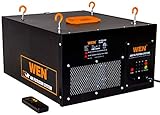
The best compact shop air cleaner for most small woodworking spaces is a ceiling- or wall-mounted unit rated around 700–1,000 CFM, with replaceable outer and inner filters and a speed setting quiet enough to run while you work. For a one-car garage or a shop under roughly 400 square feet, the WEN 3410 is a budget-friendly starting point; for more airflow and flexible hanging or bench placement, compare the JET AFS-1000B and Powermatic PM1200.
Three practical picks, depending on your shop
- Best budget fit: WEN 3410. Its published maximum airflow is 400 CFM, with three speeds and a built-in timer. It suits a small, enclosed work area where the cleaner can run for a while after dusty work. It is not a substitute for a higher-capacity unit in a larger shop or for dust collection at a tool.
- Best middle-ground capacity: JET AFS-1000B. This ceiling-mounted model is rated up to 1,000 CFM and offers multiple speeds, a remote, and a timer. It makes more sense for a moderately sized garage shop or a space shared by several machines, provided there is room to hang it without obstructing lights or storage.
- Best for a more flexible installation: Powermatic PM1200. Rated up to 1,250 CFM, it includes a remote and timer and can be mounted or positioned as the manufacturer permits. Its greater capacity can help in a room with more volume, but the larger unit, filter costs, and mounting needs may be overkill for a very small bench area.
These are manufacturer-published maximum airflow figures, not guarantees of airflow after filters load with dust. Confirm current specifications, included filters, dimensions, and installation requirements before buying; product configurations can change.
As an Amazon Associate we earn from qualifying purchases at no extra cost to you.


At-a-glance comparison
| Model | Published maximum airflow | Typical use | Placement and controls | Filter ownership |
|---|---|---|---|---|
| WEN 3410 | 400 CFM | Small, enclosed hobby shop | Hanging installation; three speeds, timer, remote | Check replacement prefilter and main-filter prices for the current version |
| JET AFS-1000B | 1,000 CFM | Small-to-medium garage shop | Ceiling-mounted; multiple speeds, timer, remote | Budget for both outer and inner filters; availability and cost vary |
| Powermatic PM1200 | 1,250 CFM | Larger room or several work zones | Mount or position according to the manual; remote and timer | Compare the cost and availability of both filter stages before purchase |
Noise figures are not directly comparable unless measured at the same distance and speed. In practice, high speed is usually louder, and a ceiling-mounted cleaner can be less intrusive than one near ear level. Check the manufacturer’s sound specification where available, but if you need to talk or concentrate, plan to use a lower speed during work and a timer afterward.
Choose by room size and working habits
Airflow ratings are useful for comparing models, but room volume and dust-producing work matter more than a label such as “small shop.” A simple sizing check is to calculate room volume, then estimate air changes per hour:
Air changes per hour = CFM × 60 ÷ room volume in cubic feet.
For example, a 20-by-20-foot garage with an 8-foot ceiling contains 3,200 cubic feet. A 400-CFM unit would provide about 7.5 theoretical air changes per hour at its rated maximum (400 × 60 ÷ 3,200). At a lower speed, or with loaded filters, the actual figure will be lower. The calculation also assumes the air mixes throughout the room; shelves, partitions, and poor placement can leave stagnant areas.
- Small bench corner, occasional hand-tool work: A 400-CFM unit may be a reasonable fit if it can circulate air around the work area. Run it during dusty tasks and afterward.
- One-car garage, regular sanding or machine work: Look toward the 700–1,000-CFM class, especially if multiple people or machines share the space. Keep the cleaner running long enough to capture suspended dust after the task.
- Frequent sanding, larger room, or several work zones: Consider 1,000 CFM or more, or use multiple units if one cleaner cannot circulate air across the whole room. More rated airflow is not a reason to skip source collection.
- Low ceiling or crowded storage: Prioritize dimensions, safe clearance, and mounting options over the highest CFM. A unit that blocks lights, garage-door hardware, or lumber storage is a poor fit.
Air cleaner versus dust collector
A shop air cleaner captures airborne particles that remain suspended after cutting or sanding. A dust collector, shop vacuum, or tool-specific extraction setup captures much of the debris at the source. These jobs are complementary: connect extraction to machines first, then use the room cleaner to deal with residual airborne dust. Neither a room air cleaner nor a general-purpose woodworking setup should be treated as a guarantee of safe air; follow tool and filter instructions and use suitable respiratory protection when the task or material calls for it.
Mounting, noise, and filter costs
Ceiling placement often preserves floor and bench space and can help circulate air through a small room, but it requires secure support and safe clearance from lights, doors, and stored materials. Follow the mounting instructions for the specific model and attach it to suitable structural framing, not just drywall. A wall-mounted or freestanding option can be easier to service, but may use valuable space or sit closer to the operator.
Filter cost is an ownership expense, not a minor detail. Many compact units use a washable or replaceable prefilter to catch larger particles and a finer inner filter for smaller dust. The outer stage generally loads first. Cleaning or replacing it as directed helps preserve airflow and can extend the useful life of the inner filter. Do not assume every filter is washable: check the manual, and do not reinstall a damp filter.
Before buying, price a full replacement set and check that the filters are readily available. A lower-cost machine can become less economical if its specific filters are difficult to source or expensive. Avoid running the unit with a missing or damaged filter, and inspect the housing and filter seals for gaps that could let air bypass the media.
Setup and upkeep that make a small unit work better
- Place it to encourage circulation. Avoid burying the intake against a wall or aiming the discharge directly into a shelf. Leave the clearances specified in the manual.
- Capture dust at the machine. Connect a suitable collector or vacuum to saws and sanders before relying on room filtration.
- Run it before and after dusty work. Starting it shortly before work helps establish circulation; a timer can keep it running after sanding or cleanup.
- Inspect filters regularly. Check more often during heavy sanding or when cutting dusty materials. Clean or replace them according to the manufacturer’s directions, not just a calendar.
- Watch for declining performance. Reduced airflow, unusual noise, vibration, or a filter that quickly clogs can signal a maintenance issue or a mismatch between the cleaner and the work.
Bottom line
Choose the WEN 3410 when space and budget are tight and the shop is genuinely small. Step up to the JET AFS-1000B for a more capable general-purpose ceiling cleaner, and consider the Powermatic PM1200 when room volume or workload justifies its higher published airflow. In every case, compare replacement-filter costs, check the mounting plan, and size the unit to the actual room—not just the machine name. For woodworking, the most useful setup is usually a correctly placed air cleaner paired with effective dust collection at the source.