What's inside
As an Amazon Associate I earn from qualifying purchases. This post may contain affiliate links at no extra cost to you.
The best compact shop lighting for most small workshops is a low-profile 4-foot LED strip or linkable shop light for general illumination, paired with an adjustable clamp-on LED task light at the bench.
That combination uses little ceiling space, puts useful light where cuts and layout marks happen, and avoids the shadows created by relying on one bright fixture. For a very tight workshop, choose a 2-foot linkable fixture or under-cabinet bar; for cordless work areas, a rechargeable panel or work light is more practical than rewiring the room.
As an Amazon Associate we earn from qualifying purchases at no extra cost to you.

Contents
What to compare before buying
Compact lighting is not simply about choosing the smallest lamp. A light with a tiny mounting footprint may produce a narrow beam, while a longer fixture may use the same wall or ceiling area more efficiently. Compare these five specifications:
- Mounting footprint: Check the fixture’s length, width, and clearance for its clips or bracket. A 24-inch light may fit beneath a shelf, while a 48-inch light can illuminate a whole bench with fewer shadows.
- Brightness: Lumens describe total light output. For detailed woodworking, aim for roughly 3,000 to 5,000 lumens over a typical 4-by-8-foot bench area, with task lighting adding another 500 to 1,500 lumens near the workpiece.
- Beam coverage: A wide diffuser spreads light across a bench; a narrow reflector gives more intensity but creates brighter and darker zones.
- Adjustability: A swivel head, flexible arm, or sliding clamp lets you move the light away from your hands and reduce shadows.
- Power needs: Plug-in lights are best for frequent use. USB-C and battery lights suit temporary setups, but runtime and charging become part of ownership.
Best compact shop lighting by workshop situation
| Workshop situation | Best light type | Typical size and output | Why it fits |
|---|---|---|---|
| Permanent bench in a garage or basement | Linkable LED strip or shop light | 24–48 in; 2,200–5,000 lumens; 20–50 W | Broad coverage with a small ceiling footprint and low operating cost |
| Bench beneath cabinets or shelving | Under-cabinet LED bar | 12–24 in; 800–2,000 lumens; 8–20 W | Mounts out of the way and keeps the bench surface clear |
| One-person precision work area | Clamp-on articulated task light | 500–1,500 lumens; 8–20 W | Easy to reposition for joinery, carving, and layout |
| Shared or rented workspace | Rechargeable LED panel or work light | 1,000–4,000 lumens; 2–8 hours per charge | No permanent installation and easy to pack away |
| Very low ceiling or narrow alcove | Thin surface-mounted LED panel | 12–24 in; 1,500–3,500 lumens; 15–35 W | Low profile reduces head clearance and shadows |
Head-to-head: the most useful compact formats
Linkable LED shop lights: best overall for a fixed bench
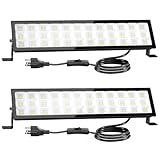
These slim fixtures are usually the strongest choice when the workshop has a permanent bench. Many are about 1 to 2 inches thick, mount with small clips, and connect in a row using short linking cables. A 4-foot fixture producing approximately 4,000 lumens can cover a long bench more evenly than a small spotlight.
The main advantage is coverage. One long diffuser reduces the hard shadows that occur when light comes from only one end. Neutral white light around 4,000K to 5,000K is a useful woodworking compromise: it is bright enough for detail without the blue appearance of very cool daylight lamps.
Choose a linkable model when you can install it above or slightly in front of the bench. Avoid mounting it directly behind your head, where your body can shade the work. The limitation is adjustability: most shop-light bars point in one direction, so keep a separate movable task light for hand tools and fine layout.
Under-cabinet LED bars: best when shelves are already consuming the wall
Under-cabinet bars are particularly effective in compact workshops with wall-mounted tool storage. They preserve headroom and place light close to the work surface. A 24-inch bar rated around 1,500 lumens can be more useful than a brighter ceiling lamp because less light is lost before reaching the bench.
Look for a frosted diffuser, a built-in switch, and either a plug-in power cord or a hardwired connection appropriate to the installation. Bars with touch controls are convenient, but the sensor can be triggered accidentally by dust or stored materials. Magnetic mounting is convenient for temporary setups, although screws or the manufacturer’s clips are safer for permanent installation.
Clamp-on articulated lights: best for detailed and changing work
A clamp light with a flexible gooseneck or hinged arm is the most adaptable option for a small work area. It can illuminate the inside of a cabinet, follow a carving project, or move to the far side of a miter saw. A clamp opening of at least 2 inches is useful on common bench tops, while a rubber-padded clamp protects finished surfaces.
Its weakness is coverage. Even a 1,000-lumen task light will not replace general room lighting, and a small head can produce sharp shadows. Select a wide LED panel or frosted dome rather than a bare point-source bulb. Also check the arm’s stiffness: a light that slowly sags is frustrating around precision tools.
Rechargeable panels and work lights: best for flexibility
Battery-powered lights make sense when the bench moves, the shop is rented, or outlets are limited. A rechargeable panel in the 1,000-to-2,000-lumen range can provide roughly 2 to 6 hours of useful runtime depending on brightness. Higher-output work lights may be brighter but often run for less time and create more glare.
USB-C charging is preferable to a proprietary low-voltage adapter because replacement cables are easier to obtain. For regular daily work, however, plug-in lighting is usually less troublesome. Battery lights require charging, lose capacity over time, and can be unavailable precisely when a project needs finishing.
A simple coverage calculation
Suppose a bench is 8 feet long and 2 feet deep, or 16 square feet. If you want approximately 250 lumens per square foot for general woodworking, the target is:
16 square feet × 250 lumens = 4,000 lumens.
A single 4,000-lumen fixture may meet that target on paper, but walls, dust, the fixture’s diffuser, and the worker’s body reduce useful light. A more practical arrangement is a 3,000-lumen overhead strip plus a 1,000-lumen adjustable task light. This also improves contrast because light arrives from two directions.
For a 4-by-4-foot assembly area, the same estimate gives 4,000 lumens. You could use a 2,000-lumen ceiling light and a 1,000-lumen task lamp, accepting lower overall brightness if the work is mostly rough assembly rather than small joinery.
Power and operating cost
LED shop lights generally use less electricity than older fluorescent fixtures and produce less heat. To estimate annual energy use, multiply watts by hours per day and operating days, then divide by 1,000 for kilowatt-hours.
For example, a 40-watt overhead light used 3 hours per day for 250 days consumes:
40 × 3 × 250 ÷ 1,000 = 30 kWh per year.
At an electricity rate of $0.20 per kWh, that is about $6 annually. A 15-watt task light used for the same schedule adds about $2.25. The exact cost varies by location, but this calculation shows why brightness, beam placement, and durability matter more than small differences in LED wattage.
Installation details that prevent shadows
- Mount the main light slightly in front of the normal standing position, not directly behind your head.
- Use two shorter fixtures on opposite sides of a long bench if one central fixture leaves dark ends.
- Place task lights on the side opposite your dominant hand when possible, so the hand does not block the beam.
- Keep lights above the tallest stored material and away from dust-producing cutting paths.
- Use a diffuser for general lighting and a movable directional light for inspection and detail work.
If the light will be near a saw, sander, or router, choose a sealed or at least dust-resistant housing where available. Do not cover ventilation openings, overload linking cables, or route cords where they can contact a blade or become a trip hazard.
Durability and maintenance realities
Dust is usually the first maintenance problem. Fine sanding dust settles on diffusers and reduces output before the LEDs themselves fail. Turn the light off, allow it to cool, and wipe the diffuser with a dry or slightly damp microfiber cloth. Avoid spraying cleaner directly into switches, seams, or charging ports.
On clamp lights, the clamp pad and flexible arm tend to wear before the LED module. Check that the clamp still grips without slipping and replace the light if the arm becomes hot, cracked, or electrically damaged. For battery models, avoid storing the pack fully discharged for long periods; recharge it according to the manufacturer’s instructions and keep the charging port free of dust.
Color quality also affects woodworking decisions. A color-rendering index, or CRI, of 80 is acceptable for general shop work, while 90 or higher is preferable when matching stains, paints, veneers, and clear finishes. High CRI does not automatically mean brighter, so compare both CRI and lumens.
Final buying recommendation
For most small permanent workshops, choose a dimmable or linkable 4-foot LED fixture with roughly 3,000 to 5,000 lumens, a wide diffuser, and neutral-white light. Add a 500-to-1,500-lumen clamp-on task light with a swiveling head for joinery and inspection.
Choose a 12-to-24-inch under-cabinet bar when wall storage or low ceilings limit your options. Choose a rechargeable panel only when portability is more important than always-available power. The best compact shop lighting is therefore not the smallest lamp or the highest lumen figure; it is the arrangement that fits the bench, spreads light without glare, and remains convenient enough to use every time you work.