What's inside
As an Amazon Associate I earn from qualifying purchases. This post may contain affiliate links at no extra cost to you.
Contents
Best DeWalt Plunge-Base Routers for Controlled Cuts
The best plunge-base DeWalt router for most controlled cuts is the 2¼-horsepower DW618PK kit: it combines a full-size plunge base with a fixed base for grooves, mortises and edge work. Choose the cordless DCW620 kit if you want a plunge router without a cord and already use DeWalt 20V batteries; choose the compact 20V DCW600 with a compatible plunge base for lighter work and easier handling, not repeated deep cuts.
These options serve different jobs. Horsepower helps indicate how much load a router can sustain, but it does not by itself determine cut quality. Base stability, bit size, depth adjustment, a sharp cutter and a sensible pass depth all matter. Check the exact kit contents and current specifications before buying: DeWalt sells different configurations, and accessories can vary by market.
As an Amazon Associate we earn from qualifying purchases at no extra cost to you.
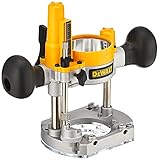


DeWalt plunge-router options compared
| Router or kit | Power | Plunge depth | Best fit | What to check |
|---|---|---|---|---|
| DW618PK fixed/plunge kit | 2¼ hp, corded | 2 in | Shop work, repeated grooves and mortises, and mixed fixed/plunge jobs | Included bases, collet sizes, guide bushings and case contents |
| DCW620 cordless plunge router kit | 20V MAX battery platform | Up to 2½ in | Site work and projects where cord-free mobility matters | Battery, charger and dust-extraction accessories may be kit-dependent |
| DCW600 compact router with compatible plunge base | 20V MAX compact router | Depends on the compatible base | Light-duty grooves, small mortises and controlled edge details | Base compatibility, available depth and whether the base is sold separately |
Horsepower ratings apply to corded motors; the cordless models are described by battery platform rather than a directly comparable horsepower figure. Cordless runtime varies with battery capacity, material, cutter diameter and cut depth, so a battery-platform label is not a runtime guarantee. Likewise, plunge depth is the base’s travel range—not a recommendation to rout that full depth in one pass.
Which one suits your work?
- Choose the DW618PK for a dedicated workshop. Its 2¼-hp motor is suited to larger cutters and sustained work, while the included fixed and plunge bases make it a versatile value if you will use both. It is the most practical pick for frequent mortises and grooves in hardwood, provided you make several shallow passes.
- Choose the DCW620 for portable plunge work. It avoids managing a cord around a bench or jobsite and offers more plunge travel than the DW618PK. Budget for a suitable battery if you do not already own one, and plan around charging for long or demanding sessions.
- Choose the DCW600 and a compatible plunge base for lighter, smaller tasks. A compact router is easier to guide around an edge or use for short, shallow cuts. It is not the first choice for long, deep mortises or large bits. Confirm that the base is explicitly compatible with the DCW600; “DeWalt trim router plunge base” is not a universal fit description.
If you are shopping for a DeWalt compact router plunge base, separate-base availability and fit are the key questions. A plunge base for a DeWalt cordless router must match the specific router model; battery-platform compatibility alone does not ensure that the motor fits the base. When comparing a DeWalt router base with a Makita router plunge base, compare the model-specific mounting interface, depth range, bushing system and accessory availability—not just the brand or advertised travel.
Setup that improves groove and mortise accuracy
Plunge travel gives you controlled entry and exit, but accuracy comes from setup. For a mortise, use a straight bit and a guide fence or a template with a compatible guide bushing. Mark the centerline, clamp the work securely and set the fence before switching on. If using a template, verify that the bushing and cutter combination leaves the intended offset; the cutter does not follow the template’s exact edge.
- Check the cutter and collet. Use a sharp bit with a shank that matches the router’s collet. Seat it securely without bottoming the shank against the collet’s interior.
- Set depth in stages. For a ¾-inch-deep mortise, for example, make three passes of about ¼ inch rather than trying to remove the full depth at once. Reduce pass depth for a large cutter, hard wood or a narrow mortise. The lighter cuts put less strain on the motor and bit and are easier to control.
- Test on scrap of the same thickness. Confirm the actual depth, fence position and template offset before routing the finished part. A small setup error can be difficult to conceal in a fitted joint.
- Keep the base flat and the plunge smooth. Let the motor reach speed before lowering the bit. Plunge steadily, lock the depth where the design calls for it, and avoid twisting the router while the cutter is engaged.
- Route edges with the right support. Use a bearing-guided bit or a straightedge as appropriate. On narrow stock, use a stable workholding setup and enough support for the base; a compact router can tip more easily when its base overhangs an edge.
Ownership details that listings can miss
Fine dust collects around plunge posts, depth stops and adjustment threads. Brush or vacuum it away after use, following the manual’s cleaning guidance; avoid forcing debris deeper with high-pressure air. Keep the plunge mechanism moving freely, check that locks hold securely, and inspect the collet and cutter shanks for resin or damage. A sticky plunge action or a depth lock that slips can undermine repeatability even when the motor is running well.
Bits are routine wear items, and dull cutters can burn wood, pull the router off course and put extra load on a motor. Clean pitch from bits with a suitable bit cleaner and replace cutters that are chipped or no longer cut cleanly. For cordless models, battery capacity, charging and the cost of owning a second battery are part of the real purchase price. For a corded DW618PK, the trade-off is less portability, but no runtime planning and no battery replacement expense.
Bottom line
For one versatile DeWalt plunge setup, the DW618PK is the strongest all-around choice: it provides a 2¼-hp corded motor and both plunge and fixed bases. Pick the DCW620 when portability and cordless operation take priority, or the DCW600 with a verified compatible plunge base when the work is mostly light edge detailing and shallow cuts. In every case, match the base to the exact router model, confirm the included accessories, and treat rated plunge depth as available travel—not as a single-pass cutting target.