What's inside
- Quick comparison
- Which set should you buy?
- Roller thickness matters more than the number of cutters
- Cutter width: what the numbers mean in the bowl
- Compatibility: check the attachment interface, not just the brand
- Attachment materials and durability
- Cleaning and storage: the ownership details that matter
- Decision matrix by situation
- Is a mixer attachment worth the cost?
- Bottom line
- Quick comparison
- Which set should you buy?
- Roller thickness matters more than the number of cutters
- Cutter width: what the numbers mean in the bowl
- Compatibility: check the attachment interface, not just the brand
- Attachment materials and durability
- Cleaning and storage: the ownership details that matter
- Decision matrix by situation
- Is a mixer attachment worth the cost?
- Bottom line
As an Amazon Associate I earn from qualifying purchases. This post may contain affiliate links at no extra cost to you.
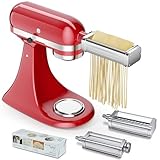
The best pasta cutters and roller attachment sets for most stand-mixer owners are the KitchenAid 3-Piece Pasta Roller & Cutter Set for simple compatibility and durable metal parts, while the Kenwood KAX980ME system is the better choice for Kenwood users who want separate cutter options; a hand-crank set is usually the best value if you do not already own a compatible mixer.
As an Amazon Associate we earn from qualifying purchases at no extra cost to you.



Contents
- Quick comparison
- Which set should you buy?
- Roller thickness matters more than the number of cutters
- Cutter width: what the numbers mean in the bowl
- Compatibility: check the attachment interface, not just the brand
- Attachment materials and durability
- Cleaning and storage: the ownership details that matter
- Decision matrix by situation
- Is a mixer attachment worth the cost?
- Bottom line
Quick comparison
| Set or system | Compatibility | Roller settings and range | Cutter widths | Main materials | Best for |
|---|---|---|---|---|---|
| KitchenAid 3-Piece Set | KitchenAid stand mixers with the front power hub | 8 settings; approximately 0.4–2 mm | Spaghetti about 2 mm; fettuccine about 6.5 mm | Chrome-plated metal housings and stainless-steel cutting rollers | Most KitchenAid owners and first-time users |
| Kenwood KAX980ME plus cutters | Compatible Kenwood Chef and Titanium machines; adapter may be needed on some older models | 7 settings; approximately 0.7–2.2 mm | Common matching cutters are about 1.5 mm and 6.5 mm | Stainless-steel roller and cutter bodies | Kenwood users who want a modular system |
| Manual 150 mm roller-and-cutter set | Countertop use; no mixer required | Usually 6–9 settings; commonly about 0.5–3 mm | Often 1.5–2 mm and 6–6.5 mm | Chrome-plated or stainless steel; quality varies widely | Occasional use, tight budgets, or kitchens without a stand mixer |
| Marcato Atlas 150 with matching cutters | Manual hand-crank machine; optional motor available | 10 settings; roughly 0.6–4.8 mm | Common cutters include 1.5 mm and 6.5 mm | Anodised aluminium body with nickel-plated steel rollers | Frequent pasta makers who value broad thickness control |
Dimensions and exact materials can vary slightly by regional version, so check the model number before ordering. In particular, a cutter designed for a manual machine is not automatically compatible with a stand-mixer power hub.
Which set should you buy?
- Choose the KitchenAid set if you already own a KitchenAid mixer and mainly make lasagne sheets, tagliatelle-style noodles, or spaghetti. Its three-part configuration covers the most useful jobs without requiring a separate motor or clamp.
- Choose the Kenwood system if you own a compatible Kenwood machine and prefer buying the roller first, then adding only the cutters you use. Confirm whether your mixer needs the newer high-speed hub connection or an adapter.
- Choose a manual set if you make pasta only a few times a year, have limited storage, or do not own a stand mixer. The lower purchase cost can outweigh the extra hand-cranking.
- Choose the Marcato system if thickness experimentation matters. Its wider adjustment range is useful for very thin sheets, stuffed pasta, and thicker rustic noodles, but it is a countertop machine rather than a mixer attachment.
Roller thickness matters more than the number of cutters
A roller determines the foundation of the pasta. Wide, thick sheets are easier to handle for lasagne and ravioli, while thin sheets cook quickly and are suitable for delicate filled pasta. Eight settings are already enough for most home recipes; additional settings are valuable mainly when you make several pasta styles.
Do not compare setting numbers directly between brands. “Setting 5” on one attachment may not equal “setting 5” on another. Compare the stated millimetre range instead. A practical home workflow is to begin on the widest setting, fold and roll the dough two or three times, then reduce the gap one setting at a time. Skipping too quickly can produce ragged edges or a sheet that tears around the rollers.
For filled pasta, rolling too thin can make the dough difficult to seal, while rolling too thick creates a heavy result and requires longer cooking. A medium-thin sheet is a safer starting point; adjust after making one test piece rather than committing an entire batch.
Cutter width: what the numbers mean in the bowl
A cutter near 1.5–2 mm produces fine spaghetti or similar narrow noodles. It suits light sauces but can clump if the pasta is still damp. A cutter around 6–6.5 mm makes fettuccine or tagliatelle-style ribbons that are easier to portion, dry, and pair with thicker sauces.
Some sets include only two cutters, and that is not necessarily a weakness. Most home recipes repeatedly use a narrow cutter, a wide cutter, or a knife-cut sheet. Specialized cutters for lasagnette, pappardelle, or angel hair can be useful, but they add cost and storage demands. Check that replacement cutters are sold individually before choosing a modular system.
Compatibility: check the attachment interface, not just the brand
Stand-mixer attachments are not universal. Even within one brand, older and newer mixers may use different drive hubs. Before buying, identify the exact mixer model and check the manufacturer’s compatibility list. A machine may physically accept an attachment but lack the correct speed, hub, or clearance for safe operation.
Also check whether the mixer’s instructions specify a speed setting. Pasta rollers generally work at a low-to-medium setting; running them too fast can stretch uneven dough, overload the hub, and throw flour around the work area. Keep one hand available to guide the sheet and use the mixer’s bowl or a tray to support long lengths.
Attachment materials and durability
Stainless-steel cutting rollers are preferable because their edges resist corrosion and remain consistent with normal household use. Chrome-plated housings can also be durable, but damaged plating should not be scrubbed aggressively or exposed to prolonged moisture. Anodised aluminium bodies, such as those found on some manual machines, are light and rigid but should not be treated as dishwasher-safe unless the instructions explicitly allow it.
The parts that usually show wear first are the drive coupling, cutter edges, surface finish, and plastic adapter components—not the main roller cylinders. For mixer attachments, forcing dough that is too dry or too large can place unnecessary stress on the hub. For manual machines, a loose clamp or bent handle can make an otherwise good set frustrating to use.
Cleaning and storage: the ownership details that matter
Most pasta rollers and cutters should be brushed clean after the dough has dried. Do not immerse a powered attachment, rinse internal gears, or use a dishwasher unless the product manual specifically permits it. Water can remain inside the cutter assembly, encourage corrosion, or wash away factory lubricant.
- Unplug or remove the attachment from the mixer.
- Let sticky dough dry for several minutes instead of wiping it into the gaps.
- Brush flour and dried dough from the roller grooves and cutter openings.
- Use a wooden skewer or the supplied cleaning brush for stubborn fragments; do not push a metal knife into the cutters.
- Store the pieces completely dry in a divided box or cloth bag.
Storage is a meaningful difference between sets. Three-piece mixer kits are compact but still need protection for three metal attachments. Modular systems can occupy more space as cutters accumulate. A manual machine often needs room for its clamp, crank, and accessories, while a motorised attachment avoids a separate countertop body but uses the mixer’s storage space.
Decision matrix by situation
| Your situation | Best match | Why | Trade-off |
|---|---|---|---|
| Budget-conscious, fewer than 6 batches per year | Manual two-cutter set | Lowest equipment cost and no mixer required | More physical work and slower throughput |
| Weekly pasta making with a KitchenAid mixer | KitchenAid 3-Piece Set | Fast setup and useful roller, narrow, and wide cutters | Less modular than buying separate cutters |
| Frequent use and many pasta shapes | Kenwood or manual modular system | Replacement and specialty cutters can be added later | Higher total cost and more storage |
| Very thin sheets or varied thicknesses | Marcato Atlas 150 | Broad adjustment range and established manual format | Requires hand-cranking or a separate motor |
| Small kitchen with limited cupboard space | Mixer attachment set | Uses equipment already stored on the counter or in a cupboard | Dependent on mixer compatibility and power-hub access |
Is a mixer attachment worth the cost?
Use cost per use rather than the initial price alone. Suppose a mixer attachment costs a general market price of $120–$200 and you make two batches per month for three years: 72 batches. At $160, the equipment cost is about $2.22 per batch before ingredients. A manual set costing $50–$100 may be cheaper per batch, but the mixer attachment can save cranking time and make repeated batches more practical.
That calculation only works if the attachment fits your existing mixer and you use it regularly. If you make pasta twice a year, a manual set—or even a rolling pin and knife—may be the more sensible purchase.
Bottom line
For most owners of a compatible KitchenAid mixer, the KitchenAid 3-Piece Set is the easiest all-round choice because its roller, approximately 2 mm spaghetti cutter, and approximately 6.5 mm fettuccine cutter cover everyday pasta. Kenwood owners should choose the matching KAX system rather than trying to adapt an unrelated attachment. Buyers without a mixer should look first at a manual 150 mm machine, with the Marcato Atlas 150 standing out when broad thickness control and long-term replacement options matter more than one-button convenience.