
What's inside
- Top 3 Picks
- Quick Comparison
- How We Chose
- 1. SimpliSafe 9-Piece Wireless Home Security System – Best Overall
- 2. Hiseeu 4K Home Security Camera System, 16CH NVR Kit – Best Premium Pick
- 3. Hiseeu 5MP Home Security Camera System Outdoor, 2.4G/5G WiFi Pro – Best for Retrofit Without Cabling
- 4. Hiseeu Wireless Security Camera System, 5MP 4 Cam-Kit, 14″ LCD, 3TB HDD – Best All-in-One Kit
- 5. ANNKE 8CH 3K Lite Wired Security Camera System – Best Wired Value
- 6. ZOSI 3K Lite 8CH Home Security Camera System – Best for Smart Detection
- 7. Hapippofa GEN 2 Wireless Home Security System, 16-Piece DIY Alarm Kit – Best Mid-Range Alarm
- 8. Gianteye 2K Solar Security Camera System – Best for Locations Without Power
- 9. PGST 12-Piece Home Security System – Best Budget Alarm
- 10. Hapippofa Wireless Alarm System, 24-Piece WiFi+4G – Best for Maximum Coverage, No Monthly Fees
- 11. RenseCum Home Security Systems, 24-Piece Kit – Best Low-Cost Whole-Home Coverage
- 12. DEEPVIGLX 8-Piece Alarm System, WiFi/GSM SMS – Best for Simple SMS Alerts
- How to Choose
- Frequently Asked Questions
- The Bottom Line by Situation
- Related Guides
- Top 3 Picks
- Quick Comparison
- How We Chose
- 1. SimpliSafe 9-Piece Wireless Home Security System – Best Overall
- 2. Hiseeu 4K Home Security Camera System, 16CH NVR Kit – Best Premium Pick
- 3. Hiseeu 5MP Home Security Camera System Outdoor, 2.4G/5G WiFi Pro – Best for Retrofit Without Cabling
- 4. Hiseeu Wireless Security Camera System, 5MP 4 Cam-Kit, 14″ LCD, 3TB HDD – Best All-in-One Kit
- 5. ANNKE 8CH 3K Lite Wired Security Camera System – Best Wired Value
- 6. ZOSI 3K Lite 8CH Home Security Camera System – Best for Smart Detection
- 7. Hapippofa GEN 2 Wireless Home Security System, 16-Piece DIY Alarm Kit – Best Mid-Range Alarm
- 8. Gianteye 2K Solar Security Camera System – Best for Locations Without Power
- 9. PGST 12-Piece Home Security System – Best Budget Alarm
- 10. Hapippofa Wireless Alarm System, 24-Piece WiFi+4G – Best for Maximum Coverage, No Monthly Fees
- 11. RenseCum Home Security Systems, 24-Piece Kit – Best Low-Cost Whole-Home Coverage
- 12. DEEPVIGLX 8-Piece Alarm System, WiFi/GSM SMS – Best for Simple SMS Alerts
- How to Choose
- Frequently Asked Questions
- The Bottom Line by Situation
- Related Guides
As an Amazon Associate I earn from qualifying purchases. This post may contain affiliate links at no extra cost to you.
Contents
- Top 3 Picks
- Quick Comparison
- How We Chose
- 1. SimpliSafe 9-Piece Wireless Home Security System – Best Overall
- 2. Hiseeu 4K Home Security Camera System, 16CH NVR Kit – Best Premium Pick
- 3. Hiseeu 5MP Home Security Camera System Outdoor, 2.4G/5G WiFi Pro – Best for Retrofit Without Cabling
- 4. Hiseeu Wireless Security Camera System, 5MP 4 Cam-Kit, 14″ LCD, 3TB HDD – Best All-in-One Kit
- 5. ANNKE 8CH 3K Lite Wired Security Camera System – Best Wired Value
- 6. ZOSI 3K Lite 8CH Home Security Camera System – Best for Smart Detection
- 7. Hapippofa GEN 2 Wireless Home Security System, 16-Piece DIY Alarm Kit – Best Mid-Range Alarm
- 8. Gianteye 2K Solar Security Camera System – Best for Locations Without Power
- 9. PGST 12-Piece Home Security System – Best Budget Alarm
- 10. Hapippofa Wireless Alarm System, 24-Piece WiFi+4G – Best for Maximum Coverage, No Monthly Fees
- 11. RenseCum Home Security Systems, 24-Piece Kit – Best Low-Cost Whole-Home Coverage
- 12. DEEPVIGLX 8-Piece Alarm System, WiFi/GSM SMS – Best for Simple SMS Alerts
- How to Choose
- Frequently Asked Questions
- The Bottom Line by Situation
- Related Guides
Our Top Picks
 SimpliSafe 9 Piece Wireless Home Security System w/HD9 Piece Bundle12.13 x 12.38 x 4.4 inches0.35 poundsCheck on Amazon
 ANNKE 8CH H.265+ 3K Lite Wired Security Camera8+4+1TB14.57 x 11.81 x 7.56 inches9.48 PoundsCheck on Amazon


Top 3 Picks
Best overall: SimpliSafe 9-Piece Wireless Home Security System with HD Camera. It pairs genuine DIY simplicity — no drilling, no wiring, no contract required — with an optional professional monitoring upgrade you can turn on or off by the month. That combination of low setup friction and flexible ongoing cost is the hardest thing to find in this category.
Best budget: PGST Home Security Systems 12-Piece Kit. It delivers the core of a serious alarm system — hub, siren, door/window contacts, motion detection, remote control, mobile app alerts — at the lowest price tier here, with WiFi plus GSM/4G backup so the alarm still reports out if your broadband drops.
Best premium: Hiseeu 4K Home Security Camera System, 16CH NVR Kit. Eight 8MP cameras recording 24/7 to onboard storage, with room to expand to sixteen channels. If you want evidence-grade detail — plates, faces, package labels — this is the tier that delivers it.
Quick Comparison
| Product | Best for | Key specs | Price tier |
|---|---|---|---|
| SimpliSafe 9-Piece Wireless Home Security System w/HD Camera | Renters and first-time buyers who want a real monitored system without a contract | 9 pieces; wireless sensors; HD camera; optional 24/7 professional monitoring; no contract; app control | Premium |
| Hiseeu 4K Home Security Camera System, 16CH NVR Kit | Large homes and small businesses needing maximum detail and channel headroom | 16-channel NVR; 8 × 8MP (4K) corded-powered cameras; 24/7 recording; expandable to 16 cameras | Premium |
| Hiseeu 5MP Home Security Camera System Outdoor, 2.4G/5G WiFi Pro | Mid-size properties where running cable is impractical but 4K is overkill | 5MP cameras; dual-band 2.4GHz/5GHz WiFi; outdoor-rated; NVR-based local recording | Premium |
| Hiseeu Wireless Security Camera System, 5MP 4 Cam-Kit, 14″ LCD, 3TB HDD | Buyers who want a self-contained kit with a built-in viewing screen | 4 × 5MP cameras; 14-inch LCD monitor with NVR; 3TB preinstalled HDD; wireless cameras | Premium |
| ANNKE 8CH H.265+ 3K Lite Wired Security Camera System, 4X 2MP Cam, 1TB HDD | Wired-camera purists who want rock-solid signal and no WiFi contention | 8-channel DVR; 4 × 2MP cameras; 3K Lite recording; 1TB HDD; H.265+ compression; wired | Mid-range |
| ZOSI 3K Lite 8CH Home Security Camera System, AI Human/Vehicle Detection | Households that want smart alerts rather than every moth tripping the siren | 8-channel DVR; 3K Lite recording; AI human/vehicle detection; night vision; H.265+; 5MP-class optics | Mid-range |
| Hapippofa GEN 2 Wireless Home Security System, 16-Piece DIY Alarm Kit | Apartments and houses needing lots of entry-point coverage on a mid-range budget | 16 pieces; WiFi + 4G dual-path reporting; touchscreen hub; DIY install; app control | Mid-range |
| Gianteye 2K Security Camera System, 5GHz/2.4GHz WiFi Solar Cameras | Properties with no power at the camera location and no appetite for trenching | 2K resolution; solar charging; wire-free installation; dual-band WiFi; weather-resistant housing | Mid-range |
| PGST Home Security Systems 12-Piece Kit (Newest Model) | Budget buyers who still want cellular backup reporting | 12 pieces; WiFi + GSM/4G; mobile app control and alerts; wireless sensors; hub and siren | Budget |
| Wireless Alarm System for Home Security, 24Pcs WiFi+4G, No Monthly Fees | Large homes wanting maximum sensor count with zero recurring cost | 24 pieces; WiFi + 4G; no subscription; wireless sensors; app alerts | Budget |
| Home Security Systems (24PCS) | Whole-home contact coverage at the lowest entry price | 24 pieces; hub-based wireless alarm; app notifications; expandable sensor layout | Budget |
| Home Security System, Alarm System for Home Security, 8-Piece Kit WiFi/GSM SMS Alarm System | Single-room or small-flat coverage with SMS alerts for non-smartphone users | 8 pieces; WiFi plus GSM SMS reporting; motion detection; wireless sensors; app control | Budget |
How We Chose
The first cut is structural, not cosmetic: a security product has to belong clearly to one of two families — camera systems that record video, or alarm systems that trigger alerts — because they solve different problems and their costs behave differently. Mixing them in one recommendation does a buyer no favours.
Within each family the criteria were ordered by what actually changes the ownership experience. Reporting path comes first: a system that depends on a single home WiFi connection has a single point of failure, so dual-path WiFi-plus-cellular reporting earns a strong weighting over WiFi-only. Second is storage and resolution, judged as a class rather than a headline — 2MP, 5MP and 8MP are meaningfully different working resolutions, and the difference shows up on licence plates and faces, not on product photography. Third is channel headroom: an 8-channel recorder with four cameras has room to grow; a 4-channel recorder with four cameras is already full.
Fourth is setup reality — wired, wireless, or wire-free solar — because that determines whether the product gets installed this weekend or sits in a box. Fifth is recurring cost, treated as a decision criterion in its own right: some of these systems are free to run forever on local storage, others reach full usefulness only with a monitoring plan. Sixth is ecosystem fit, meaning whether the system speaks to the smart-home platform you already own, and whether its app runs on the phone in your pocket. Category fit, upgrade path and durability of the underlying hardware then act as tiebreakers.
1. SimpliSafe 9-Piece Wireless Home Security System – Best Overall
As an Amazon Associate we earn from qualifying purchases at no extra cost to you.

This is the pick for the person who wants working protection tonight, not a project. Nine pieces arrive boxed with adhesive mounts and a plug-in base station; there is no drilling, no wiring, no hub configuration, and critically no long-term contract. You can run it entirely self-monitored and pay nothing monthly, then switch on 24/7 professional monitoring for a month when you travel and switch it off when you get home. That on-demand quality is what separates it from nearly everything else in this roundup.
Key specs
- Pieces: 9 — base station, keypad, entry sensors, motion sensor, and an HD camera
- Installation: Fully wireless, adhesive or screw mounting, no tools required for sensors
- Monitoring: Optional 24/7 professional monitoring, month-to-month, no contract
- Self-monitoring: Full app control, alerts, and arming/disarming without any plan
- Camera: Indoor HD camera, integrated into the same app as the alarm sensors
- Expansion: Additional sensors, keypads, cameras and a video doorbell can be added piecemeal
- Cellular backup: Available with an active monitoring plan, so the system reports out even if broadband fails
Why it earns the top spot
The decisive feature is the contract-free structure. Most professionally monitored systems lock you into a multi-year agreement where a slow response or a house move becomes a billing argument. Here the monitoring is a subscription you control, which means the total cost of ownership is something you tune rather than something you sign away. For renters especially, that matters: you can take the whole system to the next address, remount the sensors with fresh adhesive, and be running again inside an hour.
The second advantage is coherence. Sensors and camera live in one app with one timeline, so when a motion sensor trips you can look at the corresponding camera clip instead of juggling two vendors’ software. Many budget alarm kits bolt a third-party camera onto a generic hub and never quite integrate the two streams. This one was designed as a single product.
The third is the hardware feel. Base station, keypad and sensors are designed as visible household objects rather than grey industrial boxes, which sounds like a marketing point until you remember that a sensor you find ugly is a sensor you leave in the drawer.
Pros
- No contract — monitoring is optional and cancellable month to month
- Genuinely tool-free setup on sensors; suitable for renters
- Fully functional self-monitored mode at zero recurring cost
- Sensors and camera share one app and one event timeline
- Straightforward upgrade path: add pieces individually as budget allows
- Portable to a new home without leaving hardware behind
Cons
- Premium price tier — you pay for the ecosystem, not the piece count
- 9 pieces covers a flat or a small house, not a large one; expect to buy more entry sensors
- Best features, including cellular backup, depend on an active monitoring plan
- Local storage and third-party camera integration are limited compared with an NVR-based kit
How it compares
Against the Hapippofa GEN 2 16-Piece Kit, the trade is piece count versus polish. Hapippofa gives you nearly twice the sensors for less money and adds 4G reporting out of the box — a strong proposition for a large house on a mid-range budget. What it does not give you is the option of a professionally monitored response or the same level of app refinement. SimpliSafe wins if a human response to an alarm matters to you; the 16-piece kit wins if you want to cover more windows and doors and are content to be your own responder.
Against the Hiseeu 16CH 4K kit, the comparison is alarm versus evidence. SimpliSafe tells you something happened and can summon help; the 4K system shows you exactly what happened in enough detail to hand to police. If you want both outcomes, budget for both — they are complementary, not competing.
2. Hiseeu 4K Home Security Camera System, 16CH NVR Kit – Best Premium Pick

Eight 8MP cameras, a sixteen-channel recorder, and 24/7 continuous recording to local storage. This is the system you buy once and stop thinking about, and it is the correct answer for anyone whose priority is detail: reading a number plate at the end of a drive, identifying a face at a front door, or proving which courier left a package where.
Key specs
- Recorder: 16-channel NVR with room for 16 cameras total
- Cameras included: 8 × 8MP (4K-class) outdoor cameras
- Power: Corded — cameras require a power outlet, not batteries
- Recording: 24/7 continuous, with local storage on the NVR
- Connectivity: Networked to the recorder rather than relying on a single WiFi link per camera
- Expansion: Doubles the installed camera count without replacing the recorder
Why it is worth the premium
Resolution is not a marketing number; it is a working limit. At 8MP, a camera covering a driveway can render a face or a plate as identifiable detail rather than a coloured smear. At 2MP, the same framing gives you a person-shaped blur and the colour of their jacket. If your purpose is deterrence, either works. If your purpose is identification — for an insurance claim, a police report, or a neighbour dispute — only the higher tier is genuinely useful.
The sixteen-channel recorder is the other half of the argument. With eight cameras installed you are using half the capacity, which means a future garage, side gate or outbuilding camera costs you the price of one camera rather than a whole new system. Buyers who skimp on channels commonly find themselves replacing a perfectly functional recorder eighteen months later.
Continuous 24/7 recording to local storage also removes the two most common complaints about cloud-dependent cameras: a monthly bill that never ends, and footage that is unavailable when the internet is down. The recording lives in your house.
Pros
- Identifiable detail at distance — faces and plates, not silhouettes
- 16 channels mean genuine expansion headroom
- Continuous 24/7 recording with no subscription required for storage
- Local footage survives an internet outage
- Corded power removes battery-charging maintenance entirely
- Eight cameras covers a full perimeter plus interior if desired
Cons
- Highest price tier in this roundup
- Every camera needs a power outlet within reach — the real installation constraint
- 4K footage consumes storage far faster than 2MP; plan on a large hard drive
- Overkill for a flat or a small terrace house
- Initial network and recorder configuration takes longer than an adhesive alarm kit
How it compares
The Hiseeu 5MP Wireless Pro kit is the sensible step down. It trades 4K detail and channel count for dual-band WiFi cameras that need no network cabling beyond power, which makes it dramatically easier to install in a finished house. Choose the 5MP kit if cable runs are the blocking problem; choose this 4K kit if detail is the whole point and you can reach each camera with a power lead.
Against the 5MP 4-Camera kit with the 14-inch LCD, the difference is scale and convenience. The LCD kit wins on out-of-the-box usability — a screen that shows all four feeds with no phone, no app, no configuration — and suits a shop counter or a hallway. This 4K kit wins on coverage and resolution. If you can only buy one and your property is larger than a two-bedroom, buy this one.
3. Hiseeu 5MP Home Security Camera System Outdoor, 2.4G/5G WiFi Pro – Best for Retrofit Without Cabling

The awkward middle of a home security installation is the camera that needs to see the side gate, three metres from the nearest power socket and forty metres from the router. This kit exists for that problem: 5MP outdoor cameras on dual-band WiFi, with a recorder handling local storage, so the only cable each camera truly needs is power.
Key specs
- Resolution: 5MP cameras — a clear step above 2MP, short of 4K
- Wireless: Dual-band 2.4GHz and 5GHz operation for better throughput and less congestion
- Weather rating: Outdoor-rated housings for year-round exterior use
- Recording: NVR-based local storage; no cloud subscription required
- Power: Cameras still require a power source — “wireless” refers to video transmission, not power
- Setup: Cameras pair to the recorder over WiFi, avoiding long coax or Ethernet runs
Why it suits retrofits
The single most common misunderstanding in this category is the word “wireless.” Almost every wireless camera on the market still needs a power cable; what it does not need is a video cable. That distinction decides whether an installation is a weekend or a fortnight. Here, if you can get power to a spot — an existing outdoor socket, a garage circuit, a light fitting tapped correctly by an electrician — you can put a camera there without opening a single wall.
Dual-band support matters more than it sounds. The 5GHz band has less interference and higher throughput, which keeps 5MP streams smooth; the 2.4GHz band reaches further and penetrates walls better. A camera kit that only speaks 2.4GHz frequently suffers dropped frames at range, exactly when you need the footage.
At 5MP you are buying usable detail: a face at a doorway is recognisable, text on a van door is usually legible, and a plate at moderate distance is often readable. It is the sensible resolution for most domestic properties — noticeably better than 2MP without the storage and bandwidth demands of 8MP.
Pros
- No video cabling to run — power is the only hard requirement
- Dual-band WiFi improves reliability over 2.4GHz-only kits
- 5MP is a practical sweet spot for domestic detail
- Local recording with no mandatory subscription
- Outdoor-rated housings suit permanent exterior mounting
- Much faster to install in a finished house than a wired kit
Cons
- WiFi cameras are still at the mercy of signal strength; walls and foil insulation can ruin a promising location
- Less detail than 4K when you need to identify something at genuine distance
- Simultaneous 5MP streams place real load on a home network
- Premium price tier despite sitting below the 4K kit in resolution
How it compares
Against the corded 16CH 4K system, this is the pragmatic choice for an occupied, finished home. You give up resolution and channel count; you gain an installation that does not involve cable runs through lofts and cavity walls. Most people who start with the 4K kit and no wiring experience end up wishing they had bought this one.
Against the 5MP 4-Camera kit with the 14-inch LCD, the hardware is closely related and the decision comes down to how you want to view it. If you want a dedicated screen on a shelf showing live feeds at a glance — useful in a shop, a workshop or a hallway — the LCD bundle is the better buy. If you will only ever check footage on a phone, this kit is the leaner purchase.
4. Hiseeu Wireless Security Camera System, 5MP 4 Cam-Kit, 14″ LCD, 3TB HDD – Best All-in-One Kit
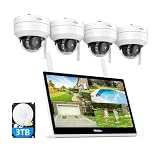
Everything needed to watch four camera feeds on a screen, in one box, with the hard drive already fitted. The 14-inch LCD is the whole point: the recorder and monitor are one unit, so live viewing requires no phone, no app, no router configuration, and no technical confidence whatsoever.
Key specs
- Cameras: 4 × 5MP outdoor cameras
- Display: 14-inch LCD integrated into the recorder unit
- Storage: 3TB hard drive preinstalled
- Recording: Local continuous recording; no cloud plan required
- Installation: Cameras connect wirelessly to the recorder; power still required at each camera
- Viewing: Live on the built-in screen, plus mobile app access when you are away
Why the integrated screen matters
There is a specific failure mode in home security that has nothing to do with cameras: people buy a system, install the app, and then never open it again. A screen on the wall or a shelf showing four live feeds changes the behaviour, because checking it costs nothing. You glance at it walking past. You notice the van that has been parked outside for an hour.
The preinstalled 3TB drive is the second quiet advantage. Many kits ship without storage, which means a second purchase, a compatibility check and a screwdriver session before the system records anything at all. Here, recording starts the moment the cameras are paired. At 5MP across four cameras, a 3TB drive gives a comfortable retention window — days to weeks depending on motion activity and quality settings — before older footage is overwritten.
Five megapixels across four cameras is a genuinely balanced specification for a semi-detached house, a small retail unit or a workshop. You can cover front, back and two flanks without stretching either resolution or storage.
Pros
- Complete out of the box — no separate monitor or hard drive purchase
- Live viewing with zero technical setup; ideal for less confident users
- 3TB storage included, giving days-to-weeks retention at 5MP
- Local recording with no subscription requirement
- Simple four-camera coverage of a typical property
- Phone app access for when you are away from the screen
Cons
- Premium price tier for only four cameras
- No channel headroom to speak of — expansion means a new recorder
- The screen ties viewing to one physical location
- 5MP still short of 4K for long-distance identification
- Camera power cables remain the installation constraint
How it compares
The 16-channel 4K kit is the upgrade and the opposite philosophy: more cameras, more resolution, more expansion, no screen. If your household is comfortable with apps and you expect to add cameras later, spend the difference there. If your household includes someone who will never open an app, this kit will actually get used, and a system that gets used beats a better system that does not.
Against the dual-band 5MP Wireless Pro kit, the difference is mainly the screen and the bundled storage. Otherwise they occupy very similar ground. Buy whichever is better value on the day; the practical outcome in a four-camera installation is nearly identical.
5. ANNKE 8CH 3K Lite Wired Security Camera System – Best Wired Value
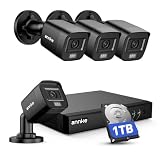
Four 2MP cameras, an eight-channel DVR, a 1TB hard drive and H.265+ compression, all on cables rather than WiFi. This is the closest thing in the roundup to a set-and-forget installation: no signal drops, no band congestion, no pairing rituals, no battery anxiety.
Key specs
- Recorder: 8-channel DVR — four channels free for later cameras
- Cameras included: 4 × 2MP
- Recording quality: 3K Lite on the recorder, with 2MP camera capture
- Storage: 1TB hard drive preinstalled
- Compression: H.265+, which reduces file size substantially versus older H.264
- Connection: Wired — video and power over a single run per camera
Why wired still wins on reliability
A wired camera cannot be defeated by a neighbour’s new mesh network, a microwave, or a thick stone wall. It either has continuity or it does not, and that certainty is worth a great deal when the footage matters. Wireless kits fail intermittently and quietly; you discover the gap only when you go looking for a clip that was never recorded.
H.265+ is the spec doing the unglamorous work here. It is a compression scheme that stores noticeably more footage in the same space than the older H.264 standard, which effectively extends the retention window on the included 1TB drive without any extra cost. On a four-camera 1080p-class system, that can be the difference between a fortnight of history and a month.
Two megapixels is the honest limitation. It is fine for overviews — you will see that someone entered the garden and roughly what they were wearing — and it is genuinely useful for deterrence. It is not enough to identify a stranger’s face at ten metres. Buy this system for perimeter awareness and pair it with a doorbell camera for identification at the one point that matters most.
Pros
- Wired reliability with no WiFi dependency
- H.265+ compression stretches the included 1TB further
- Four spare channels on the DVR for future cameras
- Mid-range pricing with storage included
- No subscription needed for recording or playback
- Predictable, interference-free performance at range
Cons
- 2MP cameras limit identification detail
- Cable runs are the hard part — disruptive in a finished house
- Only four cameras included; eight-channel recorder is partly empty
- No smart detection; every movement triggers a recording event
- Installation is a genuine DIY project, not an afternoon’s work
How it compares
Against the ZOSI 3K Lite 8-channel system, the two are closely matched on hardware class and the deciding feature is intelligence. ZOSI’s AI human and vehicle detection filters out swaying branches, cats, and headlights, which reduces false notifications to something manageable. If you have ever switched off motion alerts because your phone would not stop buzzing, that feature alone justifies the choice. ANNKE’s advantage is straightforward wiring simplicity and a lower mid-range price.
Against the Hiseeu 4K kit, this is the budget-conscious choice with a clear-eyed trade: you accept 2MP and wired installation to save a substantial amount, and you get a system that will run for years with almost no attention.
6. ZOSI 3K Lite 8CH Home Security Camera System – Best for Smart Detection

The 8-channel ZOSI system’s headline feature is not resolution; it is the AI human and vehicle detection that decides what deserves your attention. Night vision reaches into unlit gardens, H.265+ keeps storage under control, and the 3K Lite recording pipeline produces a sharper image than 2MP-class kits.
Key specs
- Recorder: 8-channel DVR with expansion room
- Recording quality: 3K Lite across channels
- Optics: 5MP-class camera sensors
- Detection: AI human and vehicle recognition, filtering non-relevant motion
- Night vision: Infrared illumination for low-light and no-light operation
- Compression: H.265+ for extended retention
- Suitable for: Indoor and outdoor mounting
Why detection intelligence changes ownership
Alert fatigue is the quiet killer of home security. A system that notifies you every time a hedge moves gets muted within a fortnight, and a muted system is worse than no system because it creates false confidence. Human and vehicle detection addresses that directly by classifying what triggered the event and only escalating the categories you care about.
The practical benefit is a notification stream you actually read. Twelve alerts a day, each one a person or a car, is manageable. Two hundred alerts a day, most of them weather, is not. Buyers consistently underestimate this when comparing spec sheets, then discover it matters more than any resolution bump.
Night vision is the second operational feature worth weighing. Most incidents that concern homeowners happen after dark, and a system that produces an unusable black frame at midnight has failed at precisely the moment it was bought for. Infrared illumination is standard across this class, but the quality of the sensor and the reach of the illuminator vary considerably.
Pros
- AI human and vehicle detection dramatically reduces false alerts
- 3K Lite recording offers better detail than 2MP-class systems
- H.265+ compression extends storage retention
- Night vision suited to genuinely dark gardens
- Eight channels with spare capacity for expansion
- Mid-range pricing for a feature set that punches above it
Cons
- Still short of 4K for long-distance identification
- Wired installation, with the cable runs that implies
- AI classification is not infallible — unusual angles and heavy weather can still produce false positives
- The app interface trails the polish of the contract-free consumer brands
- Storage capacity depends on the drive fitted
How it compares
Against the ANNKE wired kit, ZOSI wins on detection intelligence and recording quality and loses slightly on price and wiring simplicity. If you are choosing between these two specifically, ask yourself whether you would rather save money or stop being pestered by alerts. For most households the answer is the latter.
Against the Hiseeu 5MP dual-band wireless kit, the trade is wired reliability plus smart detection versus cable-free installation. ZOSI will be more dependable once installed; Hiseeu will be installed a lot sooner.
7. Hapippofa GEN 2 Wireless Home Security System, 16-Piece DIY Alarm Kit – Best Mid-Range Alarm

Sixteen pieces of alarm hardware — a touchscreen hub, sensors, remotes, siren — with WiFi plus 4G dual-path reporting. For a mid-range price you get enough components to cover every ground-floor opening on a reasonably sized house, and the system keeps reporting even when your broadband does not.
Key specs
- Pieces: 16, including hub, sensors, remotes and siren
- Hub: Touchscreen control panel
- Reporting: WiFi with 4G cellular backup path
- Installation: DIY, adhesive or screw mounting, no wiring for sensors
- Control: App-based arming, disarming and alerts, plus local panel operation
- Coverage: Suitable for a house or a large apartment
Why dual-path reporting is the feature to buy for
A burglar’s first move on a modern home is often to kill the internet connection — pull the router, trip the breaker, cut the line. An alarm that reports only over WiFi goes silent at exactly that moment. A system with a 4G backup path radios out over the cellular network regardless, which is the single most valuable redundancy in home security.
The sixteen-piece count is the second argument. Whole-home coverage is about ground-floor openings: front door, back door, side gate, and every accessible window. That is routinely ten to fourteen contact sensors in a modest house. Kits with four or six sensors are starter sets that force an immediate second purchase; sixteen pieces usually covers the property in one order.
The touchscreen panel is a matter of taste, but it is genuinely useful in a household with mixed technical confidence — a wall-mounted pad that anyone can arm on the way out, without unlocking a phone.
Pros
- 4G backup reporting survives an internet outage or deliberate line cut
- Sixteen pieces covers a full house in one purchase
- Touchscreen panel is usable by everyone in the household
- No wiring; sensors mount with adhesive or two screws
- Mid-range price for a genuinely comprehensive kit
- Expandable with additional sensors as needed
Cons
- No professional monitoring response — you are the responder
- 4G backup may require a SIM and an ongoing data cost depending on configuration
- App and cloud features less refined than premium ecosystem brands
- Sensors rely on adhesive or screws; adhesive can fail on rough render or textured wallpaper
- Battery replacement across sixteen devices becomes a maintenance item
How it compares
Against the SimpliSafe 9-piece system, Hapippofa wins decisively on coverage per pound and matches it on cellular reporting. SimpliSafe wins on software polish, hardware design and the availability of a professional monitoring response. If a human on the other end of an alarm matters, pay the premium. If you want maximum doors and windows covered for less, this is the better buy.
Against the budget PGST 12-piece kit, Hapippofa offers four more pieces, a touchscreen panel, and a generally more substantial build for a modest step up in price. The PGST kit is the right choice on a strict budget; this is the right choice if you can stretch.
8. Gianteye 2K Solar Security Camera System – Best for Locations Without Power

Solar panels charge the cameras, dual-band WiFi carries the video, and no cable runs at all. That combination solves the two hardest problems in domestic camera installation simultaneously — no power, no network cable — and opens up locations that a cabled kit simply cannot reach.
Key specs
- Resolution: 2K camera capture
- Power: Solar panels with integral battery storage — no mains connection required
- Connectivity: Dual-band 5GHz and 2.4GHz WiFi
- Installation: Wire-free — mount the bracket and the camera is running
- Housing: Weather-resistant for permanent outdoor exposure
- Best locations: Gates, outbuildings, field edges, garden perimeters, driveways without power
Why solar changes what is possible
Consider the actual constraint on most installations. It is not the camera; it is the power. A camera at the far end of a garden needs an armoured cable buried at the correct depth, an outdoor socket fitted by an electrician, or a battery camera charged by hand every few weeks. Solar sidesteps all three: the panel tops up the battery continuously, provided the mounting location sees reasonable daylight.
The honest caveat is that solar performance is seasonal and latitude-dependent. A panel facing north under winter cloud will not keep a camera recording continuously. Most solar cameras handle this by recording on motion rather than around the clock, which reduces both power draw and storage need — a reasonable trade, but one you should understand before buying. In summer, with good exposure, the same camera can run far more heavily. If you need guaranteed 24/7 recording in a shaded northern location, a mains-powered system is the correct answer.
Two thousand pixels of resolution is adequate for a gate or garden perimeter where the subjects are close to the camera. It is not the specification for identifying vehicles at distance.
Pros
- No mains power and no video cabling — genuinely wire-free installation
- Reaches gates, outbuildings and garden edges that other kits cannot
- Dual-band WiFi improves throughput over 2.4GHz-only solar cameras
- Ideal for renters and for anyone unwilling to trench a garden
- Weather-resistant housings built for permanent outdoor mounting
- No subscription required for basic operation
Cons
- Solar output depends on daylight, season and orientation — not a 24/7 guarantee
- 2K resolution limits identification at distance
- Battery capacity degrades over years and will eventually need attention
- Motion-triggered recording can miss the start of an event
- WiFi signal at remote locations may still be the limiting factor
How it compares
Against the Hiseeu 5MP dual-band kit, the difference is a single word: power. Hiseeu needs an outlet at every camera and will outperform Gianteye on detail and continuous recording. Gianteye needs nothing but daylight and will outperform Hiseeu on the one installation where no outlet exists. Decide which constraint binds your property and the choice is immediate.
Against the wired ANNKE or ZOSI kits, the comparison is not close on reliability or detail — mains-powered, cabled systems win both. But they cannot be installed at a gate four hundred metres from the house, and Gianteye can.
9. PGST 12-Piece Home Security System – Best Budget Alarm
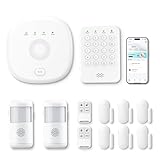
Everything an alarm system fundamentally needs — hub, siren, door and window contacts, motion detection, remote control, mobile app alerts — in a twelve-piece kit that also includes GSM/4G reporting alongside WiFi. For a budget price tier, that combination is the value proposition.
Key specs
- Pieces: 12, covering hub, siren, sensors and remote
- Reporting: WiFi plus GSM/4G cellular path
- Control: Mobile app control with push alerts
- Installation: Wireless sensors, DIY mounting, no wiring
- Detection: Door/window contacts and motion sensing
- Ongoing cost: No mandatory monitoring subscription for the core alarm function
Why it is the budget pick
Twelve pieces is enough for a flat or a small house: front door, back door, and the accessible ground-floor windows, plus a motion sensor covering the main hallway or living space. That is a real alarm system rather than a doorbell with aspirations, and it costs less than a single premium camera.
The significant feature at this price is the GSM/4G path. Cellular backup reporting is often the first thing cut when a manufacturer reduces cost, and its presence here means the alarm can still notify you when the broadband is down. That is a meaningful capability, not a checkbox.
What budget kits genuinely lack is polish: the app is functional but basic, the hardware is plastic rather than reassuringly solid, and there is no professional monitoring option. For a buyer whose priority is a loud siren, a phone alert, and no monthly bill, none of that matters much.
Pros
- Budget price for a genuinely functional twelve-piece alarm
- WiFi plus GSM/4G dual-path reporting at the entry tier
- No subscription needed for core alarm and alert functions
- Straightforward DIY installation with no wiring
- App control and push notifications on your phone
- Low-risk entry point for a first alarm system
Cons
- Build quality and app refinement are basic
- Twelve pieces may still leave larger houses short of full coverage
- No professional monitoring response
- Cellular functions may involve a SIM and associated data cost
- Sensor batteries need periodic replacement across the kit
How it compares
Against the Hapippofa GEN 2 16-piece kit, PGST gives you four fewer pieces, a plainer panel and a simpler app for a lower price. If your budget is fixed and you need to be under a specific figure, PGST delivers the core function. If you can stretch, the Hapippofa kit’s extra coverage is worth the difference.
Against the 8-piece DEEPVIGLX kit, PGST offers more sensors and a siren, which makes it the better whole-home proposition. DEEPVIGLX’s SMS reporting is the differentiator in the other direction — worth considering only if you specifically need text-message alerts rather than app notifications.
10. Hapippofa Wireless Alarm System, 24-Piece WiFi+4G – Best for Maximum Coverage, No Monthly Fees

Twenty-four pieces with no monthly fee. That combination is aimed squarely at the buyer who wants comprehensive coverage and refuses to add another subscription to the household budget. WiFi plus 4G reporting and app alerts complete the package.
Key specs
- Pieces: 24 — the largest sensor count in the budget tier here
- Reporting: WiFi with 4G cellular backup
- Ongoing cost: No monthly monitoring fee for core functionality
- Installation: Wireless, adhesive or screw-mounted sensors
- Control: Mobile app arming, disarming and alerts
- Coverage: Suited to large houses, multi-storey properties and outbuildings
Why piece count matters more than it sounds
Coverage is arithmetic. A three-bedroom house with a ground-floor layout typically has one front door, one back door, and six to ten accessible windows, plus a garage side door and perhaps a garden gate. That is ten to fourteen contact sensors before you place a single motion detector. Add a hallway and a landing detector and you are at sixteen. Twenty-four pieces gives you margin to cover a conservatory, a shed, a side gate, and still have spares.
Running out of sensors is the most common failure of budget alarm purchases, and the second purchase rarely matches the first — different firmware, different app, different radio. Buying the larger kit once avoids that entirely and usually costs less than buying a small kit plus expansion sensors separately.
The absence of a monthly fee is the other half of the value. Over three years, a budget monitoring subscription can cost more than the hardware. If you are prepared to be your own responder — checking the app, looking at a camera, calling a neighbour — a no-fee system keeps the total cost of ownership flat.
Pros
- 24 pieces covers a large house in a single purchase
- No monthly fees for core alarm functionality
- 4G backup reporting survives broadband failure
- Wireless installation with no wiring anywhere
- Expansion is possible even from a generous starting point
- Very low cost per sensor compared with premium ecosystems
Cons
- No professional monitoring — you respond to your own alarms
- Budget build quality; the panel and sensors feel light
- App experience is functional rather than polished
- Managing batteries and pairing across 24 devices takes ongoing attention
- Larger kits arrive as loose components and require methodical labelling during setup
How it compares
Against the Hapippofa GEN 2 16-piece kit, this is the same brand’s coverage-maximalist option. If your property is genuinely large — three storeys, outbuildings, many windows — the 24-piece kit is the more sensible purchase. If it is a two-bedroom flat, sixteen pieces is already generous and you would be paying for sensors that sit in a drawer.
Against the premium SimpliSafe system, the choice is coverage versus capability. Twice the sensors and no bills, versus a polished app and a professional response. There is no universally correct answer; there is only which failure you would rather avoid — an unprotected window, or an alarm nobody acts on.
11. RenseCum Home Security Systems, 24-Piece Kit – Best Low-Cost Whole-Home Coverage

Twenty-four pieces at the lowest price tier in this roundup, with hub-based wireless sensors and app notifications. The proposition is raw coverage per pound: if you want every window and door on the ground floor covered and you want to spend as little as possible doing it, this is where the arithmetic works best.
Key specs
- Pieces: 24 of mixed sensor type
- Architecture: Central hub with wireless sensors
- Notification: Mobile app alerts
- Installation: DIY, no wiring, adhesive or screw mounting
- Layout: Flexible — the high sensor count allows a tailored perimeter plan
- Ongoing cost: No mandatory monthly subscription
What to plan before installing
With this many sensors, the sensible approach is to plan the layout on paper before peeling a single adhesive backing. Walk the property and list every opening, then classify each one: primary entry, accessible window, secondary. Primary entries get contacts; ground-floor accessible windows get contacts; upper-floor windows above a flat roof or a climbable extension also get contacts. Motion detectors go where an intruder must pass — a hallway, a landing, a corner of the main living space covering two approaches.
Then decide the arming routine, because a system with too many motion detectors becomes annoying for pets and for late-night trips to the kitchen. Contacts on doors and windows can be armed permanently; motion sensing is usually armed only when the house is empty or everyone is asleep. Getting that split right at the planning stage is the difference between a system that is used daily and one that gets disabled by the second week.
Labelling is the unglamorous discipline that makes a large kit workable. Each sensor should be named in the app according to its location — “kitchen window,” “back door,” “landing PIR” — so that an alert tells you something useful rather than “sensor 14.”
Pros
- Lowest entry price for a 24-piece kit in this roundup
- Enough sensors for full ground-floor coverage and then some
- No wiring and no mandatory subscription
- Flexible layout allows a genuinely tailored installation
- Good option for a first system where budget is the binding constraint
- Spare sensors can be held back for later expansion
Cons
- Build quality and app polish are entry-level
- No cellular backup on the base configuration
- No professional monitoring
- Configuration effort scales with sensor count — setup is a real task
- Battery management across 24 devices becomes routine maintenance
How it compares
Against the Hapippofa 24-piece kit, the difference is mainly cellular backup and price. Hapippofa’s 4G path is worth paying more for if your broadband is unreliable or your property is at the end of a long line; RenseCum wins on outright cost. Both are coverage-first purchases with modest software polish.
Against the 12-piece PGST kit, this doubles the sensor count for a budget price. If you have a house rather than a flat, the extra pieces will be used. If you have a flat, PGST is the more sensible buy and you keep the difference.
12. DEEPVIGLX 8-Piece Alarm System, WiFi/GSM SMS – Best for Simple SMS Alerts

Eight pieces, WiFi and GSM reporting, and SMS alerts in addition to app notifications. It is the most compact kit here and the most direct: motion detection, door and window contacts, and a text message to your phone when something trips.
Key specs
- Pieces: 8
- Reporting: WiFi plus GSM with SMS text alerts
- Detection: Motion and door/window contacts
- Control: Mobile app
- Installation: Wireless, no wiring, DIY mounting
- Suitable for: Flats, bedsits, single-room coverage, rental properties
Why SMS is not obsolete
Text messages have one property that push notifications lack: they arrive on any phone, including a basic handset, and they do not depend on the vendor’s app servers being up or the notification being granted permission on your device. For an older relative, a second property, or a landlord who checks in occasionally, SMS is often the most reliable alert channel available.
The GSM path also means alerts route over the cellular network rather than your broadband, so a line cut or a router failure does not silence the system.
Eight pieces is deliberately modest: enough for a front door, a back door, a couple of windows and one motion detector. That is exactly the profile of a flat or a small rental, and buying more would be waste. If your footprint is larger, one of the twelve- or sixteen-piece kits is the correct choice.
Pros
- SMS alerts work on any mobile phone, smart or not
- GSM reporting is independent of home broadband
- Compact, low-cost, immediately usable kit
- Simple wireless installation with no wiring
- Well matched to flats, rentals and single-room coverage
- No mandatory monitoring subscription
Cons
- Eight pieces will not cover a house; expansion is limited
- No cellular data features beyond SMS alerts
- Minimal smart-home integration
- Requires a SIM and possibly a text-message allowance
- No professional monitoring response
How it compares
Against the PGST 12-piece kit, DEEPVIGLX trades four sensors for SMS capability. If the person receiving alerts does not use a smartphone, that trade is clearly worth making. If everyone has a phone with the vendor app installed, PGST’s extra coverage is more useful.
Against the RenseCum 24-piece kit, this is the anti-hoarding choice. Three times the sensors will not help a one-bedroom flat, and the difference in price is better spent on a doorbell camera covering the one entry point that actually matters.
How to Choose
Two systems can carry identical feature lists and produce completely different outcomes. The variables that actually determine whether a purchase works are reporting path, coverage arithmetic, storage retention, resolution class, installation reality, and recurring cost. Work through them in that order and most of the decision makes itself.
Start with the reporting path
Every alarm and camera you buy reports over something, and that something can fail. A system using only your home WiFi has one point of failure, and it is the point an intruder is most likely to remove. WiFi plus cellular backup — 4G or GSM — gives a second, independent path. In the products above, that means the Hapippofa GEN 2 16-piece kit, the PGST 12-piece kit, the Hapippofa 24-piece kit and the DEEPVIGLX 8-piece kit all offer a cellular route; a WiFi-only setup does not.
For camera systems the equivalent question is where the footage lives. Local storage on a DVR or NVR keeps recording when the internet drops and never charges a monthly fee. Cloud storage survives a burglary in which the recorder is stolen. The strongest configuration is local storage with cloud backup for the specific clips that matter, and it is worth knowing which of the two you are buying.
Do the coverage arithmetic before you buy
Count the openings, not the rooms. A typical two-bedroom ground-floor flat has one entrance door and four to six accessible windows — call it six contact sensors, plus one motion detector for the hall. That is seven sensors: an 8-piece kit fits, and a 24-piece kit is overkill.
A three-bedroom semi-detached house typically presents a front door, a back door, a side gate, a garage door and eight to twelve ground-floor windows. Expect twelve to sixteen contacts, plus two motion detectors, plus a siren. That is fifteen to nineteen devices, which means a 12-piece kit will run short and a 16- or 24-piece kit is the right size. Multiply that arithmetic across a larger detached house with an annexe or outbuildings and 24 pieces starts to look like the minimum rather than the maximum.
Running out of sensors mid-installation is the most expensive mistake in this category, because the cheapest fix is rarely available — expansion sensors must be compatible, and cross-brand pairs usually are not.
Work out storage retention before you pick a resolution
Storage is a straightforward calculation, and it is the one buyers most often skip. Retention depends on resolution, frame rate, channel count, how compressible the scenes are, and whether you record continuously or only on motion. Compression matters enormously: H.265+ stores substantially more footage in the same space than older H.264, which is why two systems with identical drive capacities can deliver very different histories.
As a practical rule, a 1TB drive on a four-camera 1080p-class system with H.265+ typically holds weeks of continuous footage, while the same drive on eight 4K cameras holds a small fraction of that. Add cameras and raise resolution, and storage need climbs faster than most people expect — roughly as a product of both, not a sum. If a kit ships with 3TB and four 5MP cameras, that is a generously specified pairing. If it ships with 1TB and eight 4K cameras, you will be shopping for a larger drive quickly.
The decision rule: buy for the retention you need, not the resolution you admire. Two weeks of history at 5MP beats three days at 8MP if you only review footage after returning from holiday.
Understand what “wireless” means in practice
Almost every wireless camera still needs a power cable. What it does not need is a video cable, and that is the whole advantage. So ask the practical question first: is there a socket, an outdoor outlet, or an accessible lighting circuit within reach of each camera position? If the answer is yes, a wireless camera kit installs in an afternoon. If the answer is no, your choices narrow to a solar kit or a paid electrical installation.
Wired systems invert this. A single cable per camera carries both power and video, which is why coax or Ethernet-based kits are more reliable and more demanding. A wired installation in a finished house means lifting floors, drilling joists and running cable through a loft. In a house under renovation, it costs almost nothing extra and should always be the choice. In a finished house with a young family, it is a project.
Solar cameras resolve the power problem but introduce a new variable: daylight. A south-facing panel with six hours of usable sun will keep a motion-triggered camera running comfortably through summer and adequately through winter. A north-facing panel under winter cloud will not. If a position is shaded year-round, solar is the wrong answer regardless of price.
Separate alarm systems from camera systems
These two categories get compared constantly and they should not be. An alarm system detects entry and tells you. A camera system records what happened and shows you. Neither substitutes for the other, and the mistake of buying one expecting the other is common.
If deterrence and immediate notification matter most — you want a siren, an alert on your phone, and the neighbours looking out of their windows — an alarm kit is the higher-value purchase. If evidence and review matter most — you want to know who was at the door yesterday, or hand footage to an insurer — a camera system is what you need.
For most houses the sensible sequence is an alarm system first, because it is cheaper, faster to install, and covers every opening. Then a camera system on the main entry points. A single doorbell-class camera at the front door plus a twelve-piece alarm kit outperforms a four-camera system with no alarm for a comparable outlay.
Price recurring cost properly, not just the hardware
The headline price is the least useful number in this category. What matters is three-year total cost, because subscription structures vary enormously between products. Some systems are free to run forever on local storage with self-monitoring. Others are functionally limited without a monitoring plan, and those plans are usually monthly.
A useful way to think about it: a mid-range monitoring plan costs a meaningful fraction of the hardware price every year. Over three years, a system that appeared cheaper can easily become the more expensive purchase. If you are confident you will self-monitor, prioritise hardware with local storage and no mandatory plan. If you want someone else to respond to an alarm, accept the recurring cost as a feature and budget for it deliberately rather than resenting it later.
Also price the consumables. Sensors run on batteries, and a 24-piece kit contains 24 batteries that will all need replacing. Cameras with IR illuminators and WiFi radios draw more than you might expect. Neither cost is large, but both are permanent.
Check smart-home and app compatibility early
Compatibility is not a minor footnote. A camera that streams into the smart display you already own earns its place on the kitchen counter; one that requires a separate app you never open does not. Before purchasing, confirm two things: that the mobile app exists on your phone’s platform and is actively maintained, and that any smart-home integration you want is supported natively rather than through a workaround.
Also think about who else lives with the system. A household with mixed technical confidence benefits from a physical keypad or a dedicated monitor — the Hiseeu 14-inch LCD kit and the Hapippofa touchscreen panel both serve this need. A single-person household checking a phone at work does not need either.
A decision matrix by situation
| Your situation | What matters most | Recommended pick |
|---|---|---|
| Renting, moving within two years, want real protection now | No damage, portable, contract-free | SimpliSafe 9-Piece Wireless System |
| Strict budget, first alarm system, flat or small house | Lowest cost, cellular backup if possible | PGST 12-Piece Kit |
| Large house, many windows, no interest in a monthly bill | Maximum sensor count, zero recurring cost | Hapippofa 24-Piece WiFi+4G Kit |
| Need SMS alerts rather than app notifications | Text-message delivery, any handset | DEEPVIGLX 8-Piece WiFi/GSM Kit |
| Want maximum evidence detail for insurance or police | Identifiable faces and plates, expansion headroom | Hiseeu 16CH 4K NVR Kit |
| Finished house, no appetite for running cables | Wireless video, power sockets available | Hiseeu 5MP Dual-Band Wireless Pro Kit |
| No power at the camera location at all | Solar charging, wire-free mounting | Gianteye 2K Solar Camera System |
| Household includes someone who will never use an app | Dedicated screen, no configuration | Hiseeu 5MP 4-Cam Kit with 14″ LCD |
| Renovating, walls open, want the most reliable setup | Wired reliability, no WiFi dependency | ANNKE 8CH Wired System |
| Tired of constant false motion alerts | AI human and vehicle detection | ZOSI 3K Lite 8CH System |
| Mid-range budget, large house, want lots of sensors | Coverage per pound with dual-path reporting | Hapippofa GEN 2 16-Piece Kit |
| Lowest possible outlay for whole-home contacts | Sensor count per unit of price | RenseCum 24-Piece Kit |
Frequently Asked Questions
Do I really need a monthly subscription for a home security system?
No — and this is the most important distinction in the category. Alarm kits and local-storage camera systems both function fully without any subscription: sensors trigger, sirens sound, the app notifies you, and footage records to a drive in your house. What a subscription buys is professional monitoring, meaning a third party receives the alarm and can dispatch a response, plus cloud storage that survives the theft of your recorder. If you are prepared to act on your own alerts, a no-fee system is a legitimate and cost-effective choice.
How many sensors does an average house actually need?
Count openings rather than rooms. A two-bedroom flat typically needs six contacts plus one motion detector. A three-bedroom house with a garden usually needs twelve to sixteen contacts plus two motion detectors and a siren. Larger detached properties with outbuildings commonly exceed twenty devices. Buying a kit that matches your opening count is more important than any other specification decision, because expansion sensors are rarely compatible across brands.
Are wireless cameras as reliable as wired ones?
Not quite, and the difference shows up under load. Wired cameras have a dedicated physical connection and are unaffected by interference, distance or the number of devices on your network. Wireless cameras perform excellently when signal strength is good — dual-band models especially — but degrade behind thick walls, metal cladding or foil-backed insulation. If a camera position has marginal WiFi, a wired camera will be reliable where a wireless one will not.
How long will recorded footage actually be kept?
It depends on four variables: resolution, channel count, compression and whether you record continuously or only on motion. A 1TB drive on a four-camera 1080p-class system using efficient H.265+ compression can hold weeks of continuous footage. The same drive with eight 4K cameras holds a fraction of that. Motion-only recording extends retention dramatically, sometimes by a factor of several, at the cost of missing the moments before an event begins.
Can I install one of these systems myself?
Yes for alarm kits and solar or wireless camera kits, with caveats. Alarm sensors mount with adhesive or two screws and need no wiring; a twelve- to twenty-four-piece kit takes an unhurried afternoon to place, pair and label. Wireless camera kits take longer because each camera needs a power source. Wired camera systems are a genuine DIY project involving cable runs through lofts and joists, and many buyers reasonably choose to pay an installer instead.
What happens to my alarm if the internet goes down?
It depends entirely on the reporting path. A WiFi-only system goes quiet. A system with cellular backup continues to report over the mobile network, which is why dual-path WiFi-plus-4G or GSM reporting is such a valuable specification. If your system is WiFi-only, an uninterruptible power supply for your router and broadband line covers some failures, but a deliberately cut line will still defeat it.
Do solar security cameras work in cloudy climates?
They work, but with reduced margins rather than guaranteed continuous operation. Solar panels generate far less in overcast winter conditions, and a camera set to record around the clock will drain its battery faster than the panel replenishes it. Most solar cameras handle this by recording on motion, which reduces power draw substantially. In a shaded northern location, a mains-powered camera remains the correct choice.
Should I buy an alarm system or a camera system first?
An alarm system, for most households. It costs less, installs faster, covers every opening in the property rather than a handful of viewpoints, and delivers an immediate siren and notification. Camera systems add evidence and review capability, which is valuable but secondary. The strongest budget sequence is an alarm kit first, then a single camera covering the front door — that combination outperforms a four-camera system with no alarm for a comparable spend.
The Bottom Line by Situation
If you want the most capable single purchase that most households will actually use, the SimpliSafe 9-Piece Wireless System is the pick — no contract, no tools, and optional monitoring you control month by month.
If the budget is the binding constraint, buy the PGST 12-Piece Kit. It delivers the core alarm function with cellular backup reporting, and it will not leave you feeling short-changed.
If you have a large house and refuse another subscription, the Hapippofa 24-Piece WiFi+4G Kit covers more openings per pound than anything else here, and it keeps reporting when the broadband does not.
If your priority is evidence rather than deterrence, the Hiseeu 16CH 4K NVR Kit is the system that will still be useful in five years — eight cameras today, sixteen channels of headroom, and footage detailed enough to identify someone rather than merely describe them.
And if there is no power where the camera needs to go, stop comparing specifications and buy the Gianteye 2K Solar System. It solves the only problem that mattered.