What's inside
- Top 3 Picks
- Quick Comparison
- How We Chose
- 1. Mendini By Cecilio Bb Standard Trumpet Set – Best for First-Year Band Students
- 2. ROWELL Bb Student Trumpet Set – Best for Value-Conscious Families
- 3. ALLSET Bb Standard Trumpet – Best for Orchestra and Performance Students
- 4. Kmise Bb Standard Trumpet – Best for Returning or Advancing Students
- 5. Yasisid Bb Trumpet for Beginners – Best Budget Starter
- 6. Vangoa Student Bb Trumpet (Gold Finish) – Best Premium Step-Up in Gold
- 7. Fancihabor Professional Standard Trumpet (Nickel-Plated) – Best Budget Nickel Finish
- 8. Glory Bb Trumpet (Black, with Gloves) – Best Budget Option with a Distinctive Finish
- 9. Vangoa Student Bb Trumpet (Silver Finish) – Best Mid-Range Silver Option
- How to Choose
- Frequently Asked Questions
- Final Recommendations by Situation
As an Amazon Associate I earn from qualifying purchases. This post may contain affiliate links at no extra cost to you.
Contents
- Top 3 Picks
- Quick Comparison
- How We Chose
- 1. Mendini By Cecilio Bb Standard Trumpet Set – Best for First-Year Band Students
- 2. ROWELL Bb Student Trumpet Set – Best for Value-Conscious Families
- 3. ALLSET Bb Standard Trumpet – Best for Orchestra and Performance Students
- 4. Kmise Bb Standard Trumpet – Best for Returning or Advancing Students
- 5. Yasisid Bb Trumpet for Beginners – Best Budget Starter
- 6. Vangoa Student Bb Trumpet (Gold Finish) – Best Premium Step-Up in Gold
- 7. Fancihabor Professional Standard Trumpet (Nickel-Plated) – Best Budget Nickel Finish
- 8. Glory Bb Trumpet (Black, with Gloves) – Best Budget Option with a Distinctive Finish
- 9. Vangoa Student Bb Trumpet (Silver Finish) – Best Mid-Range Silver Option
- How to Choose
- Frequently Asked Questions
- Final Recommendations by Situation
Our Top Picks

Top 3 Picks
If you want the single safest starting point, the Mendini By Cecilio Bb Standard Trumpet Set is the best overall beginner trumpet: a standard .459″ medium-large bore, smooth stainless-steel valves, a complete accessory bundle, and a long track record in school band programs. The Yasisid Beginner Bb Trumpet is the best budget choice, covering the essentials — case, mouthpiece, cleaning cloth — for a first-year player. The Vangoa Student Bb Trumpet in Gold Finish is the best premium-leaning step up, with a slightly fuller build and better hardware for a student who has already committed to band.
Quick Comparison
| Product | Best For | Key Specs | Price Tier |
|---|---|---|---|
| Mendini By Cecilio Bb Standard Trumpet Set (Gold) | Best overall for a first-year band student | Bb key; medium-large .459″ bore; stainless steel piston valves; 7C mouthpiece; hard case, stand, gloves, cleaning cloth | Premium |
| ROWELL Bb Student Trumpet Set | Best value bundle with a stand included | Bb key; standard student bore; 7C mouthpiece; hard case, trumpet stand, gloves, cleaning cloth | Mid-range |
| ALLSET Bb Standard Trumpet | Best for orchestra and performance-track students | Bb key; student-to-intermediate bore class; brass body; hard case and mouthpiece included | Mid-range |
| Kmise Bb Standard Trumpet (Upgraded Components) | Best for a returning or advancing student | Bb key; premium brass construction; upgraded valve and trim components; full set with case and mouthpiece | Premium |
| Yasisid Bb Trumpet for Beginners | Best budget starter | Bb key; lightweight student body; case, mouthpiece, and cleaning cloth included | Budget |
| Vangoa Student Bb Trumpet (Gold Finish) | Best gold-finish step-up for school band | Bb key; brass body; gold-lacquer finish; hard case and mouthpiece included | Premium |
| Fancihabor Professional Standard Trumpet (Nickel-Plated) | Best budget alternative with a nickel finish | Bb key; nickel-plated brass; hard case and mouthpiece included | Budget |
| Glory Bb Trumpet (Black, with Gloves) | Best budget option with a distinctive finish | Bb key; brass body; black finish; case and a pair of gloves included | Budget |
| Vangoa Student Bb Trumpet (Silver Finish) | Best mid-range silver option for band | Bb key; brass body; silver-plated finish; hard case and mouthpiece included | Mid-range |
How We Chose
The trumpet market for beginners is unusually crowded, and the differences that matter to a first-year player are not the ones marketing copy emphasizes. We built this roundup around five criteria. First, bore size: beginner trumpets almost universally use a medium-large bore around .459″ (11.66 mm) because it balances a warm tone with manageable air resistance for young lungs. A smaller bore is easier to blow but sounds thin; a larger bore demands more air support than most beginners have. Second, valve quality: piston valves with smooth, consistent action matter more than any cosmetic feature, because sticky valves are the number-one reason a beginner gets discouraged. Third, weight and balance: a trumpet in the 2.2–2.5 lb (1.0–1.1 kg) range is comfortable for a 10- to 13-year-old to hold for a 45-minute rehearsal without fatigue in the left hand.
Fourth, included accessories: a hard case, a 7C mouthpiece, and basic cleaning supplies eliminate the hidden cost of buying them separately, and a 7C is the standard beginner mouthpiece for its shallow cup and easy high register. Fifth, upgrade path: a first trumpet should be good enough to carry a student through two to three years of band, at which point they either move to an intermediate instrument or stop. We did not test or handle any of these instruments; our assessment is based on published specifications, brand category, and how each instrument fits the beginner use case.
1. Mendini By Cecilio Bb Standard Trumpet Set – Best for First-Year Band Students
As an Amazon Associate we earn from qualifying purchases at no extra cost to you.

The Mendini by Cecilio Bb Standard Trumpet Set is the instrument that appears most often in the hands of beginning band students, and for good reason: it gets the fundamentals right at a price that does not punish a family for a child’s first year in music. It suits a student in fifth through eighth grade who has settled on trumpet as their band instrument and needs something reliable enough to practice daily without hardware complaints.
The set arrives as a complete kit rather than an instrument alone, which is exactly what a new player needs — the missing accessory is always the thing that derails the first month of playing.
Key specs:
- Key: Bb, the standard school band trumpet pitch
- Bore: Medium-large, approximately .459″ (11.66 mm) — the beginner sweet spot
- Valves: Stainless steel piston valves, three-valve configuration
- Mouthpiece: 7C, the standard beginner mouthpiece
- Included: Hard-shell case, trumpet stand, a pair of gloves, cleaning cloth
- Finish: Gold-lacquer brass
What makes this set stand out is the inclusion of a trumpet stand. Practicing habits form in the first six months, and a player who can set the trumpet on a stand between repetitions during a practice session plays far more than one who has to unzip a case every time. The gloves and cleaning cloth also nudge students toward handling the instrument with reasonable care, which preserves the lacquer and keeps the valves clean longer.
The .459″ bore is the correct choice for a beginner. It is not the smallest bore on the market, which means tone quality does not suffer, but it is also forgiving enough that a student with developing breath support can play a full phrase without running out of air. The stainless steel valves are the component that will take the most abuse; they are smooth out of the box but, as with any student horn, they need oiling every few practice sessions to stay that way.
Pros
- Complete kit — instrument, hard case, stand, mouthpiece, gloves, and cleaning cloth in one purchase
- Standard .459″ medium-large bore suits beginning breath support
- 7C mouthpiece is the correct starting mouthpiece for most students
- Well-established brand presence in school band programs
- Smooth valve action out of the box
Cons
- Premium tier relative to the plainest budget starters
- Gold lacquer shows fingerprints and requires regular wiping
- As with all student brass, valves require consistent oiling to stay responsive
Compared with the ROWELL Bb Student Trumpet Set, the Mendini is the more established name with a slightly broader accessory bundle; ROWELL matches it on the essentials and also includes a stand, but at a lower price tier. If the student is disciplined about putting the horn back in its case, ROWELL is a fine alternative. If the goal is the most proven beginner instrument with the least risk, the Mendini set is the safer pick.
2. ROWELL Bb Student Trumpet Set – Best for Value-Conscious Families
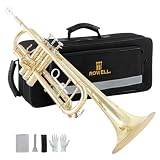
ROWELL’s Bb Student Trumpet Set is the pick for a family that wants a complete, usable beginner kit without paying the premium name-brand price. It suits a first-year student who needs everything in the box on day one, including a stand for home practice, and it is a sensible choice for parents who are not yet sure whether band will stick past the first year.
The set includes the hard case, a trumpet stand, a 7C mouthpiece, gloves, and a cleaning cloth — which happens to be the same accessory list as the Mendini set, at a mid-range tier rather than premium.
Key specs:
- Key: Bb
- Bore: Standard student bore class
- Valves: Three piston valves
- Mouthpiece: 7C
- Included: Hard case, trumpet stand, 7C mouthpiece, gloves, cleaning cloth
- Finish: Lacquered brass
The value proposition here is straightforward: the stand and glove combination is what separates a first-year trumpet experience that goes well from one that does not. A stand that lives on a desk or music stand keeps the trumpet out and accessible, and the gloves protect the lacquer from the skin oils that dull a finish over months of daily handling. Getting both in a mid-range kit is genuinely useful rather than marketing filler.
Bore and valve quality are in the standard beginner class. If you have read the opening section, you already know why that matters: a medium-large bore balances tone and air resistance, and three smooth piston valves are the minimum bar for a beginner instrument. ROWELL meets that bar. What it does not do is exceed it — this is a student horn, not a step-up, and a student who progresses quickly will eventually want an intermediate instrument.
Pros
- Mid-range price tier with a full accessory bundle including a stand
- 7C mouthpiece included — no separate mouthpiece purchase needed
- Standard beginner bore and valve configuration
- Hard case protects the instrument in transit to and from school
Cons
- Less brand recognition in band programs than the Mendini name
- Student-class build rather than step-up quality
- Lacquer finish needs regular wiping to stay presentable
The nearest alternative in this list is the Mendini set. If the accessory list is the deciding factor, the two are nearly identical; the Mendini wins on brand reputation and slightly broader market presence, while ROWELL wins on price tier. For a family buying a first instrument on a budget, ROWELL is the more efficient purchase.
3. ALLSET Bb Standard Trumpet – Best for Orchestra and Performance Students

The ALLSET Bb Standard Trumpet is positioned for the student whose ambitions run past the practice room and into orchestra and performance settings. It suits a beginner-to-intermediate player who has already decided that band is a long-term commitment and wants an instrument that can hold up under the brighter, more exposed sound an orchestra or audition setting demands.
ALLSET markets this instrument for student band, orchestra, and pro-level performance, which signals a slightly more confident build than a pure first-year starter.
Key specs:
- Key: Bb
- Bore: Student-to-intermediate bore class
- Body: Professional brass construction
- Valves: Three piston valves
- Included: Hard case, mouthpiece
- Finish: Lacquered brass
The value here is in the ceiling. A beginner who starts on a pure budget horn often outgrows it in a year and needs a replacement, which means paying twice. ALLSET’s student-to-intermediate positioning hints at a slightly more capable instrument that can carry a student further before an upgrade becomes necessary, particularly for players who will be playing in a section where tone and projection are audible.
That said, this is still a beginner-appropriate instrument. The bore and valve specification are in the same class as the other student horns here. The difference is in build intent rather than radical specification changes. Beginners should not read “performance” as “harder to play” — the mouthpiece and valve layout are standard, and a first-year student can learn on it just as easily as on a dedicated starter horn.
Pros
- Positioned for orchestra and performance use, not just practice
- Brass construction with a confident build quality for the price tier
- Hard case included for safe transport
- Mid-range tier keeps it accessible for committed beginners
Cons
- Accessory bundle is thinner than the Mendini or ROWELL sets — no stand or gloves included
- “Pro level” marketing language may overstate what a beginner horn can do
- Less established in school band programs than the Mendini name
Compared with the Vangoa Student Bb Trumpet in Gold Finish, ALLSET trades finish and included accessories for a performance-oriented build. If your student is auditioning for orchestra or a competitive band, ALLSET’s positioning is the better match. If you want the fullest starter kit, Vangoa or ROWELL will serve the first year better.
4. Kmise Bb Standard Trumpet – Best for Returning or Advancing Students

Kmise’s Bb Standard Trumpet is aimed at the student who is past the absolute first months and wants upgraded components without jumping to a truly intermediate instrument’s price. It suits a returning player — someone who played in middle school and is picking the trumpet back up — or a student finishing their first year who wants better hardware before committing to a step-up horn.
The listing emphasizes premium brass construction and upgraded valve components, which is where the price tier comes from.
Key specs:
- Key: Bb
- Bore: Standard student bore class
- Body: Premium brass construction
- Valves: Upgraded valve components
- Included: Full set with case and mouthpiece
- Finish: Lacquered brass
The upgraded valve components are the most meaningful part of this listing. Valves are the first thing to degrade on a heavily used trumpet, and they are the single component that determines whether playing feels effortless or frustrating. A beginner instrument with better-than-student valves can remain satisfying well past the point where a standard starter horn starts feeling sluggish.
For a returning player, that is worth paying for. Someone who already knows how to play will notice valve response immediately in a way a first-year student will not. For a true beginner, the premium tier may be more than necessary — the same money buys a fuller accessory kit elsewhere. This is an instrument for the player who already knows they are staying with the trumpet.
Pros
- Upgraded valve components address the most common wear point
- Premium brass construction for a fuller, more confident tone
- Complete set with case and mouthpiece
- Good bridge instrument before a full step-up purchase
Cons
- Premium tier without the accessory depth of some cheaper sets — no stand or gloves
- True beginners may not extract the value from upgraded valves in the first year
- Less brand recognition in school programs
Compared with the ALLSET Bb Standard Trumpet, Kmise leans harder into hardware upgrades while ALLSET leans into performance positioning. Both sit in the same general class, and both cost more than the Mendini or ROWELL sets without including as much in the box. Choose Kmise if valve quality is your priority; choose ALLSET if orchestra or audition performance is the goal.
5. Yasisid Bb Trumpet for Beginners – Best Budget Starter

The Yasisid Bb Trumpet is the lowest-risk way to find out whether a child actually wants to play trumpet. It suits a first-year student whose family is not ready to spend premium money on an instrument that might sit unused by November, and it covers the essentials: the horn, a case, a mouthpiece, and a cleaning cloth.
It is a genuine beginner instrument, not a toy — it plays in Bb and is built for school band use, which is what matters at this tier.
Key specs:
- Key: Bb
- Bore: Standard lightweight student class
- Valves: Three piston valves
- Included: Case, mouthpiece, cleaning cloth
- Finish: Lacquered brass
The important thing to understand about a budget trumpet is where the savings come from. It is not the bore or the key — every beginner trumpet here plays in Bb with a standard bore, because that is what band music requires. The differences show up in valve smoothness, lacquer durability, case quality, and the completeness of the accessory bundle. Yasisid gives you the instrument and the basics; it does not give you the stand, the gloves, or the broader kit.
For a strong, self-motivated student, that is fine. For a student who is undecided, it is also fine — the money saved can go toward lessons, which matter far more to early progress than the instrument’s finish or brand.
Pros
- Lowest entry cost among the picks here
- Standard Bb tuning and beginner bore class
- Case, mouthpiece, and cleaning cloth included
- Low financial risk for an undecided beginner
Cons
- No stand, gloves, or extended accessory kit
- Budget-tier valve and finish durability
- Will need replacing sooner if the student progresses quickly
Compared with the ROWELL set, Yasisid saves money and gives up the stand, the 7C mouthpiece branding, and the gloves. If the goal is the absolute lowest cost to get started, Yasisid wins. If the goal is a first year that runs smoothly with the least friction, ROWELL’s fuller kit is worth the step up.
6. Vangoa Student Bb Trumpet (Gold Finish) – Best Premium Step-Up in Gold

The Vangoa Student Bb Trumpet in Gold Finish is the pick for a student who has already committed to band and wants a nicer-feeling instrument than a budget starter. It suits a first- or second-year student whose family is willing to spend a little more for a gold-lacquer brass horn with a hard case, and it is a reasonable choice for a student in a program where the instrument will be visible on stage.
Vangoa also makes this trumpet in a silver finish, which we cover separately below; the gold version is the warmer, more traditional-looking option.
Key specs:
- Key: Bb
- Body: Brass construction
- Valves: Three piston valves
- Included: Hard case, mouthpiece
- Finish: Gold-lacquer brass
Gold lacquer is the standard finish on most beginner trumpets, and it has real advantages: it is warm-looking, it is the finish most students associate with a trumpet, and it is straightforward to maintain with a soft cloth. The trade-off is that lacquer wears at contact points — where the right hand rests and where the valves are handled — and worn lacquer is cosmetic rather than functional.
The instrument is intended for school band and orchestra beginners, and the included hard case makes it practical to carry to rehearsals. The brass body and standard valve layout mean a beginner can pick it up and learn on it exactly as they would a cheaper horn, but the build quality should hold up better over two or three years of use.
Pros
- Premium brass build for a beginner instrument
- Gold-lacquer finish matches school band expectations
- Hard case included
- Suitable for band and orchestra settings
Cons
- Accessory bundle lacks a stand and gloves
- Premium tier price for a student-class instrument
- Lacquer wears at contact points over time
Compared with the Vangoa silver model below, this is purely a finish choice: the same instrument with a different plating. Silver offers a brighter look and a slightly brighter perceived tone association, gold offers a warmer look and the traditional beginner-trumpet appearance. If you have no preference, choose silver for the marginally more durable plating; choose gold if the student wants the classic look.
7. Fancihabor Professional Standard Trumpet (Nickel-Plated) – Best Budget Nickel Finish

The Fancihabor Professional Standard Trumpet is a budget-tier option distinguished by its nickel-plated finish. It suits a beginner or student who wants the brighter, harder-wearing look of nickel plate without paying a premium, and who is comfortable buying a less established brand at a lower price.
The listing markets it for both beginners and students, and the included hard case and mouthpiece cover the walking-in essentials.
Key specs:
- Key: Bb
- Body: Nickel-plated brass
- Valves: Three piston valves
- Included: Hard case, mouthpiece
- Finish: Nickel plate
Nickel plating is worth understanding before you buy. It is harder than lacquer, so it resists scratches and wear at the contact points better over a long ownership period, and it gives the instrument a silver-bright appearance. On the other hand, some players find nickel-finished instruments feel slightly more slippery in the hands, and the plating itself can be more expensive to repair if it is ever damaged.
For a budget purchase, the practical upside is durability: a nickel-plated horn tends to look newer longer than a budget lacquer horn, which matters if the instrument will be handed down to a younger sibling. The trade-off is the budget-tier valve and build quality, which is where the savings come from.
Pros
- Nickel plate resists wear better than budget lacquer
- Bright silver-like appearance at a budget price
- Hard case and mouthpiece included
- Good hand-me-down durability for a family instrument
Cons
- Budget-tier valve and build quality
- Nickel plating is more expensive to repair if damaged
- Thinner accessory bundle than the Mendini or ROWELL sets
Compared with the Yasisid budget trumpet, Fancihabor’s advantage is the finish: nickel plate will outlast budget lacquer at the same general price tier. If durability and appearance matter more than the absolute lowest price, Fancihabor is the better budget pick. If price is the only priority, Yasisid is the leaner purchase.
8. Glory Bb Trumpet (Black, with Gloves) – Best Budget Option with a Distinctive Finish

The Glory Bb Trumpet is the pick for a beginner or advancing student who wants something visually different from the standard gold trumpet. It suits a student who is drawn to a black-finished horn and wants a case and gloves included at a budget price. Glory ESTD. 1962 is an established instrument brand, which offers some reassurance at the budget tier.
The black finish is the differentiator here, and it is worth being honest about what it does and does not change.
Key specs:
- Key: Bb
- Body: Brass construction
- Valves: Three piston valves
- Included: Case, pair of gloves
- Finish: Black
A black finish does not affect how the trumpet plays — the bore, valves, and mouthpiece determine that. What it affects is visibility and identity. For a student who feels more motivated by an instrument that looks distinct, that is a real benefit; motivation is a genuine factor in early progress. The included gloves also make sense with a dark finish, since handling a black horn with bare hands leaves visible smudges.
The build and valve specification are in the student class, appropriate for a beginner or a student who is still developing. This is not a step-up instrument, and a student who progresses quickly will eventually want to move on, but for the first year or two it does the job.
Pros
- Distinctive black finish that some students find motivating
- Established brand with a long instrument-making history
- Case and gloves included
- Budget tier keeps the entry cost low
Cons
- Dark finish shows fingerprints and smudges readily
- Budget-tier valve and build quality
- No stand or extended accessory kit
Compared with the Fancihabor nickel-plated budget trumpet, Glory trades the wear-resistant finish for a striking black look and included gloves. If the student is motivated by appearance and the family wants a low entry cost, Glory is the better fit. If durability over years matters more, nickel plate holds up better.
9. Vangoa Student Bb Trumpet (Silver Finish) – Best Mid-Range Silver Option

The Vangoa Student Bb Trumpet in Silver Finish is the mid-range pick for band and orchestra beginners who prefer a silver-plated instrument. It shares its design with the gold Vangoa above but changes the finish, and it suits a student in a school band program who wants a brighter-looking, easier-to-keep-clean horn.
Vangoa’s silver model is positioned at the mid-range tier, making it the most accessible of the higher-quality finishes in this roundup.
Key specs:
- Key: Bb
- Body: Brass construction
- Valves: Three piston valves
- Included: Hard case, mouthpiece
- Finish: Silver-plated
Silver plating is the more practical finish for a student instrument in many ways. It is harder than lacquer, so it resists the scratching and wear that come from daily handling in a band room, and it wipes clean easily. The visual appearance is brighter and more formal, which some students and directors prefer for orchestra settings.
The trade-off is tonal association rather than tone itself — players often describe silver-plated trumpets as sounding slightly brighter, though the mouthpiece and player have far more to do with that than the plating. For a beginner, the practical reasons to choose silver are durability and easy cleaning, not sound.
Pros
- Silver plating resists wear and cleans easily
- Mid-range tier makes it the most affordable of the better finishes here
- Hard case and mouthpiece included
- Bright, formal appearance suited to band and orchestra
Cons
- Silver tarnish requires occasional polishing to stay bright
- No stand or gloves in the bundle
- Student-class valve specification
Compared with the Mendini set, Vangoa silver offers a more wear-resistant finish but a thinner accessory bundle and less band-program recognition. Choose Vangoa silver if finish durability and appearance are the priority; choose Mendini if you want the fullest, most proven beginner kit. Compared with the ALLSET trumpet, Vangoa trades performance positioning for finish quality at a similar mid-range tier — a good choice for a student who cares about how the instrument looks and holds up, rather than about audition-level projection.
How to Choose
The trumpet is one of the few band instruments where the beginner specification is genuinely standardized, which means most of the buying decision comes down to five measurable factors. Understand them and you can evaluate any beginner trumpet in a few minutes.
Bore size: the number that decides how the horn feels
Bore is the internal diameter of the main tubing, and it directly controls how much air resistance the player feels and how much air the instrument demands. Beginner trumpets cluster around a medium-large bore of .459 inches (11.66 mm). This is not an accident: it gives a warm, full tone without requiring the air volume that a large-bore .462″ or .468″ instrument demands. A small-bore trumpet around .450″–.455″ will feel easier to blow but tends to sound thin at the lower end of a beginner’s range, and it can teach a student to under-support their air.
Here is the practical rule: for a student under about 12, or any player with limited breath support, stay at or slightly below .459″. For a strong 13-year-old or a returning adult player, a .459″ bore is still appropriate and a slightly larger bore is not out of the question. Do not buy a large-bore instrument for a beginner because it is marketed as “professional” — the extra air demand makes early playing harder, not better.
Valve quality: the component that decides whether practice is pleasant
Piston valves are the moving parts on a trumpet, and they are the first thing to wear out. In a beginner instrument, look for three piston valves with smooth, consistent action and no lateral play. Most beginner trumpets use stainless steel or nickel-plated valves; stainless steel is generally more corrosion-resistant and holds up better against the moisture that inevitably comes from playing.
The maintenance reality matters as much as the specification. Valves need oiling roughly every two to three practice sessions, or weekly at minimum, depending on how often the instrument is played. A valve that feels sticky is almost always a cleaning-and-oiling problem rather than a defect, but a valve that has been run dry for months can develop wear that nothing fixes. For a beginner, the practical takeaway is: buy an instrument whose valves are easy to remove and reinsert, because that is how the student will clean and oil them.
Weight and balance: what actually causes fatigue
A Bb trumpet typically weighs between 2.2 and 2.5 pounds (1.0 to 1.1 kg). For a 10- to 13-year-old holding it in the left hand through a 45-minute rehearsal, that is a real load. Weight is not the main issue in most cases — balance is. An instrument that is top-heavy or front-heavy forces the player to grip harder, which tires the left hand and encourages bad posture.
If you can inspect an instrument before buying, hold it as the student would: left hand around the valve casing, right hand on the valves, bell forward. If it feels like the bell is pulling the horn down, the student will fight it. Weight and balance are also why a trumpet stand is such a useful accessory — it lets the player set the horn down without breaking practice flow.
Included accessories: what is actually worth having
Accessory bundles vary widely, and not everything in them is equally useful. Ranked by value to a first-year player:
- Hard case — essential. A gig bag offers less protection for the valves and bell, which are the most vulnerable parts in transit to school.
- 7C mouthpiece — important. The 7C is the standard beginner mouthpiece: a moderately shallow cup that supports the high register without being punishing on the lips. Most beginner sets include one; if a set includes a different size, budget for a 7C separately.
- Cleaning cloth and basic cleaning supplies — important. The instrument needs wiping after every session to remove moisture and skin oils.
- Trumpet stand — genuinely useful. It increases practice time by making the horn accessible.
- Gloves — nice to have. They slow lacquer wear from skin oils, which matters more on gold-lacquer and black finishes.
A set that includes all five removes the need for any follow-up purchase, which is why the Mendini and ROWELL kits are the practical starting point. A set with only a case and mouthpiece (like the Vangoa and ALLSET offerings) is not deficient, but you should budget for a cleaning cloth, valve oil, and a stand separately.
Finish: lacquer, silver, nickel, or black?
Finish is the most visible choice and the least sonically significant. Here is how the four common finishes compare:
| Finish | Wear Resistance | Cleaning | Appearance | Repair Cost If Damaged |
|---|---|---|---|---|
| Gold lacquer | Moderate — wears at contact points | Easy — wipe with soft cloth | Warm, traditional | Low to moderate |
| Silver plate | High — resists scratching | Moderate — needs occasional polish to remove tarnish | Bright, formal | Moderate to high |
| Nickel plate | High — hardest common finish | Easy — wipes clean | Bright silver-like | High |
| Black finish | Moderate | Difficult — shows smudges readily | Distinctive, dark | Moderate |
For a first-year student, gold lacquer is the traditional and perfectly adequate choice. Silver and nickel make sense when the instrument will be handed down or is expected to take heavy handling. Black is a motivation choice, not a durability choice.
Maintenance and ownership: what wears first
Understanding what actually wears on a beginner trumpet will save you money and prevent a mid-year crisis. In order of how often they cause problems:
- Valves and valve oil — the most frequent issue. Oil every two to three sessions, or weekly. Use proper valve oil, not household oil.
- Mouthpiece and leadpipe — accumulates residue. Clean the mouthpiece weekly with warm soapy water and a mouthpiece brush; the leadpipe should be cleaned periodically, and many beginners benefit from having the whole instrument cleaned professionally once a year.
- Slides and tuning slides — can seize if left untouched. Grease them periodically and move them slightly each time the instrument is cleaned.
- Lacquer at contact points — cosmetic only. Do not replace an instrument because the lacquer is worn where the hand rests.
- Water keys (spit valves) — small cork or rubber pads that can dry out and leak. These are cheap consumables, and a small air leak here is a common cause of a “stuffy” trumpet that is otherwise fine.
- Dents — the most expensive repair. A small ding near the bell is cosmetic; a dent in the leadpipe or valve casing can affect playing and should be fixed by a technician.
Common beginner mistakes to avoid
Parents and new players make a handful of predictable errors. Buying a used trumpet without checking valve compression is the most expensive one — valve wear is invisible from the outside and can cost as much as a new budget instrument to fix. Assuming that a more expensive trumpet will make a student sound better is the second; for the first year, a properly maintained budget horn beats a neglected premium one. Skipping the mouthpiece purchase because “one came in the box” is a third; if the included mouthpiece is not a 7C or comparable beginner size, it will make playing harder. Finally, treating valve oil as optional is a fourth — a dry valve is the single fastest route to a trumpet that feels broken.
Mapping your situation to a pick
If you want the short version, use these situations:
- Absolute first trumpet, undecided student, tightest budget: Yasisid or Glory — lowest cost, standard beginner specification, low risk if the student stops.
- First trumpet in a school band program, family wants a smooth first year: Mendini By Cecilio set — proven, complete, premium tier but nothing missing.
- Same goal, paying attention to price: ROWELL set — same accessory list, mid-range tier.
- Student is committed and may audition or join orchestra: ALLSET — performance-oriented student-to-intermediate build.
- Returning player or second-year student who notices valve feel: Kmise — upgraded valve components, premium tier.
- Looks and durability matter, mid-range budget: Vangoa silver — hard-wearing plating, easy cleaning.
- Hand-me-down instrument for siblings: Fancihabor nickel-plated — the most wear-resistant finish at a budget price.
Frequently Asked Questions
What size trumpet should a beginner buy?
A beginner should buy a standard Bb trumpet with a medium-large bore of about .459 inches (11.66 mm). This is the near-universal beginner specification because it balances tone quality with manageable air resistance. A smaller bore is easier to blow but can sound thin, and a larger bore demands more breath support than most beginners have. Unless a teacher specifically recommends otherwise, a standard .459″ Bb trumpet is the right answer.
Is a 7C mouthpiece right for a beginner?
Yes. The 7C is the standard beginner mouthpiece because its moderately shallow cup supports the high register without putting excessive strain on undeveloped lips. Most beginner trumpet sets include one. If a set ships with a different size, buying a 7C separately is inexpensive and will make the first months noticeably easier. A teacher can confirm the right size for an individual student.
How often do trumpet valves need oiling?
Valve oil should be applied roughly every two to three practice sessions, or at least weekly. A valve that feels sticky is usually dry or dirty rather than defective, and cleaning followed by oiling usually fixes it. If a valve remains sluggish after cleaning and oiling, a technician should look at it, since a valve that has run dry for a long period can develop wear that cannot be reversed.
Do I need to buy a stand and cleaning supplies separately?
Not always — the Mendini and ROWELL sets include a stand, gloves, and a cleaning cloth, which covers most of the extras. Budget sets and the Vangoa and ALLSET offerings typically include a case and mouthpiece but not a stand. Valve oil is worth buying regardless, since it is a consumable that every trumpet player needs from the first week.
What is the difference between lacquer, silver, and nickel finishes?
Lacquer is the traditional gold finish, easy to clean but wears at contact points. Silver plating is harder, resists scratching, and looks brighter, but needs occasional polishing to remove tarnish. Nickel plating is the hardest common finish and wipes clean easily, but is the most expensive to repair if damaged. None of them meaningfully changes how the instrument plays for a beginner.
How much should a family expect to spend on a first trumpet?
Beginner trumpets fall into three general market tiers: a budget tier that covers the instrument, case, and mouthpiece; a mid-range tier that adds a fuller accessory bundle or a harder-wearing finish; and a premium tier that adds better build quality or upgraded valve components. Any of the three can serve a first-year student. The most important investments after the instrument itself are valve oil and, if the student sticks with it, a teacher.
How long will a beginner trumpet last?
A well-maintained beginner trumpet should carry a student through two to three years of school band. Valves, slides, and water key pads are the wear items, and with regular oiling and an annual professional cleaning, the instrument will remain playable well past the point where the student is ready for a step-up horn. The lacquer will wear at contact points over time, but that is cosmetic.
Should a beginner buy a used trumpet instead of a new one?
A used trumpet can be excellent value, but only if the valves are in good condition. Valve wear is not visible from the outside, and replacing worn valves can cost more than a new budget instrument. If buying used, have a teacher or technician check valve compression and slide movement before purchase. For a family without access to that check, a new beginner trumpet from an established brand is the lower-risk choice.
Final Recommendations by Situation
For the most common situation — a first-year band student whose family wants a complete, proven instrument — choose the Mendini By Cecilio Bb Standard Trumpet Set. It has the right bore, the right mouthpiece, and every accessory a beginner needs in one purchase. If price is the deciding factor, the ROWELL Bb Student Trumpet Set delivers the same essentials at a mid-range tier. If the student is already committed and thinking about orchestra or auditions, the ALLSET Bb Standard Trumpet is the better match, and the Kmise Bb Standard Trumpet is worth the premium if smooth valves are the priority. On the tightest budget, the Yasisid and Glory trumpets get a student playing for the least money — and if the instrument will be handed down, the Fancihabor nickel-plated model resists wear best at that tier. Whichever you choose, budget for valve oil from day one; it matters