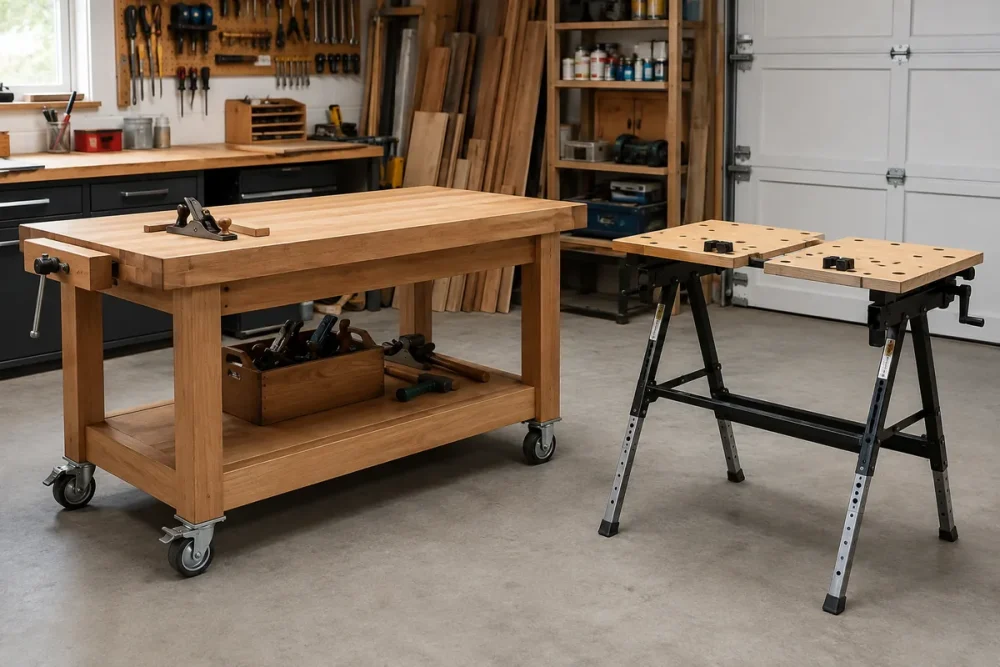
Key takeaways
- A rolling workbench review focused on procedure: setting bench height around the caster stack, choosing total-lock casters, and building a 1-1/2 inch top that stays flat.
What's inside
As an Amazon Associate I earn from qualifying purchases. This post may contain affiliate links at no extra cost to you.
A rolling workbench fixes one problem and quietly creates three more. It gets the work surface out of the dark corner and into the middle of the shop where you can walk all four sides of a project. Then it creeps sideways the first time you lean into a hand plane, the top flexes when you clamp near the center, and the base racks into a parallelogram every time you shove it across the floor. This rolling workbench review is less about brand badges and more about the four things that decide whether a mobile bench is worth the floor space: caster rating, top thickness, resistance to racking, and finished height.
Procedure before product. Set the height correctly, bolt on the right casters, and stiffen the base, and an inexpensive steel shop cart will outwork a handsome bench that skates. Here is how the common styles compare before we get to the steps.
As an Amazon Associate we earn from qualifying purchases at no extra cost to you. Product prices and availability are accurate as of the date shown and are subject to change.


| Rolling bench type | Typical top | Best for | Main weakness |
|---|---|---|---|
| Steel mobile workbench | Thin hardwood or MDF over a steel frame | Tool storage and repair work | Top is usually too thin for hand tools |
| Folding portable workstation | Composite or slatted plastic | Job sites and apartment shops | Light weight flexes under real pressure |
| Shop-built plywood cart | Two layers of 3/4 in sheet goods | Assembly, sanding, general shop use | Costs a weekend and a sheet of plywood |
| Assembly table with retractable casters | 1-1/2 in MDF or laminated ply | Glue-ups and sheet goods | Awkward to move if the casters are undersized |
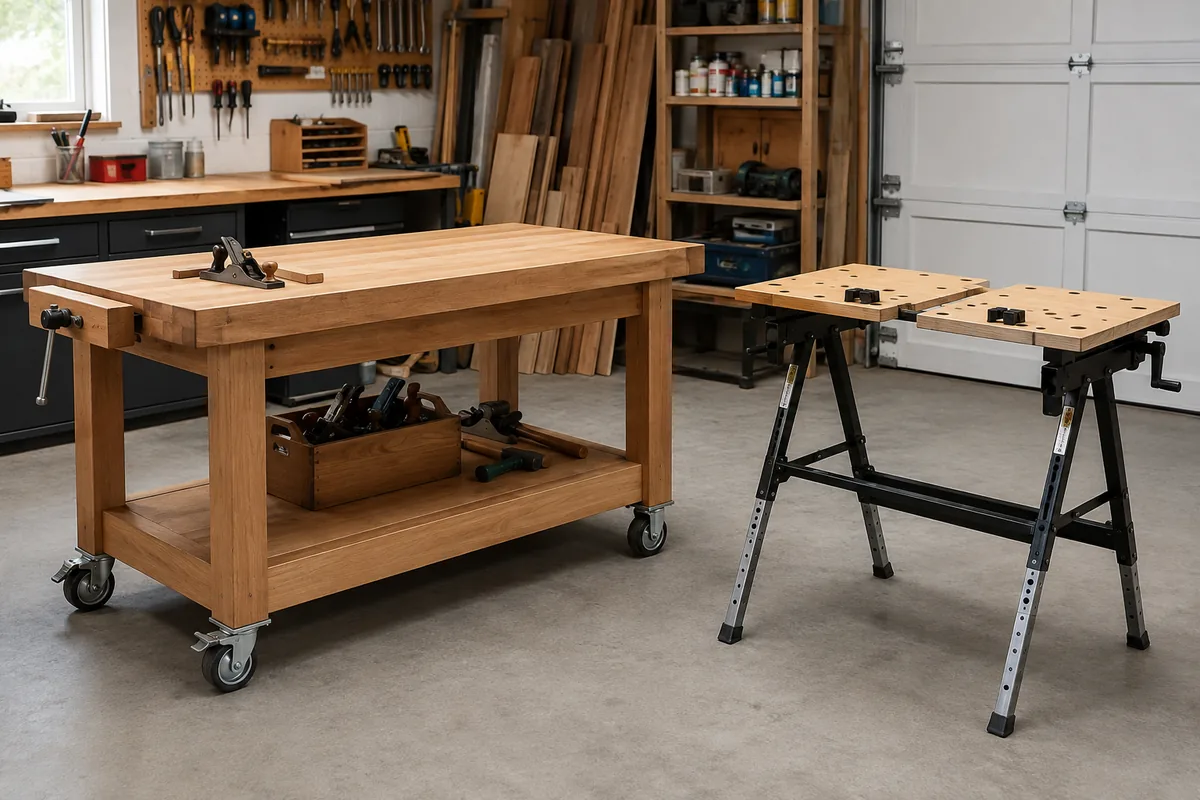
What a Rolling Workbench Review Should Actually Measure
Caster rating, per wheel. Shop floors are never flat, so at any moment three casters carry the load and the fourth rides along. Rate each caster for at least half the loaded weight of the bench. A plywood cart with a stocked lower shelf lands in the low hundreds of pounds, so a 200 pound per wheel rating is a sane floor rather than overkill.
Wheel size and material. Three inch wheels are fine on clean sealed concrete. If you cross expansion joints, extension cords, or a garage door track, move up to 4 or 5 inches. Non-marking polyurethane rolls quietly and spares an epoxy floor. Hard nylon rolls easier under heavy loads but transmits every pebble into your work.
Top thickness. Anything under an inch will drum and dish. For general work I want 1-1/2 inches, which is just two layers of 3/4 inch sheet goods glued together. Most steel-frame benches ship with a 3/4 inch or 1 inch top, and that is the first thing worth upgrading.
Racking resistance. Casters remove the friction that used to hold a four-legged base square. Without a full back panel, a diagonal brace, or a torsion box top, the base will rack out of square. If a bench is open on all four sides with nothing but stretchers, plan on adding a panel.
Steel rolling workbench with drawers
Buy these for the base and the storage, not the top. Look for total-lock casters and a drawer bank that adds ballast, then plan on laminating a second layer of plywood over the factory surface.
How to Set the Height and Choose Casters
Step 1. Measure yourself, not the internet. Stand relaxed with your arms hanging. Your wrist crease is a good general-purpose height, your pinky knuckle is closer to a hand-tool height. For most adults that means 32 to 34 inches for planing and sawing, 34 to 36 inches for assembly and routing, and 38 to 40 inches for a dedicated sanding or glue-up table. Two inches too tall and you cannot get your shoulder over a plane.
Step 2. Subtract the caster stack before you cut legs. Measure the caster with its top plate installed. A 4 inch caster commonly adds 4-1/2 to 5-1/4 inches. For a 36 inch finished bench with a 1-1/2 inch top and 5 inches of caster, the legs get cut at 29-1/2 inches. Skipping this is the number one reason shop-built rolling benches end up too tall.
Step 3. Mount casters into solid material. Screws driven into plywood edges will work loose. Bolt through with 5/16 or 3/8 inch bolts, flat washers on both faces, and nylon-insert lock nuts. If the leg is plywood, glue on a doubled pad so the plate bears on at least 1-1/2 inches of material.
Step 4. Lock the swivel, not just the wheel. A wheel brake stops rotation but lets the caster pivot, and that pivot is how a bench walks a quarter inch at a time. Use total-lock casters that pin both, and put them on all four corners instead of two.
Total-lock and retractable workbench casters
The cheapest real upgrade you can make. Total-lock casters stop the drift on a light bench; retractable or foot-lever kits drop the bench onto its legs so it behaves like a fixed bench when you plane.
Step by Step: Building a Top That Stays Flat
Step 1. Size the panel with clamping in mind. 24 by 48 inches suits a one-car garage, 30 by 60 is better if you assemble cabinets. Leave 1 to 2 inches of overhang on at least three sides so F-clamps have somewhere to bite. A top flush with an apron gives you nowhere to clamp.
Step 2. Laminate oversize. Roll PVA glue over the full face of both layers, stack them, and drive 1-1/4 inch screws on a rough 8 inch grid from underneath so you do not need thirty clamps. Cut both layers 1/2 inch oversize and trim to final size after the glue cures.
Step 3. Sand only as far as you need. 80 grit on a random orbit sander to level the seam and any proud edge, then 120 to erase the 80 grit scratches. Stop there. A top sanded to 220 is slippery, and parts slide when you plane.
Step 4. Seal it instead of finishing it. Two coats of wipe-on polyurethane thinned roughly 50/50 with mineral spirits, or a coat of paste wax. That is enough to keep glue squeeze-out from bonding and to stop MDF from drinking spills. A glossy film finish just shows every scratch.
Step 5. Add a sacrificial layer if you cut on the bench. 1/4 inch hardboard held down with a few 23 gauge pins or double-sided tape at the corners. Replace the hardboard when it gets chewed up rather than resurfacing the whole bench.
Step 6. Drill dog holes last. Use a 3/4 inch Forstner bit at roughly 500 to 750 rpm with a scrap backer clamped underneath to stop blowout. Lay out holes on 4 inch centers along the front edge and 6 inch centers through the field. Test one hole in scrap and check that your hold-down actually drops in.
- ✔ Work sits in the middle of the shop where you can reach all four sides
- ✔ Total-lock casters plus tools stored low kill nearly all movement
- ✔ A doubled 3/4 inch top can be resurfaced or swapped in an afternoon
- ✔ The lower shelf turns dead floor space into storage
- ✘ Casters add 4 to 5 inches you have to design around
- ✘ Hand-tool work wants mass that a light rolling bench does not have
- ✘ Swivel-only casters let the bench creep under load
- ✘ Open bases rack unless you add a panel or a diagonal
Common Mistakes I See Over and Over
Buying casters rated for the empty bench, then loading it with a planer. Building the frame at final height and discovering the casters after the fact. Locking two casters instead of four. Leaving the base open on all sides so it racks and the top no longer sits level. Storing nothing on the lower shelf, which leaves the bench top-heavy and tippy over a threshold. Gluing the top down permanently instead of screwing it from below, so a worn surface becomes a rebuild. And in an unheated garage, choosing MDF over plywood and watching the edges swell after one humid summer.
Folding portable workbench
If you share the garage with a car or work in an apartment, a folding workstation beats a rolling bench you have to shuffle constantly. Accept the flex, use it for layout and assembly, and clamp real work down.
Rolling Workbench FAQ
How much weight should a rolling workbench hold? Add the bench, the tools you store on it, and the heaviest thing you will ever set on top, then double it. Sizing each caster for half the loaded total gives you margin for the uneven floor and the odd curb.
Do all four casters need to lock? Yes, if you plan to do anything but push it around. Two locking casters still let the free corners swivel, which is how a bench slowly walks across the shop while you work.
Can you hand plane on a rolling workbench? Not comfortably on a light one. You need mass and a base that cannot rack, so either use retractable casters that set the bench down on solid legs, load the lower shelf with heavy tools, or park the bench against a wall and plane toward it.
Set the height first, then the casters, then the top. Do those three in order and the bench disappears into the background, which is exactly what a good one should do.
Check prices on Amazon →