What's inside
As an Amazon Associate I earn from qualifying purchases. This post may contain affiliate links at no extra cost to you.
Contents
Why Humidity Wins Every Time
If you build furniture that lives in a heated house in winter and a humid house in summer, wood movement is not optional. Most interior spaces in the US swing from 30-35% relative humidity in January to 55-65% in July and August. That swing changes the equilibrium moisture content of wood from about 6-7% to 11-12%. Solid wood responds by swelling and shrinking across the grain. Sheet goods with veneer respond much less. If you ignore that difference, you get cracked tops, stuck drawers, and doors that rub in August and rattle in February.
The question is not which material is better in general. It is which material is more predictable for the part you are building and the climate it will live in.
As an Amazon Associate we earn from qualifying purchases at no extra cost to you.


How Solid Wood Actually Moves
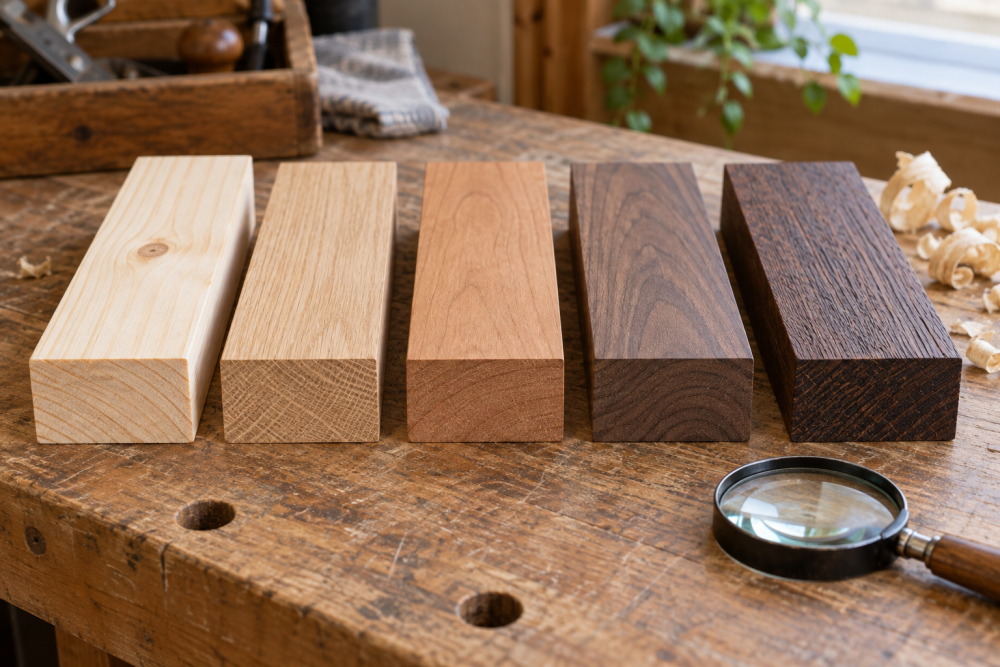
Solid wood moves almost entirely across the grain. Along the length of a board, movement is negligible – about 0.1% from oven-dry to fiber saturation. Across the width, it is significant. Tangential movement (flat-sawn) is roughly double radial movement (quarter-sawn).
For a practical example, take a 36-inch-wide flat-sawn white oak table top. White oak moves about 10.5% tangentially and 5.6% radially from green to oven-dry. In real indoor conditions, a 6% moisture content swing will cause that 36-inch top to change width by about 1/4 to 5/16 inch if it is flat-sawn. Quarter-sawn stock of the same width will move closer to 1/8 to 3/16 inch. That is enough to blow apart a glued joint or split the top if it is screwed solidly to the base.
Failure modes for solid wood in seasonal swings are consistent: panels glued into rigid frames split down the middle, breadboard ends crack when draw-bored too tightly, and table tops cup when one face finishes and the other does not. The fixes are well known but take work: allow floating panels, use elongated screw holes and table top clips, finish all sides equally, and build with wood at 6-8% moisture content. A wood moisture meter is the cheapest way to avoid building a problem into the piece before you start.
Where solid wood excels is longevity and repairability. A 3/4-inch solid top can be sanded, scraped, dented, and refinished for decades. Edges can be profiled with any router bit, joinery like dovetails and mortise-and-tenon is at full strength, and damage is repairable. It also looks and feels like solid wood because it is.
How Veneered Panels Behave
Veneered panels are a thin face veneer – typically 0.5mm to 1.5mm for commercial plywood and 0.6mm for shop veneer – glued to a stable substrate like MDF, particleboard, or balanced veneer-core plywood. The substrate does most of the work.
MDF is the most stable for indoor furniture. Its thickness and in-plane expansion is about 0.2% to 0.3% for a large humidity swing, an order of magnitude less than solid wood. High-quality hardwood plywood with a balanced construction (veneer on both faces) is also very stable in length and width, though it can warp if the faces are unbalanced or if it gets wet. Both are far less likely to crack a frame or bind a door seasonally.
The trade-off is edge treatment and moisture tolerance. You cannot shape a heavy roundover on veneered MDF without exposing the core, so you need edge banding, solid wood lipping, or a mitered veneer edge. If water gets under the veneer through a chip or an unfinished edge, MDF swells irreversibly and the veneer bubbles. Plywood handles edge exposure a bit better but will delaminate if repeatedly wetted. And once you sand through a 0.6mm veneer, you cannot fix it without patching or re-veneering.
For doors, case sides, and large panels that must stay flat, veneered panels are often the better engineering choice. A 24×36-inch raised panel door made from solid flat-sawn cherry can move 1/8 inch seasonally and may cup. The same size door with a shop-sawn veneer over MDF will stay within a few thousandths of an inch and stay flat, which is why most high-end kitchens use wood veneer sheets for furniture over a stable core for doors and end panels.
Solid Wood vs. Veneered Panels Head-to-Head
| Factor | Solid Wood (3/4″ hardwood) | Veneered Panel (MDF or Baltic Birch core) |
|---|---|---|
| Seasonal width movement on 36″ panel (6% MC swing) | 1/8″ to 5/16″ depending on species and cut | Less than 1/32″ to 1/16″ |
| Stays flat under humidity swing | No, needs careful grain selection and framing | Yes, if balanced and sealed on both faces |
| Cost for 4×8 sheet equivalent | $120 to $300+ for 4/4 hardwood boards | $60 to $140 for premium veneered panel |
| Edge profiling | Any profile, any depth | Limited; needs solid lipping or iron-on edge banding |
| Repairability over 20 years | Excellent; can refinish 4-6 times | Fair; light scuffs okay, sand-through is fatal |
| Failure mode in humidity | Splitting, cracked joints, cupping | Edge swelling, veneer checking or bubbling if moisture enters |
| Best for | Tops, chairs, frames, anything with exposed joinery | Doors, case sides, large flat panels, marquetry |
When to Choose Which for Real Projects
Choose solid wood when the part is structural, will be shaped, or will take abuse. Table tops, chair parts, face frames, legs, and drawer fronts that you want to sculpt or distress are solid-wood jobs. If you live in a climate with a 30% RH winter-to-summer swing, budget for movement: use quarter-sawn stock where you can, and never trap a solid panel with glue on all four edges. Buying quarter sawn white oak boards for a wide top costs 20-30% more than flat-sawn but cuts seasonal movement nearly in half and looks more stable over time.
Choose veneered panels when flatness and stability matter more than edge shaping. For a 72-inch-wide wardrobe side, a bookcase with adjustable shelves, or a set of four inset doors that must keep an even 3/32-inch gap in both January and July, veneered MDF or plywood will save you callbacks and re-fitting. It is also the honest budget choice: a veneered panel gives you a walnut or white oak look for about half the cost of solid boards, with less waste and no need to glue up wide panels.
The cheaper option is fine in low-risk places. Veneered particleboard with a proper edge band is perfectly acceptable for cabinet interiors, closet built-ins, and painted casework that never sees standing water. Save solid wood for the touch points. This hybrid approach is how most professional furniture is built: solid wood frames and edges with veneered floating panels.
Build Details That Prevent Seasonal Failures
Regardless of which you choose, a few details decide whether the piece survives the first year.
First, acclimate and measure. Bring wood inside for at least 7-10 days and check it with a meter. Build at the middle of your expected indoor range, around 7-8% MC for most heated homes. Building with wet 12% stock from the yard is a guarantee it will shrink and crack indoors.
Second, finish both faces. An unfinished bottom on a solid top or a veneered panel creates uneven moisture exchange and cupping. Two coats of finish on the bottom for every three on the top is a good rule.
Third, allow movement mechanically. Solid tops get Z-clips or figure-8 fasteners in slots, not screws through oversized washers. Frame-and-panel doors get space balls or a 1/16-inch gap per side in the groove, and panels are never glued. Veneered panels still need a little room in solid wood grooves – 1/32 inch per side – and all edges must be sealed, especially MDF edges, with glue size or primer before finishing.
If you build with these allowances, both materials work. If you try to lock everything rigid, solid wood will tell you first by cracking, and veneered panels will tell you later by bubbling at the edges. Let the panel float and the frame do the work, and seasonal swings become a non-issue.