What's inside
As an Amazon Associate I earn from qualifying purchases. This post may contain affiliate links at no extra cost to you.
Contents
Best Wooden Work Benches for Every Shop Size
The best wooden work bench is the one whose top, workholding, and storage suit your projects without consuming the floor space you need to work. For a compact shop, prioritize a sturdy 48-inch bench and useful storage; for general woodworking, a roughly 60-inch top with a vise is a versatile choice; for furniture work, look for a longer, thicker top with room for dogs and clamps.
Compare common bench sizes and builds
The figures below are practical comparison targets, not specifications for a particular model. Actual dimensions and weight vary by maker, wood species, and included hardware. Check those details before buying—especially if you need to move a bench through a doorway or mount it on a particular floor.
As an Amazon Associate we earn from qualifying purchases at no extra cost to you.


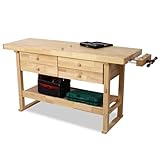

| Bench type | Typical top dimensions | Common construction | Workholding and storage | Best fit |
|---|---|---|---|---|
| Compact assembly bench | 36–48 in. long × 20–24 in. deep; 1½–2 in. thick | Beech, birch, or laminated hardwood; roughly 80–160 lb | Often one vise or clamp-friendly edges; shelf or cabinet may be included | Small shops, apartments, occasional repairs |
| General-purpose bench | 54–72 in. × 24–30 in.; 2–3 in. thick | Hardwood or laminated hardwood; roughly 150–300 lb | One or two vises, with dog holes on some models; shelf or drawers | Frequent hobby work and mixed projects |
| Traditional woodworking bench | 72–96 in. × 24–30 in.; 3–4 in. thick | Thick beech, maple, or other hardwood, often laminated | Front and tail vise, dog holes, and open shelf or tool well | Furniture making and large workpieces |
| Workbench with cabinet base | 48–72 in. × 24–30 in.; 1½–2½ in. top | Hardwood or laminated top over a wood or mixed-material base | Drawers or cupboard; vise may be an upgrade or absent | Shops that need organized, enclosed storage |
Choose by shop size and kind of work
For a tight shop: compact bench with a useful base
A 36- to 48-inch bench can handle sharpening, small furniture parts, boxes, and household repairs. A cabinet base makes good use of a small footprint, while an open shelf is easier to access and leaves room for awkward items. Measure the bench’s full footprint, including vise handles, and leave enough clearance to walk around it and operate tools. A compact bench that is difficult to reach from multiple sides may need to sit against a wall, which can limit clamping options.
For an all-purpose shop: around 60 inches with a vise
A bench about 60 inches long and 24 inches deep is a sensible middle ground for many hobbyists. It can support medium-size cabinet parts without demanding the floor area of a full-length bench. Look for a front vise and a top thick enough to resist movement during hand-planing. Dog holes are useful only if their spacing and diameter suit the vise dogs or accessories you intend to use; confirm compatibility rather than assuming every system matches.
For furniture work: longer top and more workholding
A 72-inch-or-longer bench gives you more support for doors, rails, and broad panels. A front vise holds stock at the edge; a tail vise or end vise works with bench dogs to secure a board flat on the top. Together, they make it easier to plane and edge-joint without resorting to improvised clamps. A longer bench is not automatically better if it forces you to work in a cramped aisle, so check the shop layout before prioritizing top length.
What to inspect before buying
- Top material and thickness: Beech and maple are common durable choices; laminated hardwood is also widely used. A thick top adds mass and can resist racking, but construction quality, joinery, and a rigid base matter too. Inspect for a flat working surface and solid, well-fitted joints.
- Workholding: Check vise placement, jaw opening, dog-hole layout, and whether the hardware is included. A vise that cannot open wide enough for your stock, or that conflicts with the base, can be frustrating despite a large top.
- Base stability: A heavy bench with a well-braced base tends to stay put during hand-tool work. If the bench rocks, check the floor and level the feet or shim the base before blaming the top.
- Storage: Drawers protect small tools and keep them sorted, but they add cost and can reduce access beneath the bench. An open shelf is simpler and suits larger supplies. Avoid storing damp wood or wet finishes in enclosed drawers.
- Assembly and moving: A large hardwood bench can be difficult to carry and maneuver. Check packaged dimensions, assembly requirements, and whether the base can be disassembled. Confirm your floor can support the bench alongside other heavy equipment.
A practical fit calculation
Allow about 30 inches of working clearance on the sides you need to reach, then add the bench’s depth to estimate the space required from a wall. For a 24-inch-deep bench placed against a wall, plan for about 54 inches from the wall to the edge of the clear work area. If you need to work from both long sides, plan for access on both sides instead. This is a planning allowance, not a safety standard; larger projects and nearby machinery may require more room.
Also compare top height with your work. A common starting point is around wrist height when standing upright, but hand-planing often feels better at a lower surface, while detailed assembly can benefit from a higher one. If you share the bench with another person or switch between tasks, adjustable feet or a separate assembly surface may be more useful than trying to find one perfect height.
Wooden work benches by budget and use
| Situation | What to prioritize | Trade-off to expect |
|---|---|---|
| Occasional repairs, tight budget | Compact top, stable base, clamp-friendly edges | Fewer built-in workholding features; add clamps as needed |
| Growing hobby shop | About 54–72 in. of top, front vise, compatible dog holes | More floor space and assembly effort |
| Regular hand-tool work | Thick top, substantial mass, rigid joinery, effective vise system | Higher cost and harder relocation |
| Shared or multipurpose workspace | Manageable footprint, storage suited to tools, movable or modular base | Mobility may reduce stability unless the bench locks securely |
As a broad market guide, simple compact benches may cost a few hundred dollars, while larger hardwood benches with quality vises can run from several hundred to well over a thousand dollars. Price depends on dimensions, species, hardware, finish, and whether the bench arrives assembled. Compare the cost of a bare bench plus the vise and accessories you actually need, not just the headline price.
Keep the bench flat and dependable
Wood moves with changes in humidity, so check the top periodically for seasonal cupping or twist, particularly during the first year in a new shop. Follow the maker’s guidance before flattening it; aggressive sanding or planing can remove more material than necessary. Keep grit and glue off the surface, protect it from standing water, and use a thin sacrificial board when working with finishes or messy adhesives. Tighten vise hardware and base fasteners when they loosen, and avoid using the top as an anvil: repeated heavy impacts can damage joints and throw the bench out of alignment.
For most woodworkers, the strongest value is not the largest bench but the smallest one that supports the projects and workholding they use regularly. Choose a compact model for occasional tasks, a roughly 60-inch bench for broad versatility, and a longer, heavier bench when furniture-scale work and hand-tool operations justify the space.