What's inside
As an Amazon Associate I earn from qualifying purchases. This post may contain affiliate links at no extra cost to you.
The best compact air filtration system for most small workshops is a ceiling- or wall-mounted three-speed unit rated around 800–1,100 CFM, with a washable prefilter, a replaceable fine filter, timer, and remote control; choose a smaller 400–700 CFM cleaner when headroom, noise, or budget matters more than fast cleanup.
As an Amazon Associate we earn from qualifying purchases at no extra cost to you.


Contents
What “compact” should mean in a workshop
Air filtration systems remove airborne dust that escapes a tool’s collection hood. They are not substitutes for a dust extractor, shop vacuum, source-capture hose, or suitable respiratory protection. Their value is in cleaning the room’s residual airborne dust after cutting, sanding, routing, or turning.
For a small garage, basement, or woodworking room, the most useful dimensions are usually a cabinet roughly 20–25 inches wide, 12–24 inches deep, and 10–16 inches high. A unit that fits between ceiling joists or above a garage door is often more useful than a higher-CFM model that consumes valuable floor space.
Look for four practical features:
- Multiple mounting options: ceiling suspension is best for saving floor space; wall brackets are useful where joists are inaccessible; floor placement is convenient but takes space and can create a trip hazard.
- Variable speed: low speed is suitable during quieter work, while high speed gives faster cleanup after dusty operations.
- Two-stage filtration: a washable or inexpensive outer filter catches larger dust, protecting the finer inner filter.
- Timer or remote: leaving the cleaner running for 15–30 minutes after work is more realistic than remembering to return to the shop manually.
Compact air filtration systems compared
The figures below are manufacturer-published maximum airflow figures or commonly listed specifications. Actual airflow falls when filters load with dust, and the high-speed number is not the same as delivered airflow in every installation.
| System or type | Published airflow range | Approximate cabinet size | Noise and controls | Best fit |
|---|---|---|---|---|
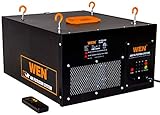
| WEN 3410-style compact ceiling cleaner | About 556–1,044 CFM, 3 speeds | Approximately 24 × 20 × 12 in | Remote, timer; about 50–60 dB depending on speed | Budget-conscious garage or basement shop |
| JET AFS-1000B | About 550–1,044 CFM, 3 speeds | Approximately 26 × 20 × 13 in | Remote, timer; roughly 50–65 dB by setting | Frequent use and heavier-duty construction |
| Shop Fox W1830-style 1,044-CFM cleaner | About 547–1,044 CFM, 3 speeds | Approximately 24 × 20 × 12 in | Remote, timer; moderate fan noise | Small shops needing strong high-speed circulation |
| Record Power AC400 | Approximately 409–702 CFM, 3 speeds | Approximately 22 × 19 × 12 in | Remote and timer; quieter low-speed operation | Compact rooms, hobby use, and lower noise |
| Portable box-filter cleaner | Approximately 300–700 CFM, depending on fan and filter | About 20–24 in square footprint | Usually simple switch; noise varies widely | Lowest cost or temporary workshops |
General market pricing is roughly $100–$180 for basic compact units, $180–$350 for established three-speed workshop cleaners, and more for premium low-noise or high-efficiency systems. Filter replacement costs and availability matter more than a small difference in purchase price.
Best choices by workshop situation
| Your situation | Recommended specification | Why |
|---|---|---|
| Single-car garage, occasional weekend work | 500–800 CFM; ceiling or wall mount; timer | Enough circulation without overspending or occupying floor space |
| Basement shop with limited headroom | Compact 400–700 CFM unit, under 13 inches high | Lower profile reduces interference with lighting, ductwork, and storage |
| Frequent sanding and routing | 800–1,100 CFM; two-stage filtration; easy filter access | Higher airflow clears residual dust faster and supports longer sessions |
| Shared space or noise-sensitive household | Three speeds with a low setting around 50–55 dB | Low speed is more tolerable while working; high speed can run afterward |
| Beginner on a tight budget | Basic 3-speed cleaner with standard-size filters | Simple replacement filters are easier to find and cheaper to maintain |
How much airflow do you actually need?
A useful sizing estimate is air changes per hour, or ACH. Calculate the room volume, multiply by the desired air changes, and divide by 60:
Required CFM = room length × width × height × target ACH ÷ 60.
For example, a 20 × 12 × 8-foot garage contains 1,920 cubic feet. At six air changes per hour, the theoretical requirement is 192 CFM. At ten air changes, it is 320 CFM. That sounds low because the calculation assumes perfect mixing and no losses. In a real workshop, a practical choice of 500–800 CFM gives useful circulation, while a 1,000-CFM unit cleans the space faster at the cost of more noise and power.
Do not interpret that calculation as permission to use a small air cleaner near a poorly collected table saw. Dust should be captured at the tool first. Air filtration deals with what escaped, not with chips and fine dust already being blasted into the room.
Mounting: ceiling, wall, or floor?
Ceiling suspension
Ceiling mounting preserves floor area and places the cleaner above workbenches. Use all supplied eye bolts, chains, or brackets, and attach them to structural framing rather than drywall or ceiling panels. Leave enough clearance around the intake and outlet for unrestricted airflow. A unit mounted too close to a wall or joist may circulate less air and become noisier.
Wall mounting
Wall mounting works well in basements and narrow garages. Position the intake away from the dirtiest direct plume, and avoid aiming the outlet straight at a person or across an uncollected sanding operation. Confirm the bracket’s load rating and use appropriate anchors for masonry, studs, or timber framing.
Floor placement
Floor placement is acceptable for temporary use, but it is the least convenient option. The cabinet can collect floor dust, restrict walkways, and recirculate dust stirred up by foot traffic. If it must sit on the floor, raise it on a stable shelf and keep its intake clear.
Noise, filters, and ownership costs
Published sound figures are often measured at a particular distance and speed, so compare them cautiously. A 50–55 dB low setting may be comfortable during hand-tool work, while a high setting in the 60–65 dB range can compete with conversation. If noise is a problem, run the cleaner on low during work and use the timer at high speed after leaving the room.
The outer filter usually loads first. Clean a washable prefilter outdoors or with a vacuum approved for fine dust; do not simply blow it out inside the workshop. Replace disposable filters when they remain visibly loaded after cleaning, airflow drops, or the unit becomes noticeably louder. A clogged filter increases resistance and can reduce the system’s effective airflow.
For a realistic annual budget, assume one prefilter or outer-filter replacement and one finer-filter replacement when usage is regular. That commonly adds about $25–$80 per year, depending on the model and how often you sand. Keep a spare fine filter on hand if the shop is used weekly; waiting for a replacement can turn a useful machine into an unplugged cabinet.
Common buying mistakes
- Choosing by maximum CFM alone while ignoring cabinet height and mounting space.
- Assuming an air cleaner replaces a dust collector at the tool.
- Installing it where shelving, lights, or a wall blocks the intake.
- Running only at high speed and then abandoning the machine because of noise.
- Buying a model with unusual filters that are difficult or expensive to source.
- Failing to account for the additional weight of a dust-loaded filter when selecting mounting hardware.
Bottom line
Choose a compact 500–800-CFM system for an occasional garage or basement workshop, and step up to an 800–1,100-CFM three-speed model if you sand, route, or turn wood frequently. Prioritize a cabinet that fits your mounting location, a low-speed setting you will tolerate, a timer for post-work cleanup, and filters that remain affordable and available. The best compact air filtration system is the one that can run unobtrusively, circulate the room without blocked intakes, and be maintained before its airflow has seriously declined.