What's inside
- Best compact portable workbenches compared
- 1. WORX Pegasus WX051: best all-round compact workbench
- 2. BLACK+DECKER Workmate WM425: best for awkward workpieces
- 3. Keter Folding Work Table: best for heavy loads on a budget
- 4. Bora Centipede CK6S: best large work surface that still folds
- Decision matrix for a small workshop
- How to judge whether a portable bench is stable enough
- Ownership costs and maintenance
- Best compact portable workbenches compared
- 1. WORX Pegasus WX051: best all-round compact workbench
- 2. BLACK+DECKER Workmate WM425: best for awkward workpieces
- 3. Keter Folding Work Table: best for heavy loads on a budget
- 4. Bora Centipede CK6S: best large work surface that still folds
- Decision matrix for a small workshop
- How to judge whether a portable bench is stable enough
- Ownership costs and maintenance
As an Amazon Associate I earn from qualifying purchases. This post may contain affiliate links at no extra cost to you.
The best compact portable workbench for most small workshops is the WORX Pegasus WX051 because it folds relatively flat, sets up quickly, includes useful clamping accessories, and provides a more practical everyday work surface than ultra-small folding stands.
That is not the right answer for every shop. The Bora Centipede is better when you need a large temporary bench, the BLACK+DECKER Workmate WM425 is more versatile for irregular workpieces, and the Keter Folding Work Table offers the strongest value when load capacity matters more than compact storage.
As an Amazon Associate we earn from qualifying purchases at no extra cost to you.


Contents
- Best compact portable workbenches compared
- 1. WORX Pegasus WX051: best all-round compact workbench
- 2. BLACK+DECKER Workmate WM425: best for awkward workpieces
- 3. Keter Folding Work Table: best for heavy loads on a budget
- 4. Bora Centipede CK6S: best large work surface that still folds
- Decision matrix for a small workshop
- How to judge whether a portable bench is stable enough
- Ownership costs and maintenance
Best compact portable workbenches compared
| Model | Approx. folded/storage size | Open work surface | Weight | Rated capacity | Typical setup |
|---|---|---|---|---|---|
| WORX Pegasus WX051 | About 32 × 12.5 × 6.5 in | 31 × 25 in | About 30 lb | 300 lb as a workbench; 1,000 lb as a sawhorse | Under 1 minute |
| BLACK+DECKER Workmate WM425 | About 30 × 8 × 29 in when folded | 29 × 24 in | About 28 lb | Up to 550 lb | About 1 minute |
| Keter Folding Work Table | About 33.5 × 21.7 × 4.5 in | 33.5 × 21.7 in | About 29 lb | Up to 1,000 lb | Under 1 minute |
| Bora Centipede CK6S | About 37 × 8 × 8 in | About 48 × 24 in with included top | About 30 lb | Up to 1,500 lb | About 1–2 minutes |
Dimensions and capacities can vary slightly by revision and accessory package. Load ratings are maximum manufacturer figures, not a recommendation to place a concentrated load on one corner. A portable bench is most stable when its legs are fully opened, locked, and standing on a reasonably level floor.
1. WORX Pegasus WX051: best all-round compact workbench
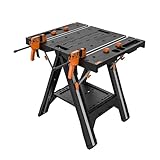
The Pegasus is the strongest choice for a small workshop that needs one bench for sanding, drilling, assembly, light routing, and occasional outdoor work. Its 31 × 25-inch top is large enough for cabinet doors, shelves, and small furniture components without becoming difficult to store.
Its main advantage is the combination of a flat worktop and integrated clamping. The bench includes removable clamping dogs and quick clamps that fit into holes in the top. The clamps are not a replacement for a heavy woodworking vise, but they hold boards securely for sawing, edge routing, and hand-planing lighter stock.
Setup is quick: unfold the legs, lock the frame, fit the top if it has been removed, and install the clamps. The plastic-and-metal construction keeps the weight near 30 pounds, though that also means it can shift during aggressive hand-planing unless you add a non-slip mat or clamp the legs to the floor.
Choose it if:
- You need a general-purpose bench for a one-car garage or apartment workshop.
- You transport the bench occasionally but want a useful work surface at home.
- You want built-in clamping without carrying a separate vise.
2. BLACK+DECKER Workmate WM425: best for awkward workpieces
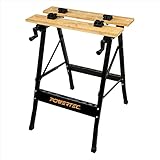
The Workmate WM425 remains useful because its split top acts more like a basic portable vise than a conventional flat table. The two sections can open and close to grip boards, pipes, trim, and irregular shapes. Its adjustable jaws and multiple clamping positions are particularly helpful when a workpiece cannot lie flat.
The trade-off is usable surface area. Although the top measures roughly 29 × 24 inches, the split and moving sections make it less convenient for laying out a large cabinet panel or assembling a box. The bench also has more moving parts than a simple folding table, so it takes a little longer to position for each job.
At about 28 pounds, it is manageable for one person. The 550-pound rating is ample for most homeowner projects, but stability depends heavily on how evenly the jaws grip the material. A long board extending far beyond one side can create leverage that is more significant than its actual weight.
Choose it if:
- You regularly work on pipes, tapered parts, trim, or irregular shapes.
- You value adjustable jaws more than a completely flat assembly surface.
- You want a compact bench for repairs and occasional woodworking.
3. Keter Folding Work Table: best for heavy loads on a budget
The Keter Folding Work Table provides a broad, flat plastic top and a high published load rating for its price category. It is a practical platform for a miter saw, planer infeed support, finishing work, or assembling larger pieces when paired with another support.
Its approximately 33.5 × 21.7-inch surface is generous for a folding bench, and the thin folded profile stores easily against a wall. The plastic top resists moisture better than an unfinished wood top, making it suitable for garages, utility rooms, and occasional outdoor use.
Clamping is its limitation. The top does not provide the same integrated dog-hole system as the Pegasus, so you may need portable clamps, a sacrificial plywood sheet, or a clamping accessory designed for the bench. The lightweight frame can also move when planing unless its feet are on rubber or the bench is secured.
Choose it if:
- You need the largest flat surface among inexpensive folding options.
- You use power tools more often than hand planes or chisels.
- You need moisture resistance and easy cleanup.
4. Bora Centipede CK6S: best large work surface that still folds
The Bora Centipede is different from the other picks: it is a folding support system with a worktop rather than a compact vise-style bench. The six-foot version creates roughly a 48 × 24-inch working platform while collapsing into a narrow bag-sized package.
Its many crossing supports distribute load well, and the large surface is useful for breaking down sheet goods, assembling furniture, and supporting long boards. The included top can be removed or replaced with plywood, which makes the system adaptable to unusual projects.
However, the large footprint is not automatically more stable. The legs need room to spread, and the flexible structure can feel less rigid than a fixed cabinet bench. It is also less convenient for small detail work because there is usually no built-in clamping system. Add a sacrificial top with dog holes or use track clamps if secure positioning is important.
Choose it if:
- You need a temporary large bench but have very little storage space.
- You break down plywood or assemble furniture periodically.
- You are willing to add your own clamping surface.
Decision matrix for a small workshop
| Your situation | Best choice | Why |
|---|---|---|
| Very limited storage, frequent carrying | WORX Pegasus | Compact folded size, quick setup, useful built-in clamps |
| Irregular parts, plumbing, repair work | BLACK+DECKER WM425 | Adjustable split jaws grip shapes a flat table cannot |
| Heavy power tools and low budget | Keter Folding Work Table | Broad flat top and high published capacity |
| Large panels or occasional furniture assembly | Bora Centipede CK6S | Largest temporary surface with compact storage |
| Mostly hand-tool woodworking | WORX Pegasus, with added non-slip mat | Clamping options are more valuable than maximum load rating |
How to judge whether a portable bench is stable enough
Load capacity alone is a poor stability measure. A bench rated for 1,000 pounds may still move under a hand plane if it is light and has narrow feet. Consider three separate factors:
- Footprint: wider legs resist tipping when a long board extends beyond the top.
- Frame stiffness: cross-bracing and locked hinges reduce rocking during sawing.
- Grip on the floor: rubber feet or a non-slip mat often make a larger practical difference than an extra few hundred pounds of rated capacity.
For hand-planing, place the bench against a wall, add a rubber mat, and keep the force directed toward the wall. For routing or sawing, secure the workpiece rather than relying on the bench’s weight. Portable workbenches are designed to be moved; they are not normally as rigid as a bolted cabinet base.
Ownership costs and maintenance
General market prices for these benches usually range from about $60 to $180, depending on the model, included clamps, and promotions. A useful way to compare value is cost per use. A $120 bench used twice a month for five years provides about 120 uses, or roughly $1 per use before accessories. A cheaper bench that lacks suitable clamps may cost more after adding a vise, dog-hole top, rubber mat, and replacement hardware.
The parts that commonly wear first are hinge rivets, plastic clamp pads, rubber feet, and locking tabs. Keep the folding joints free of packed sawdust; brush or vacuum them rather than flooding them with oil, which can attract more dust. Check that every leg lock fully engages before loading the top.
Do not exceed the rating with a concentrated load such as a benchtop planer placed on one corner. Spread heavy tools across the center, use a plywood sacrificial sheet when cutting, and store the bench folded upright so its top does not warp. With those precautions, the WORX Pegasus is the best compact portable workbench for most small workshops, while the other three picks make better sense for specialized space, load, or clamping needs.