What's inside
- Quick picks by household
- Head-to-head comparison
- Quietness: pump design matters more than the brand name
- Drinking surface: choose for the cat, not the photo
- Reservoir capacity and the refill calculation
- Filter cost is a recurring ownership decision
- Cleaning access and the parts most likely to cause trouble
- Which fountain should you buy?
- Bottom line
- Quick picks by household
- Head-to-head comparison
- Quietness: pump design matters more than the brand name
- Drinking surface: choose for the cat, not the photo
- Reservoir capacity and the refill calculation
- Filter cost is a recurring ownership decision
- Cleaning access and the parts most likely to cause trouble
- Which fountain should you buy?
- Bottom line
As an Amazon Associate I earn from qualifying purchases. This post may contain affiliate links at no extra cost to you.
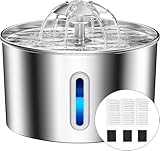
The best pet fountains for cats are the Catit Flower Fountain for affordable everyday use, the Pioneer Pet Raindrop for a simple stainless-steel drinking surface, the PetSafe Drinkwell Platinum for households needing a larger reservoir, and the PETLIBRO Dockstream RFID Smart Fountain when selective access and app features matter more than low ownership cost.
As an Amazon Associate we earn from qualifying purchases at no extra cost to you.


Contents
- Quick picks by household
- Head-to-head comparison
- Quietness: pump design matters more than the brand name
- Drinking surface: choose for the cat, not the photo
- Reservoir capacity and the refill calculation
- Filter cost is a recurring ownership decision
- Cleaning access and the parts most likely to cause trouble
- Which fountain should you buy?
- Bottom line
Quick picks by household
- Best value for one or two cats: Catit Flower Fountain, especially when you want adjustable water flow and inexpensive filters.
- Best drinking surface: Pioneer Pet Raindrop Stainless Steel, with a broad, shallow area that suits cats that dislike narrow streams.
- Best for multiple cats: PetSafe Drinkwell Platinum, whose larger reservoir reduces refill frequency.
- Best premium, selective-access option: PETLIBRO Dockstream RFID Smart Fountain, provided you are willing to pay for proprietary filters and keep the electronics dry.
- Best low-tech alternative: A stainless-steel or ceramic gravity fountain with a removable pump, if quiet operation and easy scrubbing matter more than app control.
Head-to-head comparison
Capacities below are advertised reservoir sizes; the usable level is lower once the pump, minimum fill line, and headroom are considered. Filter prices vary by pack size and retailer, so the ranges are more useful for ownership planning than a single advertised price.
| Fountain | Reservoir | Approx. size | Drinking design | Noise expectation | Filter cost | Best fit |
|---|---|---|---|---|---|---|
| Catit Flower Fountain | 3 L / 100 fl oz | 19.5 × 19.5 × 20 cm | Flower top with selectable streams and a shallow basin | Quiet when water covers the pump | About $1.50–$3 per filter | One or two cats; modest budgets |
| Pioneer Pet Raindrop Stainless Steel | 1.7 L / 60 fl oz | About 28 × 23 × 10 cm | Broad stainless-steel upper surface and lower pool | Very quiet with adequate water | About $2–$4 per filter | One cat; cats that prefer a wide surface |
| PetSafe Drinkwell Platinum | 5 L / 168 fl oz | About 38 × 28 × 26 cm | Elevated stream falling into a large basin | Quiet to moderate, depending on water level | About $2–$5 per filter | Multiple cats or fewer refills |
| PETLIBRO Dockstream RFID Smart Fountain | 2.5 L / 84.5 fl oz | About 19 × 19 × 16 cm | Contained outlet with access controlled by a pet tag | Quiet when correctly assembled | About $4–$8 per filter | Homes needing selective drinking access |
Quietness: pump design matters more than the brand name
A fountain is usually quietest when the pump is fully submerged, the water level is above the intake, and the unit sits on a stable rubber foot or mat. A low-water pump can make a surprisingly loud rattle even in a well-designed fountain. Flow-control settings also matter: a gentle stream is generally quieter than a high arch that splashes against a hard lid.
The Pioneer Pet Raindrop has an advantage for noise-sensitive homes because water spreads over a low, broad surface rather than dropping from a tall spout. The Catit Flower Fountain can also be quiet, but its pump needs frequent water-level checks. The Drinkwell Platinum provides more capacity, although its elevated stream can become audible if the reservoir is allowed to run low. Smart models such as the PETLIBRO Dockstream can be quiet, but their extra sensors and fittings create more parts to clean and reassemble correctly.
Drinking surface: choose for the cat, not the photo
Cats vary in whether they prefer moving water, a still pool, or a low-access surface. A fountain with several drinking options is safer than one that offers only a narrow jet.
- Wide and shallow: Best for a cat that avoids dipping its face into a deep bowl or appears bothered when its whiskers touch the sides. The Pioneer Pet Raindrop is the strongest choice in this group.
- Multiple flow settings: Useful when you do not yet know whether your cat prefers a stream or a gentle bubbling surface. The Catit Flower Fountain offers this flexibility.
- Large open basin: Better for two cats drinking at once, though a large basin also exposes more water to hair and litter dust. The Drinkwell Platinum has the most practical capacity here.
- Restricted access: RFID fountains can prevent one pet from drinking another pet’s water, but they are not automatically better for a normal multi-cat household. Each cat may need a compatible tag, and access electronics add cost and maintenance.
Reservoir capacity and the refill calculation
Capacity is only useful if it matches the number of cats and your refill schedule. A 3-liter fountain does not provide three full liters for drinking: the pump’s minimum water level and evaporation reduce the practical reserve.
As a planning example, suppose two cats collectively drink about 400 ml of water per day from all sources, and a fountain loses another 100 ml daily to evaporation and splashing. A 3-liter reservoir has roughly:
3,000 ml ÷ (400 ml + 100 ml) = 6 days of theoretical capacity.
In practice, you should refill sooner because the pump must remain submerged and water quality declines before the tank is empty. A 5-liter fountain gives more margin, but it is not a substitute for fresh water and cleaning. For three or more cats, a second drinking station is often preferable to relying on one oversized fountain; it reduces crowding and provides a backup if the pump stops.
Filter cost is a recurring ownership decision
Most fountain filters combine activated carbon with a foam prefilter. Carbon helps reduce odors and some dissolved contaminants, while foam catches hair and debris. Neither filter makes a neglected fountain hygienic.
At a typical replacement interval of every two to four weeks, a fountain using $3 filters costs approximately $39–$78 per year:
$3 × 13 to 26 filters per year = $39–$78.
Premium proprietary filters can double that figure. Washable foam sleeves and reusable mesh screens can reduce waste, but they still need regular rinsing and do not replace carbon media. Before buying, check whether filters are sold locally and whether the pump has a separate intake sponge. A fountain with a cheap body but scarce filters can cost more over two years than a slightly expensive model with widely available consumables.
Cleaning access and the parts most likely to cause trouble
The most important distinction is not whether a fountain is advertised as dishwasher-safe; it is whether you can reach the pump cavity, impeller, lid channels, and rubber seals without special tools.
- Every few days: Top up with fresh water and remove visible hair or food particles.
- Weekly: Empty the reservoir, wash accessible plastic, ceramic, or stainless-steel parts with mild dish soap, and rinse thoroughly. Clean the pump intake sponge if fitted.
- Every two to four weeks: Replace the filter according to its condition and the manufacturer’s schedule. Disassemble the pump and brush around the impeller and its cavity.
- Monthly or as needed: Descale mineral buildup with the manufacturer’s recommended method. Hard-water deposits can slow the impeller and increase noise.
Pump impellers, small rubber feet, filter housings, and silicone seals usually wear before the reservoir itself. A pump that becomes noisy after cleaning may have trapped hair around the impeller, a dry-running history, or a misaligned cover. Never run the pump below its minimum water line, and keep electrical connectors outside the wash basin.
Which fountain should you buy?
| Your situation | Most sensible choice | Why | Trade-off |
|---|---|---|---|
| One cat, limited counter space | Pioneer Pet Raindrop Stainless Steel | Low profile, broad surface, easy-to-wipe material | Smaller reservoir and more frequent refills |
| One or two cats, lowest ongoing cost | Catit Flower Fountain | Good capacity-to-price balance and adjustable flow | More plastic channels and pump cleaning |
| Several cats or frequent travel | PetSafe Drinkwell Platinum | Largest reservoir in this comparison | Occupies more floor space and still needs a backup water bowl |
| One pet must be kept from another pet’s water | PETLIBRO Dockstream RFID Smart Fountain | Selective access and monitoring features | Higher filter cost and greater electronic complexity |
Bottom line
For most cat owners, the Catit Flower Fountain is the balanced starting point because it combines useful capacity, adjustable drinking flow, and manageable filter expense. Choose the Pioneer Pet Raindrop when drinking-surface shape and easy stainless-steel cleaning are more important than capacity. Choose the PetSafe Drinkwell Platinum for a multi-cat home that needs fewer refills, but keep a second water station available. The PETLIBRO Dockstream RFID Smart Fountain is a specialist purchase: its selective access can solve a particular household problem, while its filters and electronics make it less attractive as a simple everyday fountain.
If a cat suddenly drinks much more or much less than usual, or refuses all available water sources, contact a veterinarian rather than treating a fountain as a health solution. A fountain can make water more appealing, but it cannot diagnose or correct an underlying problem.