
What's inside
As an Amazon Associate I earn from qualifying purchases. This post may contain affiliate links at no extra cost to you.
The best Milwaukee combo kits for home projects are usually the M18 FUEL five-tool kits for remodeling and frequent use, while M12 FUEL kits offer the better value for apartment repairs, furniture work, and lighter-duty maintenance.
As an Amazon Associate we earn from qualifying purchases at no extra cost to you.


Contents
Our Top Picks


Quick picks by situation
| Situation | Best fit | Why | Typical market range |
|---|---|---|---|
| Small repairs, shelves, furniture, limited storage | M12 FUEL 4- or 5-tool kit | Compact tools, lower weight, adequate power for common fasteners | $250–$450 |
| General home ownership and weekend projects | M18 brushless 5-tool kit | More torque and broader tool selection without paying for every premium feature | $400–$650 |
| Remodeling, decking, framing, repeated cutting | M18 FUEL 5- or 6-tool kit | Higher output, better sustained performance, and access to larger batteries | $600–$1,000 |
| One-handed overhead work or tight spaces | M12 FUEL kit | Lower tool and battery weight reduces fatigue | $250–$500 |
| Future expansion into outdoor or high-demand tools | M18 kit with an XC or HIGH OUTPUT battery | The M18 platform has more capacity for saws, grinders, blowers, and outdoor equipment | $500–$1,000 |
What you actually get in the main Milwaukee kit families
Milwaukee combo kits generally fall into two quality levels. Standard brushless kits provide a strong improvement over brushed entry-level tools and are often the sensible choice for occasional home use. FUEL kits add Milwaukee’s higher-performance brushless motor and electronic control systems, usually delivering more power, better overload management, and improved performance under sustained load.
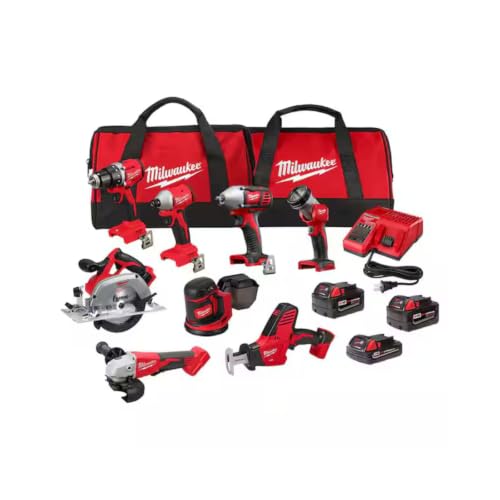
Tool count is not the same as usefulness. A five-tool kit containing a drill, impact driver, reciprocating saw, circular saw, and multi-tool covers much more home-improvement work than a seven-tool kit padded with a light, compact vacuum, or duplicate battery charger. Before comparing the number on the box, identify whether you need drilling, fastening, cutting, sanding, grinding, or outdoor maintenance.
M12: compact and capable
The M12 platform uses 12-volt batteries and is designed around compact tools. A typical M12 FUEL drill/driver weighs roughly 2 to 3 pounds with a compact battery and produces enough torque for cabinet hardware, pilot holes, furniture assembly, small framing repairs, and most household fastening. M12 impact drivers are similarly easy to control, particularly when working in confined spaces.
M12 is especially attractive when the kit includes specialized tools such as a compact multi-tool, installation driver, rotary tool, ratchet, or small impact wrench. These tools can be far easier to handle than their M18 equivalents. The trade-off is cutting speed and endurance: an M12 circular saw or reciprocating saw is useful, but it is not the best choice for repeated 2x lumber cuts, demolition, or thick material.
Common M12 battery capacities include approximately 2.0, 4.0, and 6.0 amp-hours. The compact 2.0Ah pack keeps the system light; the larger packs extend runtime but make the tool less nimble. For drill and driver work, a 2.0Ah battery is often sufficient. For cutting or sanding, a 4.0Ah or 6.0Ah pack is more practical.
M18: the general-purpose home workshop platform
M18 tools use 18-volt batteries and provide a larger performance reserve. An M18 FUEL drill/driver commonly reaches about 1,200 inch-pounds of peak torque, compared with roughly 400 inch-pounds for a compact M12 FUEL drill. Published figures vary by tool and generation, but the difference is meaningful when drilling large holes, driving long structural screws, or working in dense material.
M18 circular saws, reciprocating saws, angle grinders, and blowers are also better suited to long cuts and demanding workloads. For a homeowner who expects to build a deck, remodel a room, cut roofing materials, or maintain a larger property, M18 is usually the safer long-term purchase.
M18 batteries range from compact 2.0Ah packs to 5.0Ah XC packs and larger 6.0Ah, 8.0Ah, and 12.0Ah HIGH OUTPUT packs. Larger packs can increase runtime and output, but they also add noticeable weight. A 5.0Ah battery is a useful middle ground for a kit containing both drills and saws.
Brushless versus FUEL: is the upgrade worth paying for?
Brushless motors generally run cooler, require no carbon-brush replacement, and use battery power more efficiently than brushed motors. For occasional drilling, a standard brushless kit can be excellent value. The limitation is that not every brushless tool has the same electronics, speed control, or sustained-load performance as a FUEL model.
FUEL is most valuable on tools that work hard: circular saws, reciprocating saws, grinders, hammer drills, and impact wrenches. It is less important if the tool will drive a few screws each month. A homeowner buying one drill and one impact driver may save money with standard brushless tools and spend the difference on extra batteries or quality accessories.
Do not assume that “FUEL” means unlimited runtime. A high-output motor still needs the right battery. A compact battery may cause a saw to stop sooner than a 5.0Ah or HIGH OUTPUT pack, especially in hardwood or thick stock.
Head-to-head: M12 FUEL versus M18 FUEL
| Category | M12 FUEL | M18 FUEL |
|---|---|---|
| Nominal battery voltage | 12V | 18V |
| Typical compact drill weight with battery | About 2–3 lb | About 3–5 lb |
| Typical compact battery | 2.0Ah | 2.0Ah |
| Common larger battery | 4.0–6.0Ah | 5.0Ah XC or 6.0–12.0Ah HIGH OUTPUT |
| Best tasks | Hardware, cabinetry, furniture, light repair | Framing, decking, demolition, larger cutting jobs |
| Storage footprint | Smaller | Larger |
| Typical recharge time | About 30–60 minutes, charger dependent | About 30–90 minutes, charger and battery dependent |
| Runtime expectation | Best with moderate intermittent use | Better for sustained cutting and high-load work |
Voltage alone does not determine runtime. Watt-hours provide a more useful comparison: voltage multiplied by amp-hours. A 12V 4.0Ah battery stores approximately 48 watt-hours, while an 18V 5.0Ah battery stores approximately 90 watt-hours. Actual runtime depends on the tool, material, pressure, temperature, and battery condition, but this explains why an M18 5.0Ah pack generally lasts much longer in a demanding saw.
Cases, chargers, and the ownership details listings leave out
Many Milwaukee combo kits arrive in a soft contractor bag rather than a molded case. The bag is convenient for carrying several tools, but it offers limited protection and makes small bits and blades easy to lose. If organized storage matters, budget for a separate tool case, organizer, or wall-storage system. Check the contents carefully: some kits include one charger, two batteries, and a bag, while others include a rapid charger, fewer batteries, or no specialized storage.
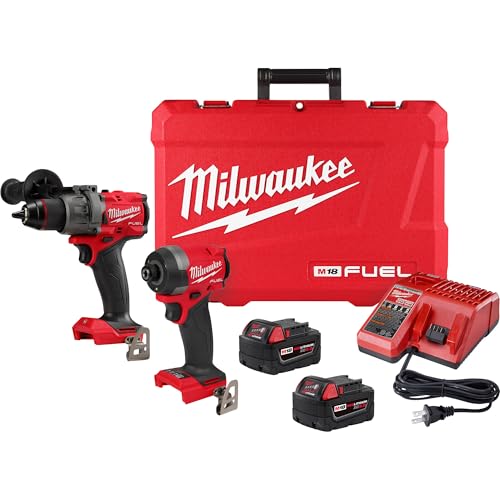
Battery quantity also affects value. A kit with two compact batteries may be cheaper but less useful when one battery is charging. For a kit containing a circular saw or reciprocating saw, two batteries are preferable, and at least one should be 4.0Ah or larger. For a drill-and-impact-driver kit, two 2.0Ah batteries can be entirely adequate.
The first consumables to wear are usually driver bits, drill bits, saw blades, sanding pads, reciprocating-saw blades, and grinder discs—not the motor. A cheap kit with poor accessories can become expensive once replacement blades and bits are added. Include the cost of a suitable blade set when comparing prices.
How to choose without overbuying
- Choose M12 if most projects involve furniture, shelves, cabinets, picture hanging, light plumbing repairs, or tight workspaces.
- Choose M18 standard brushless if you want a capable home-maintenance set and expect intermittent use.
- Choose M18 FUEL if you regularly cut lumber, drill masonry, remove fasteners, grind metal, or plan to expand into demanding outdoor tools.
- Prioritize the right battery over an extra low-use tool. A 5.0Ah M18 pack may add more practical value than a compact light or duplicate driver.
- Compare included tools by workload, not by count. A useful four-tool kit beats a seven-tool kit containing equipment you will never use.
Bottom line
The best Milwaukee combo kits are the ones that match the work rather than the largest tool count. M12 FUEL is the strongest choice for compactness, control, and light-to-medium household projects. M18 standard brushless offers the best balance for many homeowners. M18 FUEL costs more, but its higher output and larger battery options become worthwhile for remodeling, construction-style projects, and frequent use. Before buying, compare the included battery capacities, charger, storage bag or case, and the replacement cost of the blades and bits you will actually consume.