What's inside
As an Amazon Associate I earn from qualifying purchases. This post may contain affiliate links at no extra cost to you.
A power outage can last hours or stretch into days, and the difference between coping and crisis often comes down to whether you have a reliable source of electricity waiting in the garage. The right emergency generators for home use keep your refrigerator cold, your furnace running, and your lights on during storms, heat waves, or grid failures. Choosing the wrong one means a unit that will not start, cannot handle your essential loads, or drowns out the neighborhood with noise.
After comparing published specifications, current pricing, and recurring themes from owner feedback across this category, a few clear patterns emerge. The best generators balance output capacity against fuel flexibility, offer electric or remote start so you are not cranking in the dark, and are built to connect to a transfer switch for whole-home coverage. Budget options can serve RVs or a handful of circuits, but they will not run a central air conditioner and a well pump simultaneously. The units below span every scenario from light backup to serious whole-home demand.
As an Amazon Associate we earn from qualifying purchases at no extra cost to you. Product prices and availability are accurate as of the date shown and are subject to change.



Quick Picks
| Product | Best for | Price |
|---|---|---|
| DuroStar DS13000MX | Whole-home backup on a budget | $899 |
| Westinghouse 12500 Watt Dual Fuel | High output with dual fuel flexibility | $999 |
| Oxseryn 4400-Watt Inverter | RV camping and light emergency backup | $289.99 |
| Oxseryn Power Equipment 4400 Watt | Quieter small-load backup | $309.99 |
| Generac 12,500 Starting Watt Tri-Fuel | Fuel flexibility from a trusted brand name | $1069 |
| DuroMax XP13000EH | Premium whole-home dual fuel | $1499 |
| Westinghouse 14500 Peak Watt Tri-Fuel | Maximum output and natural gas option | $1499 |
| Westinghouse 6500 Watt Dual Fuel | Mid-size homes with CO safety priority | $579 |
How We Picked
We evaluated emergency generators for home use based on four criteria drawn from manufacturer specifications and patterns in owner reviews. First, usable output: rated and surge wattage must cover your critical circuits, not just the headline number. Second, fuel flexibility: dual-fuel or tri-fuel capability extends run time and lets you store propane long-term without degradation. Third, start reliability: remote electric start matters more than owners expect when a storm hits at 2 a.m. Fourth, transfer switch compatibility and safety features such as CO sensors, which determine whether the unit can power your panel rather than just your RV.
The 8 Best Emergency Generators For Home Use in 2026
DuroStar DS13000MX 13,000-Watt 500cc Dual Fuel Portable Generator
This is the value king of whole-home backup. A 13,000-watt output from a 500cc engine means it can carry multiple heavy circuits at once, and the dual-fuel system lets you run on gas during short outages or propane for extended events. Remote electric start removes the physical struggle, and transfer switch readiness means it integrates into your home panel cleanly. Owners praise the build quality for the price point. The main trade-off is noise; at this wattage and open-frame design, it is loud. Skip it if you live close to neighbors or need something quieter for weekend camping.
- Pro: 13,000 watts covers heavy loads like central AC and electric water heaters
- Pro: Remote electric start plus dual-fuel flexibility at a competitive price
- Con: Open-frame design produces significant noise during operation
Westinghouse 12500 Watt Dual Fuel Home Backup Portable Generator
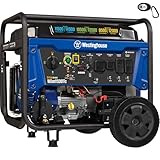
Westinghouse delivers a well-rounded 12,500-watt package with remote electric start and dual-fuel capability, making it a strong alternative to the DuroStar above. Transfer switch ready means you can back up your entire panel rather than relying on extension cords. Owners report reliable cold-weather starts and consistent output. At $999, it sits just above the DuroStar in price while offering slightly less wattage, so the value gap is narrow. The 200-watt difference is negligible in real-world use. Skip it if budget is your absolute priority and the DuroStar’s louder operation would not bother you.
- Pro: Proven brand reputation with strong cold-start performance
- Pro: Remote electric start and transfer switch readiness out of the box
- Con: Slightly less output than similarly priced competitors
Oxseryn 4400-Watt Inverter Generator
For owners who need basic emergency backup without breaking the bank, this inverter delivers 4,400 watts with a 30-amp RV outlet and EPA compliance in a compact open-frame package. The inverter design means cleaner power for electronics, and at under $300 it is among the cheapest options on this list. Owners appreciate the lightweight portability and straightforward gas operation. The limitation is obvious: 4,400 watts will not run a central air conditioner alongside other appliances. Skip it if your home needs exceed a few essential circuits or you want propane flexibility.
- Pro: Inverter clean power safe for sensitive electronics
- Pro: Unbeatable price for a 30-amp inverter with EPA compliance
- Con: Gas-only, no fuel flexibility or propane option
Oxseryn Power Equipment 4400 Watts Inverter Generator
The sibling model adds a low-noise ECO mode to the same 4,400-watt inverter platform, making it better suited for neighborhoods where generator noise is a concern or for quiet campsite mornings. The price bump over the base model is modest for the added feature. Owners note the ECO throttle noticeably reduces sound at lighter loads. The trade-off is that 4,400 watts still caps your usable circuits, and like the base model it is gas-only. Skip it if you need dual-fuel or higher output for whole-home coverage.
- Pro: ECO mode delivers meaningfully quieter operation at partial load
- Pro: Same clean inverter output and 30-amp RV capability
- Con: Limited wattage ceiling prevents heavy-appliance use
Generac 12,500 Starting Watt Tri-Fuel Portable Generator
Generac brings its standby-generator reputation to the portable space with tri-fuel operation: gas, propane, and natural gas all work from a single unit. Electric start is standard, and the 12,500 starting-watt figure handles large motor loads during startup. For owners in areas with access to a natural gas line, this eliminates fuel storage concerns entirely. The price is higher than comparable Westinghouse and DuroStar models, partly for the brand name and tri-fuel complexity. Skip it if you do not have natural gas access and the extra cost over dual-fuel options feels unjustified.
- Pro: Tri-fuel capability including natural gas removes fuel-storage anxiety
- Pro: Generac brand carries strong service-network availability
- Con: Premium pricing over competitors with similar output
DuroMax XP13000EH 13,000-Watt Dual Fuel Portable Generator
The DuroMax matches the DuroStar DS13000MX in output—13,000 watts, dual fuel, electric start, transfer switch ready—while stepping up build quality and adding a remote start option. Owners frequently choose it as the premium version of the DuroStar platform, citing more robust components and better long-term reliability. The $600 price premium over the DuroStar is substantial and only justified if you value those upgrades. Skip it if the DS13000MX at $899 already meets your needs and the extra money could go toward a transfer switch or fuel storage instead.
- Pro: Stronger build and component quality than budget dual-fuel rivals
- Pro: Full whole-home capability with proven DuroMax drivetrain
- Con: Significant price premium over similarly spec’d options
Westinghouse 14500 Peak Watt Tri-Fuel Home Backup Portable Generator
This is the output champion on the list at 14,500 peak watts, and the tri-fuel system adds natural gas alongside propane and gasoline. Remote electric start and transfer switch readiness make it a serious whole-home solution for large properties with multiple heavy loads. At $1,499 it matches the DuroMax in price while offering more watts and an additional fuel type. The weight and size demand careful placement. Skip it if your home’s critical load stays under 12,000 watts and you are paying for capacity you will never use.
- Pro: Highest peak output on this list handles the most demanding loads
- Pro: Tri-fuel including natural gas for maximum flexibility
- Con: Heavy and bulky, requiring a permanent outdoor placement plan
Westinghouse 6500 Watt Dual Fuel Home Backup Portable Generator
Westinghouse positions this as the safety-conscious mid-size option: 6,500 watts of dual-fuel output with a built-in CO sensor that automatically shuts down the unit if carbon monoxide reaches dangerous levels. The 30-amp outlet works for both RV and transfer switch connections, making it versatile for mid-size homes. At $579 it occupies a sweet spot between the budget inverters and the high-wattage whole-home units. Owners praise the peace of mind the CO sensor provides for garage-adjacent placement. Skip it if your essential loads exceed 6,500 watts or you need the unit to run a central AC and well pump together.
- Pro: Integrated CO shutoff sensor adds a critical safety layer
- Pro: Dual fuel and 30-amp transfer switch compatibility at a fair price
- Con: Mid-range wattage limits simultaneous heavy-appliance use
Buying Guide
Matching Wattage to Your Critical Loads
Start by listing every appliance you need during an outage and note both running and starting watts. Motors in compressors and pumps draw two to three times their running wattage at startup. A 4,400-watt inverter handles a refrigerator, a few lights, and a router comfortably. A 12,000-watt-plus unit can carry a central air conditioner, electric water heater, and refrigerator at once. Always add a 15-20 percent safety margin to your calculated total to avoid stalling the engine under combined startup loads.
Fuel Type and Storage Practicality
Gasoline degrades within weeks unless treated, which makes it unreliable for long outages unless you rotate stock. Propane stores indefinitely in sealed tanks and burns cleaner, extending engine life. Natural gas connects to a utility line and requires no storage at all. If you buy a dual-fuel unit, you get a propane option as a fallback during gas shortages. Tri-fuel models that add natural gas eliminate fuel logistics entirely but demand a gas line or large propane tank on your property.
Transfer Switch Readiness and CO Safety
A transfer switch isolates your home panel from the grid so back-feed cannot electrocute utility workers. Any generator used for whole-home power must be rated for this connection. Some units ship with or require a compatible transfer switch sold separately—factor that into your total cost. CO sensors that automatically shut down the generator when dangerous gas levels accumulate are increasingly common and are the single most important safety feature for anyone placing a unit near an attached garage or window.
Our Verdict
The DuroStar DS13000MX is the top pick for whole-home backup. It delivers 13,000 watts, dual fuel, remote electric start, and transfer switch readiness at a price no other unit in this class matches. The Oxseryn 4400-Watt Inverter is the clear budget pick for anyone who needs clean, portable power for a few essential circuits or RV use under $300. The Westinghouse 6500 Watt becomes the right choice if CO safety is non-negotiable and your load profile sits in the mid-range.
FAQ
How many watts does a whole-home generator need?
Most single-family homes need between 10,000 and 14,000 peak watts to run essential appliances simultaneously, including HVAC. Homes with electric heat, well pumps, or large refrigerators should aim toward the higher end of that range.
Can I run a generator in my garage?
No. Generators must operate outdoors with proper ventilation regardless of open-frame or inverter design. A CO sensor adds a safety layer but does not make indoor use acceptable. Always place the unit at least several feet from doors, windows, and vents.
What is the difference between rated and surge watts?
Rated watts represent continuous output the generator sustains indefinitely. Surge (or peak) watts indicate a brief boost available during motor startup, typically lasting a few seconds. Your generator must provide enough surge capacity to handle the largest single motor load in your critical list.
Do I need a transfer switch or can I plug into my panel directly?
A transfer switch is mandatory for safe home-panel backup. Plugging a generator into a wall outlet creates dangerous back-feed that can kill utility workers and violates the electrical code. A manual or automatic transfer switch physically isolates your home wiring from the grid during generator operation.