
Key takeaways
- Compare tire pressure gauges, checking type, range, display and chuck for cars, bikes, garages, trucks, RVs, motorcycles and accurate pressure checks.
What's inside
As an Amazon Associate I earn from qualifying purchases. This post may contain affiliate links at no extra cost to you.
Disclosure: As an Amazon Associate, I earn from qualifying purchases. Product details were verified at the time of writing.
A tire pressure gauge is one of the smallest tools in a garage, yet it guards fuel economy, tire life, braking grip, and ride comfort all at once. The gauge built into a gas station air hose is often off by several PSI, and the dashboard warning light only speaks up after pressure has already dropped far below the door-jamb figure. A dedicated gauge of your own, kept in the glove box or on the workbench, turns a monthly two-minute check into a habit. This guide compares five gauges across the three main types — digital, dial, and pencil — so you can match one to the vehicles you actually maintain, from a family sedan to a truck, RV, motorcycle, or bicycle.
Contents
How to Choose a Tire Pressure Gauge
Type. Digital gauges show an exact number on a screen, which removes any guesswork about where a needle sits. Dial gauges use a round analog face; better models hold the reading after you pull the chuck off the valve, and they never need batteries. Pencil gauges are the slim stick type: a calibrated bar slides out of a brass tube. They are the least refined to read but nearly indestructible and small enough for a shirt pocket.
Range. Most passenger cars run 30–35 PSI cold, so a 0–60 or 0–100 PSI gauge covers them with room to spare. A narrower range is easier to read precisely, because the markings sit farther apart. Truck, trailer, and RV tires can run 65–80 PSI or more, so check the top end of the scale before buying if you tow or haul.
Display and readability. On digital models, look for a backlit screen and a lighted nozzle for night checks. On dial models, a 2-inch face with glow markings beats a small dial in a dim garage. Resolution matters too: digital gauges reading in 0.1 PSI steps make small adjustments easier to track than a dial marked in 2 PSI steps.
Chuck style. A straight chuck works for most car valves. A 360-degree swivel chuck or a flexible hose helps on motorcycle wheels, dual rear truck wheels, and valves tucked behind hubcaps. Cyclists need a Presta adapter for road bike valves, which some gauges include in the box.
Accuracy standard. Gauges certified to ANSI or ASME grades have been tested against a reference standard. For home use, anything within about 1 PSI of true pressure is plenty; consistency matters more than lab-grade precision, because you are tracking changes over time.
The 5 Best Tire Pressure Gauges
1. AstroAI Digital Tire Pressure Gauge, 150 PSI
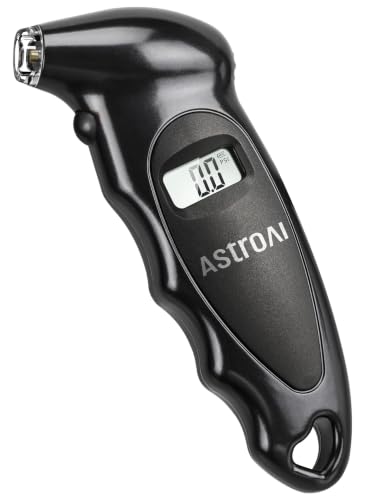
The AstroAI digital gauge is the straightforward pick for most drivers. It reads from 0 to 150 PSI in fine 0.1 PSI increments, so it handles everything from a bicycle tire to a loaded truck tire, and the backlit LCD removes all squinting at needle positions. The lighted nozzle helps you find the valve stem in the dark, the grip is shaped to stay put in a gloved hand, and a Presta adapter is included for bike tires. Four measurement units cover vehicles with door-jamb specs in BAR or kPa as well as PSI.
Specs:
– Type: Digital stick gauge
– Range: 0–150 PSI
– Resolution: 0.1 PSI increments
– Units: PSI, BAR, kPa, kg/cm²
– Display: Backlit LCD with lighted nozzle
– Extras: Presta valve adapter included, non-slip grip
2. JACO ElitePro Digital Tire Pressure Gauge, 100 PSI

JACO’s ElitePro Digital is built for owners who check pressures often and want shop-style consistency. Dual pressure sensors are certified to ASME Grade 2A accuracy, and the large 2.5-inch backlit screen shows readings to a tenth of a PSI across a 5–100 PSI working range that suits cars, SUVs, and light trucks. The alloy steel and brass construction feels a class above basic plastic digitals, and the longer body keeps your hand clear of brake dust and wheel grime while you work around a set of tires.
Specs:
– Type: Digital gauge
– Range: 5–100 PSI
– Accuracy: ±0.5% full scale, ASME Grade 2A certified
– Resolution: 0.10 PSI
– Display: 2.5 in backlit LCD
– Build: Alloy steel and brass, dual pressure sensors
3. JACO ElitePro Tire Pressure Gauge, 100 PSI
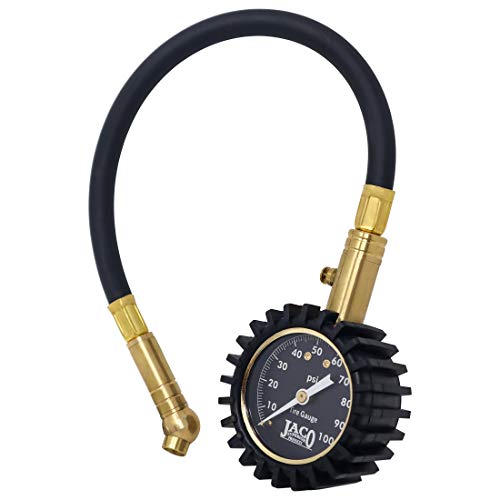
The analog ElitePro takes the same job and removes batteries from the equation entirely. Its 2-inch dial glows in the dark, the scale runs to 100 PSI, and the gauge is calibrated to ANSI B40.1 standards. A solid brass 360-degree swivel chuck seats cleanly on awkward valve angles, and a built-in bleeder valve lets you drop an overfilled tire down to spec in small steps instead of guessing with the valve core. It is the gauge to leave in a toolbox or hang by the compressor, ready at any moment.
Specs:
– Type: Analog dial gauge
– Range: 0–100 PSI
– Accuracy: ANSI B40.1 certified, ±1.5%
– Dial: 2 in glow-in-the-dark face
– Chuck: 360-degree swivel, solid brass
– Extras: Air bleeder valve, no batteries required
4. Rhino USA Heavy Duty Tire Pressure Gauge, 75 PSI

Rhino USA pairs a 2-inch glow dial with a premium braided hose, and that hose is what sets it apart for garage use. The flexible line and 360-degree swivel chuck reach valves on motorcycles, trailers, and dual-wheel setups without contorting your wrist, while the gauge holds its reading so you can pull it out into the light and check the number. Solid brass hardware and ANSI B40.1 certification round out a tool built to be dropped, tossed in a drawer, and still read true. The 0–75 PSI range is well matched to cars, trucks, and RVs.
Specs:
– Type: Analog dial gauge with hose
– Range: 0–75 PSI
– Accuracy: ANSI B40.1 certified
– Dial: 2 in glow dial, 1 PSI increments
– Hose: Premium braided hose
– Chuck: 360-degree swivel, solid brass, air release valve
5. Milton S-921 Pencil Tire Pressure Gauge

The Milton S-921 is the classic pencil gauge, made in the pattern that has lived in glove boxes for decades. The plated brass barrel resists corrosion, the nylon indicator bar reads in 1 PSI increments from 5 to 50 PSI with kPa markings alongside, and a built-in deflator valve lets you trim an overfilled tire without a separate tool. There is nothing to charge, nothing to crack, and a pocket clip keeps it where you left it. For a second vehicle, a teen driver’s first car, or a backup in the road kit, this simple format still earns its place.
Specs:
– Type: Pencil (stick) gauge
– Range: 5–50 PSI, also marked in kPa
– Resolution: 1 PSI increments
– Body: Plated brass barrel, nylon indicator bar
– Chuck: Single head
– Extras: Built-in deflator valve, pocket clip
Comparison Table
| Product | Type | Range | Display | Chuck |
|---|---|---|---|---|
| AstroAI Digital 150 PSI | Digital | 0–150 PSI | Backlit LCD, 0.1 PSI steps | Straight with lighted nozzle |
| JACO ElitePro Digital 100 PSI | Digital | 5–100 PSI | 2.5 in backlit LCD | Straight, extended body |
| JACO ElitePro 100 PSI | Analog dial | 0–100 PSI | 2 in glow dial | 360-degree swivel, brass |
| Rhino USA Heavy Duty 75 PSI | Analog dial with hose | 0–75 PSI | 2 in glow dial | 360-degree swivel on braided hose |
| Milton S-921 | Pencil | 5–50 PSI | Sliding indicator bar | Single head |
FAQ
How often should I check tire pressure?
Once a month and before any long trip. Always measure cold, before driving, because heat from the road raises the reading by several PSI and hides a slow leak.
Is a digital or dial gauge more accurate?
Both types can be very accurate. Certified digital models resolve to 0.1 PSI and are easiest to read, while a quality dial gauge holds its reading and never runs out of battery. Either beats the worn gauge on a public air hose.
What range do I need for a truck or RV?
Check the sidewall and door or manual figures first. Many truck and trailer tires run 65–80 PSI, so pick a gauge whose scale tops out comfortably above your highest tire, such as the 100 or 150 PSI models in this guide.
Can one gauge serve cars and bicycles?
Yes, if it covers the pressure your bike tires need and includes a Presta adapter, as the AstroAI digital does. High-pressure road bike tires may need a gauge that reads well past 100 PSI.
Why do two gauges give different numbers?
Small differences of about 1 PSI are normal between gauges. Bigger gaps usually mean one gauge has been dropped or its chuck seal is worn. Cross-check against a third gauge and retire the outlier.
Verdict
For most households, the AstroAI Digital 150 PSI is the easiest gauge to live with: wide range, fine resolution, and a screen anyone can read at a glance. If you prefer a certified, shop-style instrument, the JACO ElitePro Digital brings Grade 2A accuracy, while its analog ElitePro sibling covers the same ground with no batteries at all. The Rhino USA Heavy Duty is the pick when valves are hard to reach, thanks to its braided hose and swivel chuck. Keep the Milton S-921 as the inexpensive spare in a second car. Whichever you choose, use it monthly — a gauge only helps if it leaves the drawer.
Related guides
More from Amazon
Programs that pair well with the guide above. Offers and eligibility are set by Amazon and may change.
A free business account with business pricing and bulk-buying tools for work, shop or home office.
Create a business accountFree shipping on eligible items, Prime Video and more. Eligible new members can start with a free trial.
Start a Prime free trialAudiobooks and podcasts to listen to on the go. Eligible new members can start with a free trial.
Try Audible freeAd-free music streaming. Eligible new subscribers can start with a free trial.
Try Music Unlimited freeAs an Amazon Associate we earn from qualifying purchases.








