Key takeaways
- Compare roof coatings by base type, coverage build and cure needs, with the clean-the-roof-first rule and watch-the-weather habit for tight seals.
What's inside
- How to Choose a Roof Coating
- 1. Henry 887 Tropi-Cool 100% Silicone White Roof Coating, 0.90 Gallon
- 2. GacoRoof 100% Silicone Roof Coating, Medium Blue, 5 Gallon
- 3. Rust-Oleum 710 Elastomeric Roof Coating (301994), White, 4.75 Gallon
- 4. Liquid Rubber Waterproof Sealant, Black, 1 Gallon
- 5. Dicor RP-MRC-1 Acrylic Elastomeric Coating for Metal Roofs, White, 1 Gallon
- Verdict
As an Amazon Associate I earn from qualifying purchases. This post may contain affiliate links at no extra cost to you.
A roof coating is a liquid membrane in a bucket: you roll or spray it over a sound but aging flat, low-slope or metal roof, and it cures into a seamless skin that sheds water, seals hairline cracks and fastener heads, and reflects sun off the surface. It is a maintenance coat for a roof that is still structurally sound — it will not rescue rotted decking, collapsed insulation or a roof whose seams have already let go. Two boundaries before the picks. This guide covers bucket coatings for flat roofs and metal panels; it is not about coatings or rejuvenators for asphalt shingles, which shingle makers advise against field-coating, and it is not about sealant tubes, caulk or patch cements, which are spot-repair products with a different job. The working rules come before every comparison: clean the roof first and let it dry fully before any coating goes down, seal the seams, laps and fasteners before the field coat, watch the weather and keep rain out of the maker’s cure window, and match the coating base to your roof material and to how your roof actually drains.
Disclosure: As an Amazon Associate, I earn from qualifying purchases. Product details were verified at the time of writing.
Contents
- How to Choose a Roof Coating
- 1. Henry 887 Tropi-Cool 100% Silicone White Roof Coating, 0.90 Gallon
- 2. GacoRoof 100% Silicone Roof Coating, Medium Blue, 5 Gallon
- 3. Rust-Oleum 710 Elastomeric Roof Coating (301994), White, 4.75 Gallon
- 4. Liquid Rubber Waterproof Sealant, Black, 1 Gallon
- 5. Dicor RP-MRC-1 Acrylic Elastomeric Coating for Metal Roofs, White, 1 Gallon
- Verdict
How to Choose a Roof Coating
Pick the base before the brand. Three families cover most of the shelf in this guide, plus one legacy family worth knowing. Silicone coatings are the ponding-water specialists: once cured they sit under standing water without softening, they go down in one heavy coat, and they turn rain-safe fast — but nothing sticks to cured silicone except more silicone, so a silicone roof is a one-way door. Acrylic elastomeric coatings are water-based, easy to roll, and the reflective white workhorses for roofs that drain; their weakness is standing water, which softens them, so they belong on roofs that clear fully after rain. Liquid rubber coatings build a flexible waterproof membrane in several coats and grip many surfaces, which suits patchwork roofs and smaller jobs. The legacy family is fibered aluminum: a solvent-based asphalt coating loaded with aluminum flake that dries silver, long used over asphalt and metal — it needs a roof that drains, a long dry window, and solvent cleanup, and it is not for single-ply membranes.
Be honest about ponding water. Walk the roof a day after rain before you buy anything. If puddles are still standing where you plan to coat, the choice narrows hard: silicone, or fix the drainage first. Acrylic and aluminum coatings on a ponding roof blister and peel from underneath, and the failure shows up as a leak that looks new. A roof that drains within a day or so gives you the full shelf to choose from.
Match the coating to what is already up there. Coatings fail by chemistry as often as by weather. Nothing adheres to an old silicone coat except silicone. Acrylic over an unknown old coating is a gamble until a test patch cures and pulls hard. Bare metal needs its rust dealt with first — wire-brush loose rust, treat what remains, and let the surface dry before coating. EPDM and TPO membranes have their own compatibility rules, and at least one pick below is metal-only and names those membranes as off-limits; the maker’s substrate list, not the bucket’s front label, is the deciding document.
Do the coverage math from the maker’s rate. Every pick below states its maker’s application figure, and the spread is wide — a silicone going down at roughly a gallon and a half per 100 square feet drinks more than twice what a thin acrylic coat uses. Plan the full build, not the first coat: most acrylics want two coats at the stated rate, silicone wants its full rate in one pass, and rough or porous roofs drink more than smooth ones. Measure the roof, divide by the maker’s figure, then add a margin for seams, laps and the material that stays in the roller.
Watch the weather window. A coating is only as good as the days around it. The roof must be clean and fully dry at application — dew counts as wet — and rain inside the cure window washes or blisters water-based coats before they set. Silicones turn rain-safe quickly once down, which forgives a tight forecast, but they still need a dry surface to bond. Keep off the fresh film until it has cured through, because a wet coat under a boot prints the boot.
The safety rules, stated plainly. Roof work is ladder work and edge work: set the ladder on firm ground with the rails past the eave, wear fall protection where the roof and your local rules call for it, and work in the cool part of the day, because a dark roof in summer sun is a hot, tiring surface. A wet or freshly coated roof is slick — plan the route off before the last pass, not after. Solvent-based coatings need ventilation and no open flame anywhere near the work, and every coating in this guide wants gloves and eye protection while it is being mixed and rolled.
1. Henry 887 Tropi-Cool 100% Silicone White Roof Coating, 0.90 Gallon

The Tropi-Cool is the flat-roof default in this guide: a high-solids, 100% silicone coating that cures by moisture into a seamless white membrane, made to sit under permanent ponding water without softening — the one failure mode that kills acrylics on dead-flat roofs. It goes down in a single heavy coat at the maker’s rate of about a gallon and a half per 100 square feet, by roller, brush or spray gear, and the maker puts it rain-safe in about an hour, which forgives the tight weather windows flat roofs so often get coated in. The application range is wide, from just above freezing to full summer heat, and the white finish is built to hold its brightness against dirt pickup. The honest limits are silicone’s own: the small bucket suits patches, small roofs and single sections rather than a whole warehouse, and once this coat is on the roof, every future recoat must be silicone too — nothing else will bond to it. Seams and repairs get the maker’s matching silicone sealant and seam products before the field coat, not this coating dabbed thick and hoped over.
Specs
- Format: 100% silicone roof coating, moisture-cure
- Model: HE887HS042
- Size: 0.90 gal
- Color: White
- Maker application figure: about 1.5 gal per 100 sq ft, one coat
- Rain readiness: rain-safe in about 1 hour (maker figure)
- Ponding behavior: made to resist permanent ponding water
- Application window: 35°F to 120°F (maker figures)
- Substrates: Aged asphalt, built-up and modified bitumen, metal, concrete and other sound roofs on the maker’s list
- Maker warranty: Lifetime limited
2. GacoRoof 100% Silicone Roof Coating, Medium Blue, 5 Gallon
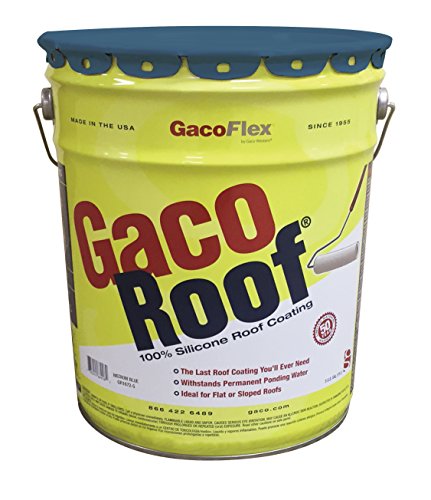
GacoRoof is the other silicone in this guide, and it earns its place on volume and on the maker’s ponding promise: the cured film will not soften, bubble or degrade under permanent ponding water, and the maker backs the material with a 50-year limited warranty. The listing figure is about 50 square feet per gallon across two coats, so the five-gallon pail is the whole-roof size the Henry bucket above is not — the format for a full flat or low-slope roof done in one project. The honest flag is the color: this listing is the Medium Blue version, not white. Blue silicone still seals and sheds water exactly like its white sibling, but it gives back less of the sun-bouncing benefit a white coat delivers, so pick it when the roof is not seen from the street and sealing matters more than reflecting heat — a warehouse, a barn, an outbuilding — and pick a white coat when the roof shows or the cooling effect is the point. Like every silicone, it commits the roof to silicone recoats from here on.
Specs
- Format: 100% silicone roof coating, single component
- Size: 5 gal
- Color: Medium Blue
- Coverage figure: about 50 sq ft per gallon across two coats (listing figure)
- Ponding behavior: will not soften, bubble or degrade under permanent ponding water (maker)
- Maker warranty: 50-year limited material warranty
- Application: Brush, roller or spray, on properly prepared substrates
3. Rust-Oleum 710 Elastomeric Roof Coating (301994), White, 4.75 Gallon

The 710 is the acrylic elastomeric workhorse: a bright white, water-based coat that reflects sun, flexes with the roof through cold snaps without cracking, and sheds dirt better than most of its family. The listing’s build is two coats at a gallon and a half per 100 square feet per coat, and the maker puts a waterproof seal at about six hours — plan a full rain-free day anyway, because the second coat and full cure want the longer window. The 710 line carries the maker’s 10-year warranty, and the substrate list is broad: metal, concrete, weathered single-ply, and smooth built-up and modified bitumen systems. The boundary is the family boundary, stated plainly: this is a coating for roofs that drain. Standing water softens acrylic film, so a dead-flat roof with day-old puddles belongs to the silicones above, not to this bucket. On a metal or membrane roof with honest slope, it is the straightforward two-coat refresh in this guide.
Specs
- Format: Acrylic elastomeric roof coating
- Model: 301994 (710 White)
- Size: 4.75 gal
- Color: White
- Coverage figure: 1.5 gal per 100 sq ft per coat, two coats (listing figures)
- Cure figure: waterproof seal in about 6 hours (maker figure); allow a full rain-free window for the two-coat build
- Maker warranty: 10-year (710 line)
- Substrates: Metal, concrete, weathered single-ply, smooth built-up and modified bitumen
- Ponding behavior: for roofs that drain; not a standing-water coating
4. Liquid Rubber Waterproof Sealant, Black, 1 Gallon

Liquid Rubber is the membrane builder of the guide: a water-based liquid rubber that brushes or rolls on and cures into a flexible, waterproof skin, applied in successive coats until the film reaches the thickness the job needs. The maker’s own list of uses runs from flat, metal and low-slope roofs to foundations and gutters, which makes this the pick for the mixed-material job — the porch roof that meets a metal flashing that meets a concrete step — and for smaller roofs where a five-gallon pail would sit half-used. The honest trade is the color: this listing is black. A black membrane takes on solar heat instead of reflecting it, so it seals without cooling, and on a sun-baked roof the white coats above run cooler. In shade, on a north-facing low-slope section, or under a deck, that trade gives up nothing. Film build is the discipline here: thin coats, each allowed to dry before the next, beat one heavy coat that skins over and traps moisture underneath.
Specs
- Format: Water-based liquid rubber waterproof coating
- Size: 1 gal
- Color: Black
- Build: Flexible waterproof membrane, built up in multiple coats
- Application: Brush or roller; each coat dry before the next
- Maker uses: Flat, metal and low-slope roofs, foundations, gutters and more
- Heat behavior: black finish absorbs sun rather than reflecting it
5. Dicor RP-MRC-1 Acrylic Elastomeric Coating for Metal Roofs, White, 1 Gallon

Dicor is the metal specialist, and it is deliberately narrow: a 100% acrylic elastomeric coating formulated for metal roofing only — aluminum, steel and previously coated metal roofs — and expressly not for EPDM rubber or TPO. That narrowness is the value. Metal panels move with temperature more than any other roof in this guide, and this formula is built to expand and contract with the panels while its brilliant white finish reflects heat off a surface that otherwise cooks the space below. The maker’s build is two coats at a gallon per 200 square feet per coat — a thinner, higher-spreading rate than the general acrylic above, which suits sound metal that needs sealing and brightening rather than rebuilding. It comes out of the RV world, where metal roofs are the standard job, but the substrate is the same standing-seam and corrugated metal found on barns, workshops and sheds. Confirm the roof is metal before ordering; on a membrane roof this pick is not a weaker choice, it is the wrong one.
Specs
- Format: Acrylic elastomeric coating for metal roofs
- Model: RP-MRC-1
- Size: 1 gal
- Color: White
- Coverage figure: 200 sq ft per gallon per coat; two coats required (maker figures)
- Substrates: Metal, aluminum, steel and previously coated metal roofs only
- Not for: EPDM rubber or TPO roofing (maker)
- Build notes: Formulated to expand and contract with metal roof movement
Verdict
Match the base to the water first, and the rest of the choice makes itself. A flat roof that holds puddles takes silicone: the Henry Tropi-Cool for small roofs, patches and single sections in white, or the GacoRoof pail when the whole roof is one project and its blue finish is acceptable out of sight. A roof that drains honestly takes the acrylics: the Rust-Oleum 710 as the general two-coat refresh across metal, concrete and membrane, and the Dicor as the metal-only specialist for panels that move with the heat. The Liquid Rubber fills the remaining gap — small, mixed-material jobs where one membrane has to grip several surfaces and a black finish gives up nothing. Whichever bucket you open, the result is decided before it: a roof cleaned and dried properly, seams and fasteners sealed first, and a forecast with no rain inside the cure window will make any of these five look good; skipping that prep will make all five fail the same way.
Related guides
More from Amazon
Programs that pair well with the guide above. Offers and eligibility are set by Amazon and may change.
A free business account with business pricing and bulk-buying tools for work, shop or home office.
Create a business accountFree shipping on eligible items, Prime Video and more. Eligible new members can start with a free trial.
Start a Prime free trialAudiobooks and podcasts to listen to on the go. Eligible new members can start with a free trial.
Try Audible freeAd-free music streaming. Eligible new subscribers can start with a free trial.
Try Music Unlimited freeAs an Amazon Associate we earn from qualifying purchases.