Key takeaways
- Find the best box joint jigs with precise index picks, sturdy fence designs, and smooth sliding action for tight even finger joints on boxes fast.
What's inside
As an Amazon Associate I earn from qualifying purchases. This post may contain affiliate links at no extra cost to you.
A box joint looks simple — a row of straight, square fingers locking two boards at a corner — and that simplicity is exactly what makes it unforgiving. Every finger and every socket is the same width, so a spacing error of a few thousandths of an inch does not stay local: it compounds down the row, and by the last finger the two halves of the corner either wedge apart or close with a visible gap. A box joint jig exists to remove that compounding error. It registers the board against an index — a key, a pin, a stop plate, or a template — that advances the work by exactly one finger width after every cut, so the tenth socket lands in the same place the first one did. This guide compares five jigs you can buy today: two that run on a table saw, two built for the router table, and one that works on both machines. A scope note before the picks: a box joint jig cuts straight-sided fingers only. Dovetail jigs cut angled tails and pins, and tenoning jigs hold stock vertical for cheeks and shoulders — both are different tools for different joints, and neither substitutes for the jigs here.
Disclosure: As an Amazon Associate, I earn from qualifying purchases. Product details were verified at the time of writing.
How to Choose a Box Joint Jig
Indexing accuracy. This is the headline criterion, because the index is the joint. Fixed-key jigs register the board on a machined key whose width matches the cutter, so the spacing is set by the key itself and cannot drift mid-row. Stop-plate and lead-screw designs advance the work mechanically, which adds flexibility but puts the accuracy on the mechanism’s machining and on your setup. Template systems space the fingers with physical spacers, so the pattern is only as even as the spacers are uniform. Whichever pattern you choose, the test is the same: cut a full row in scrap, flip one board, and check that the fingers mesh along the whole corner with hand pressure alone.
Micro-adjustment. Indexing sets the spacing; micro-adjustment sets the fit. A joint can be perfectly even and still too loose or too tight, because the cutter’s true width never quite matches its stamped size. The better jigs give you a fine screw, a dial, or a shim-free way to nudge the index sideways in thousandths, cut one test finger, and sneak up on a fit that closes with a palm tap. Jigs without any fine adjustment force you to shim the key or the fence with tape and paper — workable, but slower, and the shim stack changes every time you set up.
Table saw or router table. Saw-based jigs cut with a dado stack or, in one case here, a single standard blade, and they handle thicker stock and wider boards with ease; the trade-off is a coarser bottom to each socket if the stack’s teeth are not perfectly matched. Router-table jigs cut with a straight or spiral bit, leave a cleaner socket floor, and shine on small boxes and thin drawer stock, but they take lighter passes and most are limited to boards of modest width. Buy for the machine you actually run your joinery on, not the one you plan to buy someday.
Fence, clamping, and support. The board must stay dead vertical and dead still while its end grain crosses the cutter. Look for a tall fence face that supports the full width of the board, a clamp or a comfortable grip point that keeps your hands behind the fence, and a sacrificial backer that prevents tear-out where the cutter exits. A jig that lets the board creep or tilt by a degree turns even spacing into uneven fingers.
Miter slot fit. Every jig here rides in a 3/4 by 3/8 inch miter slot, but slots vary by a few thousandths between machines. Expandable bars, expansion discs, and leaf-spring bars all take up that slack so the jig slides without side play; a loose bar is side play, and side play is a wavy row of fingers. Check that your slot size and, on router tables, the distance from the slot to the bit fall inside the jig maker’s stated range before ordering.
The 5 Best Box Joint Jigs
1. INCRA I-BOX Jig for Box Joints
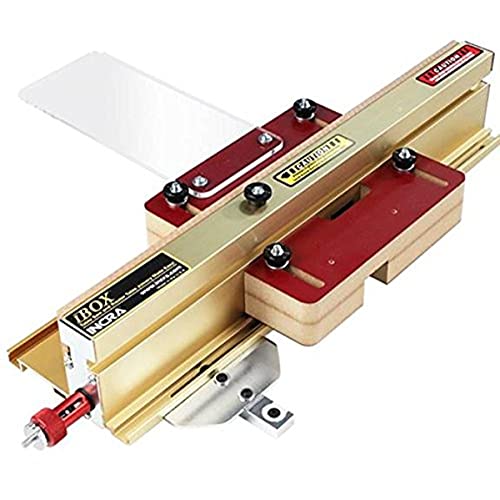
The I-BOX is the precision benchmark in this class, and the only jig here that treats fit as a dialed setting rather than a setup ritual. It runs on a table saw with a dado stack or on a router table with a straight bit, and it cuts finger widths anywhere from 1/8 to 3/4 inch — the widest continuous range in this guide. The mechanism is a dual-pitch lead screw: coarse travel moves the fence quickly into position, and the fine pitch then adjusts the cut in steps of about a thousandth of an inch, so dialing a loose test joint into a snug one takes seconds and, just as valuable, the setting can be recorded and returned to weeks later. The miter bar adjusts to fit slots from 0.740 to 0.762 inch wide, which covers the realistic spread of saw and router table slots, and the fence assembly reverses, letting you work from either side of the cutter. A clear guard rides over the cut zone and the stock is clamped against the fence rather than hand-held. For a shop that cuts box joints often, in several sizes, on both machines, this is the jig the others are measured against.
Specs
- Machines: Table saw or router table
- Finger widths: 1/8 to 3/4 in, continuously adjustable
- Indexing: Dual-pitch lead screw with fine micro-adjustment
- Miter bar: Adjustable fit for slots 0.740 to 0.762 in wide
- Fence: Reversible, with stock clamp and clear cut-zone guard
2. Woodpeckers Adjusta-Joint Box Joint Jig

The Adjusta-Joint takes the opposite approach to indexing: instead of a key or a screw, it builds the joint pattern from a template of precision steel spacers — 62 of them in the box — stacked to set each finger and socket width. That makes patterns possible that no fixed-key jig can touch: mixed finger widths, decorative uneven spacing, and symmetrical layouts worked out from the center of the board. It is a table saw sled, and unusually it cuts with a standard 1/8 inch kerf blade rather than a dado stack, making repeated passes that the template controls; there is no stack to assemble, shim, or measure. The template covers 8 inches of joint in one pass and up to 15 inches with flipped cuts, and the sled accepts stock up to 2-1/2 inches thick, the most here by a wide margin. The miter bar uses a leaf-spring design that keeps constant pressure against the slot walls, and the whole outfit stores on a wall-mounted rack. It is a heavy, serious sled at about 28 pounds, and it rewards a methodical setup — but for custom, one-off finger patterns in thick stock, nothing else in this guide does what it does.
Specs
- Machine: Table saw (sled design)
- Indexing: Template system with 62 precision steel spacers
- Pattern capacity: 8 in per pass, 15 in with flipped cuts
- Max stock thickness: 2-1/2 in
- Cutter: Standard 1/8 in kerf blade, no dado stack needed
- Miter bar: Leaf-spring fit for 3/8 x 3/4 in slots
3. Rockler Router Table Box Joint Jig

Rockler’s standard box joint jig is the fixed-key pattern done carefully, and it is the pick for small and medium boxes cut at the router table. Three precision-machined brass indexing keys — 1/4, 3/8, and 1/2 inch — set the finger widths, and because each key is machined to match its bit size, spacing accuracy comes from the key itself rather than from a mechanism you must calibrate. The sled is glass-filled nylon, light and slick, and it runs on a melamine-coated MDF platform that supports the work flat and lets it glide without grabbing; the platform’s slots limit sled travel so the bit cannot be overrun. Expandable miter bars lock the platform into a standard 3/4 by 3/8 inch router table slot, and large five-star knobs make the setup a tool-free job. The one fit check that matters: the jig needs the near edge of your table’s miter track to sit between 4-1/2 and 6-1/4 inches from the center of the bit. Within that window, this is the fastest route here from unboxing to a tight first corner.
Specs
- Machine: Router table only
- Indexing keys: Solid brass, 1/4, 3/8, and 1/2 in
- Sled: Glass-filled nylon with travel-limiting slots
- Platform: Melamine-coated MDF, 1/2 in thick
- Mounting: Expandable miter bars for 3/4 x 3/8 in slots, tool-free knobs
- Fit requirement: Miter track edge 4-1/2 to 6-1/4 in from bit center
4. Rockler XL Box Joint Jig for Router Tables

The XL is Rockler’s answer for woodworkers who outgrew the standard jig’s reach — wider drawer boxes, casework sides, and small production runs at the router table. The sled is steel rather than nylon, riding on the same style of melamine-coated MDF base, and the extra mass shows up as steadiness: the sled tracks straight through cut after cut without the light, skittish feel of a small jig. Its brass indexing keys come in 1/2 and 3/4 inch sizes, aimed at the chunkier fingers that suit larger boxes and thicker drawer stock, and sacrificial fence faces take the exit-side tear-out so the work does not. Ergonomic knobs and a quick, repeatable setup suit batch work, where the same joint is cut on a dozen matching parts in a sitting. The limits are honest ones: it is a router-table-only tool, it fits 3/8 by 3/4 inch miter slots, and with only two key sizes it gives up the fine 1/4 inch fingers the standard model offers. Shops that cut both small and large work may end up owning both Rockler sizes; shops that mostly build bigger boxes should start here.
Specs
- Machine: Router table only
- Indexing keys: Brass, 1/2 and 3/4 in
- Sled: Steel, for steady tracking on batch work
- Base: Melamine-coated MDF with sacrificial fence faces
- Miter slot: 3/8 x 3/4 in
- Focus: Wide boards, drawer boxes, and casework parts
5. POWERTEC Adjustable Box Joint Jig (71759)

The POWERTEC 71759 is the flexible budget pattern in this guide: a miter-bar jig that works on table saws and router tables alike, using a pair of stop plates to set the finger spacing. One plate is fixed and one is adjustable, and an adjustment knob on the mechanism moves the stop so you can tune the spacing to match your dado stack or bit instead of being locked to preset key sizes. The guide bar carries expansion discs at each end — the same take-up idea as on good miter gauges — so the bar can be snugged to glide in your slot without side play, and it can be set in either the right or left track. An MDF sub fence gives the work a sacrificial face, and a clamp guard holds the stock down and keeps hands clear of the cut line. Fit tuning here is a practical process of test cuts rather than a dialed readout, so expect a few more minutes at setup than with the INCRA. In exchange, one modest jig covers both machines and a wide range of finger sizes, which makes it a sensible first box joint jig for a small shop.
Specs
- Machines: Table saw or router table
- Model: POWERTEC 71759
- Indexing: Fixed and adjustable stop plates with adjustment knob
- Guide bar: Expansion discs for a snug, play-free slot fit, right or left track
- Fence: MDF sub fence with clamp guard
- Includes: Adjustment mechanism, stop plates, hex wrench, full hardware set
Verdict
Choose by machine first and by pattern second. If you cut box joints on both a table saw and a router table and want the fit dialed rather than coaxed, the INCRA I-BOX is the standout: its lead-screw micro-adjustment is the feature that turns test cuts into a two-minute formality. If your work is custom patterns in thick stock on the table saw, the Woodpeckers Adjusta-Joint stands alone — its spacer template system makes finger layouts the fixed-key jigs simply cannot cut. Router-table shops should pick between the two Rockler jigs by scale: the standard model with its three brass keys for small and medium boxes, the XL with its steel sled and larger keys for wide boards and batch work. And if you want one jig that covers both machines while you learn the joint, the POWERTEC 71759 earns its place with adjustable stop plates and a slot fit you can snug up yourself. Whichever you choose, budget an hour for test cuts in scrap the first time: an even row of fingers is the jig’s job, but the final fit is always set on your machine, with your cutter.
Frequently Asked Questions
What cutter do I need? Table saw jigs cut with a dado stack set to the finger width, except the Woodpeckers sled, which uses a standard 1/8 inch kerf blade and makes repeated passes. Router table jigs use a straight or spiral up-cut bit matched to the key size. A flat-top grind leaves the squarest socket floors on the saw.
How thick can the stock be? The joint’s finger length equals the stock thickness, so the cutter must reach through the board with a little to spare for trimming the fingers flush. Most jigs here handle the 3/8 to 3/4 inch stock typical of boxes and drawers; the Woodpeckers sled goes to 2-1/2 inches for casework and blanket chests.
Why does my last finger come out the wrong width? Because board width is rarely an exact multiple of the finger width. Lay the pattern out from both edges, or start the row so the partial finger lands where it shows least, or resize the board by a shaving so the fingers divide evenly. Template and lead-screw jigs make this layout easier because their spacing is not locked to fixed keys.
Can a box joint jig cut dovetails? No. Box joints are straight-sided fingers cut with a straight cutter path; dovetails are angled and need a dovetail jig with angled guides and matched bits. The two jigs solve different joints and neither does the other’s work.
Related guides
More from Amazon
Programs that pair well with the guide above. Offers and eligibility are set by Amazon and may change.
A free business account with business pricing and bulk-buying tools for work, shop or home office.
Create a business accountFree shipping on eligible items, Prime Video and more. Eligible new members can start with a free trial.
Start a Prime free trialAudiobooks and podcasts to listen to on the go. Eligible new members can start with a free trial.
Try Audible freeAd-free music streaming. Eligible new subscribers can start with a free trial.
Try Music Unlimited freeAs an Amazon Associate we earn from qualifying purchases.