Key takeaways
- Compare sun tunnels by tube size, dome build and flashing style, with the measure-your-attic-run rule and seal-every-joint habit for bright rooms.
What's inside
As an Amazon Associate I earn from qualifying purchases. This post may contain affiliate links at no extra cost to you.
A hallway, bathroom or closet with no exterior wall has no window option, and that is exactly the gap a sun tunnel fills. Also called a tubular daylighting device or solar tube, it is three parts working together: a dome on the roof that gathers daylight, a reflective tube that carries that light through the attic, and a diffuser set into the ceiling that spreads it across the room. The roof opening is small, the tube fits between standard joists, and no framed shaft has to be built the way a conventional skylight well demands.
Disclosure: As an Amazon Associate, I earn from qualifying purchases. Product details were verified at the time of writing.
Every kit below is a complete dome, flashing, tube and diffuser package sold on Amazon US. All five picks use rigid tube, and that is stated plainly in each Specs list, because tube type is the single biggest factor in how much light survives the trip through your attic.
How to Choose a Sun Tunnel
Measure the attic run before ordering
Climb into the attic first and measure, do not guess. Mark the ceiling spot where the diffuser will sit, then find the roof spot directly workable above it. Note the joist spacing (16 or 24 inches on center in most homes), and check the straight path between the two points for ducts, wiring runs, plumbing vents and truss webs. Compare the maker’s ceiling rough-opening figure against your joist bay: a 10-inch tube drops into a 16-inch bay with room to spare, while 13- and 14-inch tubes need the bay checked carefully before any cutting. Add up the run length, including any offset, and confirm the kit tube plus available extensions covers it.
Tube size
Maker coverage figures give the working guide. A 10-inch tube suits closets, baths and short hallways, with maker coverage figures up to about 150 square feet. A 13- or 14-inch tube serves larger hallways, kitchens and laundry rooms, with maker coverage figures up to about 300 square feet. Longer runs and extra elbows dim any tube, so size up when the run is long rather than hoping a small tube will push light further than it can.
Rigid tube versus flexible tube
Rigid pipe holds its mirror-smooth shape, so light keeps bouncing cleanly on long runs and through elbow turns. Flexible tube bends around attic obstructions and suits short, crooked runs, but each bend and each sag in the material dims the output. All five picks in this guide use rigid tube. Flexible kits exist in the same maker lines (VELUX sells flexible versions of its tunnels, for example), and they are the honest choice when a duct or truss chord blocks every straight path — just expect a dimmer result than the tube diameter suggests.
Flashing matched to the roof
The flashing is the weather seal, and it must match the roof. Pitched flashing is shaped for shingle roofs and tucks under the courses above it. Low-profile flashing sits flatter against the roofline for a cleaner look on the same pitched roofs. Flat flashing is built for low-slope and flat roofs where water moves slowly. Tile and metal roofs need their own adapter flashings, so confirm the maker lists your roof covering for the exact kit before ordering.
Dome build
Most domes are acrylic: light, clear and UV protected. Impact domes, built to shrug off hail and wind-blown debris, are the safer pick in storm country and are required by some local codes. Whichever dome you choose, never lean body weight on it or rest tools against it; the makers state plainly that these units are not built to hold weight.
Seal every joint
Light leaks and air leaks happen at the joints. Tape every tube joint with the foil tape the maker supplies or specifies, fit each tube section fully home before taping, and seal the ceiling ring so attic air, dust and insulation fibers cannot drift into the room around the diffuser. On the roof, follow the maker’s flashing sequence exactly and seal fastener heads as directed. A tunnel that is bright in June and drips in January was almost always a sealing miss, not a product failure.
Roof work safety
Plan the roof half of the job with the same care as the attic half. Set the ladder on firm, level ground and keep three points of contact while climbing. Wear fall protection on steep pitches, work in dry weather, and keep off the roof entirely when shingles are wet or frosty. Cut the roof opening only after the ceiling hole below is confirmed clear of wiring and plumbing.
The Picks
1. VELUX TMR 010 0000 Sun Tunnel — the straight-run standard for small rooms

The TMR 010 is the classic 10-inch rigid tunnel for pitched shingle roofs. Its pitched flashing is shaped to gather light from all roof directions and weave into shingle courses, the tunnel pivots at the flashing so the run below can be angled straighter, and the Flexi Loc connection system clicks tube sections together quickly. This is the kit for a bathroom or short hallway where the attic path is clear and a straight, bright run is possible.
Specs
- Tube: 10 in. diameter, rigid
- Dome: acrylic
- Flashing: pitched metal flashing for shingle roofs
- Kit tube length: 48 in., including two elbows and one 24 in. extension
- Maximum recommended run: 20 ft (maker figure)
- Roof pitch range: 14 to 60 degrees (maker figure)
- Connection system: Flexi Loc, with a silver reflective tunnel layer
2. VELUX TGR 014 1000 Sun Tunnel — 14-inch output with an impact dome

The TGR 014 steps up to a 14-inch rigid tunnel for bigger, darker spaces, and the 1000 version carries an impact dome for hail and debris country. Its low-profile flashing hugs the roofline instead of standing proud of it, which suits roofs that face the street. Rigid sections and elbows extend the run well beyond the kit length when the attic is deep, up to the maker’s 30-foot recommended limit.
Specs
- Tube: 14 in. diameter, rigid
- Dome: impact dome, clear
- Flashing: low-profile metal flashing for pitched roofs
- Kit tube length: 4.3 ft
- Maximum recommended run: 30 ft (maker figure)
- Ceiling rough opening: 15 1/4 in.
- Roof pitch range: 14 to 60 degrees (maker figure)
3. Solatube 160 DS Tubular Skylight Kit — collector dome tech in a 10-inch kit

Solatube builds its 160 DS around two dome-side ideas: the Raybender 3000 collector dome, which uses a fresnel lens pattern to catch low morning and evening sun, and the LightTracker reflector inside the tube top, which aims that extra light down the run. The tubing is the maker’s rigid Spectralight Infinity pipe. This Amazon kit bundles the top and bottom tubes with two 20-inch extension tubes, so a typical one-story attic run is covered without a second order.
Specs
- Tube: 10 in. diameter, rigid Spectralight Infinity tubing
- Dome: Raybender 3000 collector dome with LightTracker reflector
- Kit contents: top and bottom tubes plus two 20 in. extension tubes
- Diffuser: Classic Vusion diffuser with softening effects lens
- Coverage: up to 200 sq. ft. (maker figure)
- Flashing: metal roof flashing; order the pitch class that matches your roof
4. Natural Light 13-Inch Tubular Skylight Kit, Pitched — big-tube output, long backing
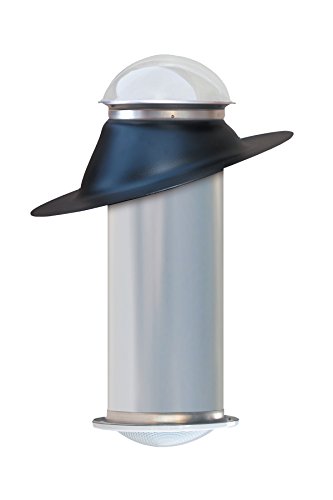
Natural Light’s 13-inch kit is the high-output pitched-roof option here, with a maker coverage figure of up to 300 square feet. The dome is high-impact modified acrylic with UV protection, the flashing is 1100-series aluminum, and the rigid light pipe arrives as two 24-inch sections. Diffuser choice is part of the kit decision: prismatic for maximum spread, soft white for a gentler look. The maker backs the kit with a 25-year warranty, stated here as a maker figure.
Specs
- Tube: 13 in. diameter, rigid light pipe, two 24 in. sections in the kit
- Dome: high-impact modified acrylic, UV protected
- Flashing: pitched, 1100-series aluminum
- Coverage: up to 300 sq. ft. (maker figure)
- Maximum tube length: 20 ft (maker figure)
- Diffuser options: prismatic, soft white or SkyBrite
- Warranty: 25 years (maker figure)
5. Natural Light 10-Inch Tubular Skylight Kit, Flat Roof — the low-slope specialist

Flat and low-slope roofs rule out pitched flashing entirely, and this is the kit built for them. It keeps the same rigid light pipe, protected acrylic dome and aluminum construction as the pitched 13-inch kit above, sized down to a 10-inch tube with flat flashing that seals against slow-moving water. It suits a closet, bath or hallway under a porch roof, an addition roof or any other low-slope section of the house.
Specs
- Tube: 10 in. diameter, rigid light pipe, two 24 in. sections in the kit
- Dome: high-impact modified acrylic, UV protected
- Flashing: flat roof flashing, 1100-series aluminum
- Coverage: up to 150 sq. ft. (maker figure)
- Maximum tube length: 18 ft (maker figure)
- Warranty: 25 years (maker figure)
Verdict
For most hallways, baths and closets under a pitched shingle roof, the 10-inch VELUX TMR 010 is the safe first choice: rigid tube, proven flashing and a run limit that covers most one- and two-story attics. Step up to the 14-inch VELUX TGR 014 when the room is large or the run is long, and pick its impact dome if hail is a regular visitor. The Solatube 160 DS earns its place when low sun angles leave a room dim at the ends of the day, since its collector dome and reflector are built for exactly that problem. Choose the Natural Light 13-inch kit for the brightest pitched-roof result with long maker backing, and the Natural Light 10-inch flat-roof kit when the ceiling sits under a low-slope roof. Whichever kit lands on your roof, the result is decided before it arrives: measure the attic run first, match the flashing to the roof, tape and seal every joint, and seal the ceiling ring tight against attic air.
Related guides
More from Amazon
Programs that pair well with the guide above. Offers and eligibility are set by Amazon and may change.
A free business account with business pricing and bulk-buying tools for work, shop or home office.
Create a business accountFree shipping on eligible items, Prime Video and more. Eligible new members can start with a free trial.
Start a Prime free trialAudiobooks and podcasts to listen to on the go. Eligible new members can start with a free trial.
Try Audible freeAd-free music streaming. Eligible new subscribers can start with a free trial.
Try Music Unlimited freeAs an Amazon Associate we earn from qualifying purchases.