
Key takeaways
- Compare camber gauges, checking dial or digital readout, magnet, range and case for cars, alignment, home garages, workshops, wheels and track days.
What's inside
As an Amazon Associate I earn from qualifying purchases. This post may contain affiliate links at no extra cost to you.
Camber is the inward or outward lean of a wheel seen from the front of the car, and it quietly decides how evenly a tire wears and how hard the car turns in. After a strut swap, a set of lowering springs, or a brush with a curb, that lean changes, and the only way to know by how much is to measure it. A camber gauge turns that measurement into a five-minute job on a flat garage floor, no alignment rack required.
Disclosure: As an Amazon Associate, I earn from qualifying purchases. Product details were verified at the time of writing.
The five gauges below span the designs a home mechanic or weekend racer will actually meet: a professional bubble gauge with a magnetic adapter, a hands-free rim-clamp gauge, a digital readout gauge, and two compact magnetic bubble gauges sized for quick checks after suspension work. Each one also reads caster, the forward or backward tilt of the steering axis, so a single tool covers both front-end angles.
Contents
How to Choose a Camber Gauge
Pick a readout style. Bubble gauges use fluid vials and need no batteries, and a practiced eye reads them to a quarter degree. Digital gauges show the angle on a screen, which removes squinting and makes small changes easy to track while you adjust. Either style works; the choice is about how you like to read numbers under a car.
Check the range. Street cars usually live between two degrees of negative camber and one degree positive, while track setups push further. Caster runs higher, often three to eight degrees positive on modern cars. A gauge that covers at least five degrees of camber and twelve degrees of caster handles nearly everything a home garage sees.
Match the mount to your wheels. Magnetic gauges stick to a brake rotor, hub, or steel wheel, which is fast but fails on many alloy wheels with no flat ferrous surface. Rim-clamp gauges grip the wheel lip instead and stay put at ride height, which suits lowered cars and wheels with covered hubs.
Mind the floor, not just the tool. Every gauge assumes a level surface. A sloped driveway adds its own angle to the reading, so work on the flattest slab you have, settle the suspension with a short roll and bounce, and keep tire pressures even before measuring.
Look for a case. Vials are glass and digital screens scratch. A fitted case keeps the gauge honest between jobs and stops it rattling around a toolbox drawer.
Think about caster sweeps. Reading caster means turning the wheels twenty degrees each way and comparing readings. Gauges with angle flats or clear instructions for that sweep make the job quicker, and turn plates, while optional, smooth the whole process.
1. Longacre Caster/Camber Gauge with Magnetic Adapter

Longacre builds this gauge for racers, and it shows in the details. Three bubble vials handle the work: two outer vials read camber in quarter-degree steps, and a center vial reads caster after a twenty-degree sweep each way. The magnetic adapter snaps onto a hub, brake rotor, or steel wheel and holds firmly while you work, and the whole gauge arrives in a padded case that protects the vials between events. There are no batteries to go flat and nothing to calibrate beyond zeroing the gauge on a known level surface. For a home garage that also sees track days, this is the gauge that stays accurate for decades and reads fast once the routine becomes habit.
Specs
- Readout: bubble vials, camber read in 1/4 degree steps
- Camber range: +6 to -6 degrees
- Caster range: +12 to -4 degrees, read in 1/2 degree steps
- Mount: magnetic adapter for hub, rotor, or steel wheel
- Case: padded carrying case included
2. SPC Performance FasTrax Camber/Caster Gauge (91000)

The FasTrax takes a different approach: instead of sticking to the hub, it clamps to the rim and holds itself in place, so both hands stay free for adjusting. An adjusting knob lengthens or shortens the body to suit wheels from 13 to 18 inches, and the gauge can be zero-set to match an uneven floor or a rack, which keeps readings consistent from session to session. The vial block displays camber across four degrees either way and caster from four degrees negative to twelve positive, using a fifteen-degree sweep built into the angled tip of the block. It suits street cars and mild track setups where the wheels stay on the car during alignment work.
Specs
- Readout: bubble vial block
- Camber range: +4 to -4 degrees
- Caster range: -4 to +12 degrees, 15 degree sweep reference
- Mount: hands-free rim clamp, adjustable length
- Wheel fit: 13 to 18 inch wheels
- Weight: 2.9 lb
3. AUTOSOLO Digital Camber and Caster Gauge

The AUTOSOLO gauge swaps vials for a backlit LCD that shows the angle as a number, which makes it easy to watch camber change live while you loosen a strut bolt and nudge the hub. The sensor covers a very wide span, from ninety degrees negative to ninety positive, so it doubles as a general angle finder for suspension and fabrication work. A strong magnetic base holds it to a rotor or hub, a zero button sets your reference on the floor you actually have, and an integrated bubble vial helps you orient the gauge before reading. The aluminum body runs on AAA batteries and shuts its display around a battery level indicator, so you know where you stand before a session.
Specs
- Readout: digital LCD with backlight
- Range: -90 to +90 degrees
- Mount: magnetic base
- Extras: zero reset, integrated bubble level, battery level display
- Body: aluminum
- Power: AAA batteries, not included
- Size: 1.77 x 1.77 x 2.54 inches
4. Sixzoo Magnetic Camber Gauge
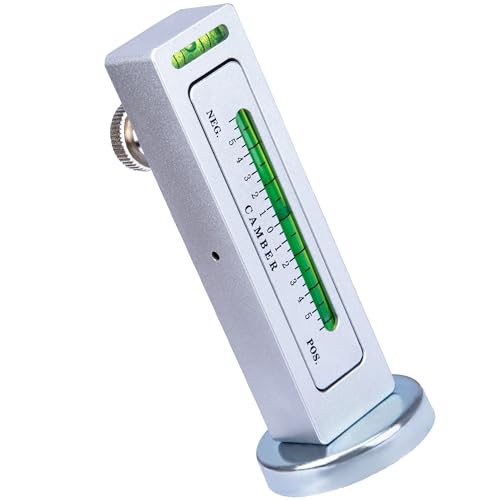
The Sixzoo gauge is the compact option for quick checks rather than full alignments. It mounts on the brake rotor through a 1.9 inch magnetic base, and a knob on the back lets you dial the reading across five degrees either side of zero, which is the span that matters when you are restoring camber after a strut or control arm swap. The body is molded PC plastic, so it shrugs off knocks and weighs almost nothing in a glove box or tool roll. At 4.8 inches long it fits where bulkier gauges cannot, including behind tight wheel openings, and the simple vial keeps the reading honest without any setup beyond zeroing on the rotor face.
Specs
- Readout: bubble vial with rear adjustment knob
- Range: -5 to +5 degrees
- Mount: magnetic base, 1.9 inch diameter, rotor or hub face
- Body: PC plastic
- Weight: 7.4 oz
- Size: 4.8 x 1.2 x 0.8 inches
5. YQABLE Camber Castor Strut Wheel Alignment Gauge

The YQABLE gauge follows the same magnetic bubble pattern but in an aluminum body, which gives it a sturdier feel in the hand. It attaches to the wheel hub or brake disc and offers a leveling adjustment from five degrees negative to five positive, enough to return a strut to its original camber position after dismantling and reassembly, or to record how much camber changed during a repair. At just under ten ounces it is light enough to keep in the car for checks at the track or after suspension work away from home. The procedure is simple: mount, level to zero, adjust the suspension part, and read the new angle against your starting point.
Specs
- Readout: bubble vial
- Adjustment range: -5 to +5 degrees
- Mount: magnetic, hub or brake disc
- Body: aluminum
- Weight: 9.9 oz
- Size: about 5 x 2 inches
Comparison Table
| Gauge | Readout | Camber range | Caster range | Mount | Case |
|---|---|---|---|---|---|
| Longacre Caster/Camber Gauge | Bubble vials | +6 to -6 deg | +12 to -4 deg | Magnetic adapter | Padded case included |
| SPC Performance FasTrax 91000 | Bubble vial block | +4 to -4 deg | -4 to +12 deg | Rim clamp, hands-free | Not specified |
| AUTOSOLO Digital Gauge | Digital LCD, backlit | -90 to +90 deg span | -90 to +90 deg span | Magnetic base | Not specified |
| Sixzoo Magnetic Camber Gauge | Bubble vial, rear knob | -5 to +5 deg | Via sweep with knob | Magnetic base, 1.9 in | Not specified |
| YQABLE Camber Castor Gauge | Bubble vial | -5 to +5 deg | Via sweep | Magnetic, hub or disc | Not specified |
FAQ
Do I need to remove the wheel to use a magnetic camber gauge?
Usually, yes. Magnetic gauges read most accurately on the hub or brake rotor, which means the wheel comes off. Rim-clamp designs like the FasTrax read with the wheel fitted and the car at ride height, which some people prefer for final settings.
How level does the floor need to be?
Level enough that the gauge reads the same when you turn it around on the same spot. A typical garage slab is fine. Zero the gauge on the floor first, and always measure on the same spot after any adjustment so the floor adds the same small offset every time.
Can one gauge measure both camber and caster?
Yes. Every gauge here reads camber directly and caster by sweeping the steering twenty degrees each way and comparing the two readings. Caster takes a few extra minutes but needs no extra tool beyond the gauge itself.
Why do my readings change after I drive the car?
The suspension settles. Bushings relax, springs seat, and the car finds its true ride height. Measure after a short drive or after rolling the car back and forth and bouncing each corner, otherwise you are aligning a suspension that has not settled yet.
Is a digital gauge more accurate than a bubble gauge?
Not automatically. A good bubble gauge reads to a quarter degree, which matches what most street alignments call for. Digital gauges win on readability and repeatability, especially when you are watching the number move during an adjustment, but both styles depend on a level floor and a settled car.
Verdict
For most home garages, the Longacre gauge is the one to buy once: its quarter-degree vials, wide caster range, magnetic adapter, and padded case cover street and track work without batteries or fuss. Choose the SPC FasTrax if your wheels give a magnet nothing to hold and you want readings at ride height with both hands free. The AUTOSOLO digital gauge suits anyone who prefers a number on a screen and wants a tool that doubles as an angle finder. The Sixzoo and YQABLE gauges earn their place as compact companions for restoring camber after repairs, small enough to live in the car and quick enough to use anywhere.
Related guides
More from Amazon
Programs that pair well with the guide above. Offers and eligibility are set by Amazon and may change.
A free business account with business pricing and bulk-buying tools for work, shop or home office.
Create a business accountFree shipping on eligible items, Prime Video and more. Eligible new members can start with a free trial.
Start a Prime free trialAudiobooks and podcasts to listen to on the go. Eligible new members can start with a free trial.
Try Audible freeAd-free music streaming. Eligible new subscribers can start with a free trial.
Try Music Unlimited freeAs an Amazon Associate we earn from qualifying purchases.








