
Key takeaways
- Transfer bore measurements to a micrometer with telescoping gauge sets that lock smoothly, spring evenly, and cover small to large bore size ranges.
What's inside
As an Amazon Associate I earn from qualifying purchases. This post may contain affiliate links at no extra cost to you.
A telescoping gauge never shows a number on its own. It is a transfer tool: spring-loaded plungers expand inside a bore, you lock them at the handle, withdraw the gauge, and read the span across the contact points with an outside micrometer. That simple method reaches places caliper jaws cannot — the bearing pocket inside a shop-built jig, the recess turned into the base of a bowl blank, or a dowel socket bored into a leg. Because the reading depends on how evenly the plungers spring out and how positively the lock holds during withdrawal, build quality matters far more here than with most hand measuring tools. The five sets below all cover the classic span from small dowel holes to large lathe work, each earning its place for a different reason.
Disclosure: As an Amazon Associate, I earn from qualifying purchases. Product details were verified at the time of writing.
Contents
How to Choose a Telescoping Gauge Set
Range and steps. Nearly every full set spans 5/16 to 6 inches (8 to 150 mm) split across six gauges, each covering one band: roughly 5/16–1/2, 1/2–3/4, 3/4–1-1/4, 1-1/4–2-1/8, 2-1/8–3-1/2, and 3-1/2–6 inches. If your drawings and machinery are metric, a set stepped in millimeters keeps size selection intuitive, though the micrometer makes the final reading in whatever units you choose.
Plunger action. Good gauges use two spring-loaded plungers that extend from the center under constant, even tension, so both contact points press the bore wall with the same force and the head centers itself. Sticky or lopsided action is the main cause of readings that wander from one attempt to the next. Hardened, smoothly ground contact faces slide through the bore without digging in.
The lock. A knurled clamp screw at the end of the handle freezes the plungers once they have settled. It should snug down with fingertip effort, hold the span while the gauge is rocked out of the bore, and release without a jerk that shifts the setting.
Handle length and reach. Standard handles suit shallow holes and open work. Deep bores — a long spindle housing, a hollow form on the lathe — call for extended handles that keep your hand clear while the head works well below the rim.
Finish and storage. Satin chrome resists moisture and shop grime, and stainless construction shrugs off damp benches entirely. A fitted case or wallet keeps the six gauges sorted by size and protects the ground contact faces in a drawer.
Technique still rules. Insert the gauge at a slight angle, let the plungers expand, then rock the handle gently through center so the head finds the true diameter before locking. Take two readings at right angles to catch ovality. Even the finest set rewards a practiced hand, and even a modest set gives repeatable results once the motion becomes habit.
The 5 Best Telescoping Gauge Sets
1. Mitutoyo 155-903 Telescoping Gage Set — The Inch Benchmark

Mitutoyo’s Series 155 set is the one other gauges get compared against, and the reason is the plunger action: both arms glide out under steady spring pressure with no grit or hesitation, so the head settles in the bore the same way every time. The knurled clamp locks with a positive feel and holds the span while you rock the gauge free. Hardened measuring faces and a satin chrome finish stand up to daily shop use, and the six gauges arrive in a plastic wallet that keeps the sizes in order. For inch-based work — bearing seats, chuck recesses, jig bushings — this is the set to build the habit on.
Specs
- Range: 5/16 to 6 in total, in six steps (5/16–1/2, 1/2–3/4, 3/4–1-1/4, 1-1/4–2-1/8, 2-1/8–3-1/2, 3-1/2–6 in)
- Pieces: 6 gauges
- Action: Spring-loaded, self-centering plungers with constant spring force
- Lock: Knurled clamp screw
- Finish: Satin chrome with hardened measuring faces
- Storage: Plastic wallet
2. Fowler 52-470-007-0 Telescoping Gage Set — The Deep-Bore Reach Pick
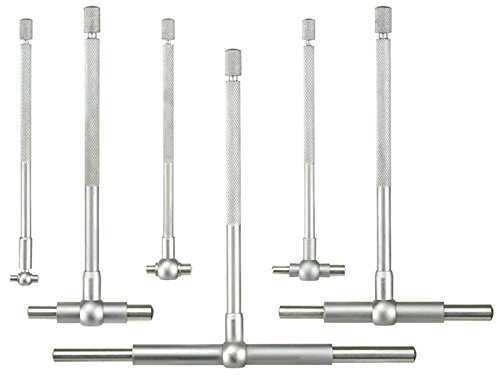
Fowler builds this set around 12-inch handles, and that extra length changes what you can measure: deep spindle housings, long bored columns, and hollow vessels where a standard handle leaves your fingers inside the work. The double-action heads are rigid and self-centering, with constant spring tension pressing both contacts evenly, and the measuring tips are hardened and precision ground so they track smoothly along the bore wall. It covers the same six size bands as a standard set and ships in a fitted vinyl case.
Specs
- Range: 5/16 to 6 in total across the set
- Pieces: 6 gauges
- Handle length: 12 in for deep-bore reach
- Action: Double-action, self-centering plungers with constant spring tension
- Contacts: Hardened, precision-ground tool steel tips
- Storage: Fitted vinyl case
3. Mitutoyo 155-905 Telescoping Gage Set — The Metric Benchmark

This is the millimeter sibling of the 155-903, built to the same standard with the same smooth, even spring action and positive knurled locking clamp. The six gauges step through metric bands from 8 mm up to 150 mm, lining up neatly with the bearing sizes and machine specifications found on metric drawings and imported machinery. Satin chrome finish, hardened faces, and a plastic wallet complete the package — pick this one when your shop thinks in millimeters.
Specs
- Range: 8 to 150 mm total, in six steps (8–12.7, 12.7–19, 19–32, 32–54, 54–90, 90–150 mm)
- Pieces: 6 gauges
- Action: Spring-loaded, self-centering plungers with constant spring force
- Lock: Knurled lockscrew
- Finish: Satin chrome with hardened measuring faces
- Storage: Plastic wallet
4. Beslands 6 Pc Telescoping Gage Set — The Stainless Shop Pick

Beslands builds its T-bore set from stainless steel, a sensible choice for benches that see water-based finishes, green lumber, and humid summer air. The contact points are hardened tool steel, the plungers run with a self-centering double action, and the knurled locking knob holds the span firmly for the transfer to a micrometer. Six gauges cover the full span in the familiar bands, and the set travels in a protective pouch.
Specs
- Range: 5/16 to 6 in total across the set
- Pieces: 6 gauges
- Construction: Stainless steel body
- Contacts: Hardened tool steel measuring points
- Action: Self-centering double-action plungers
- Lock: Knurled locking knob
- Storage: Vinyl pouch
5. AuSL 6PCS Precision Telescopic Gauge Set — The Starter Pick
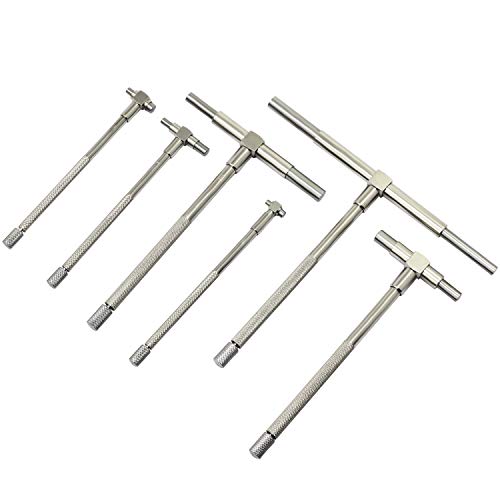
The AuSL kit covers the same ground as the established brands — six carbon steel gauges spanning 8 to 150 mm — in a plain, no-frills package that suits occasional bore checks and anyone learning the transfer technique. The spring-loaded plungers expand from the center of each T-head, the knurled handles lock the setting for withdrawal, and the standard six size bands handle everything from small dowel sockets to wide lathe recesses. Technique matters more than pedigree with this tool type, and a set like this lets a beginner build the rocking, locking, and reading routine before deciding whether the work justifies a premium set.
Specs:
– Range: 8 to 150 mm (5/16 to 6 in) total across the set
– Pieces: 6 gauges
– Construction: Carbon steel
– Action: Spring-loaded plungers expanding from the center
– Lock: Knurled locking handle
– Pairing: Reads with an outside micrometer or caliper
Comparison Table
| Set | Range | Pieces | Handle / Reach | Lock | Storage |
|---|---|---|---|---|---|
| Mitutoyo 155-903 | 5/16–6 in | 6 | Standard | Knurled clamp | Plastic wallet |
| Fowler 52-470-007-0 | 5/16–6 in | 6 | 12 in long handles | Knurled clamp | Fitted vinyl case |
| Mitutoyo 155-905 | 8–150 mm | 6 | Standard | Knurled lockscrew | Plastic wallet |
| Beslands 6 Pc | 5/16–6 in | 6 | Standard | Knurled knob | Vinyl pouch |
| AuSL 6PCS | 8–150 mm | 6 | Standard | Knurled handle | Kit packaging |
FAQ
Do I need a micrometer to use a telescoping gauge?
Yes. The gauge only captures the bore size; it carries no scale of its own. You lock the plungers inside the bore, withdraw the gauge, and measure across the contact points with an outside micrometer. Calipers can take the reading for rough work, but a micrometer gives the repeatability the method is capable of.
How repeatable are readings from a telescoping gauge?
With clean parts, even spring action, and a consistent rocking motion through center, a practiced hand repeats within about a thousandth of an inch. Most variation comes from technique — locking before the head centers, or squeezing the micrometer anvils with uneven force — rather than from the gauge itself.
How do I check a bore for taper or ovality?
Measure at several depths along the bore and at two positions at right angles to each other at every depth. Differences along the length reveal taper; differences between the two cross readings reveal an oval bore. A telescoping gauge suits this work because it can sample anywhere along the bore, not just at the rim.
What is the difference between single-action and double-action gauges?
Single-action gauges have one moving plunger and one fixed contact; double-action gauges spring both plungers from the center, which centers the head automatically in the bore. Double-action sets are generally easier to use consistently, especially in larger sizes.
How should I store and maintain the set?
Wipe the plungers clean after use, work each one a few times to confirm the action stays smooth, and keep the gauges in their case or wallet so the ground contact faces do not knock against other tools. A trace of light instrument oil on the sliding parts keeps the action free in a damp shop.
Verdict
For most woodworking shops measuring in inches, the Mitutoyo 155-903 is the set to own: its even spring action and dependable lock make the transfer technique as repeatable as it gets. Metric shops get the identical behavior from the Mitutoyo 155-905. Choose the Fowler 52-470-007-0 when deep bores are routine, thanks to its 12-inch handles. The Beslands set suits damp, finish-heavy shops that benefit from stainless construction, and the AuSL kit is a sensible way to learn the method or cover occasional checks. Whichever set lands on your bench, spend the first session practicing on a known bore until three readings in a row agree — that habit is worth more than any single feature on this page.
Related guides
More from Amazon
Programs that pair well with the guide above. Offers and eligibility are set by Amazon and may change.
A free business account with business pricing and bulk-buying tools for work, shop or home office.
Create a business accountFree shipping on eligible items, Prime Video and more. Eligible new members can start with a free trial.
Start a Prime free trialAudiobooks and podcasts to listen to on the go. Eligible new members can start with a free trial.
Try Audible freeAd-free music streaming. Eligible new subscribers can start with a free trial.
Try Music Unlimited freeAs an Amazon Associate we earn from qualifying purchases.








