
Key takeaways
- Compare kinetic recovery ropes by diameters, stretch figures and loop designs, with the no-metal-hardware rule and clear-line habit crews use.
What's inside
- How to Choose a Kinetic Recovery Rope
- Safety: The Rules That Keep a Pull Clean
- 1. Bubba Rope Power Stretch Recovery Rope, 7/8″ x 20 ft — the Original, Sized for Tight Trails
- 2. Yankum Ropes Python Kinetic Recovery Rope, 7/8″ x 30 ft — the Jeep and Half-Ton Standard
- 3. Factor 55 Extreme Duty Kinetic Energy Rope, 1″ x 30 ft — the Published Working Figure
- 4. ALL-TOP Kinetic Recovery Rope Kit, 1″ x 30 ft — the Strong Figure in a Complete Kit
- 5. Rough Country Kinetic Recovery Rope, 1″ x 30 ft — the No-Frills Truck Rope
- Comparison: Which Rope Goes in Which Truck
- Frequently Asked Questions
- Verdict
As an Amazon Associate I earn from qualifying purchases. This post may contain affiliate links at no extra cost to you.
A kinetic recovery rope frees a stuck vehicle with stored energy instead of brute force. The rope is round, double-braided nylon, and it is built to stretch — commonly by 20 to 30 percent of its length as the pull builds. The recovery vehicle takes a short run, the rope stretches and soaks up the surge, then the stored energy releases as one long, smooth tug that walks the stuck truck out of mud, sand, or snow without the violent shock a chain sends through both frames.
That stretch is the whole class boundary, and it matters. A flat tow strap, covered in its own guide on this site, is polyester webbing that barely stretches at all; it is the right tool for steady towing and the wrong tool for a running pull, because a jerked flat strap slams both vehicles. Tow chains, also covered separately, do heavy dragging work but store no energy and forgive nothing. Snatch blocks are winch rigging hardware, a different purchase again. Every product below is the rope itself: double-braided nylon, spliced loop ends, made to stretch and pull a buried vehicle free.
Disclosure: As an Amazon Associate, I earn from qualifying purchases. Product details were verified at the time of writing.
Contents
- How to Choose a Kinetic Recovery Rope
- Safety: The Rules That Keep a Pull Clean
- 1. Bubba Rope Power Stretch Recovery Rope, 7/8″ x 20 ft — the Original, Sized for Tight Trails
- 2. Yankum Ropes Python Kinetic Recovery Rope, 7/8″ x 30 ft — the Jeep and Half-Ton Standard
- 3. Factor 55 Extreme Duty Kinetic Energy Rope, 1″ x 30 ft — the Published Working Figure
- 4. ALL-TOP Kinetic Recovery Rope Kit, 1″ x 30 ft — the Strong Figure in a Complete Kit
- 5. Rough Country Kinetic Recovery Rope, 1″ x 30 ft — the No-Frills Truck Rope
- Comparison: Which Rope Goes in Which Truck
- Frequently Asked Questions
- Verdict
How to Choose a Kinetic Recovery Rope
Match the rope to the lighter vehicle, using the maker’s sizing guidance. Makers size these ropes by vehicle weight, and the working rule is a minimum breaking strength around two to three times the gross weight of the vehicle being pulled free. Follow the maker’s chart against the lighter vehicle in the pair. An oversized rope behind a light rig barely stretches, and a rope that cannot stretch cannot do its job — it just becomes an expensive tow line that hits hard. An undersized rope works past the figure its maker published, which is how ropes fail.
Read the two strength figures the right way. Minimum breaking strength is the pull at which the rope itself can break. A working load limit, when the maker publishes one, is the figure meant for regular use, with margin already built under the break point. Plan every recovery against the lower figure you have, and treat the breaking figure as the ceiling you never approach, not a target to work up to.
Pick diameter and length for the ground you run. The 7/8 inch class is the home size for Jeeps, mid-size SUVs, and half-ton trucks. One inch ropes serve full-size and three-quarter-ton trucks. Thirty feet is the standard length because it leaves room for the recovery vehicle to find firm ground and build momentum; a 20 foot rope concentrates the pull and suits tight trails where thirty feet of line simply does not fit between the trees.
Loops, not hooks. Every rope here ends in spliced loop eyes. Loops connect with soft shackles, and that pairing is deliberate: there is no metal anywhere in the connection to bend, unlatch, or fly if something lets go. If a rope you are considering ends in metal hooks, it belongs to a different class and a different job.
Coatings and sleeves are working parts. A polymer coating over the braid sheds mud and water, slows UV damage, and keeps grit from grinding the inner fibers. Sleeves or chafe guards over the loop eyes protect the splice where the rope bends around a recovery point. Neither feature changes the strength figure, but both decide how many seasons the rope survives.
Safety: The Rules That Keep a Pull Clean
Soft shackles only — no metal hooks and no metal shackles on a kinetic rope. This is the headline rule of the class. A kinetic pull stores real energy, and if a connection fails, anything metal in that connection becomes a projectile. A soft shackle that fails drops to the ground. Connect loop to recovery point with soft shackles, every time, with no exceptions for the steel hardware already in the truck box.
Everyone stands well clear of the line’s reach before the pull starts. The danger zone is the full span of the rope plus its stretch, in every direction the line could travel if an end let go. Spectators, spotters, and passengers wait outside that zone, off to the side and well back — never in line with the rope, never between the vehicles, and never downhill of the pull. One driver per vehicle, an agreed signal set, and nobody moves until both drivers confirm the line is slack.
Attach only to proper recovery points — never to a tow ball. A tow ball is a towing fitting, not a recovery point, and it can shear off under a kinetic load. Use frame-mounted recovery points or the maker’s designated recovery eyes on both vehicles. If a vehicle has no proper point, that vehicle does not take a kinetic pull until it has one fitted.
Inspect the rope before every pull, and retire it when the core shows. Run the full length through your hands. Look for cuts in the outer braid, flat or glazed spots, frayed fibers, and any place where the inner core is visible through the cover. Grit worked into the braid cuts fibers from the inside, so rinse mud and sand out after a recovery and let the rope dry before it goes back in its bag. A rope with a cut cover or a showing core is done — retire it rather than saving it for one more pull.
1. Bubba Rope Power Stretch Recovery Rope, 7/8″ x 20 ft — the Original, Sized for Tight Trails

Bubba Rope built the modern version of this class, and the Power Stretch is its benchmark rope: 7/8 inch double-braided nylon with a 28,600 lb breaking strength, in a 20 foot length that suits the recoveries where a standard 30 foot line is a liability. On a tight wooded trail or a narrow wash, the shorter rope lets the recovery vehicle set up closer, builds its stretch over a shorter run, and gives the driver finer control of the pull direction.
The construction is the traditional one for this maker: a double-braided nylon rope with spliced loop eyes and a polymer coating over the braid to shed water, mud, and grit. The 28,600 lb figure is sized for trucks, SUVs, and Jeeps in the mid-weight class, and the blue braid is easy to spot against mud and snow when the crew is checking that the line runs clear. This is the rope for a driver whose stucks happen in tight country and who wants the class’s most established name on the bag.
Specs
- Diameter: 7/8 in
- Length: 20 ft
- Material: double-braided nylon with polymer coating
- Minimum breaking strength: 28,600 lb (maker figure)
- Ends: spliced loop eyes
- Model: 176660BLG
- Best for: tight trails and close-quarters recoveries of mid-weight trucks and SUVs
2. Yankum Ropes Python Kinetic Recovery Rope, 7/8″ x 30 ft — the Jeep and Half-Ton Standard

The Python is Yankum’s answer for the most common recovery on the trail: a 4-door Jeep, a half-ton pickup, or a large SUV buried to the axles. It runs the same 7/8 inch diameter as the Bubba Rope above but in the full 30 foot length, which gives the recovery vehicle room to find traction and build a longer, gentler run before the rope comes taut.
Yankum publishes its figures plainly, which helps planning: a break strength of 28,600 lb and a working load of 5,700 lb, with the rope aimed at recovery vehicles weighing between 5,000 and 7,200 lb. The rope is double-braided nylon with spliced loop eyes, made in the USA, and built to stretch progressively so the load arrives as a surge rather than a slam. For a half-ton truck that wheels on weekends, this is the size and length the maker’s own chart points to first.
Specs
- Diameter: 7/8 in
- Length: 30 ft
- Material: double-braided nylon
- Break strength: 28,600 lb (maker figure)
- Working load: 5,700 lb (maker figure)
- Ends: spliced loop eyes
- Origin: made in the USA
- Best for: Jeeps, half-ton trucks, and large SUVs in the 5,000–7,200 lb class
3. Factor 55 Extreme Duty Kinetic Energy Rope, 1″ x 30 ft — the Published Working Figure

Factor 55 comes to ropes from precision recovery hardware, and the Extreme Duty shows that habit: it is one of the few ropes in the class that publishes a working load limit alongside its breaking strength and expects you to plan on it. The 1 inch by 30 foot rope carries a minimum breaking strength of 33,500 lb and a working load limit of 6,700 lb, sized for full-size trucks and SUVs doing repeated recoveries rather than one emergency pull a year.
The braid wears a flexible polymeric coating that resists UV, moisture, and abrasion, which is the feature that decides service life on a rope that lives in a truck bed or a trail box. The spliced loop ends are built to work with soft shackles and with the maker’s own recovery hardware. Buyers who treat recovery gear as safety equipment with a service life, rather than as an accessory, are the audience for this one.
Specs
- Diameter: 1 in
- Length: 30 ft
- Material: double-braided nylon with flexible polymeric coating
- Minimum breaking strength: 33,500 lb (maker figure)
- Working load limit: 6,700 lb (maker figure)
- Ends: spliced loop eyes
- Best for: full-size trucks and SUVs, and crews who plan on a published working figure
4. ALL-TOP Kinetic Recovery Rope Kit, 1″ x 30 ft — the Strong Figure in a Complete Kit

The ALL-TOP kit pairs the thickest working rope in this guide with the connections it needs, in one bag. The rope is 1 inch by 30 foot double-braided Nylon N66 with a stated break strength of 48,000 lb and a working load limit of 16,000 lb — the highest pair of figures here, aimed at heavy full-size trucks and repeated pulls in deep mud and sand.
Two soft shackles come in the kit, which matters more than it sounds: the no-metal rule means a rope alone is not a recovery system, and a kit that ships with matched soft shackles is ready to rig the day it arrives. Plan against the 16,000 lb working figure rather than the headline break number, keep the shackles inspected for abrasion like any other soft gear, and this is the complete-box answer for a heavy rig.
Specs
- Diameter: 1 in
- Length: 30 ft
- Material: double-braided Nylon N66
- Break strength: 48,000 lb (maker figure)
- Working load limit: 16,000 lb (maker figure)
- Ends: spliced loop eyes
- Includes: rope, two soft shackles, storage bag
- Best for: heavy full-size trucks and buyers who want rope and soft shackles in one kit
5. Rough Country Kinetic Recovery Rope, 1″ x 30 ft — the No-Frills Truck Rope
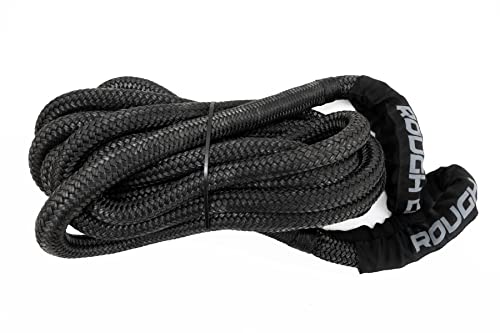
Rough Country’s rope, model RS173, is the plain option: 1 inch diameter, 30 feet long, a 30,000 lb maker capacity figure, loop ends, and a storage bag in the box. There is no bundled hardware and the maker publishes fewer construction details than the brands above it — no strand counts and no stretch percentage — and the guide notes that plainly rather than filling the gap with guesses.
What it offers instead is a recognized truck-aftermarket name and a figure that covers most full-size recovery work, in a rope that asks nothing of the buyer beyond a pair of soft shackles bought separately. The storage bag earns its mention: a kinetic rope stored loose in a cargo area abrades against every tool it rides with, and a bag is what keeps the braid clean between pulls. For a driver who already owns soft shackles and wants a simple, strong rope from a known badge, this is the straightforward pick.
Specs
- Diameter: 1 in
- Length: 30 ft
- Material: braided nylon kinetic rope
- Capacity figure: 30,000 lb (maker figure)
- Ends: loop eyes
- Model: RS173
- Includes: storage bag (soft shackles supplied separately)
- Best for: full-size trucks whose owners already carry soft shackles
Comparison: Which Rope Goes in Which Truck
- Tight trails, mid-weight rig: the Bubba Rope’s 20 ft length builds its pull in close quarters where a 30 ft line will not fit.
- Jeep or half-ton, standard trail work: the Yankum Python pairs the 30 ft length with a published working load for the 5,000–7,200 lb class.
- Full-size truck, gear treated as safety equipment: the Factor 55 publishes its working load limit and coats the braid against UV and grit.
- Heaviest figures, complete box: the ALL-TOP kit ships the 48,000 lb rope with the two soft shackles the no-metal rule requires.
- Simple rope, hardware already owned: the Rough Country covers full-size work at a plain 30,000 lb figure and includes its bag.
Frequently Asked Questions
What is the difference between a kinetic rope and a tow strap?
A kinetic rope is round double-braided nylon built to stretch — commonly 20 to 30 percent — so it stores energy during the pull and releases it as a smooth tug. A flat tow strap is polyester webbing that barely stretches; it is made for steady towing of a vehicle that can roll, and jerking one sends the whole shock load into both frames. Use the rope for stuck recoveries and the strap for towing.
How strong a rope does my truck need?
Work from the maker’s sizing chart, matched to the lighter vehicle in the pair, with a minimum breaking strength around two to three times that vehicle’s gross weight. Then plan the actual pull against the working load limit when the maker publishes one. A rope far stronger than the vehicle is not safer — it barely stretches behind a light rig and pulls harshly.
Why soft shackles instead of the steel shackles in my toolbox?
Because of what happens on a failure. A steel shackle or hook that lets go under a kinetic load becomes a projectile. A soft shackle that lets go falls to the ground. Soft shackles also wrap recovery points that a rigid steel shackle cannot fit, and they weigh a fraction as much in the gear bag.
Can I attach the rope to a tow ball for a short pull?
No. A tow ball is a towing fitting and can shear under a kinetic load. Attach only to frame-mounted recovery points or the maker’s designated recovery eyes, on both vehicles, every time.
How do I look after the rope between recoveries?
Rinse out mud and sand, since grit inside the braid cuts fibers under load. Dry the rope fully before bagging it, store it out of direct sunlight, and inspect the full length before every pull. Retire the rope when the outer braid is cut through or the inner core shows anywhere along its length.
Verdict
For most truck and SUV owners, the Yankum Python is the first buy: the standard 30 ft length, an honest pair of published figures, and sizing aimed squarely at Jeeps and half-ton trucks. Trail drivers in tight country should take the Bubba Rope’s 20 ft version of the same idea. The Factor 55 is the pick when a published working load limit and a coated braid matter more than anything else, the ALL-TOP kit is the complete and strongest box for heavy rigs, and the Rough Country is the plain rope for owners who already hold the hardware. Whichever rope lands in the truck, the rules travel with it: soft shackles only, everyone clear of the line’s reach, proper recovery points never tow balls, and a rope with a showing core is retired that day.
Related guides
More from Amazon
Programs that pair well with the guide above. Offers and eligibility are set by Amazon and may change.
A free business account with business pricing and bulk-buying tools for work, shop or home office.
Create a business accountFree shipping on eligible items, Prime Video and more. Eligible new members can start with a free trial.
Start a Prime free trialAudiobooks and podcasts to listen to on the go. Eligible new members can start with a free trial.
Try Audible freeAd-free music streaming. Eligible new subscribers can start with a free trial.
Try Music Unlimited freeAs an Amazon Associate we earn from qualifying purchases.








