
Key takeaways
- Compare concrete edgers, checking radius, blade material, handle and lip for slabs, sidewalks, driveways, patios, curbs and finishing work at home.
What's inside
As an Amazon Associate I earn from qualifying purchases. This post may contain affiliate links at no extra cost to you.
A freshly poured slab looks finished long before it actually is. The last pass that makes flatwork look professional is the edger: a small hand tool whose turned-down lip rides against the form while its curved underside rolls the sharp top corner of the slab into a smooth, rounded radius. That rounded edge is more than decoration. A square corner is the weakest part of any slab, and it chips the first time a shovel, a snow blade, or a car tire clips it. A properly formed radius compacts the concrete at the edge, pushes coarse aggregate back from the face, and leaves a margin that shrugs off everyday knocks.
Edgers look simple, but the details decide how the tool behaves on wet concrete. The radius sets how round the finished edge will be, the lip depth controls how the tool tracks along the form, and the blade material changes how the tool glides and how it must be stored. This guide compares five hand edgers that cover the range a home concrete worker is likely to meet, from a shallow-profile tool for thin slabs to a deep-lip sidewalk edger and a long stainless blade for covering ground on bigger pours.
Disclosure: As an Amazon Associate, I earn from qualifying purchases. Product details were verified at the time of writing.
Contents
How to Choose a Concrete Edger
Radius. The radius is the size of the curve the tool forms on the slab corner, and it is the single most important number on the tool. A small 1/8-inch radius leaves a subtle, nearly square edge suited to thin slabs, overlays, and interior floors where a bold roundover would look out of place. The 3/8-inch radius is the all-purpose middle ground for sidewalks and patios. A 1/2-inch or larger radius makes a pronounced rounded edge on driveways and thicker sections, where the extra material removed is no problem and the tougher edge pays off over years of use.
Lip depth. The lip is the turned-down edge that runs against the form board and keeps the tool aligned. A shallow 1/4-inch lip works on thin work and gives the operator fine control. Deeper lips track more positively along tall forms and thick slab edges, but on a thin pour a deep lip can dig below the form line and disturb the edge. Match the lip to the thickness of the work rather than treating deeper as automatically better.
Blade material. Blue steel is the traditional edger material: hard, smooth, and able to take a fine finish, but it must be cleaned and dried after every use or it will rust in storage. Stainless steel gives up a little of that slick feel in exchange for easy care, since it can be rinsed and put away without worry. For a tool that comes out a few times a year, stainless is the forgiving choice; for frequent work, blue steel rewards the extra minute of care.
Blade size and end shape. The 6 by 6 inch blade is the standard hand edger footprint, big enough to bridge small surface waves yet easy to steer. Longer blades, such as a 9-inch highway pattern, cover a straight run faster and help keep a long edge uniform. Straight ends work cleanly into corners and against cross forms, while turned-up curved ends let the tool slide in either direction without the leading corner catching, which suits long uninterrupted edges.
Handle. The handle is your only connection to the work, and edging is done kneeling at arm’s length, so grip shape matters. Molded soft-grip handles such as DuraSoft and ProForm stay comfortable with wet, gloved, or bare hands and resist spinning in the palm. A shaped wood handle is the classic alternative, lighter in the hand and easy to hold with a relaxed grip. Whichever style you pick, the mounting should feel rigid, because any flex between handle and blade shows up as a wavy edge.
1. Marshalltown 162BD Straight Concrete Edger

The 162BD is the edger most finishers would name if asked for one tool to own. Its 6 by 6 inch blue steel blade carries a 3/8-inch radius with a 1/2-inch lip, a combination that lands right in the middle of residential work: round enough to protect a driveway or sidewalk edge, restrained enough not to hollow out a thinner patio slab. The straight ends run cleanly up to cross forms and stop boards, so corners finish without swapping tools. The DuraSoft handle gives a secure hold when your hands are wet and dusty, and the blade’s hard blue steel takes a smooth finish on the concrete while asking only for a rinse, a dry, and a wipe of oil before storage. For a first edger, or the only edger, this is the sensible default.
Specs
- Blade size: 6 x 6 in
- Blade material: Blue steel
- Radius: 3/8 in
- Lip: 1/2 in
- Ends: Straight
- Handle: DuraSoft soft grip
- Origin: Made in the USA
2. Marshalltown 161BD Straight Concrete Edger

The 161BD shares the 6 by 6 inch blue steel platform of its sibling but pares the profile down to a 1/8-inch radius and a 1/4-inch lip, and that restraint is exactly its purpose. Thin slabs, repair patches, overlays, and step treads cannot spare the material a deep edger removes, and a bold radius on a 2-inch topping looks clumsy. This shallow tool kisses the corner into a neat, subtle round that resists feather-edge chipping without changing the look of the work. The shallow lip also makes the tool easy to control freehand along a chalk line or an existing edge where no form guides it. Keep the 161BD in the kit for the delicate jobs, and reach for a deeper tool when the section is thick enough to allow it.
Specs
- Blade size: 6 x 6 in
- Blade material: Blue steel
- Radius: 1/8 in
- Lip: 1/4 in
- Ends: Straight
- Handle: DuraSoft soft grip
- Origin: Made in the USA
3. Marshalltown 163BD Curved-End Concrete Edger
The 163BD is built for long, straight runs where stopping and turning the tool around wastes time and leaves marks. Both ends of its 6 by 6 inch blue steel blade curve upward, so the edger glides in whichever direction you push it without the leading corner digging in or the trailing corner dragging a line. The profile is bolder than the 162BD, with a 1/2-inch radius and a 5/8-inch lip that suits full-thickness driveway and sidewalk sections and produces a rounded edge that stands up well to tires and plow blades. On a long driveway apron or a street-side walk, the two-way action keeps your rhythm unbroken from one end of the pour to the other. It gives up a little precision in tight corners, where a straight-end tool still wins.
Specs
- Blade size: 6 x 6 in
- Blade material: Blue steel
- Radius: 1/2 in
- Lip: 5/8 in
- Ends: Curved (turned up both ends)
- Handle: DuraSoft soft grip
- Origin: Made in the USA
4. Kraft Tool CF190PF Stainless Steel Highway Edger
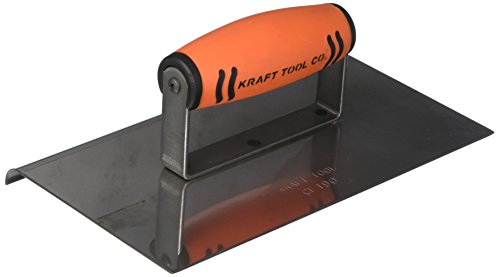
Kraft’s highway edger stretches the blade to 9 by 5 inches, and the extra length changes how the tool works. A long blade bridges minor waves in the surface, holds a truer line over distance, and finishes more edge per stroke, which matters on a long sidewalk or driveway where a standard edger means hundreds of extra passes. The blade is stainless steel with a 3/8-inch radius, so it delivers the all-purpose edge profile while shrugging off the rinse-and-forget storage habits that would ruin blue steel. The ProForm soft-grip handle fills the hand and stays put when wet. At just under a pound and a half, it is not tiring to run, though its length makes it clumsy in tight corners, where you will still want a standard 6-inch tool alongside it.
Specs
- Blade size: 9 x 5 in
- Blade material: Stainless steel
- Radius: 3/8 in
- Handle: ProForm soft grip
- Weight: 1.37 lb
- Style: Highway (long blade) pattern
5. Bon Tool 12-448 Stainless Steel Sidewalk Edger

The Bon 12-448 is the heavyweight profile of this group. Its 6 by 4 inch stainless blade forms a full 1-inch radius and carries a deep 1-1/2-inch lip, a combination made for thick sidewalk sections poured against tall forms, curb-adjacent work, and edges that will take real abuse from plows, shovels, and foot traffic. The deep lip registers firmly against the form face, so the tool tracks straight with little steering effort, and the big radius rolls an edge that has plenty of material behind it. The wood Comfort Wave handle is shaped to spread pressure across the palm during the firm downward push this tool invites. It is too much tool for thin slabs, where it would displace more concrete than the section can spare, but on heavy flatwork it produces the boldest, toughest edge here.
Specs
- Blade size: 6 x 4 in
- Blade material: Stainless steel
- Radius: 1 in
- Lip: 1-1/2 in
- Handle: Wood Comfort Wave
- Style: Sidewalk edger
Comparison Table
| Product | Blade size | Material | Radius | Lip | Handle |
|---|---|---|---|---|---|
| Marshalltown 162BD | 6 x 6 in | Blue steel | 3/8 in | 1/2 in | DuraSoft |
| Marshalltown 161BD | 6 x 6 in | Blue steel | 1/8 in | 1/4 in | DuraSoft |
| Marshalltown 163BD | 6 x 6 in | Blue steel | 1/2 in | 5/8 in | DuraSoft |
| Kraft Tool CF190PF | 9 x 5 in | Stainless steel | 3/8 in | — | ProForm |
| Bon Tool 12-448 | 6 x 4 in | Stainless steel | 1 in | 1-1/2 in | Wood Comfort Wave |
FAQ
When is concrete ready to edge? Begin once the bleed water sheen has left the surface and the concrete holds its shape when the tool passes. Run a short trial stroke: the edger should leave a clean, smooth groove without tearing the surface or pushing a wave of wet mix ahead of it. If the mix slumps back into the groove, wait a little longer and try again.
Should I choose a hand edger or a walking edger? A hand edger gives the control and feedback that most home pours need, and every tool in this guide is a hand edger for that reason. A walking edger, which mounts a similar blade on a long pole handle, earns its place on very long driveway runs where kneeling the whole distance is impractical, at the cost of some feel for what the blade is doing.
What radius works best on a driveway? A 3/8-inch radius is the safe all-round choice, and a 1/2-inch radius is worth choosing when the slab is thick and the edge will meet tires regularly. Reserve the 1-inch radius for heavy sidewalk and curb work, and the 1/8-inch radius for thin slabs and repairs.
How should an edger be cleaned and stored? Rinse concrete off the blade before it hardens, using a plastic scraper rather than striking the tool against a form. Dry the blade fully; blue steel deserves a light wipe of oil before it goes away, while stainless steel needs nothing more than drying. Store the tool flat or hung so the lip is not bent by other gear piled on top of it.
Verdict
Most home concrete work needs one good mid-profile edger, and the Marshalltown 162BD fills that role with its 3/8-inch radius, standard footprint, and comfortable grip. Add the shallow 161BD if you patch or pour thin sections, or the curved-end 163BD if your pours run long and straight. The Kraft CF190PF speeds up big jobs and stores without fuss thanks to its stainless blade, while the Bon 12-448 stands ready for the thickest, hardest-working edges. Match the radius and lip to the thickness of your slab, and any of these five will turn a raw pour into finished flatwork.
Related guides
More from Amazon
Programs that pair well with the guide above. Offers and eligibility are set by Amazon and may change.
A free business account with business pricing and bulk-buying tools for work, shop or home office.
Create a business accountFree shipping on eligible items, Prime Video and more. Eligible new members can start with a free trial.
Start a Prime free trialAudiobooks and podcasts to listen to on the go. Eligible new members can start with a free trial.
Try Audible freeAd-free music streaming. Eligible new subscribers can start with a free trial.
Try Music Unlimited freeAs an Amazon Associate we earn from qualifying purchases.








