
Key takeaways
- Compare the best cutting gauges by beam length, blade style, fence design and micro-adjust, with picks for slicing crisp layout lines across the grain.
As an Amazon Associate I earn from qualifying purchases. This post may contain affiliate links at no extra cost to you.
A cutting gauge does one job no pencil and no pin gauge can match: it severs wood fibers with a small knife blade as it draws a line parallel to an edge. That sliced line is what a tenon shoulder, a dovetail baseline, or the edge of a hinge mortise needs, because the cut fibers give a chisel or saw a physical wall to register against instead of a fuzzy scratch to guess at. Run a pin gauge across the grain and the point drags and tears; run a cutting gauge across the same board and the blade parts the fibers cleanly, leaving a line that stays crisp even on end grain.
Disclosure: As an Amazon Associate, I earn from qualifying purchases. Product details were verified at the time of writing.
The five gauges below share one pattern — a beam, a sliding fence, a lock, and a knife blade — but serve different benches: a traditional British hardwood gauge, a modern Canadian micro-adjust gauge in steel and aluminum, two Japanese kebiki in different reaches, and an ebony gauge with copper fittings. Each entry lists the beam, blade, fence, and adjustment facts from its maker or listing.
How to Choose a Cutting Gauge
Blade style comes first. Every gauge here uses a knife blade rather than a pin or a wheel, but the blades differ. Traditional British gauges hold a small spear-point cutter in the end of the beam with a brass wedge; tap the wedge out to remove the blade for honing, and flip the blade to put the bevel on either side. Japanese kebiki blades are thin carbon steel knives that slide in and out of the bamboo body, so the edge hides inside the tool in a drawer or apron pocket. The modern JessEm design uses a beveled A2 tool steel blade that retracts below the reference face when not in use. All three cut the same kind of line; the difference is how you sharpen, store, and replace the edge.
Beam length sets your reach. The distance from the fence face to the blade is the widest line you can strike from an edge. A compact 90 mm kebiki covers drawer parts, box work, and most tenon shoulders. A 120 mm gauge reaches deeper into casework, and a traditional beam of around 8 inches handles wide panels and long shoulders on breadboard ends. Longer is not automatically better — a short gauge is easier to control one-handed on small parts — so match the reach to the parts you mark most often.
Fence design decides how the line tracks. The fence face rides the edge of the board and does most of the work of keeping the line parallel. Wide faces resist tipping on narrow stock. Brass facing plates on a wooden fence stop the board’s edge from chewing into the wood over years of use. On metal gauges, a broad reference face keeps the tool from rocking at the start of a stroke.
Adjustment style is about how you set the width. Most traditional gauges are simple: slide the fence along the beam, lock it with a thumbscrew, and check the setting against a rule or directly off the mating part. That is fast and adequate for most joinery. A micro-adjuster earns its place when you creep up on a fit — matching a tenon to an existing mortise, for example — because it moves the fence in fine, repeatable steps without loosening the lock and starting over. If you set one width and mark forty parts, a plain thumbscrew is fine; if you sneak up on fits all day, micro-adjust is worth having.
Plan for the edge. A cutting gauge works only as well as its blade is sharp, so look at how the blade comes out and whether replacements exist. Wedge-held and screw-held blades remove in seconds and hone on any flat stone. Keep the bevel polished, and deepen the line over two or three light strokes rather than forcing one deep cut.
The 5 Best Cutting Gauges
1. Faithfull FAIRCUT Hardwood Cutting Gauge — the traditional all-rounder
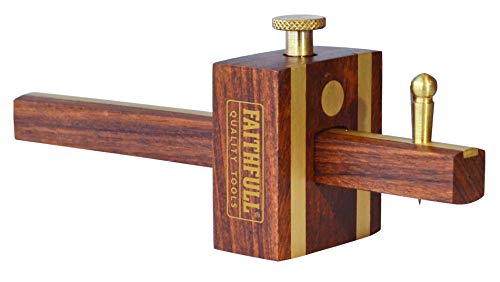
Faithfull builds the classic British cutting gauge the way Sheffield-pattern tools have been made for generations: a hardwood beam and fence, brass facing plates on the fence to resist wear, and a small re-sharpenable cutter clamped in the end of the beam by a solid brass wedge. It is made for scoring across the grain, and the same blade will slice small strips of veneer in thin stock. The fence locks with a knurled brass thumbscrew, and Faithfull fits a nylon friction pad under that screw so it bears on the stem smoothly without chewing into the wood — a small detail that keeps settings secure and repeatable. At just over ten ounces it tracks steadily without feeling clumsy on drawer-sized parts. For one straightforward, traditional cutting gauge for shoulders, baselines, and veneer work, this is the pattern to start with.
Specs
- Beam: hardwood stem with brass fittings
- Blade style: knife cutter, re-sharpenable, held by a solid brass wedge
- Fence design: hardwood fence with brass facing plates
- Adjustment style: sliding fence locked by a knurled brass thumbscrew with a nylon friction pad
- Weight: 10.2 oz
2. JessEm Wood Sabre Marking Gauge (08801) — the precision micro-adjust pick

JessEm re-engineered the cutting gauge in stainless steel and 6061 anodized aluminum, with the most exact setting mechanism in this group. The beveled blade is A2 tool steel hardened to 60 RC, and it retracts below the reference face when the tool is idle, so the edge stays protected in the tool chest. The reference face is stainless steel, just under 3 inches wide, for a stable, flat registration on the edge of a board. Setting is the headline feature: a fine micro-adjuster moves the fence with laser-engraved graduations, each full revolution of the collar advancing the setting by 1/16 of an inch and the collar reading down to 1/256 of an inch, with a sight window on the face to confirm the setting at a glance. A stainless knob locks the position once dialed in. The working range runs from 0 to 6 inches, and each gauge is honed and checked for accuracy at JessEm’s Canadian facility before it ships. For makers who match tenons to mortises by sneaking up on the fit, this is the gauge built for that habit.
Specs
- Beam: stainless steel, 0 to 6 in working range; body in stainless steel and 6061 anodized aluminum
- Blade style: beveled knife blade, A2 tool steel hardened to 60 RC, retracts below the reference face
- Fence design: stainless steel reference face, just under 3 in wide
- Adjustment style: micro-adjuster with graduated collar (1/16 in per revolution, readings to 1/256 in), sight window, stainless locking knob
3. KAKURI Suji Kebiki 120 mm (40948) — the longer-reach Japanese pick

The kebiki is Japan’s traditional answer to the cutting gauge: a bamboo beam and fence with a thin carbon steel knife that severs fibers instead of scratching them. This 120 mm version is the larger of KAKURI’s two kebiki gauges, with an overall length of 180 mm and a printed millimeter scale on the beam for quick repeat settings. The blade slides back into the bamboo body for storage, keeping the edge safe in an apron pocket. At 120 grams it is far lighter than any Western gauge here, and that lightness suits long layout sessions on the casework parts where its extra reach over the 90 mm model gets used — wider drawer sides, cabinet panels, and frame parts. The fence slides along the beam and locks with a hand-tightened screw, the arrangement Japanese carpenters have used for generations. It is made in Japan by KAKURI, and the thin blade takes a keen edge on a water stone in moments.
Specs
- Beam: bamboo, 180 mm overall length, printed millimeter scale
- Blade style: single carbon steel knife blade, retracts into the body for storage
- Fence design: bamboo fence block sliding on the beam
- Adjustment style: sliding fence with hand-tightened screw lock; maximum marking width 120 mm
- Weight: 120 g
4. KAKURI Suji Kebiki 90 mm (40947) — the compact Japanese pick

The smaller kebiki from KAKURI covers the layout work that fills most benches: dovetail baselines, tenon shoulders on drawer and box parts, and hinge gains. Its marking width tops out at 90 mm, which sounds modest until you realize how rarely a line falls farther than that from an edge in small joinery. The laminated bamboo body keeps the weight down to just over 3 ounces, so the gauge steers easily one-handed while your other hand holds the work. The Japanese carbon steel blade draws back into the body when you are done, and the fence sets by sliding and locking with a hand screw — set it off the chisel or the mating part and mark. It is the natural choice for anyone whose layout work lives at the small end of the scale.
Specs
- Beam: bamboo; overall size 5.91 in long per the listing dimensions
- Blade style: Japanese carbon steel knife blade, retracts into the body for storage
- Fence design: bamboo fence block sliding on the beam
- Adjustment style: sliding fence with hand-tightened screw lock; maximum marking width 90 mm
- Weight: 3.17 oz
5. Marhynchus Ebony Cutting Gauge, 8 Inch — the ebony and copper traditional pick

Marhynchus makes this gauge in the British style but in denser materials: an ebony beam and fence with pure copper fittings. Ebony is hard, heavy for its size, and takes a smooth polish, so the fence face glides along an edge and shrugs off wear that softer woods eventually show. The 8-inch beam gives it the longest reach in this group, suiting wide panels, long tenon shoulders, and veneer strips cut from bigger sheets. The knife blade sits at the end of the beam in the traditional arrangement, and the fence slides and locks with a screw in the copper-fitted head. There is no scale and no micro-adjuster — you set it from a rule or from the work itself, as this pattern has always been used. Choose it if you like the traditional form, want the reach, and prefer dense hardwood and metal fittings over bamboo or beech.
Specs
- Beam: ebony, 8 in
- Blade style: knife blade in the traditional end-of-beam arrangement
- Fence design: ebony fence with pure copper fittings
- Adjustment style: sliding fence with screw lock; set from a rule or the workpiece
Comparison Table
| Gauge | Beam | Blade | Fence | Adjustment |
|---|---|---|---|---|
| Faithfull FAIRCUT | Hardwood stem | Knife cutter, brass wedge | Hardwood, brass facing plates | Thumbscrew with nylon friction pad |
| JessEm Wood Sabre 08801 | Stainless steel, 0–6 in | A2 knife blade, 60 RC, retractable | Stainless face, just under 3 in wide | Micro-adjuster, readings to 1/256 in |
| KAKURI Kebiki 120 mm | Bamboo, 180 mm overall | Carbon steel knife, retractable | Bamboo block | Sliding fence, screw lock |
| KAKURI Kebiki 90 mm | Bamboo, compact | Carbon steel knife, retractable | Bamboo block | Sliding fence, screw lock |
| Marhynchus Ebony | Ebony, 8 in | Knife blade | Ebony, pure copper fittings | Sliding fence, screw lock |
FAQ
What is the difference between a cutting gauge and a marking gauge?
The cutter. A marking gauge scribes with a pin or a wheel, which works well along the grain but can tear fibers across it. A cutting gauge carries a small knife blade that slices the fibers as it goes, so lines stay clean across the grain and on end grain — exactly where joint shoulders need them.
Can a cutting gauge cut veneer?
Yes. Because the blade severs rather than scratches, a cutting gauge set to a narrow width will slice thin strips of veneer cleanly along a straight edge. Several traditional makers describe veneer strip cutting as a standard use for the tool, alongside scoring shoulder lines.
How do I set a cutting gauge so the line lands in the right place?
Set the fence from the work whenever you can — hold the blade against the chisel the joint must fit, or against the mating part — rather than trusting a scale. Lock the fence, make a test line on scrap, check it, then mark the real part with a light first pass and one or two deeper passes.
How do I sharpen the blade?
Remove the blade — tap out the brass wedge on a traditional gauge, or slide the blade out of a kebiki body — and hone the bevel on a fine stone, keeping the flat back flat. A few strokes restore the edge; the blades are small, so work slowly and keep fingers behind the edge.
Which should I choose for dovetail baselines: a cutting gauge or a wheel gauge?
Both are used, but the cutting gauge has the edge for baselines across end grain, because the knife severs the fibers at the exact shoulder line and leaves a wall the saw and chisel can follow. A wheel gauge tracks calmly and is forgiving; a blade cuts the crispest shoulder. Many hand-tool benches end up with one of each.
Verdict
For a single traditional gauge covering shoulders, baselines, and veneer strips, the Faithfull FAIRCUT is the straightforward choice: hardwood, brass wear plates, and a wedge-held blade you can hone for decades. If your layout work is about creeping up on exact fits, the JessEm Wood Sabre’s micro-adjuster and retractable A2 blade make it the precision pick. The two KAKURI kebiki split the Japanese option by size — the 120 mm for casework reach, the 90 mm for small joinery — and both disappear into an apron pocket with the blade safely inside the body. The Marhynchus ebony gauge suits anyone who wants the longest beam and the dense, polished feel of ebony and copper. Whichever you choose, set it from the mating part, test it on scrap, and let a sharp blade do the work in light passes.
Related guides
More from Amazon
Programs that pair well with the guide above. Offers and eligibility are set by Amazon and may change.
A free business account with business pricing and bulk-buying tools for work, shop or home office.
Create a business accountFree shipping on eligible items, Prime Video and more. Eligible new members can start with a free trial.
Start a Prime free trialAudiobooks and podcasts to listen to on the go. Eligible new members can start with a free trial.
Try Audible freeAd-free music streaming. Eligible new subscribers can start with a free trial.
Try Music Unlimited freeAs an Amazon Associate we earn from qualifying purchases.








