
Key takeaways
- Compare the best veneer glues with urea and PVA formulas, long open times, and rigid glue lines for flat panels and curved work in the shop.
As an Amazon Associate I earn from qualifying purchases. This post may contain affiliate links at no extra cost to you.
Veneer is the least forgiving sheet in the shop. It is thin enough for wet glue to soak straight through its pores, stiff enough to telegraph every bump in the substrate, and wide enough that a glue line which creeps even slightly shows up months later as a lifted edge or a wavy face. General wood glues are built for joints, where the glue hides inside a mortise or along an edge; veneer glue is built for full-surface bonds, where the glue line is the whole job. This guide compares five glues that are made or sold specifically for veneer work: a cold-press PVA blended to limit bleed-through, two urea-formaldehyde powders that cure into hard, creep-free glue lines, and the traditional liquid hide glue that veneer workers still reach for on curved work and repairs. General joinery glues, CA glues, and epoxies each have their own guides and are deliberately left out here; so are glue rollers and spreaders, which handle the spreading rather than the bonding.
Disclosure: As an Amazon Associate, I earn from qualifying purchases. Product details were verified at the time of writing.
How to Choose a Veneer Glue
Match the chemistry to the panel and the press. Cold-press PVA is the default for flat panels: it comes ready to use, cleans up with water, and its makers blend it to resist soaking through thin or open-grained veneer. Urea-formaldehyde powders are the choice when the glue line itself must stay rigid, on large flat panels that cannot be allowed to creep and on bent laminations that would spring back against a flexible glue. Liquid hide glue is the traditional veneer adhesive: it suits hammer veneering, marquetry, and curved work, and it is the one option here whose bond can be softened again later with heat and moisture.
Open time is the number that plans the glue-up. A veneer sheet cannot be nudged once it lands, so the minutes between spreading and full pressure decide how big a panel you can handle alone. The cold-press PVA below gives a stated 15 minutes of open assembly time. The urea powders work differently: once mixed, a batch stays usable for a stated pot life, and the DAP powder lists two to four hours, which is why big shops mix resin glue for multi-panel sessions. Hide glue works on a shorter, heat-driven clock and rewards a rehearsed routine. Whichever family you choose, dry-fit everything, cut the veneer oversize, and have the cauls or the vacuum bag ready before any glue is spread or mixed.
Bleed-through is a glue choice before it is a technique problem. Glue that reaches the show face blocks stain and finish unevenly, and the blotches only appear after the panel is too far along to fix. Veneer-specific PVA is formulated to minimize bleed-through on open-grained and unbacked veneers, and a thin, even spread of about six mils is the maker’s own guidance. Powdered resins mixed to the stated ratio stay where they are rolled for the same reason. With any of these glues, spread on the substrate only, keep the film thin, and keep excess away from edges and seams.
Rigid glue lines matter most on curved and large work. A cured PVA line stays slightly flexible, which is harmless inside a joint but lets a bent lamination creep toward its old shape and lets wide panels move under seasonal stress. Urea-formaldehyde cures glass-hard and does not creep, which is why it has been the panel-shop standard for decades. Hide glue also dries hard and brittle in the glue line, one reason restorers trust it under old veneer. If the piece is flat, small, and clamped well, any family here works; if it is curved or spans a tabletop, pick a glue whose cured line stays rigid.
Respect mixing, temperature, and shelf life. The powders only perform when the ratios are followed: DAP states five parts powder to three parts water by weight, and Cascamite states two parts powder to one part water by weight. Both powders also want a warm shop, with DAP listing a 70 degree F minimum for use. Dry powder keeps far longer than any mixed batch, and DAP gives its powder a 12-month shelf life in the pail. The liquid hide glue inverts the problem: it arrives ready to use but is a fresh, small-batch product with about a year of shelf life, which the maker says refrigeration extends. Urea powders contain formaldehyde, so mix them with a respirator on and air moving through the shop, and follow the label directions for the glue in front of you.
The 5 Best Veneer Glues
1. Titebond Cold Press for Veneer, Quart (5175)

Franklin builds this modified PVA for one job: cold-press laminating of veneer to solid wood, particleboard, MDF, plywood, and other porous substrates. The maker positions it as an alternative to contact cement for large-scale bonding of veneers to flat surfaces, with none of the solvent fumes that come with that route. The figures a veneer worker plans around are all printed in the maker’s data: a 15-minute open assembly time and 15 to 20 minutes total assembly time at 70 degrees F, a minimum spread of about six mils (roughly 250 square feet per gallon), and application above 50 degrees F. The formula is made to minimize bleed-through on open-grained and unbacked veneers, and the dried film is dark brown, so squeeze-out at an edge stays inconspicuous on darker species. It is nonflammable, cleans up with a damp cloth while wet, and suits a vacuum bag, a mechanical press, or clamps and cauls. The maker is equally plain about the boundary: this glue is designed for veneering and is not suited to general assembly work, and it is not recommended for exterior use or anywhere moisture is likely.
Specs
- Formula: Modified PVA emulsion
- Size: 32 fl oz (1 quart) bottle
- Open assembly time: 15 minutes at 70 degrees F
- Total assembly time: 15 to 20 minutes
- Spread: About 6 mils, roughly 250 sq ft per gallon
- Application temperature: Above 50 degrees F
- Solids: 42%
- Dried film: Dark brown
- Model: 5175
- Best for: Flat panels in a vacuum bag or cold press
2. DAP Weldwood Plastic Resin Glue, 4.5 lb (00204)

This is the classic North American urea-formaldehyde veneer and laminating glue: a pre-catalyzed powder you activate with water, mixed five parts powder to three parts water by weight (five to two by volume). Once mixed, a batch has a pot life of two to four hours, long enough to roll out a full session of panels without the glue changing character mid-job. The cured line is the reason generations of panel shops standardized on this chemistry: hard, rigid, and free of the cold creep that lets PVA-bonded veneer wander. DAP lists a bond shear figure of 2,800 PSI minimum, a useful temperature floor of 70 degrees F, and coverage of about 40 square feet from each pound of powder mixed with 9.5 fluid ounces of water. The amber glue line suits medium and darker species best. The trade-offs are real and worth stating: the powder contains formaldehyde, so mixing calls for a respirator and ventilation, the glue is for interior work, and a mixed batch that sits past its pot life is waste, not a head start on tomorrow.
Specs
- Formula: Urea-formaldehyde resin, pre-catalyzed powder
- Size: 4.5 lb pail
- Mixing: 5 parts powder to 3 parts water by weight
- Pot life: 2 to 4 hours once mixed
- Minimum use temperature: 70 degrees F
- Bond strength: 2,800 PSI minimum bond shear, per the maker
- Coverage: About 40 sq ft per pound of powder
- Shelf life: 12 months as dry powder
- Model: 00204
- Best for: Large flat panels and bent laminations that must not creep
3. Polyvine Cascamite Powdered Resin Wood Glue, 220g
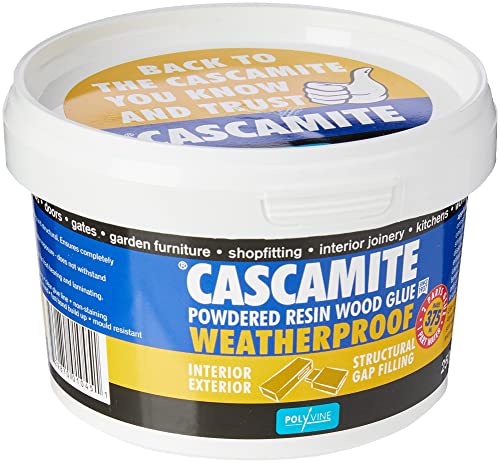
Cascamite is the long-established British urea-formaldehyde powder, and its maker’s own data sheet names veneering among its areas of use alongside joinery and cabinet work. It mixes two parts powder to one part cold water by weight (three and a half to one by volume), and the maker gives the mixed glue a usable life of about 45 minutes at 15 degrees C, so small batches mixed fresh are the working pattern with this tub. The cured glue is gap filling, highly water resistant, and mould resistant, and Polyvine states the bond is stronger than the wood itself; the glue also serves interior and exterior joinery, which none of the other powders here claim. Coverage runs 100 to 250 grams per square metre depending on the substrate. This 220-gram tub is the small-shop format: enough for a run of door panels, box lids, or a first bent lamination without opening a bulk pail. Keep the powder sealed and dry between sessions, because the maker notes it takes up moisture from the air.
Specs
- Formula: Powdered urea-formaldehyde resin
- Size: 220 g tub
- Mixing: 2 parts powder to 1 part water by weight
- Working life: About 45 minutes at 15 degrees C, per the maker
- Coverage: 100 to 250 g per square metre
- Glue line: Gap filling, off-white
- Maker-listed uses: Joinery, cabinet work, veneering
- Water resistance: High, per the maker; interior and exterior use
- Best for: Small veneer jobs mixed in fresh, tiny batches
4. Old Brown Glue Liquid Hide Glue, 5 oz

Old Brown Glue is the traditional veneer adhesive in a ready-to-use bottle. It is made by Patrick Edwards, a marquetry specialist, from 192 gram-strength hide glue and urea, and nothing else; the urea holds the glue liquid at room temperature, so there is no glue pot, no waiting for granules to melt, and a longer, more forgiving working window than hot hide glue gives. Hide glue earned its place in veneering centuries before resin glues existed: it dries to a hard glue line, it is worked with a veneer hammer on curved and shaped work where a press cannot follow, and a bubble or lifted corner can be softened with heat and moisture and pressed down again instead of stripped. The maker’s own description leads with veneer work, lamination, and antique restoration, which is exactly the work this bottle suits. The honest limits: the bond stays sensitive to damp heat, so kitchen and bathroom pieces are poor candidates, and the glue is made fresh in small batches with about a year of shelf life, which the maker says refrigeration extends.
Specs
- Formula: Liquid hide glue, 192 gram-strength hide glue with urea
- Size: 5 fl oz bottle
- Preparation: Ready to use, no glue pot needed
- Working style: Hammer veneering and pressed work
- Reversibility: Softens again with heat and moisture
- Shelf life: About 12 months, per the maker; longer refrigerated
- Maker: Antique Refinishers Inc.
- Model: OBG 5oz
- Best for: Curved work, marquetry, and repairs you may need to undo
5. DAP Weldwood Plastic Resin Glue, 1 lb (00203)

The one-pound pail of the same DAP urea-formaldehyde powder is the format occasional veneer work actually calls for. The chemistry, the mixing ratio, and the working figures match the big pail above: five parts powder to three parts water by weight, a two-to-four-hour pot life once mixed, a 70 degree F minimum use temperature, and the same rigid, creep-free cured line. What changes is the arithmetic of waste and storage. One pound of powder mixed with 9.5 fluid ounces of water yields about two and a half pints of glue and covers roughly 40 square feet, which is a sensible batch for a pair of cabinet doors, a tabletop, or a single bent lamination, and the unopened powder keeps its stated 12-month shelf life without a large pail sitting open in the shop. If you veneer every week, the larger pail is the better habit; if you veneer a few times a year, this is the pail that stays fresh. The same formaldehyde caution applies: respirator on while mixing, air moving, interior work only.
Specs
- Formula: Urea-formaldehyde resin, pre-catalyzed powder
- Size: 1 lb pail
- Mixing: 5 parts powder to 3 parts water by weight
- Pot life: 2 to 4 hours once mixed
- Minimum use temperature: 70 degrees F
- Yield: About 2.5 pints of mixed glue per pound of powder
- Coverage: About 40 sq ft per pound of powder
- Shelf life: 12 months as dry powder
- Model: 00203
- Best for: Occasional veneer work in single-panel batches
Comparison Table
| Product | Formula | Form | Working window | Standout trait |
|---|---|---|---|---|
| Titebond Cold Press for Veneer, Quart | Modified PVA | Ready-to-use liquid | 15 min open assembly | Blended to minimize bleed-through |
| DAP Weldwood Plastic Resin Glue, 4.5 lb | Urea-formaldehyde | Powder, mix with water | 2 to 4 hr pot life | Rigid line for panels and bent laminations |
| Polyvine Cascamite, 220g | Urea-formaldehyde | Powder, mix with water | About 45 min at 15 degrees C | Gap filling; interior and exterior use |
| Old Brown Glue, 5 oz | Liquid hide glue | Ready-to-use liquid | Heat-driven, hammer work | Bond can be softened and reworked |
| DAP Weldwood Plastic Resin Glue, 1 lb | Urea-formaldehyde | Powder, mix with water | 2 to 4 hr pot life | Single-panel batch size, stays fresh |
FAQ
Can I veneer with the regular wood glue already in my shop?
You can, and small panels often survive it, but general PVA is blended for joints, not for full-surface bonds under thin sheet material. It is more prone to bleed-through on open-grained veneer, and its cured line stays flexible enough to let wide panels and bent work creep over time. A glue made for veneer work exists precisely to close those two gaps.
Which glue should I pick for curved work and bent laminations?
Pick a glue whose cured line stays rigid. The urea-formaldehyde powders are the standard answer, because a hard glue line holds the curve instead of slowly letting go of it. Liquid hide glue is the traditional alternative for shaped work that a veneer hammer can follow, with the bonus that mistakes can be softened and reworked.
How do I stop glue bleeding through the veneer face?
Spread less, and spread it on the substrate only. The cold-press PVA here is formulated to minimize bleed-through and its maker calls for a film of about six mils; the resin powders mixed to their stated ratios behave the same way. Thick, wet coats near seams and edges are where bleed-through starts.
How long does a veneered panel stay in the press?
Follow the glue in front of you. The PVA sets at a moderate speed and its maker frames the job in minutes of assembly time, while the urea powders work on a pot life measured in hours and are commonly left under pressure far longer, often overnight in small shops. Hide glue panels come out once the glue has grabbed and cooled. When in doubt, leave the panel pressed longer rather than shorter, and let it rest flat before trimming.
Do I need to veneer the back of the panel too?
In most cases, yes. A panel veneered on one face only takes up and releases moisture unevenly, and it can bow toward the bare side. A balancing veneer of similar thickness on the back, glued in the same session with the grain running the same way, keeps both faces moving together.
Verdict
For flat panels in a home shop, start with Titebond Cold Press for Veneer: it is ready to use, its working figures are printed and plan-able, and it is blended for the bleed-through problem that ruins more first panels than weak bonds ever do. When the work is large, curved, or simply cannot be allowed to creep, mix a urea-formaldehyde powder instead: the DAP Weldwood Plastic Resin Glue in the 4.5 lb pail for regular panel work, the same DAP powder in the 1 lb pail for occasional single-panel sessions, or Polyvine Cascamite where a small gap-filling batch with exterior tolerance is the better fit. Keep Old Brown Glue for the work the synthetics cannot do: hammer-veneered curves, marquetry, and the repair you may one day need to undo. Match the glue to the press you own and the panel in front of you, and the bond stops being the risky part of veneering.
Related guides
More from Amazon
Programs that pair well with the guide above. Offers and eligibility are set by Amazon and may change.
A free business account with business pricing and bulk-buying tools for work, shop or home office.
Create a business accountFree shipping on eligible items, Prime Video and more. Eligible new members can start with a free trial.
Start a Prime free trialAudiobooks and podcasts to listen to on the go. Eligible new members can start with a free trial.
Try Audible freeAd-free music streaming. Eligible new subscribers can start with a free trial.
Try Music Unlimited freeAs an Amazon Associate we earn from qualifying purchases.








