
Key takeaways
- Compare belt tension gauges by belt type, deflection scales and case storage, with maker chart matching and the repeat checks that keep readings honest.
What's inside
As an Amazon Associate I earn from qualifying purchases. This post may contain affiliate links at no extra cost to you.
A drive belt set by thumb feel is a guess wearing work gloves. Too loose, and the belt slips, squeals, glazes its contact faces, and under-drives the alternator, pump, or spindle it serves. Too tight, and the same belt side-loads every bearing in the drive until one of them starts to growl. A belt tension gauge replaces the guess with a number you can match against the maker’s chart, and that is the only subject of this guide. The families are few: click-type gauges that press on the span and signal when the belt reaches a set tension, deflection gauges that apply a known force and read the result on a scale, and the fixed-force tools built around the 10 lb specification used on motorcycle secondary drive belts. Engine timing tools are a different shelf — the locking kits in our timing belt tools guide pin camshafts and crankshafts in place while a belt is swapped, and they measure nothing. Serpentine belt wrenches and tensioner tools are likewise built to move a tensioner, not to read a belt. What follows is the measuring shelf: one universal shop gauge, one click gauge for V-belts, two 10 lb motorcycle tools, and the meter made for belt-drive bicycles.
Disclosure: As an Amazon Associate, I earn from qualifying purchases. Product details were verified at the time of writing.
How to Choose a Belt Tension Gauge
Match the gauge family to the belt first. Plain V-belts and narrow ribbed belts on cars, mowers, and shop machines are click-gauge territory: the gauge sits on the span, you press the pad, and the tool clicks when the belt reaches the tension printed on its scale, in pounds and kilograms. Wider ribbed serpentine belts run higher installation tensions and need the higher-range click gauges built for five ribs and up. Deflection gauges take the other route — they push the belt with a known force and read either the resulting tension or the travel — which suits mixed fleets and industrial drives where one tool must cover many belt sections. Motorcycle secondary belts are their own case: the factory method fixes the force at 10 lbs and gives you a deflection window, so the tool’s whole job is delivering that exact force squarely, every time.
Read at mid-span, on a cold belt, more than once. Every method in this guide assumes the gauge sits midway between two pulleys, square to the belt, with the drive at rest and cool. A single reading is a sample, not a verdict. Pulleys are never perfectly true, so tension varies around the drive; roll the belt through a full turn and check at several points, then set the drive so the tightest point sits inside the maker’s range. Belts also seat in during the first minutes of running, which is why maker charts print a higher installation figure and a lower re-check figure. Set a new belt to the installation number, run the drive briefly, let it cool, and confirm it still holds the re-check number before you call the job done.
Match the number to the maker’s chart, not to habit. A gauge reading means nothing until it is compared with the chart for that belt and drive. Vehicle service manuals give the figure for accessory drives; belt makers publish installation and re-tension tables by belt section and rib count; motorcycle manuals give the deflection window at 10 lbs for each model. Automatic spring tensioners are the exception that proves the rule — they set their own tension and give you nothing to adjust, so a gauge earns its keep on manually adjusted drives: older vehicles, mowers, snow blowers, shop equipment, HVAC blowers, and belt-drive motorcycles and bicycles.
Think about where the gauge will live. These are small tools, and most ship in a blister pack or a simple box rather than a fitted hard case. The click gauges are pocket-sized and carry well in a tool roll; the long universal gauge wants a drawer or a pouch where its scale stays clean and its arm cannot be bent by heavier tools. If the gauge travels in a road kit, a zip pouch or a small blow-mold case bought alongside it is cheap protection for the one part that matters — the printed scale. Wipe grit off the pad and scale before a reading; dirt under the pad is a false reading waiting to happen.
The 5 Best Belt Tension Gauges
1. OTC 6673 Universal Belt Tension Gauge

The one-gauge answer for a bench that sees many kinds of drives. The OTC 6673 is a universal deflection-style gauge whose dual scale reads belt tension directly from 30 to 180 lbs, with a second scale from 130 to 800 newtons for the manuals that spec the job in metric force. That range covers the working heart of automotive V-belts and ribbed belts, mower deck and spindle belts, and the small industrial drives in shop and farm equipment, and the direct-reading scale removes the separate force-versus-travel math that pencil testers demand. OTC has kept this model in its catalog for decades, which matters for a measuring tool: the chart values in older service manuals were written with this class of gauge in mind. If a shop buys one tension gauge for everything with pulleys, this is the shape that purchase usually takes.
Specs
- Brand: OTC
- Model: 6673 Belt Tension Gauge, Universal
- Scale: 30 to 180 lbs; 130 to 800 N (dual scale)
- Gauge type: Deflection, direct-reading
- Belts: V-belts and ribbed drive belts
- UPC: 731413046124
- ASIN: B000I198J0
2. Continental 9001 Krikit Tension Gauge

The click-type pick for plain V-belts and narrow ribbed belts. Continental’s 9001 Krikit covers 30 to 150 lbs (14 to 70 kg) and is built for V-belts plus 3- and 4-rib Poly-V belts — the accessory drives on older cars and trucks, riding mowers, and compact equipment. The method is the Krikit one: lay the gauge along the span, press the pressure pad until the tool clicks, stop pressing, and read where the indicator arm crosses the scale. No second hand and no ruler are involved, which is why these gauges stay popular for quick checks in tight engine bays. At 5.1 inches long and just over an ounce, it rides in a shirt pocket like the pen it resembles, and the instruction sheet with its belt tension chart is packed in with the tool. Note the boundary Continental prints for the whole Krikit line: these gauges are not for timing belts, which are set by engine-specific procedure instead.
Specs
- Brand: Continental (ContiTech)
- Model: 9001 Krikit Tension Gauge
- Scale: 30 to 150 lbs; 14 to 70 kg
- Gauge type: Click-type, pressure pad and indicator arm
- Belts: V-belts; 3- and 4-rib Poly-V belts
- Dimensions: 5.1 x 1.4 x 0.9 in
- Weight: 1.28 oz
- ASIN: B004TB2VZI
3. Motion Pro 08-0350 Belt Tension Gauge
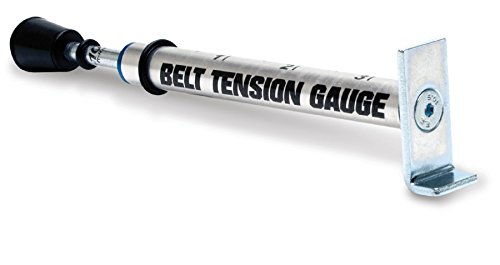
The reference tool for belt-drive motorcycles. Harley-Davidson and Indian service procedures set the secondary drive belt by deflection under a 10 lb load, and the Motion Pro 08-0350 is built to deliver exactly that load: seat the belt cradle under the lower strand at mid-span, push up on the plunger until the small O-ring marker reaches the tool body, and the belt has seen its 10 lbs. A graduated scale on the body and a second, larger O-ring let you read the deflection itself when the manual gives a travel window instead of a gauge reading. The tool replaces the Harley-Davidson OEM 40006-85 gauge and the Indian OEM PV-43532, so its readings line up with the figures printed in those factory manuals. It is compact, all-mechanical, and works on any belt-drive model whose specification is written around the same 10 lb method.
Specs
- Brand: Motion Pro
- Model: 08-0350 Belt Tension Gauge
- Test force: 10 lbs
- Gauge type: Spring plunger deflection, O-ring markers
- Belts: Motorcycle secondary drive belts
- Replaces: Harley-Davidson OEM 40006-85; Indian OEM PV-43532
- ASIN: B00I8JNOEO
4. ARES 15033 Belt Tension Gauge

A second 10 lb tool, shaped for the same motorcycle job with a different foot. The ARES 15033 follows the same factory method as the Motion Pro — apply a 10 lb load to the lower strand and read the deflection on a graduated scale — but its L-shaped pad sits flat against belts of any width in this class, which riders with several belt-drive machines will appreciate. ARES frames it for the three moments the check actually happens: after a belt replacement, after an adjustment, and after wheel service, since any rear-wheel work changes axle position and therefore belt tension. The scale is printed for quick reference at the bike rather than back at the bench, and the universal design covers the belt-drive models built around a 10 lb specification, Harley-Davidson included. Between this and the Motion Pro above, the choice is pad shape and which scale your eyes read faster; the method and the load are identical.
Specs
- Brand: ARES
- Model: 15033 Belt Tension Gauge
- Test force: 10 lbs
- Gauge type: Spring plunger deflection, graduated scale
- Pad: L-shaped, fits all belt sizes in class
- Belts: Motorcycle secondary drive belts with a 10 lb specification
- ASIN: B084KX8R61
5. Gates Carbon Drive Krikit Belt Tension Meter (74010073)

The pick for the belt drive that is not on a vehicle at all. Gates Carbon Drive bicycles and e-bikes run a toothed carbon belt instead of a chain, and that belt has a tension window of its own — too slack and it ratchets under load, too tight and it drags on the bearings. This Krikit is the mechanical meter Gates sells for the system: the same click-gauge idea as the automotive versions, sized and scaled for bicycle belt spans, with the reading matched against the Gates Carbon Drive tension charts for the frame and sprocket combination. It gives belt-drive bike owners a repeatable number without a phone, an app, or a charged battery, and it is the tool a shop reaches for when a Carbon Drive bike comes in for a wheel or gearing change. It does not read automotive belts and is not a substitute for the gauges above; within its own drive class, it is the maker’s own instrument.
Specs
- Brand: Gates Carbon Drive
- Model: 74010073 Belt Tension Meter, Krikit
- Gauge type: Click-type tension meter
- Belts: Gates Carbon Drive bicycle and e-bike belts
- UPC: 770075406150
- ASIN: B003UP6AH4
Comparison Table
| Gauge | Type | Belts it serves | Scale or test force |
|---|---|---|---|
| OTC 6673 | Deflection, direct-reading | V-belts, ribbed belts, mixed drives | 30 to 180 lbs; 130 to 800 N |
| Continental 9001 Krikit | Click-type | V-belts, 3- and 4-rib Poly-V | 30 to 150 lbs |
| Motion Pro 08-0350 | Plunger deflection | Motorcycle secondary belts | 10 lbs fixed force |
| ARES 15033 | Plunger deflection | Motorcycle secondary belts | 10 lbs fixed force |
| Gates Carbon Drive Krikit | Click-type meter | Carbon Drive bicycle belts | Maker chart match |
FAQ
Can a Krikit gauge set a timing belt? No. The Krikit makers state plainly that these gauges are not for timing belts. Timing belts are tensioned by engine-specific procedure — locking tools, marked positions, and often a spring tensioner set by rotation — and the timing belt tools guide on this site covers that shelf.
Why does the reading change as I roll the belt around? Because no pulley runs perfectly true. Every drive has a tight spot and a loose spot. Check at several points around a full turn and set the drive so the tightest point falls inside the maker’s range; setting by the loosest point leaves the tight point over-tensioned and hard on bearings.
The chart shows two different numbers for my belt. Which one do I use? The higher figure is for installation, the lower for re-checking a belt that has run. New belts seat into the pulleys and relax slightly in the first minutes of work. Set to the installation number, run the drive for a few minutes, let it cool, and confirm the belt still holds at least the re-check number.
My car has an automatic tensioner. Do I need a gauge? For that drive, no — the spring tensioner holds its set tension and offers no adjustment to make. Gauges earn their place on manually adjusted drives: older vehicles, lawn and garden equipment, shop machinery, HVAC blowers, and belt-drive motorcycles and bicycles.
Can the motorcycle gauges check a car belt? Not usefully. The 10 lb tools deliver one fixed force for the deflection method written into motorcycle manuals. Car and equipment drives are specified as tension values, and they need a gauge that reads across a range, like the OTC or the Krikit above.
Verdict
Buy the OTC 6673 if one gauge must cover a mixed bench — its dual scale reads the widest span of automotive and equipment drives directly, in pounds or newtons. Buy the Continental 9001 Krikit if your work is V-belts and narrow ribbed belts and you want the press-click-read routine with nothing else to carry. Belt-drive motorcycle owners should own one of the 10 lb tools: the Motion Pro 08-0350 for its factory-tool lineage, or the ARES 15033 for its flat L-shaped pad across belt widths. And if the belt drive in your garage is a Gates Carbon Drive bicycle, its own Krikit meter is the only pick on this page that speaks its language. Whichever gauge you choose, the habit matters more than the hardware: mid-span, cold belt, several points around the drive, and the maker’s chart open beside you.
Related guides
More from Amazon
Programs that pair well with the guide above. Offers and eligibility are set by Amazon and may change.
A free business account with business pricing and bulk-buying tools for work, shop or home office.
Create a business accountFree shipping on eligible items, Prime Video and more. Eligible new members can start with a free trial.
Start a Prime free trialAudiobooks and podcasts to listen to on the go. Eligible new members can start with a free trial.
Try Audible freeAd-free music streaming. Eligible new subscribers can start with a free trial.
Try Music Unlimited freeAs an Amazon Associate we earn from qualifying purchases.








