
Key takeaways
- Compare fireplace gloves by lengths, linings and leather builds, with the dry-gloves-only rule and ember-brush-off habit wood stove owners rely on.
As an Amazon Associate I earn from qualifying purchases. This post may contain affiliate links at no extra cost to you.
A fireplace glove has one job: to stand between your hand and the firebox for the few seconds a real task takes — setting a split of oak on the coals, swinging a stove door open, turning a damper, lifting a hot handle that has sat too close to the heat. It is a long-cuff leather or aramid glove built for hearth work, and everything about it, from cuff length to lining, serves that short, hot reach.
The boundaries are worth stating plainly. Welding gloves are a shop class built around spatter and radiant load at the bench, with their own criteria and their own guide; a welding gauntlet can survive a firebox, but it was not cut for one. General work gloves are a handling class for grip and abrasion, and a leather palm alone does not make one a hearth glove. Grill mitts and oven gloves stop at the wrist and leave the forearm bare exactly where a stove door radiates. What follows is only the hearth shelf: five long-cuff gloves sold for fireplace and wood stove use.
Disclosure: As an Amazon Associate, I earn from qualifying purchases. Product details were verified at the time of writing.
How to Choose Fireplace Gloves
Cuff length is forearm coverage, and the firebox decides how much you need. A 14-inch glove covers the hand and the lower forearm. A 16-inch glove with a long sleeve reaches toward the elbow and shields the arm on deep reaches into a low stove or a wide fireplace opening. Measure from your middle fingertip to where you want the coverage to end with your arm stretched into the firebox the way you actually load it, not standing straight at the hearth.
Read the leather, because the hide is the first insulation. Cowhide is the common hearth leather: dense, slow to stiffen, and tough against bark and split ends. Split cowhide is the suede-like inner layer, cut thick on most long-cuff pairs. Pigskin stays softer through repeated heat cycles that leave cowhide board-stiff, which is why it shows up on gloves sold for feel. Whatever the hide, Kevlar or other flame-resistant stitching matters: plain cotton thread chars where embers land and lets seams open.
Lining is the second insulation, and layers beat bulk. A cotton lining adds comfort and a first heat buffer. Better hearth builds stack an aluminum-foil layer between the leather and the lining; the foil reflects radiant heat back toward the fire instead of passing it through. A glove with a foil layer and a modest hide often outlasts a single thick skin on a long reach, because radiant heat is most of what rolls out of an open stove door.
Heat figures are maker figures, and they describe material, not holding time. Makers publish figures such as 932°F for the materials in the glove. That number says nothing about how long you can hold a hot object; heat seeps through any glove in seconds. Treat every figure as a ceiling for brief contact, and treat a glove with no published figure as a quick-grab glove until you know your own stove’s habits.
Fit is a control feature. A glove too large folds at the palm and fumbles a damper latch; a glove too small pulls at the seams and tires the hand. Most hearth gloves are one-size, so check the maker’s length and hand measurements, and confirm your fingers reach near the tips with the cuff still covering the wrist at full stretch.
Safety Rules That Come First
Gloves go on dry — only dry, every time. A damp glove steams against hot metal and drives heat straight to the skin; wet leather is worse than a thin glove. If a pair gets rained on, dunked, or sweated through, let it dry fully away from the fire before the next use, and never start a loading session with gloves that feel cool and clammy.
Gloves are for brief contact, never for holding hot metal at length. Moving a log, opening a door, turning a damper, nudging a grate — seconds each. No hearth glove is a handle you can lean on. If a job needs a sustained hold, it needs a tool: tongs, a poker, or a hook, with the glove as backup.
Embers get brushed off, never patted out by hand. A pat grinds a live ember into the leather and holds it against the palm. Brush embers off with the other gloved hand in a flicking motion away from the body, or knock the glove against the hearth edge, and check the palm and finger webs before the next reach.
Store gloves away from the hearth’s direct heat. Leather left leaning on a hot stove dries out, stiffens, and loses the suppleness that makes it protective. Hang the pair on a hook a clear step from the stove, out of the radiant path, and retire any glove whose leather has gone board-hard or whose seams have opened.
The Five Picks
1. RAPICCA Fireplace Gloves, 16 Inch

The deep-reach specialist of this guide. RAPICCA builds this pair for fireplace and fire pit work first: a 16-inch glove with a 7.5-inch extended sleeve, the longest forearm coverage here, over a three-layer stack of fire-resistant leather, an insulating aluminum-foil middle, and a heat-resistant cotton liner. Double leather reinforcement sits on the fingers, palms, and backs — the spots that brush the door frame on the way in and out. The fit runs long, so smaller hands should expect room in the fingers.
Specs
- Length: 16 in with a 7.5 in extended sleeve
- Build: 70% fire-resistant leather, 10% aluminum foil layer, 20% cotton liner
- Stitching: Kevlar thread
- Maker heat figure: 932°F for the materials
- Size: one size; colour: dark grey
2. Grill Armor Fire Pit and Campfire Gloves, 16 Inch

Grill Armor sells this pair for fire pits, campfires, fireplaces, and wood stoves, and backs the build with an EN407 maker figure of 932°F for the materials. The leather-and-cotton construction carries double-reinforced padding across the fingers, palms, and back of the hand, with flame-retardant stitching throughout. The 16-inch cuff covers the forearm on open-hearth work, and the sweat-absorbing build suits an evening of repeated loading. One size only, so there is no size-specific choice.
Specs
- Length: 16 in
- Build: leather outer with cotton, double-reinforced padding at fingers, palms, and back
- Stitching: flame-retardant thread
- Maker heat figure: 932°F, EN407 basis stated by the maker
- Size: one size; model Gagwb1
3. WZQH Leather Gloves, 16 Inch
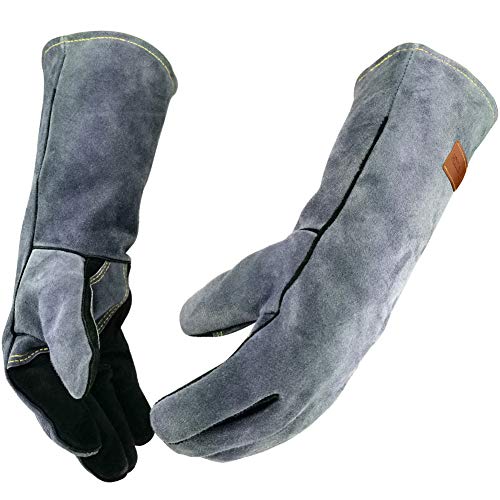
WZQH’s long leather pair is a split-cowhide glove with an aluminum-foil composite middle layer and a cotton lining, listed for fireplace and campfire work among its uses. At 16 inches it matches the longest cuffs here, and unlike most of this shelf it comes in a named Large size, which makes it the natural pick for bigger hands that swim in one-size gloves. The maker heat figure matches the top of this guide; the foil layer does the radiant-heat work on deep reaches.
Specs
- Length: 16 in
- Build: split cowhide leather, aluminum-foil composite middle layer, cotton lining
- Maker heat figure: 932°F for the materials
- Sizes: size options including Large
- Palm: full leather
4. Rocky Mountain Goods Leather Fireplace Gloves
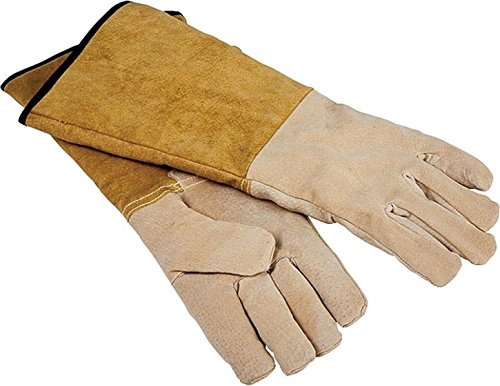
The feel pick. Rocky Mountain Goods builds this pair from pigskin, the hide that stays supple through heat cycles that stiffen cowhide, and sells it as a fireplace glove by name. At 16 inches the coverage matches the rest of the long-cuff shelf, while the softer leather keeps enough finger feel to work a latch or pinch a log end without pawing at it. The honest limit: the maker publishes no heat figure for this pair, so treat it as a brief-contact glove for loading and door work, not the pair for the longest holds.
Specs
- Length: 16 in
- Build: pigskin leather
- Maker heat figure: none published — brief contact only
- Fit: sized for fireplace and wood stove loading
- Palm: full leather
5. Breeo Fire Pit Gloves

Breeo makes fire pits, and this is its own glove for them: a 16-inch leather pair with a cowhide palm and an air-isolated aluminum-foil layer on the grip side, putting the radiant barrier exactly where the palm meets a hot handle or log. The heavyweight build suits owners of deep fire pits and wide hearths. The honest limit matches the pigskin pick above: the listing states no heat figure, so this is a brief-contact glove, and its one-size cut will not suit every hand.
Specs
- Dimensions: 16 x 7.5 in
- Build: leather with cowhide palm, air-isolated aluminum foil on the grip side
- Maker heat figure: none stated in the listing — brief contact only
- Size: one size
- Care: spot clean with leather cleaner
Verdict
For most wood stove owners, the RAPICCA pair is the first reach: the longest sleeve here, a foil layer against radiant heat, and reinforcement where the door frame bites. If a named size matters more than the last inch of coverage, the WZQH Large is the fit pick, and the Grill Armor pair matches the top maker heat figure with padding across the whole hand. Choose the Rocky Mountain Goods pigskin when feel at the latch matters most, and the Breeo when a grip-side foil layer suits how you handle logs. Whichever pair hangs by your hearth, the rules do the real protecting: dry gloves only, brief contact only, embers brushed off, and storage out of the stove’s radiant path.
FAQ
Can fireplace gloves pick up a burning log? Briefly, yes — shifting a log that is already alight is the core job. Keep the contact to seconds, set the log down rather than holding it, and never reach for a log that has rolled where your forearm would cross the coals.
How long should fireplace gloves be? Long enough to cover the wrist and lower forearm at full reach into your firebox. Sixteen inches suits deep stoves and wide openings; fourteen inches is enough for a shallow fireplace loaded from the front.
What do I do when an ember lands on the glove? Brush it off with a flick of the other gloved hand, away from your body. Never pat it — patting presses the ember into the leather and holds the heat against your palm.
When is a pair worn out? When the leather has gone stiff and board-hard, when seams open, or when the lining has crushed flat. A stiff glove has already given away its insulation; replace the pair rather than working around it.
Related guides
More from Amazon
Programs that pair well with the guide above. Offers and eligibility are set by Amazon and may change.
A free business account with business pricing and bulk-buying tools for work, shop or home office.
Create a business accountFree shipping on eligible items, Prime Video and more. Eligible new members can start with a free trial.
Start a Prime free trialAudiobooks and podcasts to listen to on the go. Eligible new members can start with a free trial.
Try Audible freeAd-free music streaming. Eligible new subscribers can start with a free trial.
Try Music Unlimited freeAs an Amazon Associate we earn from qualifying purchases.








