
Key takeaways
- Compare vapor barriers by thickness, material and roll size, with the overlap-every-seam rule and seal-the-edges habit for dry crawl spaces.
What's inside
- How to Choose a Vapor Barrier
- 1. Whitecap Woven Vapor Barrier, 20 Mil, 12 ft. by 100 ft.
- 2. PURTERIA Crawl Space Vapor Barrier and Tape Combo, 10 Mil, 10 ft. by 100 ft.
- 3. ALORAIR Crawl Space Vapor Barrier, 10 Mil, 10 ft. by 25 ft.
- 4. VBS 20 Mil Radon Barrier, EVOH, 12 ft. by 120 ft.
- 5. VAPLINX Crawl Space Vapor Barrier, 10 Mil, 12 ft. by 100 ft.
- Verdict
- Laying a Barrier That Stays Sealed
As an Amazon Associate I earn from qualifying purchases. This post may contain affiliate links at no extra cost to you.
A vapor barrier is the sheet that covers bare ground under a house. Soil gives off moisture around the clock, and in a crawl space that vapor rises into floor framing, insulation, and the air of the rooms above. A continuous ground cover, sealed at its seams and edges, is what stops it. The same family of heavy polyethylene sheets also goes under basement floors and slabs as a moisture and soil-gas layer. This guide covers those ground-cover sheets: plain films, woven and reinforced liners, and one multilayer gas barrier. It does not cover window insulation kits — shrink film for window glass is a different product — and it does not cover landscape weed fabric, which is woven to let water through on purpose, the opposite of this job.
Disclosure: As an Amazon Associate, I earn from qualifying purchases. Product details were verified at the time of writing.
Two rules govern every pick below. The first is to overlap every seam and seal it: lay each new sheet over the last by at least six inches — some local codes call for twelve — and tape the full length of the joint, because an untaped overlap is a chimney for soil vapor. The second is to seal the edges: run the sheet up the foundation walls and around every pier, and seal it there, so the finished cover is one continuous pan with no bare soil left open at the borders.
Contents
- How to Choose a Vapor Barrier
- 1. Whitecap Woven Vapor Barrier, 20 Mil, 12 ft. by 100 ft.
- 2. PURTERIA Crawl Space Vapor Barrier and Tape Combo, 10 Mil, 10 ft. by 100 ft.
- 3. ALORAIR Crawl Space Vapor Barrier, 10 Mil, 10 ft. by 25 ft.
- 4. VBS 20 Mil Radon Barrier, EVOH, 12 ft. by 120 ft.
- 5. VAPLINX Crawl Space Vapor Barrier, 10 Mil, 12 ft. by 100 ft.
- Verdict
- Laying a Barrier That Stays Sealed
How to Choose a Vapor Barrier
Thickness. Sheet thickness is stated in mil, one mil being a thousandth of an inch, and it is the plainest measure of how much abuse a liner takes before it punctures. Six mil is the floor many ground-cover rules name. Ten mil is the working standard for a crawl space floor that gets crawled over during service work. Fourteen to twenty mil belongs on rough, stony ground and in encapsulation jobs meant to be walked on for years.
Build. Plain polyethylene film is one uniform sheet: flexible, easy to fold around piers, and only as strong as its thickness. Woven polyethylene interlaces strands and coats them on both sides, so a tear that would run across plain film stops at the weave. String-reinforced film carries a cord grid inside the sheet for the same reason. Multilayer gas barriers add a resin layer such as EVOH, aimed at soil gases as well as water vapor.
Roll size and coverage. Widths of ten and twelve feet are the common crawl space formats, in lengths from a 25-foot patch roll to 120 feet. Coverage is simply width times length, plus what you spend turning the sheet up walls and wrapping piers — measure the floor, add the turn-ups, and buy for the total. A wider roll means fewer seams, and every seam is a joint you have to tape well.
Color and sidedness. White sheeting brightens a dark crawl space and makes leaks and pest sign easy to spot. Black film blocks light completely. Panda film pairs the two: a black face that blocks light and a white face that reflects your work light back at you. None of this changes the moisture work; it changes how pleasant the space is to inspect.
Code class. Ground-cover rules in many jurisdictions call for a Class I vapor retarder — the class at the low end of the permeance scale — with sealed seams and edges. Engineered sheets publish permeance figures from standard lab tests, and the picks below state those figures as the makers publish them. Check your local rule before you buy, because vented and sealed crawl spaces are treated differently in different places.
1. Whitecap Woven Vapor Barrier, 20 Mil, 12 ft. by 100 ft.
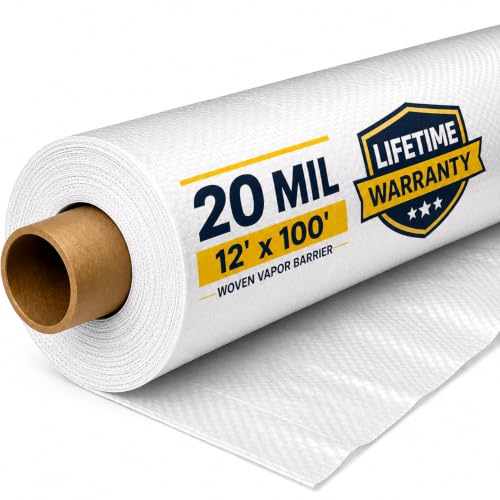
The heavy woven pick, built for encapsulation work on ground that would chew through plain film. Whitecap sheeting is woven polyethylene — interlaced strands coated on both sides — so a puncture stays a puncture instead of unzipping into a tear, and the maker positions the white sheet for crawl space floors that take foot traffic during installation and every service visit after. The 12-foot width covers a wide bay in one pass, and the full roll covers 1,200 square feet before turn-ups.
The honest facts of handling: at 80 pounds the roll is a two-person carry through a crawl space access hatch, and woven sheet is stiffer around piers than plain film of the same thickness, so corners take more patience. The maker sells this line with a lifetime warranty and publishes installation guidance that matches the rules above — turn the sheet up the foundation wall, overlap seams at least six inches, and seal with seam tape. Choose it when the ground is rough, the space will be entered often, and the liner is expected to serve as the finished floor of the crawl space.
Specs
- ASIN: B0BY3JXXZW
- Thickness: 20 mil
- Roll size: 12 ft. x 100 ft. (1,200 sq. ft.)
- Material: woven polyethylene, coated both sides
- Color: white
- Maker: Crawl Space DIY
- Model: WCWW20-12X100WV
- Roll weight: 80 lb.
2. PURTERIA Crawl Space Vapor Barrier and Tape Combo, 10 Mil, 10 ft. by 100 ft.

The kit pick: a full-size 10 mil liner that arrives with its own seam tape in the box. The sheet is black and white panda film — black face down against the soil to block light, white face up to brighten the space — at the 10-by-100-foot format that covers 1,000 square feet, the size most single-family crawl spaces are planned around. Ten mil is the thickness the trade treats as the standard for a floor that gets crawled over, thick enough to shrug off the small stones and grit that survive a careful cleanup.
The included tape is a 9 mil seam tape with a release liner, which matters more than it sounds: the liner keeps the tape from folding onto itself in a low crawl space, so long seams can be run in one pass and pressed down properly. A barrier is only as good as its seams, and this is the one pick that removes the separate tape purchase from the job list. Choose it when you want liner and seam tape matched from one maker in one box.
Specs
- ASIN: B0DYT4P154
- Thickness: 10 mil
- Roll size: 10 ft. x 100 ft. (1,000 sq. ft.)
- Material: polyethylene panda film, black one face, white the other
- Included: 9 mil seam tape with release liner
- Format: liner and tape combo kit
- Maker: PURTERIA
3. ALORAIR Crawl Space Vapor Barrier, 10 Mil, 10 ft. by 25 ft.

The small-space pick, from the one maker in this guide whose whole catalogue is crawl space and basement moisture equipment. This is ALORAIR’s 10 mil panda film cut to a 25-foot length: 250 square feet, sized for a partial floor, a repair over a damaged section, the ground under an addition, or a first section laid before committing to full encapsulation. The film itself is the same black and white construction as the long rolls — black face to block light, white face to reflect it — and the maker positions the film with anti-aging additives for long service buried out of sight.
A short roll has one more virtue: it is light enough to maneuver alone through a tight access opening and around piers without a second pair of hands. The limit is arithmetic — a full-size crawl space would need several of these and a seam every 25 feet, and each seam is work. Choose it when the area is genuinely small or the job is a patch, and take a long roll instead when the whole floor is open.
Specs
- ASIN: B0F63DYG1D
- Thickness: 10 mil
- Roll size: 10 ft. x 25 ft. (250 sq. ft.)
- Material: polyethylene panda film, black one face, white the other
- Maker: ALORAIR
- Model: 10mil Film, 10′ x 25′
- Best fit: small floors, additions, and patch work
4. VBS 20 Mil Radon Barrier, EVOH, 12 ft. by 120 ft.

The gas-barrier pick, aimed at ground where soil gas matters alongside moisture. This sheet is a seven-layer build: polyethylene blended with EVOH, the resin layer the maker uses to slow gas movement through the film, sold for radon work as part of a sealed system and for under-slab and floor underlayment duty as well as crawl space ground cover. At 20 mil it matches the thickest plain films here for puncture duty, and the 12-by-120-foot roll is the largest coverage in this guide at 1,440 square feet.
Two honest notes. First, a gas barrier only does its work as a system: every seam taped, every edge and penetration sealed, exactly the discipline in the rules above — an EVOH sheet laid loose is just thick plastic. Second, this listing has shown periods with no featured offer, so availability runs in spells; when it is in stock it is the specialist pick, and the woven Whitecap above is the fallback for a floor that only needs moisture control. Choose it where radon or soil gas is a stated concern and the budget allows the full sealing work around it.
Specs
- ASIN: B0F8PH9S5S
- Thickness: 20 mil
- Roll size: 12 ft. x 120 ft. (1,440 sq. ft.)
- Material: polyethylene blended with EVOH, seven-layer build
- Color: blue
- Maker: Farm Plastic Supply (Vapor Barrier Supply line)
- Part number: VBSRB20
- Intended duty: moisture and soil-gas barrier, crawl space and under-slab
5. VAPLINX Crawl Space Vapor Barrier, 10 Mil, 12 ft. by 100 ft.

The wide plain-film pick. VAPLINX builds this liner from virgin polyethylene — no recycled content, which is the maker’s answer to the thin spots and pinholes that reclaimed resin can leave in a sheet — in black and white panda film at a 12-foot width. That extra two feet over the standard 10-foot rolls is the point: on a wide floor it removes one full length of seam from the job, and seams are where ground covers fail first.
At 49.1 pounds the roll is manageable for one person to feed through an access hatch and unroll in sections. The maker’s size range runs from small patch rolls to this 100-foot format in several thicknesses, and this 10 mil size is the general-purpose one. One honest note: like the VBS listing above, this one has shown periods with no featured offer, so plan the purchase ahead of the work weekend rather than during it. Choose it when a plain film is enough for the ground you have and roll width is what your layout rewards.
Specs
- ASIN: B0FVDJNM65
- Thickness: 10 mil
- Roll size: 12 ft. x 100 ft. (1,200 sq. ft.)
- Material: virgin polyethylene panda film, black one face, white the other
- Maker: VAPLINX
- Roll weight: 49.1 lb.
- Best fit: wide floors where fewer seams matter
Verdict
Match the build to the ground and the job. On rough soil or a floor that will be walked on for years, the Whitecap woven 20 mil is the default: the weave is what keeps small damage small. For a standard full encapsulation, the PURTERIA kit covers the common 1,000 square feet and brings its own seam tape, which removes the easiest mistake in the whole job — an untaped seam. Small areas and patches belong to the short ALORAIR roll. Where soil gas is part of the problem, the VBS EVOH barrier is the specialist, provided the seams and edges get the full sealing treatment around it. And where the floor is wide and the ground is kind, the VAPLINX 12-foot film wins on seam count alone. None of them works laid loose: overlap every seam, seal the edges, and cover the ground wall to wall.
Laying a Barrier That Stays Sealed
- Clear the ground first. Pull out sharp stones, roots, wire offcuts, and construction debris before the sheet goes down. Most punctures are installed on day one, under the liner, where nobody sees them.
- Overlap and tape every seam. Six inches of overlap is the common maker minimum and some codes require twelve; tape the full length of every joint and press the tape down along its whole run.
- Seal the edges up the walls. Run the sheet up foundation walls — six inches above outside grade is the turn-up maker sheets commonly call for — and seal it there, then wrap and seal around every pier and pipe penetration.
- Cover wall to wall. Leave no bare soil islands at corners or behind piers. A mostly covered crawl space still feeds moisture around the edges of the cover.
- Work the space safely. Bring real lighting, keep air moving where you can, and watch for wiring, plumbing, and ductwork before you drag a roll across them. Low headroom work is slow work; kneel on a scrap of the liner itself rather than on bare grit.
- Check the local rule. Many jurisdictions name a minimum thickness and a Class I retarder for ground cover, and sealed crawl spaces carry their own wall and vent rules. A few minutes with the local code office is cheaper than re-laying a floor.
Related guides
More from Amazon
Programs that pair well with the guide above. Offers and eligibility are set by Amazon and may change.
A free business account with business pricing and bulk-buying tools for work, shop or home office.
Create a business accountFree shipping on eligible items, Prime Video and more. Eligible new members can start with a free trial.
Start a Prime free trialAudiobooks and podcasts to listen to on the go. Eligible new members can start with a free trial.
Try Audible freeAd-free music streaming. Eligible new subscribers can start with a free trial.
Try Music Unlimited freeAs an Amazon Associate we earn from qualifying purchases.








