
Key takeaways
- Compare automotive multimeters, checking range, rpm, dwell and leads for cars, batteries, garages, workshops, charging systems and careful testing work.
What's inside
As an Amazon Associate I earn from qualifying purchases. This post may contain affiliate links at no extra cost to you.
A basic household meter can tell you whether a battery shows voltage, but it stops being useful the moment you need to know why an engine cranks slowly, whether an alternator diode is leaking, or how fast a crankshaft is turning. Automotive multimeters add the functions those jobs demand: tachometer readings taken from an ignition signal, dwell angle for older distributors, duty cycle and pulse width for fuel injectors and solenoids, and current ranges wide enough to hunt down a parasitic draw. The five meters below span the full field, from a simple auto-ranging tester for battery and charging checks to a professional engine analyzer built for daily shop work.
Disclosure: As an Amazon Associate, I earn from qualifying purchases. Product details were verified at the time of writing.
Contents
How to Choose an Automotive Multimeter
Start with the automotive functions, because they decide what the meter can actually diagnose. An RPM function reads engine speed from the ignition system, either through an inductive clamp on a plug lead or directly from a signal wire. Dwell angle matters on older vehicles with breaker points, while duty cycle and millisecond pulse width are the measurements that make fuel injectors, idle air valves and other computer-driven solenoids testable on modern cars. A meter without these functions is a general electrical tester, which may be all you need, but it will not substitute for an engine analyzer.
Current range is the second deciding factor. Tracking a parasitic draw means connecting the meter in series with the battery and watching small currents with everything switched off, then pulling fuses until the draw drops. A fused 10 A DC range handles most of this work, and a 15 A or 20 A range adds headroom for larger circuits. Input impedance matters just as much: a 10 megohm input draws so little current that it will not disturb sensitive ECU circuits or skew sensor readings while you measure them.
True RMS sensing gives more accurate AC readings on the noisy, non-sinusoidal signals an alternator or a variable-speed drive produces, which helps when you are checking charging ripple. For work around hybrid and electric vehicles, look for a CAT III 1000 V or CAT IV 600 V safety category rather than a meter intended only for bench electronics. Finally, weigh the leads and accessories in the box. An included inductive clamp, a temperature probe, a backlit display for dark engine bays and a protective case all save separate purchases later.
The 5 Best Automotive Multimeters
1. Innova 3320 Auto-Ranging Digital Multimeter — Best for Simple Battery and Circuit Checks
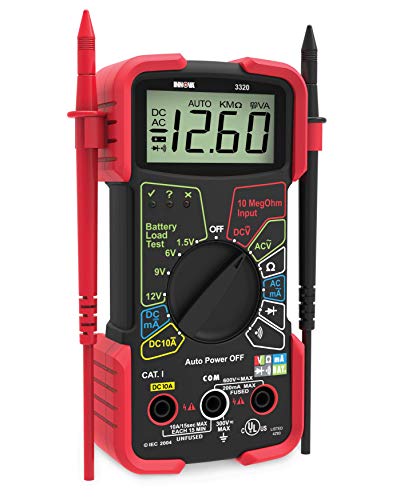
The Innova 3320 is the straightforward pick for owners whose electrical work stops at batteries, fuses, lamps and charging voltage. Auto-ranging removes the guesswork of picking a scale before every measurement, and its small battery load test uses color-coded LEDs to give a quick pass-or-fail indication on household and vehicle batteries. A 10 megohm input impedance keeps it safe around vehicle electronics, and the rubber corner guards, built-in stand and wrist strap suit a tool that lives in a glovebox or a garage drawer. It has no tachometer or dwell function, so engine-speed and ignition-timing checks are beyond it, but for everyday circuit testing it covers the essentials well.
Specs
– Display: 2000-count LCD with color-coded battery test LEDs
– Ranging: Automatic
– DC voltage: 200 mV to 600 V
– AC voltage: 200 V to 600 V
– DC current: Up to 10 A
– Resistance: 200 ohms to 20 megohms
– Input impedance: 10 megohms
– Extras: Battery load test, rubber corner guards, built-in stand, wrist strap
2. KAIWEETS HT118A Digital Multimeter — Best General-Purpose True RMS Meter
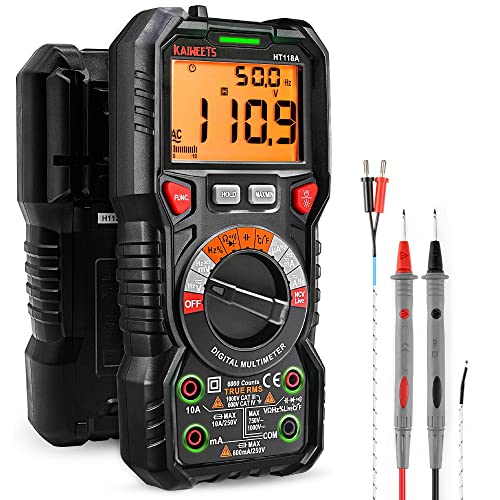
The KAIWEETS HT118A steps up to a 6000-count true RMS display with auto-ranging across voltage, current, resistance, capacitance, frequency and temperature. Duty cycle and frequency measurements help with sensor and signal checks, and the included thermocouple covers temperature work from coolant to exhaust components. LED indicators at the input jacks light up to show where the leads belong for the selected function, a small touch that prevents the classic mistake of measuring voltage with the leads in the current jack. Non-contact voltage detection and a backlit display round out a meter aimed at mixed automotive and household use. It does not read RPM or dwell, so ignition-speed testing still calls for a dedicated automotive meter.
Specs
– Display: 6000-count backlit LCD
– Sensing: True RMS, auto-ranging
– DC voltage: Up to 1000 V
– AC voltage: Up to 750 V
– Current: Up to 10 A AC/DC
– Resistance: Up to 60 megohms
– Extra functions: Capacitance, frequency, duty cycle, temperature, diode, continuity, NCV
– Safety category: CAT III 1000 V, CAT IV 600 V
3. allsun EM133A Automotive Multimeter — Widest RPM Range

The allsun EM133A is a dedicated engine analyzer with the widest tachometer span in this group, reading from 60 to 20,000 RPM on both two-stroke and four-stroke engines. Dwell angle settings cover four, five, six and eight cylinder engines, and pulse width measurement supports injector diagnosis. It is also the only meter here with a 20 A current range, which gives extra room for draw testing on larger circuits, and a USB link lets you log readings to a PC for intermittent faults that come and go. True RMS sensing, a 5999-count display and temperature measurement complete a function set aimed squarely at engine work rather than general electrical tasks.
Specs
– Display: 5999-count LCD
– Sensing: True RMS, auto-ranging
– Voltage: Up to 1000 V AC/DC
– Current: Up to 20 A AC/DC
– Resistance: Up to 60 megohms
– RPM: 60 to 20,000 RPM, two-stroke and four-stroke
– Dwell: 4, 5, 6 and 8 cylinders
– Extra functions: Duty cycle, pulse width, frequency, capacitance, temperature, data hold, PC data logging
4. Innova 3340 Professional Automotive Digital Multimeter — Best for Serious Home Diagnostics
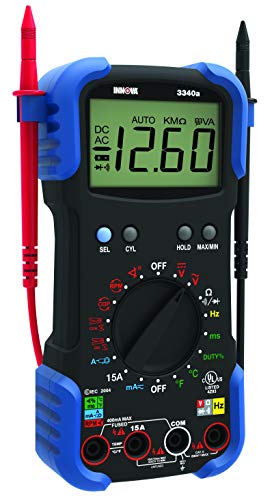
Innova builds the 3340 specifically for vehicle diagnosis, and it shows in the accessory kit: an inductive RPM clamp for non-contact engine-speed readings, a temperature probe, and a carrying case are all in the box. The meter covers dwell angle, duty cycle and pulse width alongside the usual voltage, resistance and continuity work, and a fused 15 A DC range handles draw testing with margin to spare. A 10 megohm input impedance protects engine computers during our research, and a dedicated alternator diode check helps confirm charging faults without guesswork. For a home garage that handles its own diagnostics on modern and older vehicles alike, this is the most complete car-focused package in the group.
Specs
– Ranging: Automatic
– DC current: Up to 15 A, fused
– RPM: Inductive clamp pickup, up to 10,000 RPM
– Dwell: 4, 5, 6 and 8 cylinders
– Extra functions: Duty cycle, pulse width, temperature, alternator diode test
– Input impedance: 10 megohms
– Included: Inductive RPM clamp, temperature probe, test leads, carrying case
– Extras: Min/Max and data hold
5. Fluke 88V Deluxe Automotive Multimeter — Best Professional Pick

The Fluke 88V is the long-standing shop standard for automotive electrical diagnosis on conventional and hybrid vehicles. It measures millisecond pulse width for fuel injector checks, records Min/Max/Average values to catch intermittent faults, and reads RPM when paired with an inductive pickup. A built-in thermometer covers temperature testing, and the 6000-count display offers a high-resolution mode for fine work. Its CAT III 1000 V and CAT IV 600 V safety categories suit the higher-voltage circuits found in hybrid systems, and the high-impact holster is built for a meter that gets used every day rather than stored. If electrical diagnosis is a regular part of your work, this is the meter the others are measured against.
Specs
– Display: 6000 counts, with 20,000-count high-resolution mode
– Sensing: True RMS AC voltage and current
– Voltage: Up to 1000 V AC/DC
– Current: 10 A continuous, 20 A for up to 30 seconds
– Extra functions: Pulse width in milliseconds, duty cycle, frequency, capacitance, resistance, diode test
– Recording: Min/Max/Average with Min Max Alert
– Temperature: Built-in thermometer, probe optional
– Safety category: CAT III 1000 V, CAT IV 600 V
Comparison Table
| Model | Display | Max DC Current | RPM | Dwell | Duty Cycle | Pulse Width | Temperature |
|---|---|---|---|---|---|---|---|
| Innova 3320 | 2000 counts | 10 A | No | No | No | No | No |
| KAIWEETS HT118A | 6000 counts | 10 A | No | No | Yes | No | Yes |
| allsun EM133A | 5999 counts | 20 A | Yes, to 20,000 | Yes | Yes | Yes | Yes |
| Innova 3340 | Auto-ranging LCD | 15 A | Yes, inductive clamp | Yes | Yes | Yes | Yes |
| Fluke 88V | 6000 counts | 10 A | Yes, with pickup | Yes | Yes | Yes | Yes |
FAQ
Can a regular multimeter replace an automotive multimeter?
For battery voltage, charging voltage, continuity and resistance checks, yes. It cannot read engine RPM, dwell angle or injector pulse width, so ignition and fuel-system diagnosis on anything beyond basic circuits calls for an automotive model.
Why does input impedance matter on a car?
A 10 megohm input draws almost no current from the circuit under test. That protects engine computers and keeps sensor signals from being pulled down by the meter itself, which would corrupt the very reading you are taking.
How do I use a multimeter to find a parasitic draw?
Switch the meter to its DC current range, connect it in series between the battery terminal and the disconnected cable, and let the vehicle modules go to sleep. Then remove fuses one at a time and watch for the reading to drop; the circuit on the fuse that causes the drop is the one draining the battery.
Do I need true RMS for automotive work?
Most vehicle testing is DC, where true RMS makes no difference. It earns its keep on AC measurements such as alternator ripple, where the waveform is far from a clean sine wave and an averaging meter can mislead you.
What safety category do I need for hybrid vehicles?
Look for CAT III 1000 V or CAT IV 600 V. Hybrid battery systems carry voltages well beyond a 12 V system, and the safety category describes the transient protection the meter and its leads are built to withstand.
Verdict
Pick the Innova 3320 if your work is batteries, fuses and charging checks and you want auto-ranging simplicity. The KAIWEETS HT118A is the better all-rounder for mixed car and household use, while the allsun EM133A adds true engine-analyzer functions and the widest tachometer range. The Innova 3340 is the strongest choice for serious home diagnostics thanks to its included RPM clamp and temperature probe, and the Fluke 88V remains the professional standard for daily shop work on conventional and hybrid vehicles.
Related guides
More from Amazon
Programs that pair well with the guide above. Offers and eligibility are set by Amazon and may change.
A free business account with business pricing and bulk-buying tools for work, shop or home office.
Create a business accountFree shipping on eligible items, Prime Video and more. Eligible new members can start with a free trial.
Start a Prime free trialAudiobooks and podcasts to listen to on the go. Eligible new members can start with a free trial.
Try Audible freeAd-free music streaming. Eligible new subscribers can start with a free trial.
Try Music Unlimited freeAs an Amazon Associate we earn from qualifying purchases.








