What's inside
As an Amazon Associate I earn from qualifying purchases. This post may contain affiliate links at no extra cost to you.
The best Barlow lenses for telescopes for most observers in 2026 are a 2x fully multi-coated apochromatic Barlow in the matching barrel size to your eyepieces, with the Tele Vue 2x Barlow and Explore Scientific 2x Focal Extender leading for optical quality, and the Celestron X-Cel LX 2x and GSO 2x Achromatic Barlows offering the best value for beginners.
A Barlow does not just make things bigger. It changes effective focal ratio, eye relief, field of view, and how demanding your eyepieces and telescope are on alignment and seeing. Choosing the right one means matching magnification to your telescope’s aperture and usual atmospheric conditions, not just buying the highest power.
As an Amazon Associate we earn from qualifying purchases at no extra cost to you.



Contents
What a Barlow Lens Actually Does
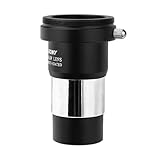
A Barlow is a negative lens group placed before the eyepiece that increases the effective focal length of your telescope. A 2x Barlow doubles focal length, a 3x triples it. If you have a 1000mm focal length telescope and a 25mm eyepiece, you get 40x normally (1000 / 25). With a 2x Barlow it becomes 80x (2000 / 25) without needing a separate 12.5mm eyepiece.
This matters for two reasons:
- It preserves the eye relief of longer focal length eyepieces while achieving high magnification. A 25mm Plossl with a 2x Barlow gives the power of a 12.5mm but keeps the comfortable 15-20mm eye relief of the 25mm.
- It can improve edge performance on fast telescopes by slowing the light cone before it hits a simple eyepiece design, though a poor Barlow will add chromatic aberration and light loss instead.
6 Decision Criteria That Affect Planetary and Deep-Sky Views
1. Magnification Factor: 2x vs 3x vs 5x
More is not better. Your telescope has a practical maximum magnification around 2x per millimeter of aperture (50x per inch) under excellent seeing, and a useful maximum around 1x per millimeter for most nights. Beyond that, the image gets larger but dimmer and softer.
For planetary viewing where you want 150x-250x on a 150mm to 200mm telescope, a 2x Barlow paired with 12mm to 25mm eyepieces covers almost everything. A 3x Barlow is useful if you already own mostly long focal length eyepieces (28mm-32mm) or you have a short focal length Dobsonian (f/5 and faster) and want lunar and planetary power without buying short eyepieces. A 5x, like the Tele Vue 5x Powermate, is a specialist tool for planetary imaging and very steady seeing, not general visual use.
Worked example: You own an 8-inch (203mm) f/6 Dobsonian with 1200mm focal length and eyepieces at 30mm, 15mm, and 9mm.
- Without Barlow: 40x, 80x, 133x
- With a 2x Barlow: 80x, 160x, 266x – ideal spread for deep-sky low power and planetary high power
- With a 3x Barlow: 120x, 240x, 400x – the 400x is beyond what the atmosphere allows most nights and will be dim for deep-sky
For that scope, the 2x is far more usable. The 3x would force you to use only the 30mm to get a reasonable planetary magnification.
2. Lens Elements and Design: Achromatic vs Apochromatic vs Telecentric
Standard achromatic Barlows use 2 elements. They are lightweight and affordable but can introduce lateral color on bright targets like the Moon and Jupiter, especially at 3x and on fast telescopes.
Apochromatic Barlows use 3 elements with extra-low dispersion glass. The Tele Vue Barlow, Celestron X-Cel LX, and Orion Tri-Mag 3x use this approach to control chromatic aberration and keep stars sharp to the edge.
Telecentric amplifiers like the Tele Vue Powermate and Explore Scientific Focal Extender use 4 elements. They do not just magnify, they correct the diverging light cone to be more parallel. This means almost no additional vignetting, minimal change in eye relief, and less sensitivity to where the eyepiece sits inside the Barlow. For imaging and for using Barlows with eyepieces that have built-in Barlow elements (like many wide-field designs), a telecentric design is more forgiving.
3. Coatings and Internal Blackening
Look for fully multi-coated optics, not just coated or multi-coated. Fully multi-coated means every air-to-glass surface has multiple anti-reflection layers, which improves transmission from about 92% on a simple coated Barlow to 96-97% on a well-coated one. That 4-5% difference matters for contrast on Jupiter’s belts and for faint deep-sky objects where you are already losing light to higher magnification.
Equally important is internal blackening and baffle threading. Shiny internal barrels cause reflections that wash out planetary contrast. Quality Barlows have matte black anodizing and threaded or baffled interiors.
4. Barrel Size: 1.25-inch vs 2-inch
Match the Barlow to your focuser and eyepieces. 1.25-inch is the standard for magnifications up to about 200x and eyepieces with focal lengths under 25mm. 2-inch Barlows are needed if you want to Barlow 30mm to 40mm wide-field eyepieces for deep-sky without severe vignetting.
A 1.25-inch Barlow in a 2-inch focuser requires an adapter and adds extra length. A 2-inch Barlow cannot be used with 1.25-inch eyepieces unless it includes a built-in 1.25-inch adapter, which most do. If you own only 1.25-inch eyepieces, a 1.25-inch Barlow keeps weight and balance better on small refractors and tabletop Dobs.
5. Eye Relief and Field of View
A traditional 2-element Barlow increases eye relief slightly, which helps with short Plossls. A telecentric Powermate-type keeps eye relief essentially unchanged, which is preferable with long eye relief wide-field eyepieces where you do not want to be pushed too far back.
Field of view narrows proportionally to magnification. A 68-degree 24mm eyepiece gives about 1.3 degrees true field in a 1200mm telescope. With a 2x Barlow it becomes an effective 12mm with the same 68-degree apparent field, so true field drops to about 0.68 degrees. For deep-sky, this is why you do not Barlow low-power sweeping eyepieces; use the Barlow for planetary, double stars, and small planetary nebulae where field is less critical.
6. Telescope Compatibility
- Fast Newtonians and Dobsonians (f/4 to f/6): Benefit most from 3-element apochromatic or 4-element telecentric Barlows. Avoid simple 2-element short Barlows which can add spherical aberration on fast optics. Check that your focuser has enough inward travel. Some shorty Barlows need 10-15mm of extra in-focus.
- Schmidt-Cassegrains and Maksutovs (f/10 to f/15): Work well with any quality 2x Barlow. These scopes already have long focal lengths, so a 2x often gives higher power than seeing allows. Many SCT owners prefer a 1.25-inch 2x used only with medium focal length eyepieces.
- Short achromatic refractors (f/5 to f/7): Sensitive to chromatic aberration. Use a well-corrected apochromatic Barlow and avoid 3x unless the Barlow is specifically apochromatic.
- Long focal length refractors and apochromatic refractors (f/7 and slower): Least demanding. Even value achromatic Barlows perform reasonably well here.
Spec Comparison: Common Barlow Models in 2026
| Model | Magnification | Elements / Groups | Coating | Barrel Size | Length | Weight |
|---|---|---|---|---|---|---|
| Tele Vue 2x Barlow | 2x | 2 / 1 apochromatic | Fully multi-coated | 1.25-inch | 95 mm | 85 g |
| Tele Vue 2x Powermate | 2x | 4 / 2 telecentric | Fully multi-coated | 1.25-inch and 2-inch versions | 105 mm (1.25″) / 145 mm (2″) | 170 g (1.25″) / 340 g (2″) |
| Explore Scientific 2x Focal Extender | 2x | 4 / 2 telecentric | Fully multi-coated | 1.25-inch and 2-inch | 102 mm (1.25″) / 140 mm (2″) | 155 g (1.25″) / 312 g (2″) |
| Celestron X-Cel LX 2x Barlow | 2x | 3 / 2 apochromatic | Fully multi-coated | 1.25-inch | 98 mm | 110 g |
| Orion Tri-Mag 3x Barlow | 3x | 3 / 2 apochromatic | Fully multi-coated | 1.25-inch | 110 mm | 125 g |
| GSO 2x Achromatic Barlow | 2x | 2 / 1 achromatic | Fully multi-coated | 1.25-inch and 2-inch | 75 mm (1.25″ shorty) / 130 mm (2″) | 70 g (1.25″) / 185 g (2″) |
General market price ranges in 2026: basic achromatic shorty Barlows $30 to $60, apochromatic 3-element Barlows $65 to $140, telecentric Focal Extenders and Powermates $150 to $350 depending on barrel size. 2-inch versions typically cost $50 to $100 more than their 1.25-inch counterparts.
Pick by Your Situation: Decision Matrix
| Your Situation | Recommended Barlow Type | Why |
|---|---|---|
| Beginner with 114mm-130mm reflector, 1.25-inch eyepieces | 1.25-inch 2x apochromatic (Celestron X-Cel LX or GSO 3-element) | Affordable, controls color on fast f/5 optics, doubles your two kit eyepieces into four usable powers |
| Planetary observer with 6-inch to 10-inch Dobsonian | 1.25-inch 2x telecentric (Explore Scientific Focal Extender or Tele Vue Powermate) | Keeps eye relief comfortable for long sessions, sharpest on-axis for Jupiter, Saturn, Mars, least added aberration |
| Deep-sky with 2-inch wide-field eyepieces (30mm+) | 2-inch 2x telecentric | Avoids vignetting that 1.25-inch Barlows cause on wide 2-inch eyepieces, preserves field illumination |
| Imager doing lunar/planetary with small sensor | 3x or 5x telecentric | Reaches f/20 to f/30 focal ratios needed for planetary imaging scale without extending focuser travel excessively |
| Owner of long f/10 SCT or Mak, wants one versatile Barlow | 1.25-inch 2x achromatic or apochromatic shorty | Scope is forgiving, high power limited by seeing so 2x is most usable, lightweight keeps balance |
| Frequent outreach, shared eyepieces, mixed telescopes | 2-inch 2x with 1.25-inch adapter, fully multi-coated | Single Barlow works in both focusers, adapter lets guests use their own eyepieces |
Durability and Ownership Realities
Barlows have no moving parts, but three things wear or degrade first:
- Set screws and compression rings: Cheap single-screw barrels mar eyepiece barrels and loosen over time. A brass compression ring holds securely without scratching and is worth prioritizing if you swap eyepieces often. Keep a spare nylon-tipped thumb screw.
- Coatings and internal dust: Barlows trap dust between elements that you cannot easily disassemble. Store with both end caps, and never clean by blowing with compressed air cans which can spray propellant. Use a blower bulb and, if needed, a single lens wipe with isopropyl alcohol. Repeated aggressive cleaning degrades coatings faster than dust affects views.
- Threads for filters: Many Barlows are threaded for 1.25-inch or 2-inch filters on the bottom barrel. Cross-threading is common. Thread filters gently by turning backward until you feel the click, then forward.
Common mistakes to avoid: stacking two Barlows for extreme power (you multiply aberrations and dim the image more than using a shorter eyepiece), buying a 3x as your only Barlow when you already own 9mm and 6mm eyepieces (you will exceed useful magnification constantly), and using a heavy 2-inch telecentric Barlow on a lightweight 80mm refractor without rebalancing – the added 300g at the focuser can make the scope nose-heavy and slip in its rings.
Cleaning routine after a dewy night: cap both ends, let the Barlow reach room temperature before wiping to avoid smearing moisture, inspect the bottom lens element where dew forms first. If you see fungal haze between elements, do not attempt to open the cell. Return it for service.
How to Set Up and Test a New Barlow
Insert the Barlow fully into the focuser and secure it, then insert the eyepiece fully into the Barlow. This is the designed spacing for the labeled magnification. Pulling the eyepiece partway out increases magnification by about 0.1x to 0.3x depending on design, but also introduces vignetting. Test declared power: center the Moon, time how long it takes to drift across the field with and without the Barlow. The drift time ratio should match the Barlow factor.
Check for in-focus issues on your fastest telescope. If you cannot reach focus with the Barlow, you need more inward focuser travel. Some refractors and Newtonians need a low-profile adapter to make up the extra 10-20mm path length of shorty designs.
Frequently Asked Questions
Does a Barlow reduce image brightness?
Yes, proportionally to the square of magnification. A 2x Barlow spreads the same light over 4x the area, so the image is dimmer. Stars remain point sources so they do not dim much, but extended objects like nebulae appear dimmer at higher power. This is true whether the magnification comes from a Barlow or a shorter eyepiece.
Is a Barlow better than buying another eyepiece?
For value, a good Barlow effectively doubles your eyepiece set. For absolute sharpness on-axis, a dedicated premium eyepiece of the equivalent focal length will usually outperform an average eyepiece plus Barlow by a small margin. A high-quality telecentric Barlow with a good eyepiece narrows that difference to the point most observers cannot see it.
Can I use a 1.25-inch Barlow with a 2-inch focuser?
Yes, with the 1.25-inch adapter that came with your telescope. The 2-inch barrel itself stays empty and the Barlow sits inside the adapter. You lose the wide-field advantage of 2-inch eyepieces, but planetary viewing is unaffected.
Do I need a Barlow if I already have 6mm and 9mm eyepieces?
Not always. If you already cover 40x to 200x in even steps, a Barlow adds overlap rather than new capability. It is most useful when you own two or three long focal length eyepieces and want high power without eye relief that drops below 8-10mm, which many observers find uncomfortable for planetary detail.