What's inside
As an Amazon Associate I earn from qualifying purchases. This post may contain affiliate links at no extra cost to you.
The best blood pressure monitors for dependable home checks are usually validated upper-arm models with the correct cuff size, a large high-contrast display, enough memory for several days of readings, and an irregular-heartbeat alert; wrist monitors are mainly a convenience choice when an upper-arm cuff is impractical.
As an Amazon Associate we earn from qualifying purchases at no extra cost to you.


Contents
Our Top Picks
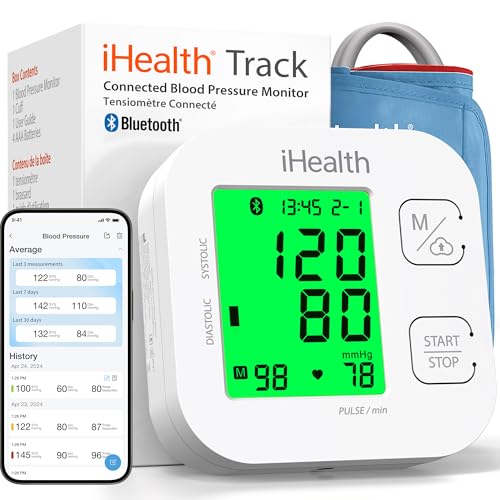 iHealth Track Smart Upper Arm Blood Pressure Monitor1 Count (Pack of 1)3.9 x 3.9 x 1.6 inches1 poundsCheck on Amazon
 OMRON Bronze Blood Pressure Monitor & Upper Arm9-17" Cuff Size | Single Unit5.5 x 3.3 x 4.3 inches1.23 PoundsCheck on Amazon
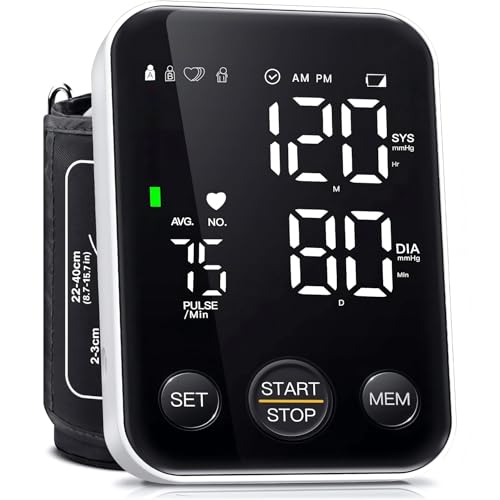 Oklar FDA Cleared Blood Pressure Monitor Upper ArmLarge4.96 x 3.34 x 1.1 inches0.33 poundsCheck on Amazon

Quick picks by situation
| Situation | Best fit | Why | Typical market range |
|---|---|---|---|
| Most households | Validated upper-arm monitor with a 22–42 cm cuff | Broad fit range, stable positioning, simple operation | $40–$90 |
| Several people share one monitor | Omron 10 Series or another two-user model | Separate memory profiles reduce mix-ups | $70–$130 |
| Large, easy-to-read numbers | Omron 3 Series or 10 Series upper-arm model | One-touch controls and a clear digital display | $40–$130 |
| Phone tracking and portability | Withings BPM Connect or QardioArm | Wireless synchronization and compact storage | $90–$150 |
| Upper-arm cuff cannot be used | Validated wrist monitor | Smaller and easier to put on, but more position-sensitive | $30–$80 |
Upper-arm versus wrist: which is more dependable?
An upper-arm monitor is the better default because the cuff sits closer to the level of the heart and over a larger artery. It is generally less sensitive to small positioning errors than a wrist device. That does not make every upper-arm monitor accurate: cuff fit, rest time, arm support, and calibration still matter.
Wrist monitors can be useful for people with a very large upper arm, limited arm mobility, or difficulty placing a conventional cuff. Their main drawback is technique. The wrist must be held at heart level during the entire measurement; letting it drop toward the lap can produce a misleading result. A wrist monitor should be compared with readings from a clinician’s equipment before it becomes your main tracking device.
Look for independent clinical validation rather than relying only on a brand’s claim of accuracy. Validation listings and professional recommendations can change, so check the current model number—not merely the product family—before buying.
What separates the leading home monitors?
Omron 10 Series: best for shared, detail-oriented use
The Omron 10 Series is a strong choice when two people need regular readings and want more than a basic single-number display. Models in this line commonly provide two-user memory, averaging features, body-movement or cuff-placement guidance, and an irregular-heartbeat indicator. Depending on the exact model, the cuff is commonly sized for approximately 22–42 cm arms.
Its advantage is organization: separate user memories and multi-reading averages can make a log easier to interpret. Its disadvantage is cost and a somewhat busier interface than a basic monitor. Confirm the exact included cuff and connectivity features because the 10 Series name covers more than one configuration.
Omron 3 Series: best simple budget choice
The Omron 3 Series suits someone who wants an upper-arm monitor with one-button operation and uncomplicated results. It typically stores a limited number of readings—often around 14—rather than maintaining extensive records for multiple users. That is enough for occasional checks, but not ideal if a clinician asks for twice-daily readings over several weeks.
Choose it when readable operation matters more than phone synchronization. Check whether the particular model includes an irregular-heartbeat symbol and whether its cuff matches your arm circumference.
Withings BPM Connect: best for app-based records
The Withings BPM Connect is designed for people who prefer readings to synchronize to a phone or connected account rather than writing them down. Its compact form and rechargeable battery are convenient for travel and regular tracking. App-based history can also make it easier to share a sequence of readings with a healthcare professional.
The trade-off is dependence on a smartphone setup, wireless connection, and the manufacturer’s software. If an app is discontinued, changed, or inconvenient for another household member, the monitor may be less useful than a standalone model. Ensure the on-device display and offline operation meet your needs before choosing a connected monitor.
QardioArm: best for a compact connected cuff
QardioArm wraps around the upper arm and uses a smartphone for much of its display and record keeping. It is attractive for users who value portability and automatic history more than a large built-in screen. It can be a practical choice for frequent travelers or people already comfortable managing health data on a phone.
Because the display experience is phone-based, it is less suitable for someone who wants to press a button and read large numbers without opening an app. Check current phone compatibility and the supported cuff range before purchase.
Key specifications to compare
| Feature | What to look for | Why it matters |
|---|---|---|
| Cuff range | At least 22–42 cm for a versatile household model | A cuff that is too small or too large can distort readings |
| Memory | 30–60 readings per user for routine tracking; two users if shared | Reduces manual logging and prevents mixing household readings |
| Display | Large digits, high contrast, clear systolic/diastolic labels | Important for users with poor eyesight or low lighting |
| Power | Four AA batteries is common; rechargeable models may use USB charging | Battery availability matters during travel or outages |
| Alerts | Irregular-heartbeat and cuff-placement indicators | Helpful prompts, but not a diagnosis |
| Validation | Independent validation for the exact model and cuff | More meaningful than a generic “clinically accurate” label |
How to size the cuff correctly
Measure around the middle of the upper arm, halfway between the shoulder and elbow, with the arm relaxed. Do not estimate from shirt size. If the measurement is 34 cm, a cuff spanning 22–42 cm has 8 cm of room on either side of the measurement and is normally a better fit than a narrow 22–32 cm cuff.
That calculation is only a screening check. The cuff’s printed range must include the entire measured circumference, and the tubing or artery marker should be positioned according to the manual. People near the boundary between sizes should compare the manufacturer’s instructions or ask a clinician which cuff is appropriate.
How to get more reliable readings at home
- Empty your bladder and avoid exercise, smoking, and caffeine for about 30 minutes beforehand when possible.
- Sit quietly for at least five minutes, with your back supported and both feet flat on the floor.
- Place the cuff on bare skin, not over a sleeve, with the lower edge roughly 2–3 cm above the elbow crease.
- Rest the arm on a table so the cuff is near heart level. Do not talk, text, or clench your fist.
- Take two readings about one minute apart and record the time, arm used, and values. Follow a clinician’s specific schedule if one was provided.
- Use the same arm and similar conditions when monitoring a trend, unless a healthcare professional instructs otherwise.
A single unusual reading is not enough to diagnose a condition. Repeat it after resting and contact a healthcare professional for advice. If a reading is very high or accompanied by concerning symptoms such as chest pain, severe shortness of breath, weakness, confusion, or difficulty speaking, seek urgent medical help.
Ownership costs and durability
The cuff is usually the first part to wear: its hook-and-loop closure can lose grip, the fabric can stretch, and the air tube can crack if sharply folded. Replacement cuffs are often available, but they must be compatible with the monitor and arm size. Do not share a cuff without cleaning it according to the manual.
Wipe the cuff and monitor with a lightly damp, non-abrasive cloth. Avoid soaking the cuff, spraying liquid into the air connector, or using harsh solvents. Store the unit dry, away from direct heat, and do not leave it in a hot car. Replace batteries as a set; leaking batteries can damage the electronics.
For frequent use, the most economical choice is often a $50–$90 validated upper-arm monitor with a replaceable cuff. At two readings per day for five years, that is about 3,650 readings, or roughly 1–3 cents per reading before battery and replacement-cuff costs. A connected monitor may cost more but can save time if automatic records are important.
Bottom line
For most people, choose a validated upper-arm monitor with a cuff that fits, a large display, at least 30 stored readings, and an irregular-heartbeat alert. Select the Omron 10 Series for two-user memory and richer tracking, the Omron 3 Series for uncomplicated occasional checks, or Withings BPM Connect or QardioArm when phone-based records are worth the extra setup. Choose a wrist model only when an upper-arm cuff is impractical, and verify its technique and readings with a healthcare professional.