
Key takeaways
- Find the best wood preservatives with deep soak picks, borate designs, and clear coat options that guard outdoor wood against rot and hungry insects.
What's inside
- How to Choose the Best Wood Preservative
- 1. Nisus Bora-Care Wood Preservative Concentrate, 1 Gallon
- 2. Nisus Tim-BOR Professional Borate Powder, 1.5 lb
- 3. Tenino Copper Naphthenate 17 Percent Wood Preservative, 1 Gallon
- 4. Wolman Woodlife CopperCoat Green Wood Preservative, Quart
- 5. Green Products Copper-Green Wood Preservative, 1 Gallon
- Side-by-Side Comparison
- FAQ
- Final Verdict
As an Amazon Associate I earn from qualifying purchases. This post may contain affiliate links at no extra cost to you.
Outdoor wood rarely fails from weather alone. It fails because living things move in: decay fungi soften the fibers from the inside, termites and carpenter ants hollow out posts and framing, and powderpost beetles turn sound boards into tunnels and dust. A wood preservative is the treatment class built to stop those organisms. Unlike a stain, which is mostly color plus a weather-shedding binder, a preservative carries an active ingredient — a borate salt or a copper compound — that soaks into the fibers and makes the wood itself hostile to fungi and insects. The five picks below split into two families. Borate treatments go on clear, diffuse deep into damp or green wood, and suit framing, fences, and any bare wood you plan to shelter or topcoat. Copper naphthenate treatments are oil- or water-carried, shrug off rain instead of washing out, and suit posts, end cuts, and ground contact work where the wood stays exposed.
Disclosure: As an Amazon Associate, I earn from qualifying purchases. Product details were verified at the time of writing.
This guide stays on the treatment shelf, and the boundaries matter. An exterior wood stain is a pigmented finish that colors and seals; it is not a registered treatment against termites or decay fungi, and none of the stain picks from our exterior stain guide appear here. A wood bleach is a cleaner and lightener that removes stains and graying before finishing; it protects nothing. A wood hardener is a repair consolidant for wood already gone soft, a different job again — and one caution travels between the shelves: hardeners do not pair well with borate-treated wood, so pick one path per board. Every pick below is a true preservative, chosen for the exposure it is labeled to handle.
Contents
- How to Choose the Best Wood Preservative
- 1. Nisus Bora-Care Wood Preservative Concentrate, 1 Gallon
- 2. Nisus Tim-BOR Professional Borate Powder, 1.5 lb
- 3. Tenino Copper Naphthenate 17 Percent Wood Preservative, 1 Gallon
- 4. Wolman Woodlife CopperCoat Green Wood Preservative, Quart
- 5. Green Products Copper-Green Wood Preservative, 1 Gallon
- Side-by-Side Comparison
- FAQ
- Final Verdict
How to Choose the Best Wood Preservative
Match the chemistry to the water exposure. Borates are mineral salts carried in water or glycol. They diffuse beautifully through bare wood — even wood that is still damp — and once dry they stay put as long as the wood stays sheltered or wears a topcoat. Repeated rain leaches them back out, so an exposed fence rail treated with borate alone loses its protection over time. Copper naphthenate is the opposite temperament: the copper rides in an oil or water-based carrier, bonds into the fibers, and resists washout, which is why it is the standard brush-on choice for ground contact, post bottoms, and the fresh end cuts on pressure-treated lumber.
Work only on bare wood. No preservative soaks through paint, varnish, or an intact sealer. Strip or sand old finishes off first, and do all cutting, drilling, and sanding before treatment so every fresh surface gets covered. End grain drinks in far more liquid than face grain, so flood cut ends and drilled holes generously — those openings are exactly where rot starts.
Read the active ingredient and its strength. For borates, the label name is disodium octaborate tetrahydrate; a concentrate built for dilution goes further per jug than a ready-to-use jug, while a powder you mix yourself gives the most working solution per bag. For copper treatments, the figure that matters is copper as metal: a 2 percent copper-as-metal solution meets the AWPA M4 field-treatment standard that building codes point to for end cuts, while lighter formulas suit above-ground brushing.
Treat the label as the law, because for these products it is. Most picks here are EPA-registered pesticides. Mix ratios, coat counts, and allowed uses are printed on the label, and using the product outside those directions is not permitted. Some formulas also carry state sale restrictions, so check the label for your state before ordering.
Gear up and keep the treatment where it belongs. Wear chemical-resistant gloves, eye protection, and long sleeves for every pick in this guide, and wash skin that contacts wet treatment before eating or drinking. Keep children and pets off treated wood until it has dried and cured per the label. Never apply any of these products to food-contact surfaces — cutting boards, countertops, food storage boxes — unless the maker grades that exact product for the job, and none of the five here do. Keep borate runoff out of ponds and streams, since borates are harmful to fish, and avoid soaking garden soil with borate solution: boron builds up in soil and can scorch the plants you are growing. Copper naphthenate labels likewise bar use on wood that will touch food or feed, and the strongest copper pick below is kept off raised beds meant for vegetables. Oil-carried formulas are combustible while wet, so lay used brushes and rags flat outdoors to dry or seal them in a water-filled metal can.
1. Nisus Bora-Care Wood Preservative Concentrate, 1 Gallon

Bora-Care is the deep-soak borate of this guide, and the pick for wood you can still reach before the finish goes on. The concentrate carries disodium octaborate tetrahydrate at 40 percent in a glycol carrier, and that carrier is the point: glycol pulls the borate deep into the fibers and keeps diffusing even through wood that is not fully dry, which is why pros reach for it on framing, sill plates, log work, and crawl space joists. You dilute it with water — richer mixes for active problems, leaner mixes for preventive passes — brush or spray it onto bare wood, and it dries clear, leaving the surface ready for paint, stain, or a sealer once cured. Because the borate ends up distributed through the wood rather than sitting on it, the protection lasts for the life of sheltered wood. Outdoors, give it a topcoat or keep it under cover, because standing rain will slowly leach any borate back out. Choose this one when the wood is bare, the area is large, and long-term insect and fungi defense matters more than weatherproofing in the same can.
Specs
- Type: Borate concentrate, dilute before use
- Active ingredient: Disodium octaborate tetrahydrate, 40 percent
- Carrier: Glycol and water solution
- Size: 1 gallon jug
- Mix ratios: 1:1 down to 5:1 with water, per label directions
- Coverage: About 400 sq ft per gallon of mixed solution per label directions
- Application: Brush or low-pressure sprayer on bare wood
- Finish: Dries clear; paintable and stainable after curing
- Registration: EPA-registered termiticide, insecticide, and fungicide
- Use: Framing, joists, logs, fences, and bare structural wood
2. Nisus Tim-BOR Professional Borate Powder, 1.5 lb

Tim-BOR is the same borate family in its most flexible and shelf-stable form: a dry powder that waits in the bag until you need it. The powder is nearly pure disodium octaborate tetrahydrate, and you put it to work four ways — dusted dry into wall voids, cracks, and beetle holes; mixed into a spray or brush solution; foamed into cavities; or misted across framing. A 10 percent mix (one pound per gallon of water) goes on in two coats, while a 15 percent mix (the full bag per gallon) does the job in one, which makes the small bag stretch across a shed, a fence run, or a stack of project lumber. It leaves no color and no odor once dry, and it will not corrode fasteners or fittings it touches. The limits are the borate limits: bare wood only, and protection that leaches under repeated wetting, so outdoor pieces still want a water-shedding topcoat over it. Choose this one when you treat wood in stages, need a dry dust option for voids and galleries, or want one bag that covers many small jobs.
Specs
- Type: Water-soluble borate powder
- Active ingredient: Disodium octaborate tetrahydrate, 98 percent
- Size: 1.5 lb bag
- Mix ratios: 1 lb per gallon for a 10 percent solution; 1.5 lb per gallon for 15 percent
- Coverage: Two coats at 10 percent, or one coat at 15 percent, per label directions
- Application: Dust, spray, foam, mist, brush, or injection
- Finish: Colorless and odorless once dry
- Registration: EPA-registered for termites, carpenter ants, decay fungi, and wood-boring beetles
- Use: Bare wood, wall voids, framing, sheds, fences, and lumber stacks
3. Tenino Copper Naphthenate 17 Percent Wood Preservative, 1 Gallon

Tenino is the heavy copper pick, built for the cuts and contact points where outdoor wood dies first. The ready-to-use oil-borne solution carries copper naphthenate at 17 percent, which works out to 2 percent copper as metal — the strength the AWPA M4 standard names for field treatment, and the strength building codes reference for end cuts on pressure-treated lumber. Brush it onto fresh crosscuts, notches, and drilled holes, or soak the buried end of a post before it goes in the ground, and the copper stays in the fibers through rain and soil contact instead of washing away. It is labeled for above-ground and ground contact use on posts, poles, fences, decking, and landscape timbers. Respect the trade-offs: it carries a strong solvent odor while wet, tints wood green-brown, and the label bars treated wood from contact with food, feed, or drinking water and from garden beds growing vegetables. Choose this one when code-level end-cut protection or ground contact duty is the whole job.
Specs
- Type: Oil-borne copper naphthenate, ready to use
- Active ingredient: Copper naphthenate, 17 percent (2 percent copper as metal)
- Size: 1 gallon jug
- Standard: Meets AWPA M4 for field treatment of cut ends
- Coverage: About 100 to 300 sq ft per gallon per maker figures
- Application: Brush, dip, or roller; no dilution
- Finish: Green-brown tint that weathers back over time
- Registration: EPA-registered, labeled for general use outdoors
- Use: End cuts, post bottoms, ground contact lumber, fences, and poles
4. Wolman Woodlife CopperCoat Green Wood Preservative, Quart
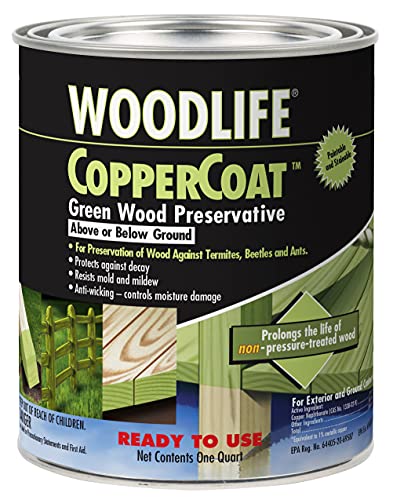
CopperCoat brings the copper naphthenate defense in a water-based formula and a small can, which makes it the practical pick for spot work. It is an EPA-registered insecticidal and fungicidal preservative labeled for the full range of exposures — below ground, ground contact, fresh water contact, and above ground — on untreated or pressure-treated wood alike. The water base keeps odor down and cleanup simple compared with the oil-carried copper picks, and the quart size suits the real shape of most jobs: a handful of fence posts, the cut ends from one deck repair, a gate frame, a cold frame. It brushes, rolls, or dips on, and the green tint fades as it weathers; once fully dry it can be painted or stained over. One honest limit: the maker positions the green formula for exterior wood only, so keep it off interior projects and, as with every copper pick here, off anything that touches food. Choose this one when the job is small, the wood sits in or near the ground, and you want copper protection without opening a gallon.
Specs
- Type: Water-based copper naphthenate preservative
- Active ingredient: Copper naphthenate
- Maker model: 1904A
- Size: 1 quart
- Coverage: About 25 to 75 sq ft per quart per maker figures
- Application: Brush, roller, or dip
- Finish: Transparent green that fades with weathering; topcoatable once dry
- Registration: EPA-registered insecticidal and fungicidal preservative
- Use: Below ground, ground contact, fresh water contact, and above ground exterior wood
5. Green Products Copper-Green Wood Preservative, 1 Gallon

Copper-Green is the old-school oil-borne workhorse of the copper family, sold by the gallon for people treating serious footage. Its copper naphthenate sits at 10 percent in a hydrocarbon solvent carrier that penetrates deeply and then sheds water on its own, so treated wood resists decay fungi, termites, and boring insects while also standing up to weather without a separate topcoat. Brush it on for surface protection or dip small stock — stakes, lattice, greenhouse flats, planter lumber for ornamentals — at the maker’s dip rates. The gallon covers roughly 150 to 200 sq ft per brush coat, and the green tone is the classic treated look that fades toward brown in the sun. It is a solvent product through and through: expect fumes while you work, ventilate well, let it dry fully before the wood goes into service, and keep it away from food-contact wood entirely. Choose this one when you are treating a fence line, a stack of posts, or rough outdoor lumber and want the copper defense and water repellency in a single pass.
Specs
- Type: Oil-borne copper naphthenate preservative
- Active ingredient: Copper naphthenate, 10 percent
- Maker model: 30001
- Size: 1 gallon
- Coverage: About 150 to 200 sq ft per gallon per brush coat per maker figures
- Application: Brush or dip
- Finish: Green that weathers toward brown
- Registration: EPA-registered wood preservative
- Use: Fences, posts, stakes, greenhouse wood, and rough outdoor lumber
Side-by-Side Comparison
| Pick | Family | Form | Best exposure | Topcoat needed |
|---|---|---|---|---|
| Nisus Bora-Care | Borate | Concentrate, dilute 1:1 to 5:1 | Sheltered or covered bare wood | Yes, outdoors |
| Nisus Tim-BOR Professional | Borate | Powder, mix or dust | Bare wood, voids, staged jobs | Yes, outdoors |
| Tenino Copper Naphthenate | Copper | Oil-borne, ready to use | End cuts and ground contact | No |
| Wolman CopperCoat | Copper | Water-based, ready to use | Small jobs, below ground to above ground | Optional |
| Green Products Copper-Green | Copper | Oil-borne, ready to use | Fences, posts, rough lumber | No |
FAQ
Can I apply a wood preservative over paint or an old finish?
No. Every pick in this guide needs bare wood to soak in. Sand or strip old paint, varnish, and sealers off first, and finish all cutting and drilling before treatment so the fresh surfaces are covered too.
Which family should I pick for a fence that stays out in the rain?
A copper naphthenate pick. Borates diffuse deeper and leave no color, but repeated rain leaches them out of exposed wood unless a sound topcoat seals them in. Copper formulas resist washout, which is why they carry the ground contact labels.
Is treated wood safe around a vegetable garden?
Read the label of the exact product. The Tenino label bars its treated wood from garden beds growing vegetables, and copper picks generally stay off food and feed contact wood. Borate labels allow more garden-adjacent framing uses, but keep the solution itself off the soil and out of runoff paths, because boron buildup can harm plants.
How long does a borate treatment last?
On sheltered interior wood, makers describe borate protection as lasting for the life of the wood, because nothing washes it away. Outdoors under a maintained topcoat it lasts for years; outdoors fully exposed, expect to renew it as the coating wears, following the label schedule.
Can I paint or stain over these treatments?
Yes, once the treatment has dried and cured per its label. Borates dry clear and take paint, stain, and sealers well, and the water-based CopperCoat is also topcoatable once dry. Oil-borne copper picks need their full dry time first, and a test patch is wise because the green tint can shade pale topcoats.
Final Verdict
Start with the exposure and the answer picks itself. For bare framing, fences you plan to topcoat, and any wood still within reach before assembly, the two borates do the deepest, cleanest work: Bora-Care when you want a liquid concentrate that diffuses through damp wood, Tim-BOR when you want a powder that stores forever and doubles as a void dust. For wood that will live in the weather or in the ground, go copper: Tenino for code-strength end cuts and post bottoms, CopperCoat for small water-based jobs, and Copper-Green when a whole fence line or lumber stack needs one heavy pass. Whichever can you open, gear up, keep it off skin and food surfaces, and let the label set the mix, the coats, and the dry time.
Related guides
More from Amazon
Programs that pair well with the guide above. Offers and eligibility are set by Amazon and may change.
A free business account with business pricing and bulk-buying tools for work, shop or home office.
Create a business accountFree shipping on eligible items, Prime Video and more. Eligible new members can start with a free trial.
Start a Prime free trialAudiobooks and podcasts to listen to on the go. Eligible new members can start with a free trial.
Try Audible freeAd-free music streaming. Eligible new subscribers can start with a free trial.
Try Music Unlimited freeAs an Amazon Associate we earn from qualifying purchases.








