
Key takeaways
- Index parts precisely with semi-universal dividing heads — center heights, spindle noses, and dividing plate sets compared for milling machine work.
As an Amazon Associate I earn from qualifying purchases. This post may contain affiliate links at no extra cost to you.
A dividing head turns a milling machine into a tool that can place holes, flats, and gear teeth at exact, repeatable angles. Instead of laying out every position by hand, you clamp the workpiece in the chuck or between centers, turn the crank a counted number of turns, and the worm drive advances the spindle by a precise fraction of a full circle. Bolt circles, hex flats, splines, and spur gears all come down to that one repeatable motion. The five heads below cover the common sizes, from a compact 4 inch hobby unit to a universal head built for helical work.
Disclosure: As an Amazon Associate, I earn from qualifying purchases. Product details were verified at the time of writing.
How to Choose a Dividing Head
Start with center height. The center height is the distance from the base of the head to the spindle axis, and it decides the largest workpiece diameter the head can swing and whether the tailstock lines up with the head. The BS-0 frame sits at 100 mm (about 4 inches) and suits benchtop and knee mills doing small work. The BS-1 frame raises that to 128 mm (about 5 inches) for larger blanks and 6 inch chucks.
Check the spindle nose and center taper. Most semi-universal heads carry a threaded spindle nose, so the chuck mounts on a threaded back plate and can be swapped for a faceplate or a collet fixture. The center taper inside the spindle (MT2 on BS-0 heads, MT3 on BS-1 heads) should match the tailstock taper so a workpiece can run between centers without adapters.
Understand the dividing plates. A direct indexing plate, usually with 24 holes, handles quick divisions of 2, 3, 4, 6, 8, 12, and 24 with no crank counting. Indirect dividing uses interchangeable plates with many hole circles plus sector arms: with a 40:1 worm, a typical three-plate set covers divisions from 2 up to 380, skipping prime numbers and a few values the hole circles cannot form. If you plan to cut gears with odd tooth counts, confirm the plate set covers your numbers before buying.
Match the worm ratio and tilt range. Nearly every head in this class uses a 40:1 worm, so one crank turn moves the spindle 9 degrees. The headstock should tilt from about 10 degrees below horizontal to vertical (90 degrees), which covers angled drilling, tapered work, and milling on inclined faces.
Decide between semi-universal and universal. A semi-universal head handles direct and indirect dividing for gears, flats, and bolt circles. A universal head adds a change-gear drive that links the spindle to the mill table leadscrew, which is what helical gears, spiral flutes, and Archimedean cams require. Buy the universal pattern only if spiral work is actually on your list, because the gear train adds setup time to plain dividing jobs.
The 5 Best Dividing Heads
1. KAKA Industrial BS-0 Dividing Head Set, 5-Inch 3-Jaw Chuck

KAKA sells the BS-0 pattern as a genuinely complete kit: the head, a 5 inch 3-jaw chuck on a threaded back plate, an MT2 tailstock, centers, a driving dog, and three dividing plates all arrive together, so the head can work the day it lands on the table. The 40:1 worm and the 24-hole direct plate cover quick divisions, and the three interchangeable plates extend indirect dividing from 2 to 380 divisions apart from prime numbers. The headstock tilts from 10 degrees below horizontal to 90 degrees vertical. For a first dividing head on a small or mid-size mill, this is the set with the fewest extra purchases left to make.
Specs
– Center height: 100 mm (4 in), BS-0 frame
– Spindle nose: threaded nose; chuck mounts on the included threaded back plate; MT2 center taper
– Dividing plates: 24-hole direct plate plus 3 interchangeable plates; indirect divisions 2–380 excluding primes
– Worm ratio: 40:1
– Included: 5 in 3-jaw chuck, MT2 tailstock, centers, driving dog, threaded back plate
– Tilt range: 10° below horizontal to 90° vertical
2. VEVOR BS-1 Dividing Head Set, 6-Inch 3-Jaw Chuck

The BS-1 is the step up in swing capacity: a 128 mm center height, a 6 inch 3-jaw chuck, and a 20 mm spindle through hole for bar stock that needs to pass through the head. VEVOR builds this set on an HT200 cast iron body with laser-engraved scales, so the degree ring reads cleanly when you set rough angles before fine dividing with the plates. The MT3 tailstock matches the larger frame, and the three index plates plus the direct plate give indirect dividing from 2 to 380 divisions, again excluding primes. Shops whose work has outgrown a BS-0, or that start with larger gear blanks, should begin here.
Specs
– Center height: 128 mm (5 in), BS-1 frame
– Spindle nose: threaded nose; MT3 center taper; 20 mm spindle through hole
– Dividing plates: direct indexing plate plus 3 interchangeable index plates; indirect divisions 2–380 excluding primes
– Worm ratio: 40:1 (listed as 1:40)
– Included: 6 in 3-jaw chuck, MT3 tailstock, dead center, 3 index plates
– Body: HT200 cast iron with laser-engraved scales
– Tilt range: horizontal to 90° vertical
3. ZHIMAI 6 Inch Precision Dividing Head Set
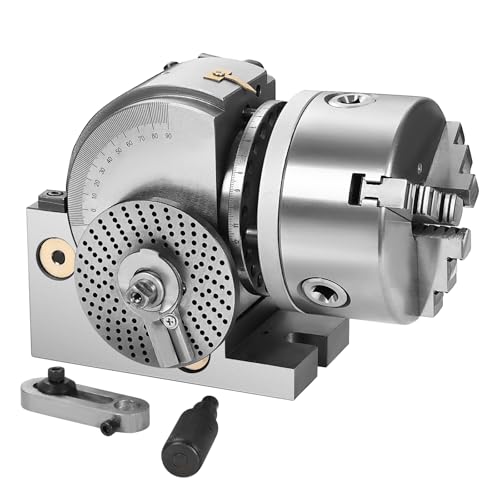
ZHIMAI’s 6 inch head is the heavy-duty entry in this group: an HT200 cast iron body, a 6-1/2 inch swing, and a 1:40 worm drive aimed at demanding milling, drilling, and grinding work. Its indexing leans on a 24-hole quick division plate, which covers divisions of 2, 3, 4, 6, 8, 12, and 24 directly — the counts that dominate bolt circles, square and hex flats, and simple gear work — with a 1-degree scale ring for angular positioning between plate stops. The semi-universal headstock tilts from 10 degrees below horizontal to 90 degrees vertical. If most of your dividing is quick direct indexing on larger stock rather than long plate calculations, this head fits that rhythm.
Specs
– Center height: 128 mm (5 in)
– Spindle nose: threaded nose for back-plate chuck mounting
– Dividing plates: 24-hole direct indexing plate (divisions 2, 3, 4, 6, 8, 12, 24)
– Worm ratio: 1:40
– Chuck: 6 in 3-jaw
– Body: HT200 cast iron; swing 6-1/2 in
– Tilt range: 10° below horizontal to 90° vertical
4. Dividing Head 4-Inch with 3-Jaw Chuck (Furvveerr)

This compact semi-universal set shrinks the BS-0 pattern around a 4 inch 3-jaw chuck for small mills and hobby work. It still ships as a full set — chuck, MT2 tailstock, and three dividing plates — and keeps the class-standard 1:40 worm and a tilt range from 10 degrees below horizontal to 90 degrees, so angled drilling and inclined milling stay on the table. The maker does not publish a center height figure for this listing, so measure your mill’s daylight and your tailstock alignment before ordering; within that limit, it is the natural pick for automotive, mold, and model work at small scale.
Specs
– Center height: not published by the maker; compact 4 in class frame
– Spindle nose: threaded nose
– Dividing plates: 3 dividing plates plus direct plate
– Worm ratio: 1:40
– Included: 4 in 3-jaw chuck, MT2 tailstock
– Tilt range: 10° below horizontal to 90° vertical
5. Universal Dividing Head, 6-Inch, 128 mm Center Height

A universal head earns its name with the change-gear train: gears link the spindle to the table leadscrew, so the workpiece rotates as it travels, which is how helical gears, spiral flutes, and Archimedean cams get cut. This 128 mm center height model carries the full three-plate set — plate A with 15–20 hole circles, plate B with 21–33, and plate C with 37–49 — behind a 1:40 worm, and the head tilts from 10 degrees down to 90 degrees up. The spindle nose follows the universal F11 pattern, a short taper nose made for mounting flanges and faceplates. Choose it when spiral work is the goal; for plain dividing alone, the semi-universal heads above set up faster.
Specs
– Center height: 128 mm
– Spindle nose: short-taper flange-mount nose (universal F11 pattern)
– Dividing plates: 3 plates — A (15–20 holes), B (21–33 holes), C (37–49 holes)
– Worm ratio: 1:40
– Drive: change gears for helical and spiral milling
– Tilt range: 10° downward to 90° upward
Comparison Table
| Product | Center Height | Spindle Nose | Dividing Plates | Worm Ratio |
|---|---|---|---|---|
| KAKA Industrial BS-0 Set | 100 mm (4 in) | Threaded; MT2 center taper | 24-hole direct + 3 plates | 40:1 |
| VEVOR BS-1 Set | 128 mm (5 in) | Threaded; MT3 center taper | Direct plate + 3 index plates | 40:1 |
| ZHIMAI 6 Inch Precision Set | 128 mm (5 in) | Threaded | 24-hole direct plate | 1:40 |
| Furvveerr 4-Inch Head | Not published | Threaded | Direct plate + 3 plates | 1:40 |
| Universal Dividing Head 6-Inch | 128 mm | Short-taper flange-mount | 3 plates (A, B, C) | 1:40 |
FAQ
What is the difference between a BS-0 and a BS-1 dividing head?
Size. The BS-0 frame has a 100 mm center height, an MT2 center taper, and usually carries a 5 inch chuck. The BS-1 raises the center height to 128 mm, moves to an MT3 taper, and carries a 6 inch chuck, which gives more swing for larger blanks.
How many divisions can a dividing head make?
The 24-hole direct plate gives 2, 3, 4, 6, 8, 12, and 24 divisions instantly. With indirect dividing on a three-plate set and a 40:1 worm, most heads cover divisions from 2 to 380, excluding prime numbers and a few values the available hole circles cannot form.
Is a dividing head the same as a rotary table?
No. A rotary table is a plain indexing table turned by its own handwheel against a degree dial, with no dividing plates and no geared dividing train. A dividing head adds the worm drive, crank, and plates that make exact counted divisions repeatable, and its spindle tilts for angled work.
When do I need the tailstock?
Whenever the workpiece is long enough to flex or vibrate on the chuck alone. The work runs between the head’s center and the tailstock center, which keeps slender shafts and long gear blanks steady through the cut.
Can a semi-universal head cut helical gears?
Not on its own. Helical and spiral work needs the workpiece to rotate in step with table travel, and that synchronized motion comes from the change-gear drive on a universal head. A semi-universal head covers straight gears, flats, splines, and bolt circles.
Verdict
Most small and mid-size mills are best served by the KAKA BS-0 set, because the box holds everything — chuck, tailstock, centers, dog, back plate, and plates — at a 100 mm center height that fits the machines it will actually sit on. Step up to the VEVOR BS-1 when blanks get bigger: the 128 mm center height, 6 inch chuck, and MT3 tailstock give real swing room. The ZHIMAI head suits heavy direct-indexing work on large stock, the compact Furvveerr 4 inch set covers hobby-scale mills, and the universal head is the one to buy when helical gears or spiral flutes are the point of the purchase. Match the center height to your mill first, then let the plate set and the work you plan settle the rest.
Related guides
More from Amazon
Programs that pair well with the guide above. Offers and eligibility are set by Amazon and may change.
A free business account with business pricing and bulk-buying tools for work, shop or home office.
Create a business accountFree shipping on eligible items, Prime Video and more. Eligible new members can start with a free trial.
Start a Prime free trialAudiobooks and podcasts to listen to on the go. Eligible new members can start with a free trial.
Try Audible freeAd-free music streaming. Eligible new subscribers can start with a free trial.
Try Music Unlimited freeAs an Amazon Associate we earn from qualifying purchases.








