
Key takeaways
- Compare the best furniture touch-up markers with stain pens, wax sticks, and filler pencils that hide scratches, nicks, and worn edges on wood fast.
What's inside
- How to Choose a Furniture Touch-Up Marker
- 1. Minwax Wood Finish Stain Marker, Dark Walnut
- 2. Rejuvenate Exact Match Wood Furniture & Floor Repair Markers, 6 Count
- 3. Mohawk Ultra Mark Wood Stain Touch Up Marker, Old World Mahogany
- 4. Katzco 13-Piece Wood Scratch Repair Kit
- 5. Guardsman Wax Wood Furniture Filler Sticks, 5 Colors
- Comparison Table
- FAQ
- Verdict
As an Amazon Associate I earn from qualifying purchases. This post may contain affiliate links at no extra cost to you.
Most furniture damage is not structural. It is a pale line where a key dragged across a tabletop, a white nick on a chair leg, a worn edge on a cabinet door where the finish and its color have been rubbed down to bare wood. The wood underneath is sound; what is missing is color. That is the exact job of a touch-up marker: it puts color back into scratches, nicks, and worn edges on wood that is already finished, blending the repair into the surrounding surface so the eye stops catching on it. The five picks below cover the four working forms of the class — a stain pen loaded with real furniture stain, a buildable multi-color marker set, a professional pigment marker that seals as it colors, a combined marker-and-wax kit, and wax filler sticks for damage that has a little depth to it.
Disclosure: As an Amazon Associate, I earn from qualifying purchases. Product details were verified at the time of writing.
One boundary matters before anything else. This guide covers color touch-up only: markers, pens, and wax sticks that recolor damage on finished wood. It does not cover structural filling. A gouge deep enough to need real material packed in and leveled, a chipped corner that has lost wood, or a dent headed for a full repair belongs to the wood filler family, which this site handles in its wood filler guide. Wax sticks sit at the shallow end of that line — they fill hairline depth while they color, and two picks below use them that way — but no marker or wax stick rebuilds missing wood. This guide also leaves out refinishing: nothing here strips, sands, or re-stains a whole surface. Every pick assumes the finish around the damage is intact and worth keeping.
Contents
- How to Choose a Furniture Touch-Up Marker
- 1. Minwax Wood Finish Stain Marker, Dark Walnut
- 2. Rejuvenate Exact Match Wood Furniture & Floor Repair Markers, 6 Count
- 3. Mohawk Ultra Mark Wood Stain Touch Up Marker, Old World Mahogany
- 4. Katzco 13-Piece Wood Scratch Repair Kit
- 5. Guardsman Wax Wood Furniture Filler Sticks, 5 Colors
- Comparison Table
- FAQ
- Verdict
How to Choose a Furniture Touch-Up Marker
Match the tool to the depth of the damage. Run a fingernail across the mark. If it glides over, the damage is color-only — the finish film is scratched or the color is gone but the surface is level — and a marker alone is the whole repair. If your nail catches, the scratch has depth, and color alone will leave a shadow line: fill the shallow valley first with a wax stick, level it, then run the marker over the top for an exact tone. Worn edges and corners are a third case: they take color best from a chisel tip worked along the edge, which is why tip shape matters below.
Color matching is a method, not a guess. Always test on a hidden spot first — the inside of a leg, the underside of a rail. Start one shade lighter than you think you need, because every marker in this guide can be layered darker and none of them can be layered lighter. Apply in the direction of the grain, wipe the excess off the surrounding finish with a soft cloth while it is still wet, and judge the match only after the repair has dried, since wet color reads darker than dry color. For in-between tones, lay the lighter shade down first and feather the darker one over it; two of the sets below are built around exactly that blending routine.
Know the three chemistries. Stain pens carry real wood stain — transparent color that soaks into exposed wood fibers and shows grain through the repair, which makes them the natural match for stained (not painted) furniture in the same stain family. Pigment markers carry fine solid color in a binder that also seals; they are more opaque, cover pale scratches on dark finishes better, and are the professional choice for edges and for work that will be topcoated. Water-based ink markers are the low-odor, buildable option — light coats stacked until the tone lands — but they are not water resistant once dry, so they suit dry indoor furniture rather than a kitchen table that gets wiped down daily. Wax sticks are solid pigmented wax: no drying time, no chemistry to cure, color and shallow fill in one rub-and-buff pass.
Tip shape decides control. A fine point is a scalpel for hairline scratches and for drawing a missing grain line back in. A chisel tip is the workhorse: the broad face floods a worn edge in one stroke and the thin edge still tracks a narrow scratch. Valve-action professional markers add flow control — you shake to mix, press the nib to start the color moving, and the tip stays wet without flooding — at the trade-off of a short learning curve and nibs that must be capped promptly.
Plan around topcoats and wax. Marker repairs on a piece you intend to clear-coat afterward should be pigment or stain based and fully dry first; both the professional marker below and the stain pen tolerate lacquer, varnish, and urethane over them. Wax is the exception: almost nothing sticks reliably to a waxed spot, so a wax stick repair should be the last step on a finished piece, never a step under a fresh topcoat. In a sunny room, favor the light-fast pigment formulas; dye-heavy colors are the ones that drift first under years of window light.
1. Minwax Wood Finish Stain Marker, Dark Walnut
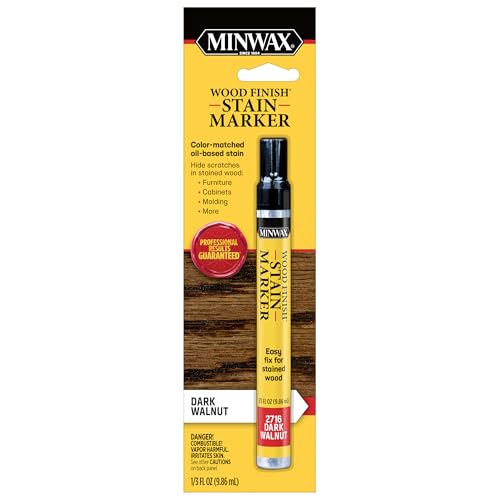
This is the simplest idea in the guide, executed by the brand that probably made the stain already on your furniture: a pen loaded with genuine Minwax Wood Finish, the company’s oil-based stain line, in the Dark Walnut shade. Because the colorant is real stain rather than an imitation ink, it behaves like stain — it soaks into the exposed fibers inside a scratch, darkens them the way the original finishing schedule did, and stays transparent enough for the grain to show through the repair. The working routine is the one printed on the card: shake well, press the tip on scrap until the stain flows, apply to the damage, and wipe the excess off the surrounding finish with a cloth. The piece is back in service as soon as the stain dries, which for a touch-up quantity is quick. The honest limitation is built into the concept: one pen, one color. Minwax sells the marker across its Wood Finish color range — Golden Oak, Cherry, and Red Mahogany among them — so the right move is to match the pen to the stain family your piece already wears, not to expect a single pen to cover a houseful of tones. For a walnut-stained table, cabinet run, or floor with the usual scattering of nicks, this is the first tool to reach for.
Specs
- Type: Stain marker pen with real oil-based wood stain
- Color: Dark Walnut (other Wood Finish shades sold separately)
- Size: 0.33 fl oz
- Model: 63487000
- Application: Shake, depress tip to start flow, apply, wipe excess with cloth
- Surfaces: Furniture, cabinets, doors, floors, molding, interior wood
- Dry behavior: Fast drying; piece ready for immediate use after drying
- Maker: Minwax
2. Rejuvenate Exact Match Wood Furniture & Floor Repair Markers, 6 Count

Rejuvenate’s answer to the matching problem is a spread of six markers in the tones that cover most factory furniture: maple, oak, cherry, walnut, mahogany, and espresso. The ink is a water-based hybrid delivered through a fine 0.5 mm point, which makes these the most controllable markers in this guide for hairline scratches, scuffed corners, and the pale rub marks that show up on chair rungs and table edges. The system is buildable by design — one pass lays down a light tint, and reapplying over the same line deepens it — so the technique is to start with the shade below your target and walk the color up, blending a lighter and darker neighbor together when the piece sits between two tones. The directions ask for the obvious discipline: test in an inconspicuous area first, remove excess pigment with a cloth, let the repair dry before touching it, and cap the markers tightly. The trade-off for the friendly water base is durability around moisture: the maker lists the dried ink as not water resistant, so these markers belong on living-room and bedroom furniture and on floors away from wet mopping, not on the dining table that gets a damp cloth after every meal. For a mixed house of light and dark pieces, six matched shades in one card is the most forgiving starting kit here.
Specs
- Type: Water-based hybrid ink repair markers, fine point
- Count: 6 markers
- Colors: Maple, Oak, Cherry, Walnut, Mahogany, Espresso
- Point: Fine, 0.5 mm line
- Model: RJ6WM
- Method: Apply, reapply to darken, blend light into dark for custom tones
- Water resistance: Not water resistant — dry indoor surfaces
- Surfaces: Wood furniture, flooring, laminate
- Maker: Rejuvenate (United Industries)
3. Mohawk Ultra Mark Wood Stain Touch Up Marker, Old World Mahogany

Mohawk is the name furniture factories and repair shops buy, and the Ultra Mark is its flagship touch-up marker: a valve-action pen loaded with light-fast pigments in a formula that seals, stains, and finishes in a single operation. That combination is what separates it from a simple ink pen — the repair is not just colored, it is sealed under the marker’s own binder, and it stays compatible with everything around it, since the maker’s data confirms the dried repair can be sprayed over with lacquer, acrylic, varnish, or urethane topcoats. The acrylic chisel nib covers a worn edge on its broad face and tracks a scratch on its edge, and the valve tip meters flow so the color arrives wet but controlled once you shake the pen and press the nib to prime it. The line’s published working times are short — dry to touch in about five minutes, ready to handle or recoat in about ten — which suits production-style work where a chair gets its edges recolored and goes straight back to the floor. Old World Mahogany (model M280-0010) is the representative shade here, a deep red-brown for traditional furniture; the real story of this line is its catalog depth, with well over a hundred factory-matched colors, so the working method is to order the pen that matches your finish by name. Buy one color at a time, exactly matched, rather than a general set.
Specs
- Type: Professional pigment touch-up marker, seals and finishes in one step
- Color: Old World Mahogany (100+ factory shades in the line)
- Model: M280-0010
- Nib: Acrylic chisel tip, valve-action flow control; replacement nibs available
- Pigments: Light-fast, solvent-based formula
- Dry time: About 5 minutes to touch, about 10 minutes to handle or recoat
- Topcoat: Compatible with lacquer, acrylic, varnish, and urethane over the repair
- Use: Edge and scratch recoloring on finished wood
- Maker: Mohawk Finishing Products
4. Katzco 13-Piece Wood Scratch Repair Kit

Katzco bundles the two halves of a complete touch-up into one blister card: six felt-tip markers and six paper-wrapped wax sticks in matching shades — maple, oak, cherry, walnut, mahogany, and black — plus a sharpener for the sticks. The pairing exists because the two tools handle different damage, and the kit’s own routine teaches the right order: for a scratch with depth, rub the wax stick in first to fill the valley and wipe away the excess, then draw the matching marker over the top to set the tone; for a shallow scuff or a color-only mark, the marker alone finishes the job. The wax sticks work like crayons — peel the paper back as the tip wears, keep a point on them with the included sharpener, and press the wax across the scratch rather than along it so it packs into the groove. Nothing in the kit needs drying time or mixing, and the six-shade spread covers the same common furniture tones as the marker-only sets, with black added for ebonized and very dark finishes. This is the kit to hand someone with a rental walkthrough coming up or a houseful of mixed second-hand pieces: it will not rebuild a chipped corner, but for the everyday census of scratches, nicks, and scuffs it carries both answers in one card.
Specs
- Type: Combined marker and wax stick repair kit
- Count: 13 pieces — 6 markers, 6 wax sticks, 1 sharpener
- Colors: Maple, Oak, Cherry, Walnut, Mahogany, Black
- Markers: Felt-tip touch-up markers with matching stain shades
- Wax sticks: Paper-wrapped, sharpenable, rub-in application
- Method: Wax first to fill depth, marker over for tone; marker alone for scuffs
- Surfaces: Floors, cabinets, desks, tables, bedposts, finished furniture
- Maker: Katzco
5. Guardsman Wax Wood Furniture Filler Sticks, 5 Colors
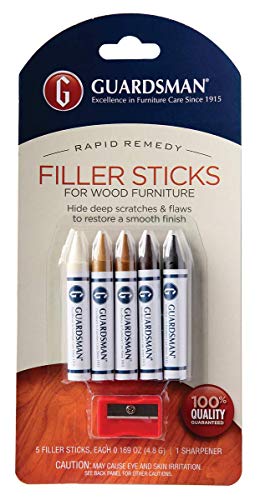
When the damage has real depth — a nick you can feel, a small gouge on a table edge, an open nail hole in a finished panel — a liquid marker has nothing to hold onto, and a wax stick is the right tool. Guardsman’s set is the focused version: five wax filler sticks in common wood tones, with a sharpener in the pack, from a brand that has sold furniture care products for over a century. The technique is mechanical rather than chemical. Soften nothing, mix nothing: rub the stick across the depression so the wax shears off and packs into it, work it slightly proud of the surface, then level it with a stiff card or the edge of a plastic scraper and buff the haze away with a soft cloth. Because the fill is solid wax, there is no drying time and no shrinkage, and an imperfect color can be adjusted on the spot by rubbing a second shade over the first and blending the two in the cavity. The limits are the honest limits of wax: the repair is a cosmetic fill for shallow damage, not a structural material, it can be displaced by heat or a hard knock, and it should go on after any topcoat work, since fresh finish will not bond over a waxed spot. For the fingernail-catching class of damage on finished furniture, nothing else in this guide works as directly.
Specs
- Type: Wax filler sticks for shallow nicks, gouges, and nail holes
- Count: 5 sticks plus sharpener
- Colors: 5 wood tones, blendable by layering in the repair
- Model: 500200
- Application: Rub across the damage to pack, level with a card, buff with cloth
- Dry time: None — solid wax, no curing
- Placement: Apply after finishing; topcoats do not bond over wax
- Surfaces: Furniture, cabinets, floors, chairs, finished wood
- Maker: Guardsman
Comparison Table
| Product | Form | Colors | Base | Best for |
|---|---|---|---|---|
| Minwax Wood Finish Stain Marker, Dark Walnut | Stain pen, single | 1 per pen (full stain range sold separately) | Oil-based real stain | Matching a known Minwax stain shade exactly |
| Rejuvenate Exact Match Repair Markers | Ink markers, fine point | 6 in the pack | Water-based hybrid ink | Hairline scratches across mixed furniture tones |
| Mohawk Ultra Mark, Old World Mahogany | Pigment marker, chisel nib | 1 per pen (100+ factory shades) | Solvent-based pigment, seals as it colors | Pro edge work and repairs that will be topcoated |
| Katzco 13-Piece Repair Kit | Markers plus wax sticks | 6 matched shades | Ink markers and solid wax | One kit for both scuffs and shallow scratches |
| Guardsman Wax Filler Sticks | Wax sticks | 5 in the pack | Solid pigmented wax | Nicks and nail holes with a little depth |
FAQ
Will a touch-up marker fix a deep gouge or a chipped corner?
No. A marker puts color back; it does not put wood back. Damage that has lost material — a deep gouge, a crushed corner, a long dent — needs a real filler packed in, leveled, and cured first, which is a different product family covered by this site’s wood filler guide. The wax sticks in this guide handle only the shallow end: nicks and nail holes with a little depth that a fingernail can just catch.
How do I get the color to match?
Test on a hidden area, start one shade lighter than the finish, and build up — every product here darkens with a second pass and none of them lighten. Work in the direction of the grain, wipe the excess off the surrounding finish while the repair is wet, and judge the result only when it is dry, because wet color always reads darker. For a tone that falls between two shades, lay the lighter one down first and feather the darker one over it until the line disappears at arm’s length.
Do I need a marker or a wax stick?
Drag a fingernail across the damage. If it slides over, the surface is level and only the color is gone — a marker is the complete repair. If the nail catches, the scratch has depth: fill it level with a wax stick first, then color over the fill with a marker. Worn edges and corners are marker work, done with the broad face of a chisel tip.
Can I put a clear finish over a touch-up repair?
Over a dried stain-pen or pigment-marker repair, yes — the professional marker in this guide is made to be sprayed over with lacquer, varnish, or urethane, and the stain pen tolerates the same topcoats once dry. Over wax, no: finish does not bond reliably to a waxed spot. Do any wax filling last, after the topcoat work is finished, or keep wax repairs on pieces that are not being refinished.
The repair looks too dark or too light. What went wrong?
Usually it was judged wet. A fresh repair reads a shade or more darker than it will dry, so wait for the full dry time before deciding. If a dried repair is too light, add another pass — that is the intended direction of adjustment. If it is too dark, the fix while the color is still fresh is to wipe the spot with a cloth dampened with the maker’s recommended thinner for that formula; once cured, a too-dark pigment repair can only be softened by gently abrading it back and starting lighter. This is why the test spot and the lighter-first rule exist.
Verdict
Start with the Katzco 13-Piece Repair Kit if your furniture shows the usual mix of damage: it carries both halves of the craft in one card — wax for the scratches with depth, markers for everything else — in six shades that cover most household wood. Choose the Rejuvenate Exact Match set when the damage is color-only and the pieces are many and varied; its fine points and buildable ink are the most forgiving tools here for hairline work. Reach for the Minwax Stain Marker when you know the stain on the piece by name, because nothing matches a Minwax finish like Minwax stain itself, in the pen made to carry it. Step up to the Mohawk Ultra Mark for the pieces that matter most — its light-fast pigment seals as it colors, tolerates a topcoat over the repair, and comes in factory shades matched by name for exact work. And keep the Guardsman Wax Filler Sticks in the drawer for the damage with depth that the markers cannot hold: packed, leveled, and buffed, they close a nick in a minute with no drying time at all. Whichever tool you open first, the discipline is the same — test hidden, start light, work with the grain, and judge it dry.
Related guides
More from Amazon
Programs that pair well with the guide above. Offers and eligibility are set by Amazon and may change.
A free business account with business pricing and bulk-buying tools for work, shop or home office.
Create a business accountFree shipping on eligible items, Prime Video and more. Eligible new members can start with a free trial.
Start a Prime free trialAudiobooks and podcasts to listen to on the go. Eligible new members can start with a free trial.
Try Audible freeAd-free music streaming. Eligible new subscribers can start with a free trial.
Try Music Unlimited freeAs an Amazon Associate we earn from qualifying purchases.








