
Key takeaways
- Compare ridge vents by style, airflow build and nail pattern, with the match-it-to-your-shingles rule and seal-the-ends habit for dry roof peaks.
What's inside
As an Amazon Associate I earn from qualifying purchases. This post may contain affiliate links at no extra cost to you.
A ridge vent is the exhaust half of a passive attic ventilation system: a continuous vent that runs along the roof peak, under the ridge cap shingles, letting hot, moist attic air escape at the highest point of the roof while baffles and filters keep wind-driven rain, snow, and pests out. It is a different product from the turbine vents covered in a separate guide — those are individual spinning heads punched through the roof field — and a different product again from the powered attic fans in another guide, which move air with a motor and a circuit. A ridge vent has no moving parts and no wiring; it works because wind passing over the peak drops the pressure there and because warm air rises. Four habits matter more than any single pick. First: match the vent to your shingles — width, cap size, and pitch range have to suit the roof you own, not the roof in the catalog photo. Second: cut the slot to the maker’s template — too narrow chokes the exhaust, too wide invites trouble, and the slot stops short of both ends of the ridge. Third: seal the ends — end plugs, baffles, and filter ends closed off properly are what stand between a dry attic and wind-driven rain walking in sideways. Fourth: balance the system — exhaust at the ridge only moves what the soffit intake below can supply, so the two sides are figured together, never separately. The five picks below cover the real formats on this shelf: two filtered rigid sections for wet and snowy country, an unfiltered high-flow rigid section, a baffled strip vent, and a fiber mesh roll for long, straight ridges.
Disclosure: As an Amazon Associate, I earn from qualifying purchases. Product details were verified at the time of writing.
Contents
How to Choose a Ridge Vent
Begin with the format. Rigid sectional vents come in 4-foot pieces that lock or lap together along the ridge. They hold a crisp, straight line, carry molded baffles and end plugs, and suit most houses. Strip vents are also rigid but built around a corrugated core, flexible enough to follow a slightly uneven ridge. Roll vents unroll in one long run — mesh rolls of entangled fiber, or low rigid rolls — and go down fast on long, straight peaks, with fewer joints to align. Metal ridge vents exist for metal roofs; every pick below is a shingle-over vent for asphalt shingle roofs, and that boundary is stated plainly because a shingle vent under a metal cap is the wrong purchase.
Read the net free area figure. Net free area, printed as NFA in square inches per linear foot, is the open area air can actually pass through, and it is the number the whole system is sized on. The shared sizing rule is roughly one square foot of total net free area per 300 square feet of attic floor, split evenly between intake and exhaust. A 1,800 square foot attic wants about 432 square inches of exhaust; at 18 square inches per foot, that is 24 feet of vented ridge. Treat the NFA on each listing as a maker figure and do the arithmetic with it before ordering, because a beautiful vent in the wrong footage is still the wrong vent.
Decide whether you need a filter. Filtered vents carry a fiberglass or fiber weather filter inside the section. In snow country and in country where wind drives rain uphill, the filter is what keeps powder snow and fine rain out of the attic, and makers position their filtered lines for exactly that. In warm, dry regions an unfiltered vent with a good external baffle moves air freely with one less layer to load up with dust over the decades. Neither is better in the abstract; the climate decides.
Check the baffle and the ends. An external baffle — a raised lip along each side of the vent — is what turns passing wind into suction at the ridge and deflects driven rain. Internal baffles and curved air passages slow weather that gets past the lip. Then look at how the run terminates: molded end plugs, fanfold plugs, or foam end caps that fit the vent’s profile. An open vent end is an open door for rain, insects, and birds, and it is the detail rushed installs get wrong.
Match pitch, width, and cap shingles. Every vent lists a pitch range, commonly 3:12 to 16:12 for rigid sections and wider for rolls. The vent width has to suit the ridge cap: an 11.5-inch vent is built for standard 12-inch caps, wider vents take wider caps, and narrow 9-inch versions exist for smaller cap shingles. Confirm all three — pitch, width, cap — against the maker’s sheet before the bundle goes on the roof.
Respect the roof work. Cutting a continuous slot along a peak and nailing vent and caps means a secured ladder, dry shingles underfoot, and fall protection on any pitch where a slip would not stop on its own. Work the slot with the deck dry, keep feet off the vent sections once they are down, and never nail through a section anywhere but the molded nail line — a fastener in the wrong place crushes the air channel the vent exists to provide.
1. GAF Cobra SnowCountry Advanced Ridge Vent

The SnowCountry Advanced is GAF’s filtered rigid section, built for the climates where an unfiltered vent earns its bad name: powder snow that drifts sideways and rain that arrives horizontally. Each 4-foot section of injection-molded polypropylene carries the Snow Guard fiberglass filter along its length, external baffles with a crush-resistant internal structure behind them, and GAF’s EasyTear sizing feature, which lets a section be hand-torn to a shorter length at the end of a run instead of sawn. The maker puts net free area at 18 square inches per linear foot and the pitch range at 3:12 to 16:12, hand-nailed with the fasteners the system calls for, and the design passes the maker’s 110 mph wind-driven rain test. The honest limits: the filter is a maintenance item in dusty country, where a decade of pollen and grit loads it slowly, and the 11.5-inch width assumes standard ridge caps. For a northern roof that spends months under snow, this is the section to beat.
Specs
- Model: Cobra SnowCountry Advanced (2028000)
- Format: Rigid sectional, filtered
- Section length: 4 ft
- Width: 11.5 in, for standard 12 in ridge cap shingles
- Material: Injection-molded polypropylene
- Filter: Snow Guard fiberglass weather filter
- Net free area: 18 sq in per linear foot (maker figure)
- Roof pitch: 3:12 to 16:12
- Fastening: Hand nail, on the molded nail line
- Weather test: Passes 110 mph wind-driven rain test (maker figure)
- Pack: 10 sections per box
2. Lomanco OmniRidge OR-4 Ridge Vent

The OmniRidge OR-4 is the unfiltered workhorse section: 4 feet of injection-molded high-impact copolymer built around Lomanco’s omni baffle system. An external venturi baffle with perpendicular omni baffles pulls air from the attic whichever way the wind crosses the peak, internal curved baffles turn back weather that slips the lip, and an external water shield guards the louver line. The detail installers praise is the molded-in fanfold end plug — it folds out of the section itself and fits every pitch in the range, so the run’s ends close with the maker’s own part instead of a wad of foam and hope. Ten supported nail holes and molded nail lines keep fasteners where the structure can take them. The maker puts net free area at 18 square inches per linear foot, 72 square inches per section, across pitches from 2/12 to 16/12. The honest limits: no filter, so in fine-snow country the filtered sections above and below it on this page are the safer buy, and the black-only finish is a non-issue under caps but worth knowing. As a general-purpose rigid section, it is hard to fault.
Specs
- Model: OmniRidge OR-4
- Format: Rigid sectional, unfiltered
- Section length: 4 ft
- Material: High-impact copolymer, UV stabilized
- Baffles: External venturi baffle with perpendicular omni baffles; curved internal baffles; external water shield
- End closure: Molded-in fanfold end plug, fits all pitches in range
- Net free area: 18 sq in per linear foot (maker figure)
- Roof pitch: 2/12 to 16/12
- Fastening: 10 supported nail holes per section, molded nail lines
- Pack: 10 sections per carton
- Warranty: Limited lifetime (maker terms)
3. CertainTeed Filtered Ridge Vent, 12 Inch

CertainTeed’s filtered vent takes the same cold-and-wet brief as the GAF section and answers it with an internal weather filter inside a 12-inch rigid profile. The sections run 4 feet each and ship ten to a pack, enough for 40 feet of ridge in one box. An external baffle works the wind, the filter behind it catches the fine snow and driven rain that baffles alone pass, and the maker puts net free area at 18 square inches per linear foot with wind-driven rain resistance to 110 mph, across pitches from 3/12 to 16/12. The wider 12-inch body suits roofs capped with full-width ridge shingles and gives the filter a broad, low channel that resists crushing under the cap course. The honest limits mirror every filtered vent: the filter layer is the long-term wear item, and on a warm, dry roof it is protection bought against weather that never comes. On a roof that sees real winters, it is the quiet, correct choice in this lineup.
Specs
- Model: CertainTeed 12 in Filtered Ridge Vent
- Format: Rigid sectional, filtered
- Section length: 4 ft
- Width: 12 in
- Filter: Internal weather filter
- Net free area: 18 sq in per linear foot (maker figure)
- Roof pitch: 3/12 to 16/12
- Weather figure: Wind-driven rain resistance to 110 mph (maker figure)
- Pack: 10 sections per pack
4. Owens Corning VentSure 4-Foot Strip Ridge Vent
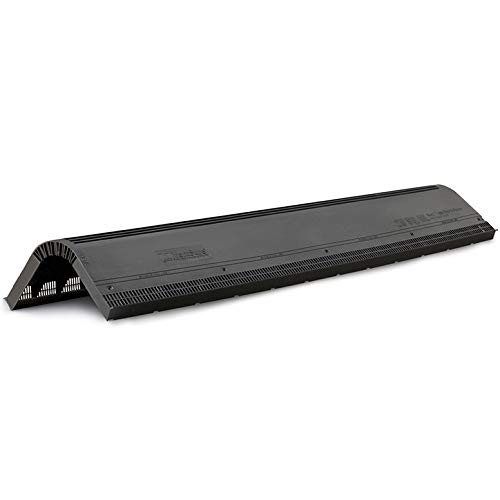
The VentSure strip is the high-flow entry: a corrugated polypropylene strip, 4 feet at a time, whose flat external baffle and corrugated ridge add up to a maker figure of 20 square inches of net free area per linear foot — the strongest airflow number on this page. The corrugation is not decoration; it gives the strip the strength to hold a uniform ridgeline and enough flex to follow a ridge that is not laser straight, and alignment tabs between strips keep the run registered as it goes down. The carton of ten includes the nails, and the material is UV resistant for the decades it will spend under the caps. This is the vent for a warm-climate roof or a big attic where exhaust area is the binding constraint and every square inch per foot shortens the run needed. The honest limits: there is no weather filter in the strip, so snow country should look at the filtered sections, and the corrugation wants careful nailing on the flange — a sunken fastener dimples the profile the caps have to bridge.
Specs
- Model: VentSure 4-Foot Strip Heat & Moisture Ridge Vent
- Format: Rigid strip, corrugated, unfiltered
- Section length: 4 ft
- Width: 15 in
- Material: Polypropylene, UV resistant
- Baffle: Flat external baffle design
- Net free area: 20 sq in per linear foot (maker figure)
- Alignment: Corrugated ridge design with alignment tabs
- Fastening: Nails included in the carton
- Pack: Carton of 10 strips
5. Blocksom TV205246 Ridge Vent Roll
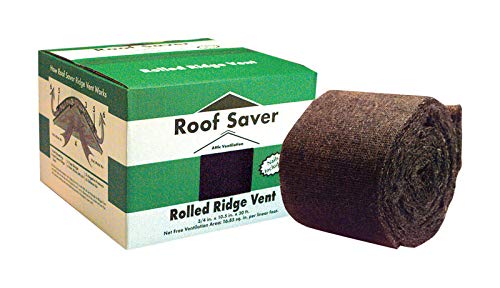
The Blocksom roll is the old-school mesh format: a 20-foot roll of entangled fiber and polyester mat, three quarters of an inch thick and 10.5 inches wide, that unrolls along the slot and disappears under the ridge caps. There is no molded baffle and no rigid profile; the mat itself is the vent, passing air along its whole length while the dense fiber tangle turns back rain, snow, and insects. It is the fastest format on a long, straight ridge — one piece, no joints to lap, cut to length at the end with a utility knife — and the forgiving one on wavy older roofs, where rigid sections bridge and rock. The trade-offs are real and stated plainly: the mat has no crush-resistant structure, so cap nails are driven snug, never sunk, or the channel pinches shut; it carries no molded end plug, so the ends are closed with the foam closures and sealant the maker describes; and in the hardest wind-driven rain country a baffled, filtered section is the stronger answer. For a mild-climate re-roof on a budget of time rather than money, the roll remains a legitimate, widely used format.
Specs
- Model: TV205246 (Roof Saver roll)
- Format: Mesh roll, shingle-over
- Roll size: 20 ft long x 10.5 in wide
- Thickness: 3/4 in
- Material: Fiber and polyester entangled mat
- Baffle: None — the fiber mat is the weather barrier
- Fastening: Hand nail or nail gun under ridge cap shingles
- End closure: Foam closures and sealant, per maker instructions
- Pack: 1 roll
The Short Answer
Match the format to the roof and the filter to the climate. Snowy and wind-scoured roofs get a filtered rigid section — the GAF SnowCountry Advanced or the CertainTeed filtered vent. A general roof in ordinary weather is well served by the Lomanco OmniRidge OR-4, whose molded fanfold end plug closes the detail most installs fumble. Where exhaust area is the constraint, the Owens Corning VentSure strip’s 20 square inches per foot shortens the run. And on a long, straight, mild-climate ridge, the Blocksom mesh roll goes down in one piece and asks only for disciplined nailing in return. Whichever section or roll goes up, the system still stands or falls on the same four habits: vent matched to the shingles, slot cut to the template, ends sealed tight, and intake at the soffits balanced against the exhaust at the peak.
Related guides
More from Amazon
Programs that pair well with the guide above. Offers and eligibility are set by Amazon and may change.
A free business account with business pricing and bulk-buying tools for work, shop or home office.
Create a business accountFree shipping on eligible items, Prime Video and more. Eligible new members can start with a free trial.
Start a Prime free trialAudiobooks and podcasts to listen to on the go. Eligible new members can start with a free trial.
Try Audible freeAd-free music streaming. Eligible new subscribers can start with a free trial.
Try Music Unlimited freeAs an Amazon Associate we earn from qualifying purchases.








