
Key takeaways
- Compare the best powder coating systems with dual voltage guns, adjustable output, and easy color changes for home shops and garages today too.
What's inside
- How to Choose a Powder Coating System
- 1. Eastwood HotCoat PCS-250 — The Dual-Voltage Standard
- 2. Eastwood PCS-150 — The Starter with Powders Included
- 3. PTOOL PT-200 — The Compact Dual-Voltage Alternative
- 4. VEVOR 50KV Powder Coating System — The Adjustable Step-Up
- 5. VEVOR 100KV Powder Coating System — The Hopper-Fed Trolley
- Comparison Table
- FAQ
- Verdict
As an Amazon Associate I earn from qualifying purchases. This post may contain affiliate links at no extra cost to you.
Powder coating turns a bare metal part into a finished one in about an hour: spray on dry powder with an electrostatic gun, cure it in an oven, and the part comes out with a tough, even finish that shrugs off chips, fuel, and weather far better than a coat from a spray can. The gun is the heart of the setup, and for home shops the choice comes down to how much electrostatic output you need, how the powder feeds, and how painless color changes are.
The five systems below are all complete guns or gun-and-feed systems sold for home and small-shop work. There is the hobby standard dual-voltage gun, its simpler single-voltage sibling with starter powders in the box, a compact dual-voltage alternative, a five-step adjustable system with a foot switch, and a hopper-fed trolley machine for anyone coating part after part. Every one of them still needs a small air supply and a curing oven, which the guide below covers honestly.
Disclosure: As an Amazon Associate, I earn from qualifying purchases. Product details were verified at the time of writing.
Contents
- How to Choose a Powder Coating System
- 1. Eastwood HotCoat PCS-250 — The Dual-Voltage Standard
- 2. Eastwood PCS-150 — The Starter with Powders Included
- 3. PTOOL PT-200 — The Compact Dual-Voltage Alternative
- 4. VEVOR 50KV Powder Coating System — The Adjustable Step-Up
- 5. VEVOR 100KV Powder Coating System — The Hopper-Fed Trolley
- Comparison Table
- FAQ
- Verdict
How to Choose a Powder Coating System
Start with the output figure, in kV. The electrostatic charge is what pulls powder onto the part and wraps it around edges. Hobby guns run from a fixed 15 kV up to 50 kV, and hopper-fed shop machines go higher. Low settings suit small, simple parts and second coats, because a heavy charge can repel powder from recesses and inside corners. Higher settings help on large flat parts and first coats. A gun with two or more settings covers more situations than a fixed-output gun, and a stepped or dial adjustment covers the most.
Decide between a cup gun and a hopper. Cup and bottle guns carry a small amount of powder on the gun itself, typically around 8 ounces or half a liter. They are light, they set up in minutes, and a color change is as simple as swapping the bottle. A hopper system feeds powder from a large tank through a hose, which keeps the flow steady over long runs of the same color but makes color changes a cleaning job. Most home shops are better served by a cup gun and a shelf of bottles, one per color.
Check the air supply you already own. These guns sip air compared with HVLP spray guns. The Eastwood-style cup guns run on roughly 5 to 10 PSI from a small compressor or even a portable tank with a regulator. What matters more than volume is dry, clean air: add an inline filter or separator, because moisture in the line clumps powder and ruins flow. The hopper machine wants a bigger supply and higher pressure, which is worth confirming before it lands in the shop.
Think about how you will trigger it. Some guns use a remote hand switch you hold alongside the gun, some use a button on the power supply lead, and some offer a foot pedal that leaves both hands free to rotate the part. On small parts held in one hand, a foot switch is a genuine convenience. On parts hanging from a rack, a hand switch is fine. Pick the style that matches how you actually hold your work.
Grounding is not optional. The part must be grounded for the charge to work, and every system here ships with a ground clamp and cable. A larger clamp that bites onto racks and hanging hooks saves frustration. Poor grounding is the most common cause of weak coverage and powder that will not stick, so treat the clamp as part of the gun, not an accessory.
Budget space and gear beyond the gun. No gun cures powder by itself. You need a dedicated electric oven (never the kitchen oven you cook food in), a ventilated place to spray, a respirator, and hooks and racks for hanging parts. None of the five systems below includes an oven, so plan the whole station, not just the sprayer.
1. Eastwood HotCoat PCS-250 — The Dual-Voltage Standard

The PCS-250 is the gun most home powder coaters start with, and the one the rest of this class is measured against. Its power supply switches between a 15 kV setting for small areas and detail work and a 25 kV setting for larger surfaces and multi-coat coverage, both running off standard 120V household current. The clear 8-ounce bottle lets you see the powder color and level at a glance, the cabling is color-coded so setup is hard to get wrong, and the ground clamp is larger than the one on the older generation of this gun. Activation is by a push-button switch on a lead, and the whole system is light enough to use for a full afternoon of brackets, wheels, and hardware.
Specs
- Model: Eastwood HotCoat PCS-250
- Output: 15 kV / 25 kV dual voltage
- Power: 120V household current, 28.8W
- Air requirement: 5 to 10 PSI, compressor or regulated tank
- Powder feed: Clear bottle, 8 oz
- Activation: Push-button switch on lead
- Includes: Gun, dual-voltage power supply, activation switch, ground clamp and cable, empty 8 oz bottle
- System weight: About 4.4 lb
2. Eastwood PCS-150 — The Starter with Powders Included

The PCS-150 is the simpler Eastwood: a single fixed 15 kV output, the same 120V power supply style, and the same color-coded cabling, but with the extras a first-time coater actually needs in the box. It ships with 8-ounce bottles of red, white, and gloss black powder, so the first parts can be coated the day the gun arrives instead of after a second order. The fixed output is the trade-off. Fifteen kilovolts handles flat and gently shaped parts well, but there is no higher setting to reach for on big panels or second coats, and the system is a little heavier in the hand than the PCS-250. For a first gun aimed at small parts, it is the most straightforward path in this group.
Specs
- Model: Eastwood PCS-150 (item 33272)
- Output: 15 kV single voltage
- Power: 120V / 60Hz household current, 28.8W
- Air requirement: 5 to 10 PSI, compressor or regulated tank
- Powder feed: Powder cup with deflector
- Includes: Gun, power supply, powder cup, deflector, 8 oz bottles of red, white, and gloss black powder
- Item weight: 6.2 lb
3. PTOOL PT-200 — The Compact Dual-Voltage Alternative

The PT-200 follows the same recipe as the Eastwood dual-voltage guns — two output settings, a clear bottle, a remote activation switch — in a slightly lighter package. Output switches between 15KV and 25KV, the power supply runs on 120V, and the leads are sensibly sized: a 6 ft power cord, a 6 ft cord for the remote switch, and an 8 ft grounding cord. The clear bottle makes powder level and color obvious before you start spraying, which matters when several colors live on the same shelf. It covers the same small-parts and hobby ground as the PCS-250, and suits buyers who want the two-setting flexibility in the lightest body here.
Specs
- Model: PTOOL PT-200
- Output: 15KV / 25KV dual voltage
- Power: 120V / 60Hz, 28.8W
- Powder feed: Clear bottle (powder cup)
- Includes: Gun, high voltage power supply box, powder cup, deflector
- Leads: 6 ft power cord, 6 ft switch cord, 8 ft ground cord
- Weight: About 4.2 lb
4. VEVOR 50KV Powder Coating System — The Adjustable Step-Up

Where the Eastwood and PTOOL guns give you two settings, this VEVOR system gives you five: output adjusts in steps of 30, 35, 40, 45, and 50KV, which makes it far easier to match the charge to the part — lower for recoats and recessed shapes, higher for large first-coat work. It also offers two ways to run it, a foot pedal and a button switch, so the part can be turned with both hands while the pedal does the triggering. Two powder bottles and two nozzles are in the box, and swapping bottles is the color change, so a two-color afternoon does not involve cleaning anything. At about 6.6 lb it is heavier than the cup guns above, the trade for the bigger power supply and the wider output range.
Specs
- Model: VEVOR 150-9000
- Output: 50KV maximum, adjustable in 30 / 35 / 40 / 45 / 50KV steps
- Powder feed: 2 powder bottles, 0.45 L each
- Controls: Foot pedal and button switch
- Includes: Spray gun, control unit, 2 nozzles, 2 powder bottles, fuse, replacement seal, strainer
- Weight: About 6.6 lb
5. VEVOR 100KV Powder Coating System — The Hopper-Fed Trolley
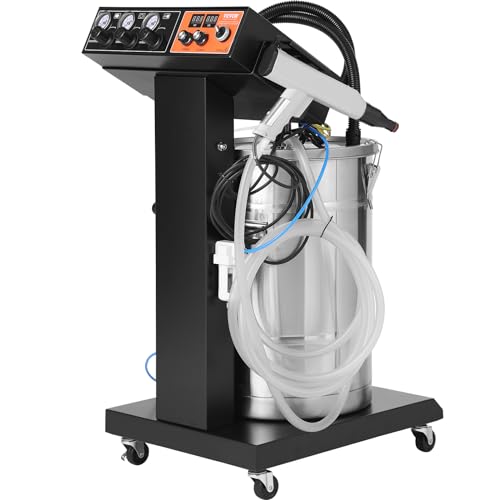
This is the step from hobby gun to small production machine. Instead of a bottle on the gun, powder feeds from a 50L hopper at up to 450g per minute, and the output adjusts across a 0 to 100KV range, so long runs of wheels, frames, and panels keep a steady flow and a strong charge without stopping to refill. The whole unit rides on a trolley base with four swivel casters, two of them lockable, and the cabinet is built from 2.5mm steel plate. It asks more of the shop in return: a bigger air supply, floor space, and real cleaning time when colors change. For a garage that coats the same two or three colors every week, that trade makes sense; for occasional small parts, the cup guns above are simpler.
Specs
- Model: VEVOR ZP-301
- Output: 0 to 100KV adjustable, 40W
- Powder feed: 50L hopper, up to 450g/min output
- Construction: 2.5mm steel plate cabinet
- Base: Trolley with 4 swivel casters, 2 lockable
- Air: Up to 90 PSI maximum pressure
- Item weight: 51.15 lb
Comparison Table
| System | Output | Settings | Powder feed | Activation | Weight |
|---|---|---|---|---|---|
| Eastwood PCS-250 | 15 / 25 kV | 2 | 8 oz clear bottle | Push-button switch | About 4.4 lb |
| Eastwood PCS-150 | 15 kV | 1 (fixed) | Powder cup | Remote switch | 6.2 lb |
| PTOOL PT-200 | 15 / 25KV | 2 | Clear bottle | Remote switch | About 4.2 lb |
| VEVOR 50KV | 30 to 50KV | 5 steps | 2 bottles, 0.45 L | Foot pedal and button | About 6.6 lb |
| VEVOR 100KV | 0 to 100KV | Dial range | 50L hopper | Gun trigger with control unit | 51.15 lb |
FAQ
Do I still need an oven with these systems?
Yes. The gun only applies the powder. The finish forms when the part is cured in a dedicated electric oven at the temperature on the powder’s instructions, commonly around 400 degrees for 15 to 20 minutes after the powder flows out. Never cure parts in an oven used for food.
What air compressor do these guns need?
The cup guns are undemanding: roughly 5 to 10 PSI through a regulator, which a small shop compressor or portable tank handles easily. Dry air matters more than volume, so an inline filter is a wise addition. The hopper-fed VEVOR wants a larger supply and up to 90 PSI available at the regulator.
Why does powder miss inside corners?
A strong charge builds up on the edges of a recess and repels powder from the middle, a behavior called the Faraday cage effect. Dropping to a lower kV setting, moving the gun farther back, and dusting the corner first before the main coat are the standard fixes, which is why adjustable output is worth having.
How do I change colors?
On the bottle guns, unscrew the bottle and fit one filled with the next color; keeping one bottle per color is the cleanest system. Blow out the gun with air between colors. On the hopper machine, the hopper and lines need a full clean-out, which is why hopper systems suit shops that spray one color for long stretches.
Can I powder coat parts that are not metal?
The part has to conduct electricity well enough to hold a ground and survive curing heat, which in practice means metal. Some dense materials can be coated with special preparation, but for a home shop the honest answer is that these systems are metal-part tools.
Verdict
For most home shops, the Eastwood PCS-250 is the system to start with: two useful voltage settings, a clear bottle, light weight, and the deepest base of owner knowledge in this class. The PCS-150 is the gentler on-ramp when the included starter powders matter more than a second voltage setting, and the PTOOL PT-200 covers the same dual-voltage ground in the lightest package here. Choose the VEVOR 50KV when you want finer control over output and a foot pedal for two-handed work, and step up to the VEVOR 100KV trolley only when a hopper’s steady flow matches how much coating your shop actually does.
Related guides
More from Amazon
Programs that pair well with the guide above. Offers and eligibility are set by Amazon and may change.
A free business account with business pricing and bulk-buying tools for work, shop or home office.
Create a business accountFree shipping on eligible items, Prime Video and more. Eligible new members can start with a free trial.
Start a Prime free trialAudiobooks and podcasts to listen to on the go. Eligible new members can start with a free trial.
Try Audible freeAd-free music streaming. Eligible new subscribers can start with a free trial.
Try Music Unlimited freeAs an Amazon Associate we earn from qualifying purchases.








