
Key takeaways
- Compare glass cutters, checking wheel type, oil feed, handle and design for workshops, crafts, diy projects, mirrors and stained glass at home.
What's inside
As an Amazon Associate I earn from qualifying purchases. This post may contain affiliate links at no extra cost to you.
A glass cutter does not actually slice through glass. Its small wheel scores a fine line on the surface, and the sheet then breaks cleanly along that line when you apply pressure in the right places. That simple idea hides a lot of variety: wheels come in steel and tungsten carbide, handles range from slim pencil barrels to upright pistol grips, and some cutters feed cutting oil to the wheel on their own while others ask you to dip the wheel in oil before each pass. Picking the right combination matters whether you are sizing a mirror for a bathroom cabinet, trimming a pane for a workshop window, or cutting colored sheet for a stained glass panel.
Disclosure: As an Amazon Associate, I earn from qualifying purchases. Product details were verified at the time of writing.
The five cutters below cover the main styles a home workshop is likely to need. Three come from Toyo, the Japanese maker whose Supercutter line has been a studio standard for decades, and they show how much difference grip shape alone can make. The Camdios adds a wide thickness range with interchangeable heads, and the Fletcher-Terry represents the classic steel wheel design that glaziers have carried for generations.
Contents
How to Choose a Glass Cutter
Wheel type. Steel wheels are the traditional option. They score everyday sheet glass well, they are simple, and the whole tool stays light. Their weakness is wear: a steel wheel dulls after a few hundred cuts and then starts to skip. Tungsten carbide wheels hold their edge far longer, often for thousands of meters of scoring, and they stay consistent on harder or thicker glass. If you cut glass more than a few times a year, carbide is the practical choice.
Wheel angle and head style. Wheels are ground at different angles, commonly around 130 to 140 degrees. A wider angle suits thicker glass, while a narrower angle tracks better on thin sheet and tight curves. Head shape matters too. Straight heads run happily along a ruler for strips and panes. Pattern heads are shaped to follow templates and curves, which is what stained glass work mostly involves.
Oil feed. Cutting oil lubricates the wheel, floats away glass dust, and helps the score run deeper and cleaner. Self-oiling cutters store oil in the handle and meter it to the wheel as you work, so long cuts stay wet from start to finish. Dry cutters need the wheel dipped in oil before each score, which is fine for occasional cuts but slows down a long session.
Handle design. Pencil grips are held like a pen and give fine control for curves and detail work. Pistol grips move the force into your palm and forearm, which reduces finger strain on long straight cuts and helps if a pinched grip bothers your hands. Contoured custom grips sit between the two, with a saddle that supports different holding positions. Handle material also changes the feel: brass adds reassuring weight, while acrylic keeps the tool light.
Replaceable heads. On most quality cutters the head or wheel can be swapped when it wears, or changed to a different angle for thicker glass. A cutter with replaceable heads lasts much longer than one you throw away when the wheel dulls.
1. Toyo Pistol Grip Glass Cutter

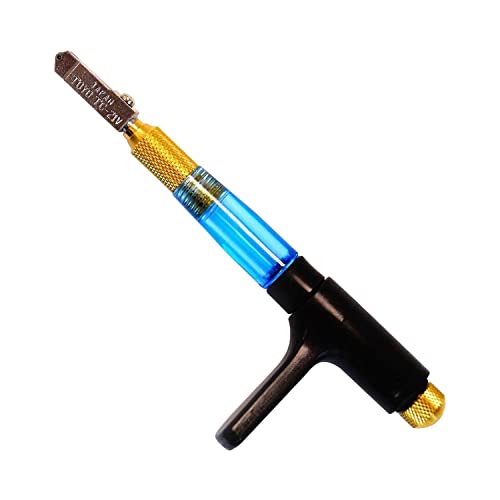
The Toyo Pistol Grip is the cutter many stained glass artists settle on after trying pencil styles, and it is easy to see why. The upright handle lets you push the wheel with your palm and arm instead of pinching a narrow barrel, so pressure stays even across a long sheet and your fingers do not cramp halfway through a panel. Inside the handle sits an oil reservoir that feeds the tungsten carbide TAP wheel as you score, keeping the line wet and consistent. The cutting head can be replaced when it eventually wears, and the tool is made in Japan to the standard the Supercutter name is known for. If you cut for more than a few minutes at a time, or if hand comfort is a concern, this is the most forgiving design in the group.
Specs:
– Wheel: Tungsten carbide TAP wheel
– Oil feed: Self-oiling, reservoir in handle
– Handle: Pistol grip, assorted colors
– Head: Replaceable cutting head
– Best for: Long cuts, stained glass, reduced hand strain
– Origin: Made in Japan
2. Toyo Custom-Grip Supercutter
The Custom-Grip Supercutter keeps the pencil-style hold that many cutters prefer, then reshapes it. A wide saddle sits on top of the barrel and supports your fingers in several positions, so you can shift your grip for straight runs, then reposition for curves without putting the tool down. Like the pistol grip model, it uses a tungsten carbide TAP wheel and feeds oil from a reservoir in the handle, so scores stay smooth on both thin art glass and thicker sheet. It is a strong pick for pattern work, where control through curves matters more than raw leverage, and for anyone who finds a plain round barrel slippery or tiring. The head is a dedicated Custom-Grip fitting, so keep that in mind when ordering replacements.
Specs:
– Wheel: Tungsten carbide TAP wheel
– Oil feed: Self-oiling, reservoir in handle
– Handle: Contoured custom grip with finger saddle, assorted colors
– Head: Replaceable, Custom-Grip fitting
– Best for: Patterns, curves, mixed stained glass work
– Origin: Made in Japan
– Model: TCGSC
3. Toyo TC17B Brass Handled Supercutter

The TC17B is the traditionalist’s Toyo: a slim brass barrel, a straight cutting head, and nothing extra. The solid brass handle gives the tool a balanced, weighty feel that helps the wheel track steadily along a straightedge, which is exactly what you want for window panes, mirror strips, and picture frame glass. Its wheel is ground at a 140 degree angle and suits glass roughly 2 to 6 mm thick, the range that covers most sheet and art glass in a home shop. The handle holds cutting oil and feeds it to the carbide wheel while you work. If most of your cutting is ruler-guided straight lines rather than freehand curves, this simple, durable cutter is the one to reach for.
Specs:
– Wheel: Tungsten carbide, 140 degree angle
– Oil feed: Self-oiling, reservoir in handle
– Handle: Solid brass, pencil style
– Head: Straight head for guided cuts
– Glass range: About 2 to 6 mm
– Best for: Straight cuts, panes, mirrors
– Origin: Made in Japan
– Model: TC17B
4. Camdios Glass Cutter 2mm-20mm with Cutting Oil

The Camdios takes a different approach: instead of one head tuned to a narrow range, it ships with three interchangeable carbide cutting heads that together cover glass from 2 mm all the way to 20 mm. One head handles thin sheet, one covers standard panes and mirrors, and one tackles thick glass that the other cutters here cannot score. The pencil style metal handle has an automatic oil dispensing system that wets the wheel as pressure is applied, and a bottle of cutting oil is included in the box, along with an oil dropper. A ball end on the handle lets you tap along the underside of a score to help start the break. For a workshop that cuts everything from thin craft glass to a thick tabletop offcut, that range is hard to match with a single tool.
Specs:
– Wheel: Carbide cutting heads, 3 included
– Oil feed: Automatic dispensing, cutting oil included
– Handle: Pencil style metal with ball end
– Glass range: 2 to 20 mm across the three heads
– Head ranges: 2-6 mm, 6-12 mm, 12-20 mm
– Best for: Mixed thicknesses, tiles, mirrors, mosaic work
5. Fletcher-Terry 01-122 Steel Wheel Glass Cutter

The Fletcher-Terry 01-122 is the classic American glass cutter, a design that has changed little because it works. A hardened steel wheel, ground at a 130 degree angle, sits in a contoured handle with a ball end for tapping the glass along the score line. There is no oil reservoir, so you dip the wheel in cutting oil before each cut, the way glaziers have always done it. Steel wheels wear faster than carbide, so this is a cutter for occasional jobs: replacing a cracked pane, trimming mirror for a frame, or keeping a spare in the toolbox. In return you get a light, simple, dependable tool from a company that has made glass cutting tools in the USA for well over a century.
Specs:
– Wheel: Hardened steel, 130 degree angle
– Oil feed: None, dip wheel in oil before cutting
– Handle: Contoured comfort grip with ball end
– Head: Fixed steel wheel
– Best for: Occasional cuts, window panes, a backup cutter
– Origin: Made in USA
– Model: 01-122
Comparison Table
| Cutter | Wheel | Oil feed | Handle | Glass range |
|---|---|---|---|---|
| Toyo Pistol Grip | Tungsten carbide TAP wheel | Self-oiling reservoir | Pistol grip | Standard sheet and art glass |
| Toyo Custom-Grip Supercutter | Tungsten carbide TAP wheel | Self-oiling reservoir | Contoured saddle grip | Standard sheet and art glass |
| Toyo TC17B | Tungsten carbide, 140 degree | Self-oiling reservoir | Brass pencil barrel | About 2 to 6 mm |
| Camdios 2mm-20mm | Carbide, 3 heads | Automatic dispensing | Metal pencil with ball end | 2 to 20 mm |
| Fletcher-Terry 01-122 | Steel, 130 degree | Dip in oil | Contoured with ball end | Thin sheet glass |
FAQ
Can a glass cutter cut tempered glass?
No. Tempered glass cannot be scored and snapped; it shatters into small pieces when the surface is disturbed. Cut and finish ordinary annealed glass first, then have it tempered if the project needs it.
Why does the wheel need oil?
Oil reduces friction, carries away fine glass dust, and helps the score form a clean, continuous fracture line. A dry wheel tends to skip and leave a weak score that breaks off line.
How do I break the glass after scoring?
Score once, in a single steady pass, and never go over the line twice. Then tap lightly under the score with the ball end of the cutter, and snap the sheet with running pliers or by pressing it down over a dowel placed under the line.
When should I replace the wheel or head?
When scores start to skip, sound rough, or need much more pressure than before, the wheel is dull. Carbide heads last a long time, but once the edge is gone, a fresh head restores clean breaks.
Which grip is better, pistol or pencil?
Neither is better for everyone. Pistol grips spread the effort into your palm and suit long sessions and straight cuts. Pencil grips give finer control for curves and pattern work. Choose based on the cuts you make most.
Verdict
For most home workshops, the Toyo Pistol Grip is the easiest cutter to live with: the carbide TAP wheel, self-oiling handle, and palm-driven grip make long, clean scores with little hand strain. If your work leans toward stained glass patterns and curves, the Toyo Custom-Grip Supercutter gives you the same wheel and oil feed in a more agile hold. Straight-line specialists cutting panes and mirrors should look at the brass TC17B, while the Camdios earns its place when one tool must handle everything from thin craft glass to thick offcuts. The Fletcher-Terry 01-122 remains the simple, traditional spare that every toolbox can justify. Match the wheel and grip to the glass you cut most, keep the wheel oiled, and score once with confidence.
Related guides
More from Amazon
Programs that pair well with the guide above. Offers and eligibility are set by Amazon and may change.
A free business account with business pricing and bulk-buying tools for work, shop or home office.
Create a business accountFree shipping on eligible items, Prime Video and more. Eligible new members can start with a free trial.
Start a Prime free trialAudiobooks and podcasts to listen to on the go. Eligible new members can start with a free trial.
Try Audible freeAd-free music streaming. Eligible new subscribers can start with a free trial.
Try Music Unlimited freeAs an Amazon Associate we earn from qualifying purchases.








