
Key takeaways
- Compare tachometers, checking type, range, accuracy and display for workshops, garages, engines, motors, chainsaws, mowers and tuning small machines fast.
As an Amazon Associate I earn from qualifying purchases. This post may contain affiliate links at no extra cost to you.
A tachometer turns guesswork about shaft speed into a number you can act on. Set a chainsaw carburetor by ear and you risk running the engine lean at full throttle; check the idle and top-end speed against the maker’s figures and the job is done properly. The same applies to a mower governor, a lathe spindle, a drill press pulley change, or a small motor on a bench test. Handheld digital tachometers fall into three camps: laser photo models that read a reflective mark from a distance, contact models that touch the shaft or ride on a moving belt, and combination units that do both.
Disclosure: As an Amazon Associate, I earn from qualifying purchases. Product details were verified at the time of writing.
This guide compares five digital tachometers across those three classes, from a pocket laser unit that doubles as a revolution counter to a die-cast contact instrument built for maintenance rounds. Each entry lists the RPM range in its Specs block so you can match the meter to the speeds you actually work with.
How to Choose a Tachometer
Measurement type comes first. A laser photo tachometer shines a beam at a small strip of reflective tape stuck on the shaft, pulley, or blade hub, and counts the reflections. Nothing touches the moving part, so it is the safe pick for chainsaws, mower blades, and exposed shafts. A contact tachometer presses a rubber tip into the shaft center or runs a wheel along a belt or roller; it needs no tape and reads slow shafts well, but you must get close to the machine. A combination unit covers both situations in one body.
Match the RPM range to your machines. Most small engines idle near 2,500 to 3,000 RPM and top out between 9,000 and 13,000 RPM, while workshop motors and spindles usually sit between a few hundred and 3,600 RPM. Every pick here reaches at least 19,999 RPM in one mode or another, and the photo models run to 99,999 RPM, so headroom is rarely the issue. The low end matters more: contact modes that begin at 0.5 RPM handle slow conveyor and mixer shafts that photo models can miss.
Accuracy and resolution decide tuning quality. A stated accuracy of ±0.05% of reading with 0.1 RPM resolution below 1,000 RPM is plenty for governor and idle work. For high-speed chainsaw tuning, the reading at 12,000 RPM only needs to be repeatable and close; every model below meets that bar on paper.
Display and memory help more than expected. A five-digit LCD with maximum, minimum, and last-value recall lets you blip the throttle and read the peak afterwards instead of watching the screen mid-run. A counter mode, found on the Extech below, also totals revolutions for cycle counting.
Power and build round out the choice. Meters run on AA cells, AAA cells, or a 9V battery; long battery life matters for a meter that lives in a toolbox and gets used monthly. A die-cast body survives bench knocks better than thin plastic, while a light plastic body is easier to hold one-handed against a shaft.
The 5 Tachometers Compared
1. NEIKO 20713A Digital Laser Photo Tachometer
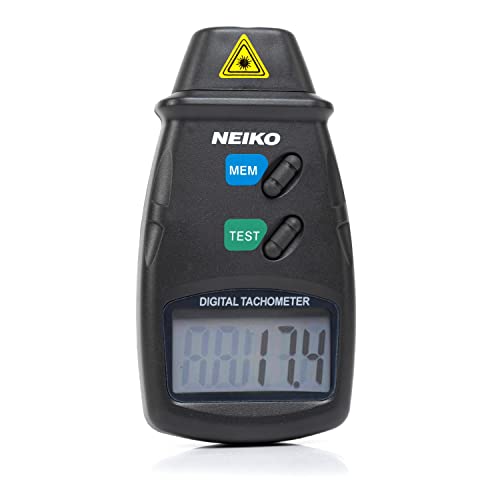
The NEIKO 20713A is the straightforward laser photo pick for engine work. Stick a reflective marker on the crank pulley, flywheel, or blade hub, aim from a short standoff, and the five-digit LCD settles on the speed. Its 2.5 to 99,999 RPM span covers everything from a slow idling twin to a strimmer at full chat, and the memory recall stores the last, maximum, and minimum readings so you can check peak revs after a throttle blip. Batteries are included in the box, which makes it a grab-and-go tool for the mower shed.
Specs:
– Type: Laser photo, non-contact
– RPM range: 2.5 to 99,999 RPM
– Resolution: 0.1 RPM below 1,000 RPM; 1 RPM above
– Accuracy: ±(0.05% of reading + 1 digit)
– Display: 5-digit LCD
– Memory: Last, maximum, and minimum recall
– Power: Batteries included
– Included: Reflective tape markers
2. AGPtek Professional Digital Laser Photo Tachometer
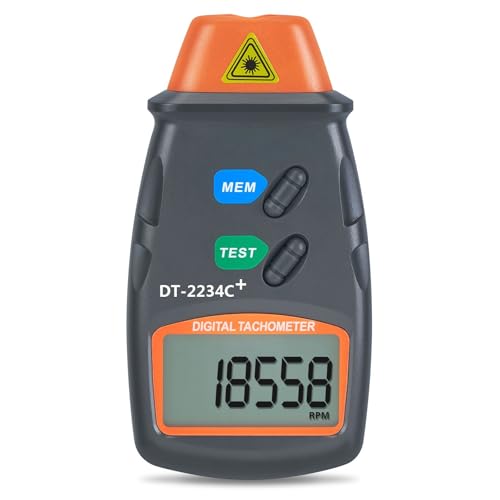
The AGPtek takes the same DT-2234C+ pattern used across workshops for years: a pistol-style body, a laser aimed at reflective tape, and a wide 2.5 to 99,999 RPM window. It suits bench checks on drill presses, bench grinders, and lathe spindles where you can tape the pulley once and read every speed step in the chart on the machine. Sampling is quick above idle speeds, and the stored maximum value is handy when a spindle takes a moment to settle after a belt change.
Specs:
– Type: Laser photo, non-contact
– RPM range: 2.5 to 99,999 RPM
– Resolution: 0.1 RPM below 1,000 RPM; 1 RPM above
– Accuracy: ±(0.05% of reading + 1 digit)
– Display: 5-digit LCD
– Memory: Last, maximum, and minimum recall
– Power: 9V battery
– Included: Reflective tape, carrying case
3. Extech 461920 Mini Laser Photo Tachometer Counter
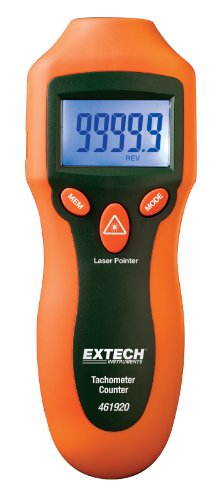
Extech’s 461920 shrinks the laser photo format into a pocket body and adds a second talent: it counts total revolutions from 1 to 99,999, which suits cycle counting on presses and winders as well as plain speed checks. The stated basic accuracy of ±0.05% and 0.1 RPM resolution put it a step above the generic photo guns for careful work, and the laser reads a taped target from up to 500 mm away, keeping hands clear of the chuck. For a workshop that wants one small meter for both motor nameplate checks and spindle speeds, this is the tidy pick.
Specs:
– Type: Laser photo, non-contact, with revolution counter
– RPM range: 2 to 99,999 RPM
– Count range: 1 to 99,999 revolutions
– Resolution: 0.1 RPM
– Accuracy: ±0.05% of reading
– Max target distance: 500 mm (1.6 ft)
– Display: 5-digit LCD
4. Shimpo DT-105A Handheld Contact Tachometer

The DT-105A is the contact specialist of the group and the most solidly built, with a die-cast aluminum body made for plant and workshop rounds. Press the cone tip into a shaft center, the funnel over a shaft end, or run the six-inch wheel along a belt or web, and it reads from 0.1 to 25,000 RPM. It also reports linear speed in feet per minute, miles per hour, and meters per minute, plus total length, which makes it the natural choice for conveyor and roller work. Two AA cells run it for roughly 65 hours, and the kit arrives with an NIST certificate, extension shaft, adapters, and a hard case.
Specs:
– Type: Contact
– RPM range: 0.1 to 25,000 RPM
– Accuracy: ±0.06 RPM from 0.10 to 999.9 RPM; ±0.6 RPM from 1,000 to 9,999.9 RPM
– Display: 5-digit LCD
– Units: RPM, RPH, ft/min, MPH, m/min, and length totals
– Body: Die-cast aluminum
– Power: 2 AA batteries, about 65 hours of use
– Included: 6 in wheel, 2 cone adapters, funnel adapter, 3.5 in extension shaft, carrying case, NIST certificate
5. FLEXMAN DT2236B Photo and Contact Tachometer

The DT2236B is the combination unit: a mode switch flips between a photoelectric sensor for taped targets and a contact port that takes four rubber wheels and probes. Photo mode spans 2.5 to 99,999 RPM from 50 to 500 mm away, while contact mode covers 0.5 to 9,999 RPM and surface speed up to 9,999 meters per minute. That split makes it a sensible single buy for a garage that tunes small engines one day and checks a belt-driven sander the next. Maximum, minimum, and last values are stored automatically, and the meter runs on four AA cells.
Specs:
– Type: Photo (non-contact) and contact combination
– Photo RPM range: 2.5 to 99,999 RPM
– Contact RPM range: 0.5 to 9,999 RPM
– Surface speed: 0.05 to 9,999 m/min
– Accuracy: ±(0.05% + 1 digit)
– Photo measuring distance: 50 to 500 mm
– Display: 5-digit LCD
– Memory: Maximum, minimum, and last value
– Power: 4 AA batteries
– Included: 4 contact wheels/probes, reflective strips, carrying bag
Comparison Table
| Product | Type | RPM Range | Accuracy | Display |
|---|---|---|---|---|
| NEIKO 20713A | Laser photo | 2.5 to 99,999 RPM | ±(0.05% + 1 digit) | 5-digit LCD |
| AGPtek DT-2234C+ style | Laser photo | 2.5 to 99,999 RPM | ±(0.05% + 1 digit) | 5-digit LCD |
| Extech 461920 | Laser photo + counter | 2 to 99,999 RPM | ±0.05% | 5-digit LCD |
| Shimpo DT-105A | Contact | 0.1 to 25,000 RPM | ±0.06 RPM at low range | 5-digit LCD |
| FLEXMAN DT2236B | Photo + contact | 2.5 to 99,999 RPM photo; 0.5 to 9,999 RPM contact | ±(0.05% + 1 digit) | 5-digit LCD |
FAQ
Do I need reflective tape for every reading?
Only for photo and laser models. A small strip on the shaft or pulley gives the sensor one bright flash per revolution. Contact models such as the Shimpo need no tape, but you must touch the moving part with the tip or wheel.
Which type is safer for chainsaw and mower tuning?
A laser photo model. You stand back, aim at a taped mark on the clutch drum or blade hub, and never bring a hand near the moving parts while the engine runs at full speed.
Can a tachometer check belt or conveyor speed?
Yes, with a contact wheel. The Shimpo DT-105A and the contact mode of the FLEXMAN report surface speed in feet or meters per minute, which is the figure belt and roller work calls for.
How close does the reading need to be for governor settings?
Within a few dozen RPM is fine in practice. Every meter here states accuracy near ±0.05% of reading, so the bigger variable is holding the throttle steady while the number settles.
Verdict
For most garages, the NEIKO 20713A covers small-engine tuning with the least fuss, while the AGPtek matches it for bench machinery checks. The Extech 461920 is the pick when you also want revolution counting in a pocket format. If your work leans on belts, rollers, and slow shafts, the Shimpo DT-105A is the dedicated contact instrument to own. The FLEXMAN DT2236B splits the difference, putting both sensing methods in one body for mixed workshops.
Related guides
More from Amazon
Programs that pair well with the guide above. Offers and eligibility are set by Amazon and may change.
A free business account with business pricing and bulk-buying tools for work, shop or home office.
Create a business accountFree shipping on eligible items, Prime Video and more. Eligible new members can start with a free trial.
Start a Prime free trialAudiobooks and podcasts to listen to on the go. Eligible new members can start with a free trial.
Try Audible freeAd-free music streaming. Eligible new subscribers can start with a free trial.
Try Music Unlimited freeAs an Amazon Associate we earn from qualifying purchases.








