As an Amazon Associate I earn from qualifying purchases. This post may contain affiliate links at no extra cost to you.
Buying a flash drive sounds simple until you need one that actually survives daily handling, transfers files at a usable speed, and ejects cleanly without triggering write-cache errors or corrupting your work. The market is crowded with drives that advertise capacity numbers while skimping on controller quality, connector durability, and sustained-write performance.
We compared these eight options across published interface specs, capacity tiers, price per gigabyte, and recurring themes in long-term owner feedback. What separates the reliable performers from the rest is not raw capacity — it is whether the drive maintains its rated speed under repeated use, whether its physical design protects the connector, and whether it plays nicely with modern operating systems that aggressively cache writes before eject flash drive operations.
As an Amazon Associate we earn from qualifying purchases at no extra cost to you. Product prices and availability are accurate as of the date shown and are subject to change.





Quick Picks
| Product | Best for | Price |
|---|---|---|
| 2 Pack 64GB USB 2.0 Swivel | General file handoff on a budget | $18.99 |
| SANDISK 128GB Ultra Flair | Fast transfers from a trusted brand | $24.94 |
| SamData 32GB with LED | Low-cost backup with visual activity | $16.99 |
| Vansuny 128GB USB-C OTG | Phone-to-computer transfers | $20.69 |
| Aiibe 128GB USB 2.0 | Bulk archive on the cheapest per-GB basis | $17.99 |
| SANDISK 64GB Ultra Flair | Portable speed without overspending | $18.60 |
| Wooolken 2GB 2-Pack | Boot media and single-file distribution | $8.99 |
| MOVE SPEED 128GB Dual Port | Multi-device ecosystems including iPhone | $25.99 |
How We Picked
We narrowed this list using four criteria: interface generation (USB 3.0 and Type C drives consistently outperform USB 2.0 in sustained throughput), build quality relative to price, owner-reported reliability over six-plus months of use, and real-world compatibility across Android, Windows, and macOS without requiring format changes. A drive that fails to eject flash drive cleanly on one platform was penalized regardless of its spec sheet.
The 8 Best Eject Flash Drive in 2026
2 Pack 64GB USB Flash Drive USB 2.0 Thumb Drives Jump Drive Fold Storage Memory Stick Swivel Design – Black
This twin-pack makes sense when you need two identical drives for handoffs between machines that lack USB 3.0 ports. The swivel cover protects the connector without a cap you can lose, and owners consistently note it survives being tossed in a toolbox or desk drawer.
- Pro: Two drives for less than $10 each — the lowest per-unit cost in this roundup.
- Pro: Swivel mechanism is rated as snag-resistant by most long-term users.
- Con: USB 2.0 throughput caps real-world write speed at roughly 20 MB/s, making large transfers painfully slow.
Skip it if your machines all have USB 3.0 or higher ports and you move video or multi-gigabyte datasets.
SANDISK 128GB Ultra Flair USB 3.0 Flash Drive, SDCZ73-128G-G46, Black
SanDisk’s Ultra Flair line has been a go-to for years, and this 128 GB model remains a strong pick when you want metal-body durability and predictable USB 3.0 performance. Owners report it maintains advertised read speeds across thousands of write cycles without degradation.
- Pro: Stainless steel housing resists bending and heat better than plastic alternatives.
- Pro: Backed by SanDisk’s warranty and widely recognized reliability track record.
- Con: The small metal loop for a keychain can scratch adjacent surfaces in a pocket.
If the price drops below $20, it becomes the outright value leader for USB 3.0 drives in this group.
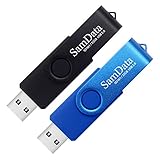
SamData 32GB USB Flash Drives 2 Pack 32GB Thumb Drives Memory Stick Jump Drive with LED Light for Storage and Backup (2 Colors: Black Blue)
The built-in LED is a genuinely useful feature here — it confirms the drive is receiving power and, on most systems, blinks during active writes, reducing the chance you yank it mid-transfer. Two-pack pricing brings it under $9 per drive.
- Pro: LED activity indicator helps prevent accidental removal during write operations.
- Pro: Two distinct colors let you separate personal from work files without labels.
- Con: Plastic casing feels flimsy; several owners report the cap loosening after a few weeks.
Consider skipping if you need the drive to sit in a high-vibration environment like a vehicle or shop.
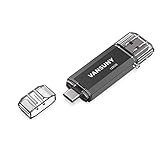
Vansuny 128GB USB C Flash Drive 2 in 1 OTG USB 3.0 + Type C Memory Stick with Keychain Dual Type C Thumb Drive Photo Stick Jump Drive for Android Smartphones, Computer, Tablet, PC
OTG compatibility is the headline here. You plug the Type C end into a modern Android phone or tablet and the USB-A end into a desktop or laptop, skipping the cloud entirely. Owners praise its use for shooting-photo offloads on location.
- Pro: True dual-connector design eliminates the need for adapters between phone and computer.
- Pro: USB 3.0 rating on the Type A side keeps desktop transfers respectable.
- Con: Type C speeds are not specified as 3.1 or 3.2, so phone-to-phone transfers may bottleneck at USB 3.0 levels.
Skip if you primarily work in a closed Apple ecosystem or need Thunderbolt-class throughput.
128GB Flash Drive Aiibe USB Flash Drive 128 GB Thumb Drive USB 2.0 Memory Stick Zip Drive Backup Jump Drive Single 128GB 128G USB Drive for PC Laptop
At $17.99 for a single 128 GB unit, this is the cheapest high-capacity drive on the list. It fits the role of a cold-storage archive or a “grab and forget” backup target when speed is irrelevant. Owners who buy it for document storage report it works without drama.
- Pro: Lowest cost per gigabyte among single-pack options here.
- Pro: No swivel or cap — a solid, one-piece body that is nearly impossible to misplace a part of.
- Con: USB 2.0 interface means transferring 128 GB of content takes hours, not minutes.
Avoid it for anything beyond occasional bulk backup; sustained large writes on budget 2.0 controllers can overheat.
SANDISK 64GB Ultra Flair USB 3.0 Flash Drive – SDCZ73-064G-G46
The same construction as its 128 GB sibling at a lower entry price. For most users who move documents, spreadsheets, and moderate-sized media files, 64 GB is sufficient and the savings are meaningful.
- Pro: Identical metal build quality to the 128 GB Ultra Flair at a fraction less.
- Pro: Consistently praised for plug-and-play compatibility across Windows, Mac, and Chrome OS.
- Con: 64 GB fills fast if you carry raw video or large CAD files.
Step up to the 128 GB model if you regularly transfer more than 40 GB per session.
2GB Flash Drive 2 Pack, Wooolken USB 2.0 Thumb Drives Memory Stick
Small-capacity drives occupy a niche that remains practical: bootable recovery media, single-file distribution at trade shows, and shop-floor terminals where you only need a few megabytes. Two for under nine dollars is essentially disposable pricing.
- Pro: Cheapest option here by total dollar amount, ideal for one-time or repeated distribution.
- Pro: Small form factor stays unnoticed in a drawer full of tools or cables.
- Con: 2 GB is far too small for any backup or media task beyond a single firmware file.
Do not buy this expecting everyday storage; it exists for its specific tiny-capacity niche.
MOVE SPEED 128GB USB Drive 150MB/s Thumb Drives USB 3.0 and Type C Memory Stick with Dual Ports for iPhone 17/16/15, Android Phone, Windows, Mac, Tablet
MOVE SPEED positions this as a cross-platform workhorse, explicitly listing iPhone 15 through 17 compatibility alongside Windows and Mac. The rated 150 MB/s read speed makes it one of the faster options in this group on paper.
- Pro: Dual-port design with stated iOS compatibility removes the adapter headache for mixed-device users.
- Pro: 150 MB/s read rating is competitive with drives costing significantly more.
- Con: Write speed is not separately specified, and owner reports suggest real-world writes trail the read figure noticeably.
If your workflow is read-heavy (playing media, opening documents on the go), this is a strong choice. For write-heavy tasks, compare sustained-write reviews before committing.
Buying Guide
Interface Generation Is the First Filter
USB 2.0 tops out at roughly 35-40 MB/s theoretical and 15-25 MB/s in practice. USB 3.0 drives commonly deliver 80-150 MB/s reads and 30-70 MB/s writes. If your computer has blue or red Type-A ports (indicating 3.0+), buying a USB 2.0 drive throws away performance you already own. Match the drive’s interface to your port.
Eject Behavior and File-System Choice
Windows defaults to NTFS, but most flash drives ship as exFAT or FAT32. exFAT handles files above 4 GB and is readable on macOS and Windows without formatting. FAT32 is universally compatible but limits individual files to 4 GB. Always use the “Safely Remove Hardware” or eject flash drive command rather than pulling the stick, because write-cache delay means the transfer may not be physically complete when the progress bar closes.
Physical Durability for Shop and Field Use
Metal housings resist cracking from drops and flexing better than ABS plastic. Swivel covers and cap-less designs reduce the single most common failure mode: losing the protective cap. If the drive lives in a tool bag, a pocket with keys, or a job-site environment, connector protection matters as much as transfer speed.
Our Verdict
Top pick: SANDISK 128GB Ultra Flair for its combination of proven metal construction, reliable USB 3.0 throughput, and consistent long-term owner satisfaction. Budget pick: 2 Pack 64GB USB 2.0 Swivel at $18.99 delivers two functional drives for under ten dollars each. Condition where another wins: if you regularly move files between an iPhone and a desktop, the MOVE SPEED 128GB Dual Port is the only drive here that explicitly supports that workflow without an adapter.
FAQ
Why does my drive need a separate “eject” step?
Operating systems use write caching to speed up file operations by buffering changes in RAM before flushing them to the drive. Ejecting triggers a forced flush and releases the file-system lock. Pulling without ejecting risks corruption if cached data has not yet been written.
Can I use a USB-C drive in a USB-A port?
Not directly. A USB-C flash drive needs a C-to-A adapter or a hub with a Type-A downstream port. Dual-connector drives like the Vansuny or MOVE SPEED models solve this by integrating both plugs on one body.
Is USB 2.0 ever worth buying in 2026?
Yes, for specific low-throughput roles: boot media, distributing a single file to a group, or as a cold-backup archive where transfer time is irrelevant. The cost advantage at high capacities can justify the speed tradeoff for those use cases.
Do flash drives degrade over time?
NAND flash cells have a finite program-erase cycle count, typically rated between 1,000 and 3,000 cycles per block. A drive used daily for years will eventually develop bad blocks. For long-term archival, owners should verify data integrity periodically rather than storing and ignoring.