What's inside
As an Amazon Associate I earn from qualifying purchases. This post may contain affiliate links at no extra cost to you.
The best shop air cleaner for beginners is usually a ceiling-mounted, two-stage unit rated around 800–1,200 CFM, with a washable or replaceable coarse prefilter, an easy-to-source fine filter, a timer or remote, and enough airflow for at least four to six room air changes per hour.
An air cleaner is not a substitute for dust collection at the table saw, router, planer, or sander. It captures airborne dust that escapes your machine’s collector; it does not reliably remove chips at the source. For a first purchase, match the cleaner to the room rather than choosing the largest number on the box.
As an Amazon Associate we earn from qualifying purchases at no extra cost to you.


Contents
Quick picks by workshop situation
| Workshop situation | Best starting specification | Most suitable choice | Why |
|---|---|---|---|
| Small garage, occasional projects, up to 400 sq. ft. | 600–800 CFM, two-stage filtration | Compact single-motor ceiling unit | Lower purchase price, less noise, and adequate circulation without taking up floor space |
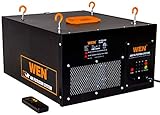
| Typical one-car or two-car shop, 400–800 sq. ft. | 800–1,200 CFM, three speeds, timer | Mid-size two-stage unit such as the WEN 3410 or JET AFS-1000B class | Good balance of airflow, controls, replacement-filter availability, and cost |
| Large shop, 800–1,200 sq. ft. or frequent sanding | 1,200–1,500 CFM, high-capacity fine filter | Higher-output unit such as the Powermatic PM1250 class | Moves more air between work areas, although it costs more and can be louder |
| Very tight budget or occasional hobby use | 600–1,000 CFM and inexpensive standard filters | Basic three-speed box-style cleaner | Acceptable if used with source dust collection and maintained carefully |
How much airflow do you need?
Use the room’s volume, not just its floor area. A practical beginner’s target is four to six air changes per hour (ACH) for general woodworking. Calculate it this way:
Required CFM = room length × width × height × desired ACH ÷ 60.
For example, a 20-by-20-foot garage with an 8-foot ceiling contains 3,200 cubic feet. At five air changes per hour:
3,200 × 5 ÷ 60 = 267 CFM.
That number looks surprisingly small because it describes complete room turnover, not the air cleaner’s advertised maximum. In practice, choose a unit rated around 800–1,000 CFM because real airflow falls when filters load with dust, the machine is mounted near a wall, and the manufacturer’s figure may be measured without restrictive conditions. The extra capacity also helps create circulation rather than leaving stagnant pockets behind machines.
For a 24-by-24-foot shop with a 9-foot ceiling, the same five-ACH calculation gives 432 CFM. A 1,000–1,250 CFM cleaner is a sensible beginner range. If the shop has unusually high ceilings, multiple work zones, or frequent hand sanding, move toward the upper end.
Head-to-head: budget, mid-range, and premium designs
Budget two-stage cleaner
Budget units commonly offer 600–1,000 CFM, three fan speeds, a disposable outer filter, and a finer inner filter. They are often the best value for a small garage. Look for a timer, remote control, and standard filter dimensions rather than a proprietary cartridge.
The trade-off is usually louder operation, less robust switches, thinner housing, and less useful airflow once the filter becomes dirty. A budget model is a sensible choice when you already have a dust collector and use the air cleaner as a secondary system.
Mid-range cleaner
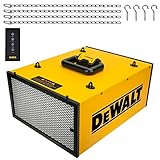
Models in the JET AFS-1000B and WEN 3410 class typically target about 1,000 CFM and provide three speeds, two-stage filtration, hanging hardware, and timed shutoff. Depending on the exact revision, the outer filter is commonly rated around 5 microns and the inner filter around 1 micron. Published dimensions are generally close to 30 inches long, 20 inches wide, and 20 inches high, with weights often in the 50–70-pound range.
This is the safest category for most first-time buyers. It provides enough capacity for a normal garage shop without the price, size, and filter expense of a premium high-efficiency unit. Confirm the current filter dimensions before buying, because replacement compatibility matters more than a small difference in advertised CFM.
Premium high-efficiency cleaner
Premium units such as the Powermatic PM1250 class usually emphasize higher airflow, more sophisticated filtration, sturdier cabinets, and improved controls. Some use a HEPA-rated final filter or an equivalent high-efficiency element, but the exact efficiency rating and test conditions differ by model.
These machines make more sense for frequent woodworking, larger rooms, or users who want better filtration and are willing to pay more for replacement filters. They are not automatically the right choice for a beginner: a premium cleaner cannot compensate for a poorly sealed dust collector hose or an unconnected machine port.
Features that matter more than a large CFM number
- Two-stage filtration: The coarse outer filter catches larger dust and protects the finer inner element. This extends service life and keeps airflow more consistent.
- Three fan speeds: Low is useful for quiet background circulation; high is appropriate after sanding or cutting. A single-speed unit gives you less control.
- Timer or remote: A 1-, 2-, or 4-hour timer lets the cleaner continue working after you leave the shop without running all night.
- Filter indicator: A pressure-based indicator is more useful than a calendar reminder because loading depends on how much dust you make.
- Standard filter sizes: Filters that can be purchased from several tool or HVAC suppliers are less likely to become an ownership problem.
- Hanging hardware: Eye bolts or brackets should be rated for the machine’s weight, with suitable lag screws or structural fasteners for your ceiling.
- Sealed filter access: Gaps around the filter allow dusty air to bypass the media. A good gasket and secure latches are valuable even on an inexpensive machine.
Noise, controls, and safe placement
Manufacturers do not always measure noise under identical conditions, so published decibel figures are difficult to compare directly. In general, a compact cleaner on high speed can be loud enough to interfere with conversation, while low speed is substantially easier to tolerate. If you work for several hours, a quieter low setting used continuously may be more useful than a powerful machine that you switch off because it is irritating.
Mount the unit high enough to keep it clear of lumber and your head, but leave the filter access and intake unobstructed. A common beginner mistake is placing the cleaner directly above the saw, where it competes with the saw’s dust stream and receives an unnecessarily heavy load. A better position is near the center or along the opposite side of the room, where it can pull dirty air across the work area.
Use rated hardware, inspect the mounting points periodically, and follow the manufacturer’s clearance requirements. Do not hang a 60- to 70-pound machine from drywall alone. Keep the power cord away from walkways and moving stock. Avoid placing the outlet directly in the airflow path if it could draw dusty air into an adjacent living space.
Filter costs and ownership reality
The filter is the main continuing expense. As a general market range, replacement outer filters often cost about $15–$35, while finer inner filters commonly cost $25–$80. Premium or HEPA-style elements can cost more. A mid-range unit may therefore require roughly $40–$100 for a complete filter replacement.
Consider a shop that uses the cleaner three times per week and replaces its filters twice a year. At $60 per complete set, the annual filter cost is about $120, or approximately $0.77 per use over 156 uses. That is a useful comparison against a machine with a lower purchase price but unusually expensive proprietary filters.
What wears first is usually the filter, not the motor. Dust buildup can also affect the fan wheel, switch, remote receiver, and motor bearings. Check the outer filter every few sessions. Clean a reusable prefilter according to its instructions; do not blast a fine filter with compressed air indoors, because that can damage the media and put captured dust back into the room. Replace a filter when it is visibly damaged, cannot be cleaned as directed, or causes a noticeable loss of airflow.
A beginner’s setup procedure
- Measure the room. Record length, width, ceiling height, and any adjoining open area.
- Choose capacity. Use the ACH calculation, then select a practical unit with roughly 800–1,200 CFM for most one- or two-car shops.
- Install source collection first. Connect the dust collector to the machine that creates the dust. The air cleaner is supplemental.
- Hang or position the cleaner. Keep intakes clear and place the outlet so it encourages a broad circulation loop rather than blowing directly at a wall.
- Test each speed. Start on low for normal work, use high after dusty operations, and listen for vibration or rattling.
- Set the timer. Allow additional run time after work—often 30–60 minutes—then adjust based on visible airborne dust and filter loading.
- Record filter changes. Note the date and inspect airflow regularly so a clogged filter does not go unnoticed.
Bottom line
For most beginners, the best shop air cleaner for beginners is a mid-range two-stage model near 1,000 CFM with three speeds, a timer, common replacement filters, and secure ceiling hardware. Choose a smaller 600–800 CFM unit for a compact occasional-use room, or step up to roughly 1,250 CFM and higher-efficiency filtration for a large or frequently used shop. Whatever you buy, maintain source dust collection, keep filters clean, and treat safe placement and affordable consumables as essential specifications—not afterthoughts.