
Our Top Picks
 Narex Premium 5 Piece Set Paring Chisels w/Hornbeam1/4", 1/2", 3/4", 1", 1 1/4"6.37 x 13.5 x 1.5 inches1.63 PoundsCheck on Amazon
 Narex Richter Paring Chisel With Long HandleOne Size Fits All0 x 0 x 0.1 inches0.58 poundsCheck on Amazon

As an Amazon Associate I earn from qualifying purchases. This post may contain affiliate links at no extra cost to you.
A paring chisel is the one edge tool you never strike. Where a bench chisel is built short and stout so it can be chopped with a mallet, a paring chisel trades that toughness for length: a long, thin blade and a long handle that let both hands steer the edge while your body weight supplies the push. That length is what makes the tool so accurate. You can sight down the blade, register its flat back against a surface, and shave a few thousandths off a tenon cheek, a dovetail socket or a hinge gain with control no short chisel can match. The trade-off is discipline — these blades are ground thin, flex slightly by design, and will chip or bend if levered or struck.
This guide compares five paring chisels you can buy today: a five-piece long-blade set from a Czech maker, a premium cryo-treated single chisel with an extra-long handle, a cranked-neck chisel for flush work, a USA-made wide chisel with a mallet-safe cap, and a bent-tang chisel that keeps your knuckles clear of the surface. Between them they cover straight, cranked and bent geometries, and widths from 1/4 inch to 1-1/4 inch.
Disclosure: As an Amazon Associate, I earn from qualifying purchases. Product details were verified at the time of writing.
How to Choose a Paring Chisel
Blade length. Length is the defining trait of the class. True long paring chisels carry blades of roughly 9 to 10 inches and overall lengths past 15 inches, giving a long reference surface and room for a two-handed grip far behind the edge. Shorter specialist patterns — cranked and bent chisels built from bench-length blades — give up some reach in exchange for access: the offset handle lets the blade lie flat on a surface your hand would otherwise block. Decide which problem you have more often, reach or access, and buy accordingly.
Blade width. Paring widths run from 1/4 inch for cleaning dovetail sockets and stringing grooves up to 1-1/2 inch for flattening wide tenon cheeks and trimming across end grain. A 3/4 inch or 1 inch blade is the most versatile single purchase; it covers most joinery cleanup without feeling clumsy in corners. If you fit a lot of large casework joints, a wide 1-1/4 inch blade earns its place quickly.
Steel. Most paring chisels are chrome-manganese or chrome-vanadium steel hardened somewhere between Rc 59 and Rc 62. Softer blades around Rc 59 hone quickly and tolerate a very low bevel angle, which matters because paring is slicing work. Harder, cryogenically treated blades hold that fine edge longer but take more patience to sharpen. Either way, thin sides matter as much as the alloy: they slip into acute dovetail corners where a thick bench chisel cannot go.
Bevel style. Paring chisels are ground with a single flat bevel, usually between 20 and 25 degrees, and many woodworkers hone the factory angle a touch lower for softwood. A lower angle slices with less wedging and leaves a cleaner surface, but the edge is more fragile — one more reason these tools are pushed, never struck or twisted. Straight blades are the generalists; cranked-neck and bent-tang blades hold the edge flat against a surface for flush trimming plugs, glue lines and inlay.
Handle material and shape. Because the handle is a steering wheel rather than a striking surface, paring handles are long, smooth and shaped for a palm or two-handed grip. Hornbeam and ash are the traditional choices, fitted with a brass or stainless ferrule to keep the tang from splitting the wood. Acetate handles with steel caps belong to the job-site end of the class: they tolerate light mallet taps, but give up some fine two-handed control.
The 5 Best Paring Chisels
1. Narex Premium 5-Piece Paring Chisel Set — Best Full Set
If you want the classic paring setup in one purchase, this Czech-made set is the obvious starting point. Five true imperial widths — 1/4, 1/2, 3/4, 1 and 1-1/4 inch — share the same long format: blades about 9-5/8 inches long and an overall length of 15-1/4 inches, so every size handles with the same two-handed balance. The chrome-manganese blades are hardened to Rc 59, ground with a 25-degree bevel and slim sides that reach into dovetail sockets, and the stained European hornbeam handles carry solid brass ferrules. It is the set to buy when you know paring will be a regular part of your joinery rather than an occasional cleanup task.
Specs
- Blade length: 9-5/8 in (245 mm); overall length 15-1/4 in
- Blade widths: 1/4, 1/2, 3/4, 1 and 1-1/4 in (five pieces)
- Steel: chrome-manganese (Cr-Mn) steel, hardened to Rc 59
- Bevel style: single flat bevel ground at 25 degrees, slim bevel-edge sides
- Handle: stained European hornbeam, long turned shape, solid brass ferrule
2. Narex Richter Paring Chisel With Long Handle, 1 Inch — Best Premium Single
The Richter line is Narex’s flagship range, and this paring version pairs a drop-forged chrome-vanadium blade with cryogenic treatment and a 62 HRc temper — noticeably harder than the standard line, so the polished edge survives long sessions in abrasive hardwoods. The blade itself is 5-3/4 inches, but the handle is a full 8 inches of European ash finished with friction shellac, giving a 13-3/4 inch overall length and a grip you can work with both hands or choke up on for delicate cuts. The front bevel is ground at 24 degrees, the sides are ground ultra-thin for tight corners, and a stainless ferrule with a leather washer guards the handle socket.
Specs
- Blade length: 5-3/4 in; handle length 8 in; overall length 13-3/4 in
- Blade width: 1 in (also made from 1/8 to 1-1/2 in)
- Steel: drop-forged chrome-vanadium (Cr-V) steel, cryogenically treated, hardened to 62 HRc
- Bevel style: single flat bevel ground at 24 degrees, polished with ultra-thin sides
- Handle: European ash, long ergonomic shape, friction shellac finish, stainless ferrule and leather washer
3. Narex Cranked Neck Paring Chisel, 1/2 Inch — Best for Flush Trimming
A straight paring chisel cannot lie flat on a panel without your knuckles getting in the way; this cranked pattern solves that by bending the blade 30 degrees at the neck, offsetting the handle above the work. It is the tool for trimming plugs and dowels flush, cleaning dried glue lines, and paring inside shallow housings where access comes from above. The 1/2 inch blade is 122 mm long with a slimmer cross-section than a bench chisel, hardened chrome-manganese steel at 59 HRc, and a cutting edge ground at 25 degrees. The stained hornbeam handle is held by a solid brass ferrule, and the line also runs 1/4, 3/4 and 1 inch.
Specs
- Blade length: 122 mm (about 4-13/16 in); overall length 256 mm (about 10-1/16 in)
- Blade width: 1/2 in (line also includes 1/4, 3/4 and 1 in)
- Steel: chrome-manganese (Cr-Mn) steel, hardened to 59 HRc
- Bevel style: single flat bevel ground at 25 degrees; neck cranked at 30 degrees
- Handle: stained hornbeam, offset cranked shape, solid brass ferrule
4. Buck Brothers 120107BC Paring Chisel, 1-1/4 Inch — Best Wide USA-Made Pick

Buck Brothers has made chisels in the USA for generations, and this wide 1-1/4 inch model is aimed squarely at paring and finishing cuts in carpentry and cabinet work. The tempered tool steel blade follows the maker’s 1-1/4 by 5 inch size format, and the shatter-resistant acetate handle is topped with a reinforced steel cap — which makes this the one chisel in this guide that tolerates light mallet taps when a cut needs a little persuasion. Treat it as a rugged wide paring and trimming chisel for the bench and the job site rather than a delicate two-handed instrument, and it fills a role the European patterns do not.
Specs
- Blade length: 5 in (maker’s 1-1/4 in x 5 in size format)
- Blade width: 1-1/4 in
- Steel: tempered tool steel
- Bevel style: single flat bevel, straight blade
- Handle: shatter-resistant acetate, straight grip with reinforced steel strike cap
5. WoodRiver Bent Paring Chisel, 3/4 Inch — Best for Glue Lines and Plugs
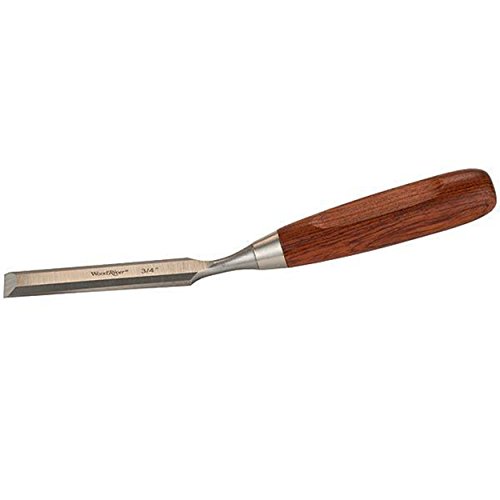
WoodRiver takes a different route to the same problem as the cranked chisel: this tool starts from the maker’s bench chisel pattern and bends the tang at about 18 degrees, so the blade lies flat while your hand rides above it. At roughly 10 inches overall it is the most compact tool here, handy for removing glue lines, trimming plugs flush, and cleaning tight corners on assembled work where a 15 inch chisel would be unwieldy. The hardened alloy steel blade has a bevel-edge profile, and the hardwood handle is the familiar WoodRiver bench shape. Sizes run 1/4, 1/2, 3/4 and 1 inch; the 3/4 inch is the most useful single width for cleanup work.
Specs
- Blade length: bench-pattern blade; overall length approx. 10 in
- Blade width: 3/4 in (line also includes 1/4, 1/2 and 1 in)
- Steel: hardened alloy steel
- Bevel style: bevel-edge blade; tang bent at about 18 degrees
- Handle: hardwood, straight turned bench-chisel shape
Comparison Table
| Pick | Blade length | Width(s) | Steel | Bevel | Handle |
|---|---|---|---|---|---|
| Narex Premium 5-Piece Set | 9-5/8 in | 1/4–1-1/4 in (5 pc) | Cr-Mn, Rc 59 | 25°, flat | Hornbeam, brass ferrule |
| Narex Richter Long Handle 1 in | 5-3/4 in | 1 in | Cr-V cryo, 62 HRc | 24°, flat | Ash, 8 in, stainless ferrule |
| Narex Cranked Neck 1/2 in | 122 mm | 1/2 in | Cr-Mn, 59 HRc | 25°, 30° crank | Hornbeam, offset |
| Buck Brothers 120107BC | 5 in | 1-1/4 in | Tempered tool steel | Flat, straight | Acetate, steel cap |
| WoodRiver Bent 3/4 in | Bench pattern, ~10 in overall | 3/4 in | Hardened alloy steel | Bevel-edge, 18° bent tang | Hardwood |
FAQ
What is the difference between a paring chisel and a bench chisel?
Length and intent. A paring chisel has a much longer, thinner blade and a long handle, and it is pushed by hand only, which gives fine control for shaving joinery to a line. A bench chisel is shorter and stouter, built to be driven with a mallet for chopping as well as paring. They overlap in the middle widths, but are not interchangeable for heavy work.
Can I hit a paring chisel with a mallet?
No — with one exception in this guide. Long paring blades are thin and can bend or chip, and their handles use ferrules rather than striking hoops. The Buck Brothers pick has a reinforced steel cap and is the only one here made to tolerate light taps. Everything else is hand pressure only.
What bevel angle should a paring chisel have?
Most ship between 20 and 25 degrees. A lower angle slices more cleanly with less effort, which suits hand paring in softwood and end grain, while 25 degrees is a safer all-round choice for hardwoods. Many woodworkers hone the factory bevel as-is and add a very small micro-bevel only if the edge starts to crumble.
Which width should I buy first?
A 3/4 inch or 1 inch blade covers the widest range of joinery cleanup: tenon cheeks, dovetail pins, hinge gains and general trimming. Add a 1/4 inch for sockets and corners and a 1-1/4 inch for wide flattening work as your projects demand them — or start with the five-piece set and skip the piecemeal route.
How do I sharpen a cranked or bent paring chisel?
Work the bevel on a flat stone with the blade held at its crank angle, rocking it slightly so the whole bevel contacts the stone, then remove the burr by laying the back flat and drawing it across the stone — the offset handle keeps your fingers clear, which is what the bend is for. Short, light strokes matter more than pressure, because the thin blade flexes.
Verdict
For most woodworkers, the Narex Premium five-piece set is the buy: genuine long blades, five useful widths, honest Rc 59 steel and hornbeam handles in a set format that ends the one-size-at-a-time hunt. If you pare constantly and want the finest edge, the Richter 1 inch adds harder cryo-treated steel and an extra-long ash handle that makes two-handed control effortless. Keep a cranked or bent chisel — the Narex cranked neck for reach into housings, the WoodRiver bent for quick glue-line and plug cleanup — as your flush-trimming specialist, and reach for the wide Buck Brothers when the work is rougher and a steel-capped handle makes sense. Whichever you choose, remember the rule of the class: push, never strike, and let the long blade do the steering.
Related guides
More from Amazon
Programs that pair well with the guide above. Offers and eligibility are set by Amazon and may change.
A free business account with business pricing and bulk-buying tools for work, shop or home office.
Create a business accountFree shipping on eligible items, Prime Video and more. Eligible new members can start with a free trial.
Start a Prime free trialAudiobooks and podcasts to listen to on the go. Eligible new members can start with a free trial.
Try Audible freeAd-free music streaming. Eligible new subscribers can start with a free trial.
Try Music Unlimited freeAs an Amazon Associate we earn from qualifying purchases.








