
Key takeaways
- Compare the best honing oils with light mineral blends, easy-flow bottles, and food-safe options for oil stones and edge tool care in the shop.
What's inside
As an Amazon Associate I earn from qualifying purchases. This post may contain affiliate links at no extra cost to you.
An oil stone only cuts well when its surface stays open, and the liquid on that surface decides whether it does. Honing oil does two jobs at once: it lubricates the stroke so a chisel or plane iron glides instead of grabbing, and it floats the swarf — the mix of steel particles and spent abrasive — up and away from the pores of the stone. Let a stone run dry or load it with the wrong fluid and the surface glazes over, the edge starts to skate, and sharpening turns into rubbing. The right oil is light enough to flush debris out of fine Arkansas and India stones, stable enough not to gum up in storage, and clean enough that a wiped blade can go straight back to the bench.
Disclosure: As an Amazon Associate, I earn from qualifying purchases. Product details were verified at the time of writing.
This guide covers the bottled oil itself: classic mineral stone oils, a non-petroleum honing solution, a food-grade system oil, and a natural blade-and-stone oil. It does not cover the stones themselves, honing guides, strops, or water-based lapping fluids for diamond plates — those are separate families with their own guides. One boundary worth stating up front: once a stone has been used with oil, it stays an oil stone. Water will not wet a surface that oil has soaked into, so pick the fluid family when the stone is new and stay with it.
Contents
How to Choose the Best Honing Oils
Viscosity decides how the stone cuts. Honing oil should be thin — closer to a light machine oil than to motor oil. A thin film lets the abrasive grains bite the steel while still carrying swarf away. Heavy oil floats the blade on a cushion of fluid, slows the cut, and leaves a stone feeling slick but dull. If an oil pours like syrup, it belongs on a hinge, not on a bench stone. Every oil in this guide is blended light for stone work.
Match the oil to the stone family. Natural Arkansas stones, India stones, and Crystolon stones are all made to run on oil, and any light mineral honing oil serves them. Diamond plates are the exception: some makers formulate their honing solution for diamond as well as natural stone, while others warn against oil on diamond abrasives altogether. Read the maker’s direction for your plate before you pour anything on it, and never put oil on a water stone — the stone drinks it in and is changed for good.
Mineral, non-petroleum, and natural formulas behave differently. Highly refined mineral oil is the traditional choice: it is stable, does not go rancid, and the purest grades are cleared for contact with kitchen tools. Non-petroleum honing solutions trade the mineral base for cleaning agents and rust inhibitors mixed into the fluid itself, which suits stones that load quickly. Natural plant-based oils double as blade protectants on carbon steel, but confirm the maker lists stone use — a blade oil that gums on a stone helps nobody.
Food contact matters if the edge touches food. Woodworkers sharpen kitchen knives on the same bench stones as their chisels. Oils built on food-grade mineral oil or natural food-safe ingredients wipe off a blade cleanly and leave nothing behind that you would not want near a cutting board. If your stones serve both the shop and the kitchen, a food-safe oil removes the need for two sharpening setups.
Bottle design is a working feature. A metal can with a spout meters oil onto a stone in drops and survives being knocked off a bench. Tall plastic bottles with narrow caps do the same job with less drama when they tip. What you want to avoid is a wide-mouth container that floods the stone: a flooded stone wastes oil, makes a mess of the bench, and slows the cut until the excess is wiped off. A few drops per session is the working amount, so even a small bottle lasts a long time.
A little oil goes a long way, so buy for freshness, not volume. Most sharpening sessions use drops, not ounces. A 3 or 4 ounce bottle covers months of regular bench work, and a large bottle only makes sense if you flood stones in a sharpening tray or maintain a multi-stone system that drinks oil at every grit change. Oil does not spoil quickly, but a modest bottle that you finish and replace beats a bulk jug gathering dust beside the bench.
1. Norton Sharpening Stone Oil, 4.5 oz

The Norton oil is the reference bottle in this class — the fluid the oil stone tradition was built around. It is a highly refined mineral oil blended light for stone work, and Norton states that it meets US Pharmacopeia standards for mineral oil purity, which is why generations of sharpeners have used it on stones that also serve kitchen knives. The oil is formulated to dislodge the abrasive and metal chips that would otherwise bond into the stone’s surface, keeping India, Crystolon, and natural Arkansas stones cutting freely. It comes in a 4.5 ounce metal can with a spout, the format that meters drops onto a stone without flooding it and shrugs off bench knocks that would crack a plastic bottle. If you run conventional oil stones and want the maker’s own fluid for them, this is the bottle the stones were designed around.
Specs
- Size: 4.5 fl oz
- Formula: Highly refined mineral oil
- Purity: Meets US Pharmacopeia mineral oil standards, per the maker
- Container: Metal can with spout
- Stone fit: Natural and synthetic oil stones, sharpening systems
- Maker: Norton Abrasives
2. Smith’s HON1 Premium Honing Solution, 4 oz

Smith’s takes a different route from the mineral oil tradition: the HON1 is a non-petroleum honing solution with stone cleaning agents and rust and corrosion inhibitors built into the formula. Those additives are the point of the product — as you sharpen, the fluid works to keep the stone’s pores from clogging, and the inhibitors leave a measure of protection on a freshly ground carbon steel edge. Smith’s positions it for Arkansas stones and diamond stones alike, which makes it the flexible bottle in this guide for a bench that mixes natural stones with plates. The 4 ounce plastic bottle is sized for a sharpening kit or a drawer beside the bench, and the light consistency means a few drops spread across a full bench stone. Choose it if your stones load up quickly and you want the cleaning help inside the fluid rather than in a separate scrubbing step.
Specs
- Size: 4 fl oz
- Formula: Non-petroleum based, with built-in stone cleaning agents
- Protection: Rust and corrosion inhibitors in the formula
- Stone fit: Arkansas stones and diamond stones, per the maker
- Container: Plastic bottle
- Maker: Smith’s (model HON1)
3. Dan’s Honing Oil, 3 fl oz

Dan’s Whetstone Company quarries and finishes Arkansas stones in Arkansas, and this is the oil the stone maker sells to run on them. The 3 fl oz bottle is the smallest in this guide, which suits the way Arkansas stones are actually used: a hard black or translucent stone takes only a light film, and a small bottle lives in the stone’s box or a pocket of the sharpening kit without leaking its way through a drawer. The listing describes the oil’s job plainly — it helps keep the stone free of metal filings as you work, so the fine surface keeps polishing instead of loading. The label is short on published formula detail, so treat this as the traditional light stone oil it is presented as rather than a specialty fluid. Pick it if your bench centers on Arkansas stones and you want the fluid the quarry itself pairs with them.
Specs
- Size: 3 fl oz
- Formula: Light honing oil; full ingredient list not printed on the listing
- Function: Helps keep the stone free of metal filings, per the listing
- Stone fit: Sharpening stones, including Arkansas stones
- Container: Plastic bottle
- Maker: Dan’s Whetstone Company
4. Lansky Nathan’s Natural Honing Oil, 4 oz

Nathan’s Natural is the food-grade entry in the Lansky line, formulated for the company’s controlled-angle sharpening systems and for natural Arkansas benchstones. Lansky’s direction is a few drops on the hone before the stroke sequence begins, and the light formula is made to protect the stone surface and carry debris out of the cut as the hone works. Because the oil is food grade, it suits the kitchen knives that Lansky systems sharpen in large numbers — the blade wipes clean and goes back to food work. One boundary the maker is clear about: this oil is for non-diamond hones and stones, and Lansky directs diamond plate users to water and a brush instead. The 4 ounce plastic bottle carries model number LOL01. Choose it if you sharpen with a Lansky kit or a set of Arkansas benchstones and want a food-grade fluid matched to them.
Specs
- Size: 4 fl oz
- Formula: Food-grade honing oil
- Stone fit: Lansky non-diamond hones and natural Arkansas benchstones
- Not for: Diamond sharpening stones, per the maker
- Container: Plastic bottle
- Maker: Lansky Sharpeners (model LOL01)
5. UniKitchen Premium Knife Blade Oil and Honing Oil, 8 oz
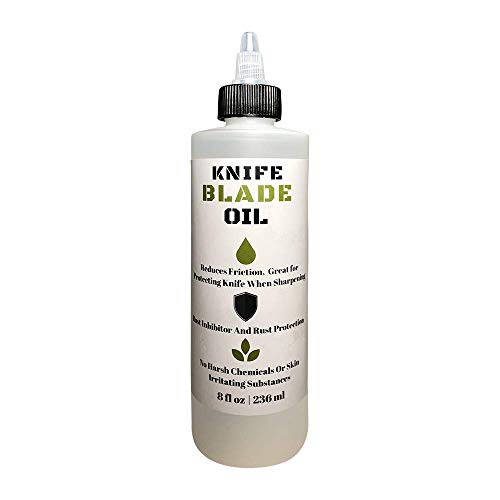
The UniKitchen bottle covers the two jobs a carbon steel owner usually splits between products: it works as a honing oil on the stone during sharpening and as a protective barrier on the finished blade afterward. The formula is built from natural, food grade ingredients — the maker states 100% natural and food safe — so a blade can move from the stone to the cutting board after a wipe. At 8 ounces it is the largest bottle in this guide, and the precision oiler format puts drops where you aim them, on a stone surface or along a blade flat. The maker also lists pivot and folding knife use, which fits a shop that maintains folding tools alongside bench chisels. It is not blended for diamond plates specifically, so plate owners should stay with a fluid made for that surface. Pick it if one food-safe bottle for both the stone and the steel it sharpens simplifies your bench.
Specs
- Size: 8 fl oz
- Formula: Natural food grade ingredients, per the maker
- Use: Honing oil for stones and protective blade oil for carbon steel
- Container: Precision oiler bottle
- Origin: Made in the USA, per the maker
- Maker: UniKitchen
Comparison Table
| Product | Size | Formula | Stone fit | Container |
|---|---|---|---|---|
| Norton Sharpening Stone Oil | 4.5 fl oz | Highly refined mineral oil | Natural and synthetic oil stones | Metal can with spout |
| Smith’s HON1 Honing Solution | 4 fl oz | Non-petroleum, with cleaning agents | Arkansas and diamond stones | Plastic bottle |
| Dan’s Honing Oil | 3 fl oz | Light honing oil | Sharpening stones, Arkansas stones | Plastic bottle |
| Lansky Nathan’s Natural | 4 fl oz | Food-grade honing oil | Non-diamond hones, Arkansas benchstones | Plastic bottle |
| UniKitchen Premium Blade Oil | 8 fl oz | Natural food grade ingredients | Stones and carbon steel blades | Precision oiler bottle |
Frequently Asked Questions
How much oil should I put on a stone? A few drops, spread into a thin film across the working surface. The stone should look wet, not flooded. Add a drop or two when the film starts to look dry or the stroke begins to drag, and wipe the surface with a cloth when the oil darkens with swarf.
Can I use honing oil on a water stone? No. A water stone is porous and will drink the oil deep into its body, after which water no longer wets the surface evenly. Stones commit to one fluid family when they are new: oil stones run on oil, water stones run on water, and the two do not mix.
Is mineral oil from the pharmacy the same thing? It is close in base — most honing oils are light mineral oil — but the bottled stone oils are blended thinner than pharmacy grades so they flush swarf instead of floating the blade. A thinner cut is what keeps a fine Arkansas stone cutting instead of skating.
How do I clean a stone that has loaded up? Flood the surface with fresh honing oil, work a stiff brush across it to lift the darkened swarf out of the pores, and wipe with a clean cloth. Repeat until the oil comes away mostly clear. Working oil into the stone during normal use slows loading down in the first place.
Does honing oil protect a blade from rust? A plain mineral stone oil leaves only a temporary film. For storage protection on carbon steel, choose a bottle that includes rust inhibitors or a blade barrier function, and store the tool dry — oil on the blade is a supplement to dry storage, not a substitute for it.
Verdict
For a bench built on conventional oil stones, the Norton Sharpening Stone Oil is the anchor bottle: a light mineral oil of stated purity in a spouted can, made by the name most oil stones were designed around. If your stones load quickly or your setup mixes Arkansas stones with diamond plates, Smith’s HON1 puts cleaning agents and rust inhibitors inside the fluid itself. Arkansas stone owners who want the quarry’s own pairing can keep the small Dan’s bottle in the stone box, while Lansky users get a food-grade oil matched to their systems and benchstones in Nathan’s Natural. And if your stones sharpen kitchen knives as often as chisels, the UniKitchen bottle closes the loop — one natural, food-safe oil for the stone during the work and for the carbon steel blade when the work is done.
Related guides
More from Amazon
Programs that pair well with the guide above. Offers and eligibility are set by Amazon and may change.
A free business account with business pricing and bulk-buying tools for work, shop or home office.
Create a business accountFree shipping on eligible items, Prime Video and more. Eligible new members can start with a free trial.
Start a Prime free trialAudiobooks and podcasts to listen to on the go. Eligible new members can start with a free trial.
Try Audible freeAd-free music streaming. Eligible new subscribers can start with a free trial.
Try Music Unlimited freeAs an Amazon Associate we earn from qualifying purchases.








