
Key takeaways
- Compare the best grinding wheels by grit, wheel size, abrasive type and arbor size, for bench grinders used in tool sharpening and general shop grinding.
As an Amazon Associate I earn from qualifying purchases. This post may contain affiliate links at no extra cost to you.
The wheel that ships on most bench grinders is a compromise: a coarse gray stone chosen to survive rough work, not to put a clean edge on a chisel. Swap that stone for a wheel matched to the steel in your hand and the whole machine changes character. The right abrasive cuts cooler, holds its shape longer, and leaves an edge that needs only a light honing instead of a rescue session at the bench. The wrong one glazes over, loads up with metal, and blues a tool edge in seconds.
Disclosure: As an Amazon Associate, I earn from qualifying purchases. Product details were verified at the time of writing.
The five wheels below cover the choices a small shop actually faces: a general-purpose aluminum oxide stone for everyday grinding, a green silicon carbide wheel for carbide tips, two white aluminum oxide wheels in medium and fine grits for cool sharpening, and an electroplated CBN wheel that never needs dressing.
How to Choose a Grinding Wheel
Match the abrasive to the metal. Aluminum oxide is the everyday abrasive for carbon steel, alloy steel, and high-speed steel. White aluminum oxide is a purer, more friable form of the same mineral: the grains fracture sooner, exposing fresh cutting edges and shedding heat, which is why it is the standard pick for hardened, heat-sensitive tool steels. Green silicon carbide is harder and sharper still, and it is the correct wheel for cemented carbide, cast iron, and non-ferrous metals — but it is a poor match for steel, where it wears fast and cuts slowly. CBN (cubic boron nitride) is a super-abrasive plated onto a metal core; it cuts high-speed steel coolly and holds its shape for years, but it should never be used on carbide or soft mild steel.
Pick the grit for the job stage. Coarse grits in the 36 to 60 range remove metal fast and are for shaping, nick repair, and regrinding a bevel. Medium grits around 80 to 120 do the bulk of routine sharpening. Fine grits from 150 up refine an edge before honing. Most two-wheel grinders end up with one coarse or medium wheel on one side and a finer wheel on the other, so a tool can move from shaping to sharpening without a wheel change.
Match diameter, width, and arbor to your grinder. The wheel diameter must match the guard size — 6 inches for most home bench grinders, 8 inches for larger and low-speed machines. Width is commonly 3/4 inch on 6-inch wheels and 1 inch on 8-inch wheels. The arbor hole must fit your spindle: 1/2 inch and 5/8 inch spindles are the most common, and many vitrified wheels carry a 1-inch hole with reducing bushings in the box. A loose fit on the spindle causes runout and vibration, so use the correct bushing rather than relying on the flange to center the wheel.
Never exceed the wheel’s maximum RPM figure. Every wheel carries a speed limit, printed on its blotter. That figure must be equal to or higher than your grinder’s no-load speed. Standard 6-inch grinders spin at 3,450 to 3,600 RPM, and the vitrified wheels below carry maximum figures of 4,140 RPM or higher, which leaves a proper safety margin. Low-speed 8-inch grinders turn at about 1,725 RPM, well inside the limits of the 8-inch wheels here. Ring-test any vitrified wheel before mounting, and let a new wheel run at full speed for a minute with the guard closed before grinding.
Plan on dressing. Vitrified wheels gradually glaze and load with metal, and their faces drift out of true. A wheel dresser restores a flat, open face in seconds. CBN wheels are the exception: the plated abrasive layer does not glaze or wear out of shape, so there is nothing to dress.
The 5 Best Grinding Wheels
1. Norton Gemini Bench Grinding Wheel, 6 in, 60 Grit — Best General-Purpose Wheel

Norton’s Gemini line is the workhorse vitrified wheel found on bench and pedestal grinders everywhere, and this 60-grit aluminum oxide version is the natural replacement for the stone a grinder ships with. The 60-grit face removes metal at a useful pace for shaping a bevel, grinding out a nick, or thinning a lawn mower blade, yet it is fine enough to leave a surface that hones quickly. The wheel is 6 inches in diameter and 3/4 inch wide with a 1-inch arbor hole, and reducing bushings in the box let it sit correctly on smaller spindles. Its maximum RPM figure of 4,140 leaves a comfortable margin over a standard 3,450 RPM grinder.
Specs:
– Wheel diameter: 6 in
– Wheel width: 3/4 in
– Arbor size: 1 in (reducing bushings included)
– Grit: 60
– Abrasive type: Aluminum oxide
– Maximum RPM figure: 4,140
2. POWERTEC Bench Grinder Wheel, 8 in, 120 Grit — Best White Oxide Wheel for 8-Inch Grinders

This POWERTEC wheel pairs the larger 8-inch format with white aluminum oxide in a medium-fine 120 grit, a combination aimed squarely at sharpening rather than shaping. The white abrasive runs noticeably cooler than a gray stone on hardened and high-speed steels, so lathe tools, drill bits, and chisels keep their temper at the edge. At 8 inches across and a full 1 inch wide, it presents a broad, stable face that suits the long, sweeping passes used on turning tools, and the 5/8-inch arbor matches the spindles of most 8-inch and low-speed grinders. The maximum RPM figure is 3,600, comfortably above the roughly 1,725 RPM of a low-speed machine.
Specs:
– Wheel diameter: 8 in
– Wheel width: 1 in
– Arbor size: 5/8 in
– Grit: 120
– Abrasive type: White aluminum oxide
– Maximum RPM figure: 3,600
3. Truper Silicon Carbide Grinding Wheel, 6 in, 60 Grit — Best for Carbide Tool Bits
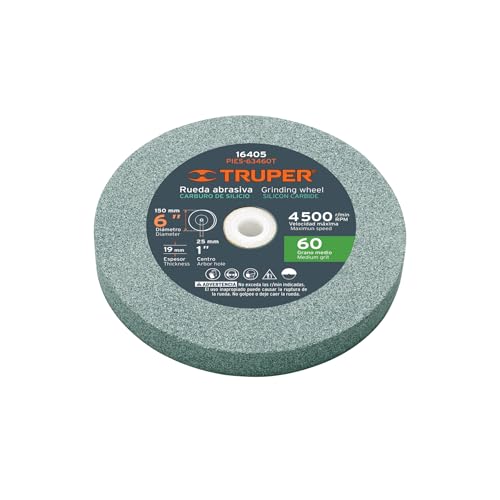
Aluminum oxide barely scratches cemented carbide, which is why every shop that grinds brazed carbide lathe bits, carbide-tipped saw teeth, or masonry drill tips needs one green wheel. This Truper wheel is green silicon carbide in a coarse 60 grit, so it bites into carbide and restores a chipped tip quickly, and it also handles cast iron, brass, bronze, and stone. The 6-inch wheel is 3/4 inch wide with a 1-inch arbor hole, and the included adapters step it down to 3/4, 5/8, and 1/2 inch spindles, so it fits nearly any bench grinder in the shop. Its maximum RPM figure of 4,500 is the highest in this lineup. Keep it for carbide and non-ferrous work — on ordinary steel it wears quickly and cuts slowly.
Specs:
– Wheel diameter: 6 in
– Wheel width: 3/4 in
– Arbor size: 1 in (adapters for 1/2, 5/8, and 3/4 in included)
– Grit: 60
– Abrasive type: Green silicon carbide
– Maximum RPM figure: 4,500
4. Norton Bench Grinding Wheel, 6 in, 150 Grit — Best Fine Finishing Wheel

Where the Gemini above is the shaper, this Norton wheel is the refiner. It is white aluminum oxide at a very fine 150 grit, the step that takes a ground bevel from serviceable to nearly honed before the tool ever touches a stone. The friable white grains shed heat as they cut, so thin chisel edges and plane irons are far less likely to blue than on a gray wheel, and the fine face leaves a scratch pattern that a few strokes on a bench stone erase. It shares the common 6-inch by 3/4-inch format with a 1-inch arbor hole, and its maximum RPM figure of 4,140 suits standard-speed grinders. Mounted opposite a 60-grit wheel, it completes the classic two-wheel sharpening station.
Specs:
– Wheel diameter: 6 in
– Wheel width: 3/4 in
– Arbor size: 1 in
– Grit: 150
– Abrasive type: White aluminum oxide
– Maximum RPM figure: 4,140
5. MORESUPERHARD CBN Grinding Wheel, 8 in, 180 Grit — Best Premium Wheel for High-Speed Steel

A CBN wheel replaces the vitrified stone entirely: a layer of cubic boron nitride is electroplated onto a precision 6061 aluminum core with a nickel-plated finish, so the wheel runs true from the first mount and never needs truing or dressing. This 8-inch, 180-grit version from MORESUPERHARD is built for high-speed steel — lathe tools, turning gouges, and chisels — and it cuts with so little heat that edges come off the wheel cool to the touch. The wheel is 1 inch wide with a 5/8-inch arbor for 8-inch grinders, and the maker gives a working speed range of 1,000 to 3,600 RPM, covering both low-speed sharpening grinders and standard machines. Reserve it for high-speed steel only; carbide and soft steels damage the plated layer.
Specs:
– Wheel diameter: 8 in
– Wheel width: 1 in
– Arbor size: 5/8 in
– Grit: 180
– Abrasive type: CBN (cubic boron nitride), electroplated on an aluminum core
– Maximum RPM figure: 3,600 (working range 1,000–3,600)
Comparison Table
| Wheel | Diameter x Width | Arbor | Grit | Abrasive | Maximum RPM figure |
|---|---|---|---|---|---|
| Norton Gemini | 6 in x 3/4 in | 1 in | 60 | Aluminum oxide | 4,140 |
| POWERTEC | 8 in x 1 in | 5/8 in | 120 | White aluminum oxide | 3,600 |
| Truper | 6 in x 3/4 in | 1 in with adapters | 60 | Green silicon carbide | 4,500 |
| Norton Fine | 6 in x 3/4 in | 1 in | 150 | White aluminum oxide | 4,140 |
| MORESUPERHARD | 8 in x 1 in | 5/8 in | 180 | CBN | 3,600 |
FAQ
Can I put an 8-inch wheel on a 6-inch grinder?
No. The wheel must match the guard diameter the grinder was built for. An oversized wheel will not fit inside the guard, and removing the guard to make it fit removes the protection that contains a wheel failure. Buy the diameter your machine specifies.
Why does my tool edge turn blue at the grinder?
Blueing means the edge passed roughly 500 degrees Fahrenheit and lost hardness. It happens fastest on coarse gray wheels with heavy pressure. Use a white aluminum oxide or CBN wheel, keep the tool moving, press lightly, and quench the edge in water between passes.
Which wheel should I use for carbide-tipped saw blades and lathe bits?
Green silicon carbide, like the Truper wheel above, is the standard vitrified choice for cemented carbide. Aluminum oxide wheels skate on carbide, and CBN is damaged by it, so neither belongs on carbide tooling.
How often does a grinding wheel need dressing?
Dress a vitrified wheel whenever the face glazes, loads with bright metal specks, or drifts out of flat — for a busy shop that can be every few sessions. A plated CBN wheel never needs dressing, because its abrasive layer does not change shape as it works.
What does the grit number mean for sharpening?
Lower numbers cut faster and leave a rougher surface; higher numbers cut slower and leave a finer edge. A practical sharpening station pairs a 60-grit wheel for shaping and repair with a 120 to 180-grit wheel for the final passes before honing.
Verdict
For most shops, the Norton Gemini 60-grit wheel is the right first upgrade: it fits the standard 6-inch grinder, handles everyday shaping and repair, and leaves an edge that hones fast. Pair it with the Norton 150-grit white wheel on the other side of the same machine and you have a complete sharpening station that runs cool and finishes fine. Owners of 8-inch and low-speed grinders should look at the POWERTEC 120-grit white wheel for the same cool-cutting behavior in the larger format. If carbide bits are part of your work, the Truper green silicon carbide wheel is the one specialized stone you cannot substitute. And if high-speed steel turning and lathe tools dominate your sharpening, the MORESUPERHARD CBN wheel ends dressing, truing, and blued edges for good — it is the last wheel most turners buy for that side of the grinder.
Related guides
More from Amazon
Programs that pair well with the guide above. Offers and eligibility are set by Amazon and may change.
A free business account with business pricing and bulk-buying tools for work, shop or home office.
Create a business accountFree shipping on eligible items, Prime Video and more. Eligible new members can start with a free trial.
Start a Prime free trialAudiobooks and podcasts to listen to on the go. Eligible new members can start with a free trial.
Try Audible freeAd-free music streaming. Eligible new subscribers can start with a free trial.
Try Music Unlimited freeAs an Amazon Associate we earn from qualifying purchases.








