
Key takeaways
- Compare eye bolts by shank types, thread sizes and shoulder designs, with the shoulder-seated rule and the straight-pull habit riggers rely on daily.
As an Amazon Associate I earn from qualifying purchases. This post may contain affiliate links at no extra cost to you.
An eye bolt is a threaded lifting point: a forged steel ring standing on a threaded shank, screwed into a tapped hole in a machine, a motor housing, a gearbox, or a heavy timber so that a hook, a sling, or a shackle has somewhere honest to attach. Every pick in this guide is a drop-forged machinery eye bolt with a working load limit published by its maker. That single requirement clears away most of the shelf, because the hardware-store bin is full of bent-wire eye screws and formed eyes that carry no published figure at all and belong on picture wire and plant hangers, not on a load.
The boundary is worth stating plainly. Screw-in eye hooks and lag-thread eye bolts bite into wood with a wood-screw thread and are a light hanging class, not this one. Tie-down anchors are deck and bed mounts that a strap hooks onto; they stay in their own guide. Shackles and quick links are connectors that join hardware to hardware; they stay in theirs. Swivel hoist rings are a bolted lifting point that rotates under load, a different and heavier discipline. What follows is only the forged machinery eye bolt shelf: shoulder pattern and plain pattern, machine thread, tapped hole or through-hole with a nut.
Disclosure: As an Amazon Associate, I earn from qualifying purchases. Product details were verified at the time of writing.
How to Choose an Eye Bolt
Start with the pattern, because the pattern decides the pull. A shoulder pattern bolt carries a machined shoulder at the base of the eye that seats flat against the mounting surface, and that seat is what lets it tolerate an angular pull at a reduced figure. A plain pattern bolt has no shoulder; the shank meets the eye with nothing to bear against the surface, so it is a straight-pull fitting only. Choose the shoulder pattern whenever the load direction is anything but perfectly in line, and choose the plain pattern only when the pull is guaranteed vertical and stays that way.
Forged is the whole point. A forged eye is one piece of steel with the grain following the ring, quenched and tempered, with the maker and the load figure marked on it. A bent eye is a rod curled into a circle, and the curl is a hinge waiting to open. If a listing does not say forged and does not publish a working load limit, it is not a lifting point, whatever the headline claims.
Thread engagement is a length, not a feeling. In steel, the threaded shank must engage at least one full bolt diameter of sound thread — a 1/2 inch bolt needs at least 1/2 inch of full thread in the tapped hole, and more in softer metals. Count the thread length on the bolt, check the depth of the hole, and never let a long eye on a short shank talk you into a shallow install.
Match the eye to the hardware that enters it. The inside diameter of the eye has to swallow the hook or shackle pin without binding or point contact. A hook that cannot sit in the bottom of the eye loads the ring at two hard points and bends it; check the inside diameter in the specs against the connector you actually own.
Pick the finish for the weather it will live in. Hot-dip galvanized carbon steel is the outdoor default and shrugs off rain for years. Stainless steel is the pick for coastal air, washdown rooms, and anywhere rust staining matters. Self-colored carbon steel is plain unfinished stock for indoor machinery, where it gets oiled, inspected, and kept dry.
Safety Rules That Come First
The shoulder must seat fully flush. A shoulder pattern bolt earns its angular figure only when the shoulder bears flat on the surface all the way around. If the eye ends up facing the wrong way when the shoulder seats, the fix is a shim or washer under the shoulder to rotate the eye into the plane of pull — never backing the bolt off a quarter turn, which unseats the shoulder and throws the load onto the threads.
Plain pattern means in-line, full stop. Side loading a plain pattern bolt bends the shank at the surface, and bending is how eye bolts fail. Side load is banned for every plain pattern pick in this guide: if the pull is not straight along the shank, re-rig the lift or change to a shoulder pattern bolt and take the reduced angular figure.
Angular pulls shrink the figure fast. Even a shoulder bolt keeps only part of its in-line figure as the angle grows — roughly a third of it at 45 degrees from in-line, and less beyond that. Keep angular pulls at or under 45 degrees from the shank line, keep the pull in the plane of the eye, and do the arithmetic with the maker’s chart before the load leaves the ground.
Retire damage, and destroy what you retire. A bent eye, a stretched ring, nicked threads, or a shank that has taken a bend comes out of service on the spot. Never straighten a bent eye bolt, never grind, machine, or weld one, and never paint over the markings. A retired bolt gets cut or crushed so nobody fishes it out of the scrap bin for one more lift.
No pick here is a life-safety device. Eye bolts in this guide move machines, motors, and materials. None of them is ever used to lift, lower, or support a person, and no working load limit in this guide is a target — it is a ceiling that assumes a sound install, a straight or charted pull, and hardware that passed inspection that day.
The 5 Eye Bolts
1. Ken Forging K2023 Shoulder Pattern Eyebolt
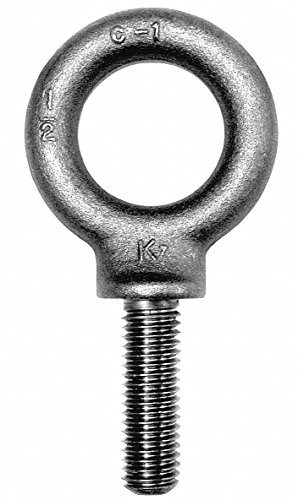
Ken Forging drop-forges this bolt in Ohio from carbon steel to ASTM A489, and it is the textbook machinery eye bolt: a shoulder pattern ring on a 3/8-16 shank, sold self-colored for indoor machinery work. The 1-1/4 inch shank is the standard machinery length, long enough for full engagement in a tapped housing with the shoulder seated, and the eye is sized for the hooks and small shackles that live on shop hoists and engine stands. This is the bolt to thread into a motor, a pump, or a machine base that gets picked up and set down over and over across its working life.
Specs
- Pattern: Shoulder pattern machinery eye bolt, drop forged
- Material: Carbon steel, ASTM A489, self-colored finish
- Thread: 3/8-16 UNC
- Shank length: 1-1/4 in
- Eye inside diameter: 15/16 in
- Eye outside diameter: 1-11/16 in
- Working load limit (in-line pull): 1,300 lb maker figure
- ASIN: B007A5W826
2. Ken Forging K2021-2-SS Shoulder Pattern Eyebolt

The stainless sibling in the Ken Forging line, forged from 304 stainless and left plain, with a longer 2 inch shank on a 1/4-20 thread. The small thread and the long shank suit tapped holes in thinner housings and equipment that lives in damp rooms, food plants, and coastal shops where a carbon bolt would bloom rust between inspections. The shoulder pattern still applies in full: seat it flush, keep angular pulls charted and modest, and let the stainless do the corrosion work it was bought for.
Specs
- Pattern: Shoulder pattern machinery eye bolt, drop forged
- Material: 304 stainless steel, plain finish
- Thread: 1/4-20 UNC
- Shank length: 2 in
- Eye inside diameter: 11/16 in
- Working load limit (in-line pull): 500 lb maker figure
- Made in: USA (Jefferson, Ohio)
- ASIN: B00945WODS
3. National Hardware N245-167 3260 Eye Bolt

National Hardware’s 3260 series is forged steel with a shoulder design, hot-dip galvanized, and this 1/2-13 by 6 inch size is the general-purpose anchor of the guide — long enough to pass through a beam or a thick mounting ear and take a nut on the back side, with the shoulder seated against the face. The galvanized finish makes it the through-bolt for gates, dock hardware, agricultural gear, and workshop fixtures that live outside. The eye takes a full 1 inch of hook or pin, and the published safe working load matches the standard figure for its size.
Specs
- Pattern: Shoulder pattern, forged
- Material: Steel, hot-dip galvanized finish
- Thread: 1/2-13 UNC
- Shank length: 6 in
- Eye inside diameter: 1 in
- Eye outside diameter: 1-3/4 in
- Working load limit (in-line pull): 2,200 lb maker figure
- Hardware: Hex nut included
- ASIN: B000BDB4YC
4. Koch 105130 Forged Eye Bolt with Nut

Koch forges this plain pattern bolt and hot-dip galvanizes it, and the honest way to read it is as a straight-pull anchor with a long 8 inch shank and a nut: through a post, a beam, or a trailer frame, tightened down, and loaded only along its own axis. The long shank is the point of the product — it reaches through thick timber and stacked material that a machinery-length bolt cannot. Used in line, for anchoring chain and wire rope runs, gate hardware, and steadying lines, it does its one job well. Angled pull is not its job, ever.
Specs
- Pattern: Plain pattern (no shoulder), forged — straight in-line pulls only
- Material: Forged steel, hot-dip galvanized finish
- Thread: 1/2-13 UNC
- Shank length: 8 in
- Working load limit (in-line pull): 2,200 lb maker figure
- Hardware: Hex nut included
- ASIN: B000R59DHY
5. US Cargo Control Eye Bolt, 5/8 x 12

The heavy anchor of the guide: a 5/8 inch forged galvanized bolt on a full 12 inch shank, from a maker whose whole catalog is cargo and rigging hardware. That shank length is for serious through-bolting — timber bents, thick steel ears, layered mounts — with the nut run down on the far side and the pull kept dead in line with the shank, because this is a plain pattern bolt and the no-side-load rule applies at full strength. The published figure, 5,200 lb in line, is the standard working load limit for a forged bolt of this diameter, and it assumes the mount itself is stronger than the bolt.
Specs
- Pattern: Plain pattern (no shoulder), forged — straight in-line pulls only
- Material: Forged carbon steel, galvanized finish
- Thread: 5/8-11 UNC
- Shank length: 12 in
- Working load limit (in-line pull): 5,200 lb maker figure
- Hardware: Hex nut included
- ASIN: B00LGYWZN4
Verdict
For a tapped hole in machinery, the Ken Forging K2023 is the default: forged, shouldered, honestly figured, and made for repeat lifts. Its stainless sibling, the K2021-2-SS, covers the damp and coastal version of the same job at a smaller size. The National Hardware 3260 is the through-bolt with a shoulder, the one that clamps into beams and thick ears outdoors. The Koch 105130 and the US Cargo Control 5/8 x 12 are plain pattern anchors for straight pulls through thick material — strong in line, and never to be side-loaded. Buy the pattern your pull direction demands, seat the shoulder or keep the line straight, and the forged ring will do the rest.
FAQ
Can a plain pattern eye bolt take an angled pull?
No. A plain pattern bolt has no shoulder to bear against the surface, so any angle bends the shank. Keep plain pattern bolts on straight in-line pulls only, and use a shoulder pattern bolt — at its reduced angular figure — when the pull cannot be kept in line.
How deep must the threads engage?
At least one bolt diameter of full thread engagement in steel: 1/2 inch of sound thread for a 1/2 inch bolt, and more in aluminum or cast iron. If the tapped hole is shallower than that, the install is wrong no matter how tight the bolt feels.
The eye faces the wrong way when the shoulder seats. What now?
Add a shim or washer under the shoulder and re-seat it until the eye lands in the plane of pull with the shoulder fully flush. Never back the bolt off to align the eye; an unseated shoulder gives up the angular figure and loads the threads in bending.
Can I straighten a bent eye bolt and keep using it?
Never. A bent or stretched eye means the steel has already yielded. Retire the bolt, destroy it so it cannot drift back into service, and replace it.
Are these eye bolts safe for lifting people?
No. Nothing in this guide is a life-safety device. These bolts move machinery and materials only; lifting or supporting a person calls for entirely different, purpose-built equipment.
Related guides
More from Amazon
Programs that pair well with the guide above. Offers and eligibility are set by Amazon and may change.
A free business account with business pricing and bulk-buying tools for work, shop or home office.
Create a business accountFree shipping on eligible items, Prime Video and more. Eligible new members can start with a free trial.
Start a Prime free trialAudiobooks and podcasts to listen to on the go. Eligible new members can start with a free trial.
Try Audible freeAd-free music streaming. Eligible new subscribers can start with a free trial.
Try Music Unlimited freeAs an Amazon Associate we earn from qualifying purchases.








