
Key takeaways
- Compare garden hoes by blade styles, handle lengths and head weights, with the shallow-first-pass rule and edge-sharpening habit gardeners use.
What's inside
As an Amazon Associate I earn from qualifying purchases. This post may contain affiliate links at no extra cost to you.
Weeding between crop rows is a shallow job done close to plants you want to keep. The hoe that suits it is not the one that digs deepest — it is the one whose blade skims the top layer of soil, severs weed stems at the surface, and fits the gap between rows without nicking the crop. The five picks below cover the four long-handled formats that do this work: a draw hoe for chopping and hilling, two stirrup hoes that slice on the push and the pull, a Dutch push hoe for gliding under weed growth, and a pointed Warren hoe for furrows and close corners. One rule governs all of them, and it is stated plainly here because it decides whether the tool helps or harms: take a shallow first pass. The blade skims the surface and cuts the weed’s stem where it meets the soil; deep chopping near a row tears crop roots, brings buried weed seed up into the light, and turns a ten-minute pass into replanting. Work shallow first, and only go deeper well away from the row.
Disclosure: As an Amazon Associate, I earn from qualifying purchases. Product details were verified at the time of writing.
Contents
How to Choose a Garden Hoe
Blade style decides the stroke. A draw hoe carries a flat blade set across the end of the handle; you chop down lightly and pull the blade toward you, which moves soil as well as cutting weeds — the format for hilling potatoes and opening a furrow. A stirrup or scuffle hoe carries a loop blade that works flat, just under the surface, cutting on both the push and the pull; it moves almost no soil, which is exactly what an established row wants. A Dutch hoe is a push tool: a flat blade on a long handle that you shove forward under the weeds so the edge slices them off at ground level. A Warren hoe narrows the draw blade to a point, trading coverage for precision in corners and furrows. The fifth format, the collinear hoe, runs a long, thin blade in line with the handle for shaving weeds in the tightest rows; it is a specialist market-garden tool sold mainly through seed and market-farm suppliers, and none of the five picks below is one — the Warren point and the Dutch blade are the close-work picks in this guide, and they are described as what they are.
Blade width against row spacing. The blade has to fit the gap with room to spare on both sides. A 5.75-inch draw blade is comfortable in rows spaced a foot apart or wider; in rows closed down to eight inches, the narrower stirrup loops and the Warren point are the tools that stay off the crop stems. Measure your tightest row before you choose, not your widest.
Keep the edge sharp. A hoe is a slicing tool, and a dull hoe tears instead of slicing: it drags weed stems out of the ground in clumps, disturbs far more soil, and makes you push twice as hard for a worse result. Run a flat file along the bevel every session or two — a minute’s work — stroking away from the edge so the file never comes toward your fingers. The stirrup picks below hold an edge well, and one of them is built to sharpen itself in use, but no blade in this guide stays keen forever without a file.
Handle length and stance. Fifty-four to sixty-three inches covers the range here. The handle should let you stand upright with the blade flat on the ground; working bent over a short handle is how backs give out by the third row. Adjustable handles solve the shared-tool problem, and one of the stirrup patterns below adjusts, but a fixed hardwood or ash handle has no joint to work loose mid-row.
Head weight. These heads run light — roughly one and a half to two and a half pounds for the whole tool. That is deliberate. A row hoe is guided, not swung; the weight you want is in the handle’s balance, not in a heavy head. Save the heavy tools for breaking ground, and let a light blade do the weekly pass.
Feet and storage. Keep your feet behind the blade’s arc on every stroke, draw hoes most of all: the blade travels toward you, and a foot planted ahead of the work is a foot in the blade’s path. When the pass is done, store the hoe blade-down against a wall or hung on a peg — never flat on a path or lying in the grass where the next person walks.
1. Rogue Prohoe 5.75-Inch Disc Garden Hoe
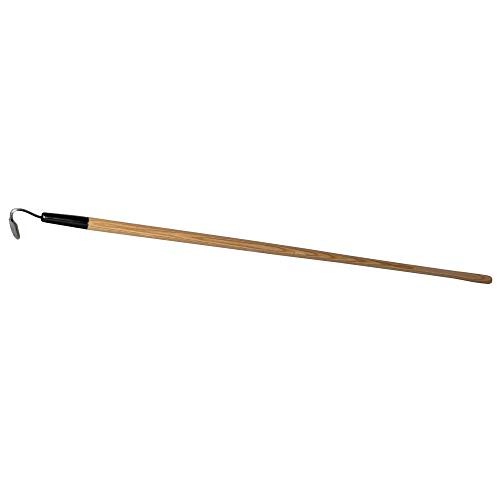
Rogue’s 575G is the draw hoe of this guide, and its head is the story: it is cut from recycled agricultural disc blades, the tempered steel discs that spend their first life working farm fields, then ground and sharpened on three sides. Three working edges means the head cuts on the pull, on the chop, and at the corners, so in a row you can turn the blade and slice sideways at a weed sitting tight against a stem instead of repositioning your feet. The half-moon head is 5.75 inches wide — the widest blade here — and it rides on a 60-inch ash handle that keeps the whole tool near two pounds, light for a head this tough. Rogue guarantees the head for life and makes the tool in the USA. This is the pick for rows wide enough to hill and chop in, and for ground with some body to it; in rows closed under ten inches, the narrower heads below are the safer hands.
Specs
- Type: draw hoe
- Blade: 5.75-inch head, recycled agricultural disc steel, sharpened on 3 sides
- Handle: 60-inch ash wood
- Weight: 2 lb
- Origin: made in USA, lifetime guarantee on the head
- Model: 575G
2. True Temper 2866300 Looped Action Hoe
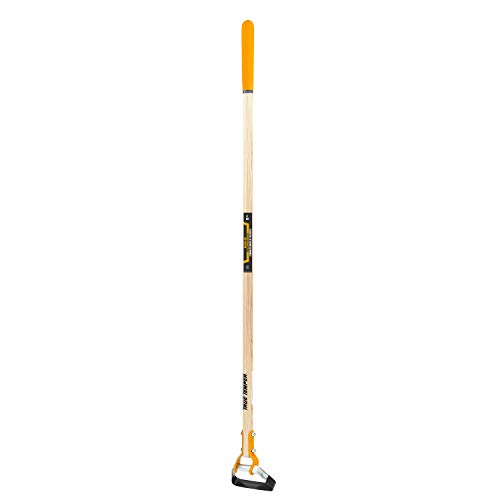
The True Temper 2866300 is the classic fixed-handle stirrup hoe: a tempered steel loop on a 54-inch hardwood handle with a cushioned grip. The loop rides flat, a half-inch under the surface, and cuts on both halves of the stroke — push it away and it slices, pull it back and it slices again — so a row gets weeded in one walking pass at a steady pace. Because the blade works so shallow and moves so little soil, it is the format least likely to disturb the roots of the crop beside it, and the loop’s open center lets soil fall through instead of piling ahead of the blade. The cushion grip is a small thing that matters by the tenth row. True Temper backs the tool with a 15-year limited warranty. Gardeners over six feet may find the 54-inch handle a touch short for a fully upright stance; for everyone else it is the straightforward, no-adjustments stirrup pick.
Specs
- Type: stirrup (looped action) hoe
- Blade: tempered steel loop, cuts on push and pull
- Handle: 54-inch hardwood with cushion grip
- Weight: 2.58 lb
- Warranty: 15-year limited
- Model: 2866300
3. Flexrake 1000L Hula-Ho Weeder Cultivator

The Hula-Ho is the original oscillating stirrup design, and the Flexrake 1000L is its long-handled form: a 54-inch hardwood handle and a heat-treated blade that flexes as it works, rocking back and forth so the edge holds its shallow angle through the stroke instead of digging in or skating over the top. That self-adjusting angle is why the design has stayed in production for decades — the blade finds the depth and keeps it, which is the whole skill of the shallow first pass done for you. Flexrake describes the blade as self-sharpening in use, and when it finally wears, the blade is replaceable rather than the whole tool being retired. At a little over two pounds with a 58-inch overall length, it is a light, nimble tool for beds and rows that get a weekly pass; baked, compacted ground is draw-hoe work, and this blade will tell you so by bouncing. Made in the USA.
Specs
- Type: stirrup (oscillating Hula-Ho) hoe
- Blade: heat-treated steel, self-sharpening in use, replaceable
- Handle: 54-inch hardwood
- Overall length: 58 inches
- Weight: 2 lb 6 oz
- Origin: made in USA
- Model: 1000L
4. Berry&Bird Dutch Hoe
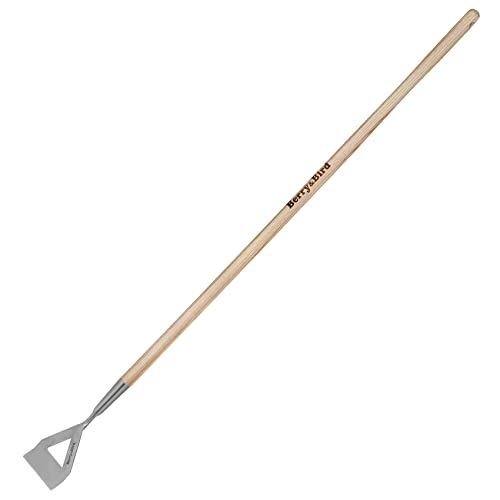
The Dutch hoe works in the opposite direction from everything above: you push it. The Berry&Bird carries a polished stainless steel blade with a tapered point on a 63-inch ash handle — the longest handle in this guide — and the stroke is a forward glide, the flat blade sliding just under the surface and severing weed stems at ground level as you walk the row. The long handle keeps you upright and puts the blade well ahead of your feet, which makes the format easy on the back and precise at the far end of a bed you cannot step into. Stainless steel shrugs off wet soil and shed storage without rust, and the tapered tip gets into the corner where a row meets a fence or a bed edge. It is a weeding tool, not a soil-moving one: it will not hill, furrow or break ground, and the guide does not pretend otherwise. Berry&Bird sources the ash from FSC-certified forests and backs the tool for ten years.
Specs
- Type: Dutch (push) hoe
- Blade: polished stainless steel, tapered tip
- Handle: 63-inch FSC-certified ash wood
- Weight: 2.5 lb
- Warranty: 10 years
5. Truper 30002 Tru Tough Warren Hoe
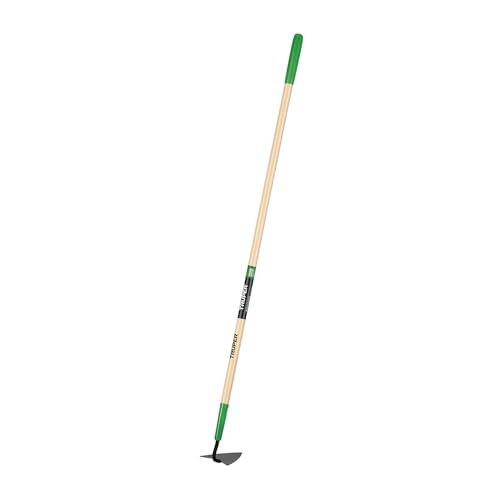
The Warren hoe takes the draw blade and narrows it to a point. Truper’s 30002 carries a 4-3/4-inch heart-shaped welded steel head on a 54-inch lacquered North American ash handle, and the whole tool weighs a pound and a half — the lightest here. The point concentrates the stroke, so it punches into the tight spots the wide blades cannot reach: the corner of a bed, the gap between two plants in the row, the end of a furrow. Run it point-first and it opens a clean seed furrow; turn it and the flat shoulders of the head draw soil back over the seed. It is also the handiest of the five for flicking out single rooted weeds that the stirrup loops ride over. The trade is coverage: a pointed head weeds a wide row slowly, and there is no cushion grip on the handle. As the second tool beside a stirrup hoe, for the close work the loops cannot do, it earns its place in the shed.
Specs
- Type: Warren hoe (pointed draw blade)
- Head: 4-3/4-inch welded steel, heart-shaped point
- Handle: 54-inch North American ash, lacquered
- Weight: 1.5 lb
- Model: 30002
The Bottom Line
For most vegetable rows, start with a stirrup hoe: the True Temper if you want a fixed hardwood handle and a long warranty, the Flexrake Hula-Ho if you want the oscillating blade that holds its own shallow angle. Add the Rogue 575G when your rows are wide enough to hill and the ground has some fight in it, the Berry&Bird when you would rather push than pull and want the longest reach, and the Truper Warren when the work shrinks to furrows and corners. Whichever you pick, the habits matter more than the brand: a shallow first pass that skims the surface instead of chopping at crop roots, an edge kept sharp with a file so the blade slices instead of tearing, feet planted behind the blade’s arc, and the tool put away blade-down or hung — never flat on a path.
Frequently Asked Questions
How deep should a hoe pass be? Shallow — the blade should travel in the top half-inch of soil, just deep enough to sever weed stems below the surface. Depth is for digging tools; a weeding pass that turns soil over is working too deep and disturbing the crop.
How often should the blade be sharpened? Check the edge every session and file it whenever it starts to drag or tear instead of slicing — for most gardens that is every session or two. A few strokes of a flat file along the bevel, filed away from the edge, is the whole job.
Stirrup or draw hoe for tight rows? Stirrup, in most cases: the loop works flat and shallow, moves almost no soil, and its width is easy to judge against the crop stems. A draw hoe earns its place when you also need to move soil — hilling, furrowing, breaking a crust — and the rows are wide enough to give the blade room.
Can one hoe do the whole garden? One hoe can do most of it if the rows are uniform, but the pointed Warren pattern exists because loops and wide blades cannot reach corners and furrow ends. A stirrup hoe plus a Warren hoe covers nearly every weeding job a vegetable garden sets.
Related guides
More from Amazon
Programs that pair well with the guide above. Offers and eligibility are set by Amazon and may change.
A free business account with business pricing and bulk-buying tools for work, shop or home office.
Create a business accountFree shipping on eligible items, Prime Video and more. Eligible new members can start with a free trial.
Start a Prime free trialAudiobooks and podcasts to listen to on the go. Eligible new members can start with a free trial.
Try Audible freeAd-free music streaming. Eligible new subscribers can start with a free trial.
Try Music Unlimited freeAs an Amazon Associate we earn from qualifying purchases.








