What's inside
As an Amazon Associate I earn from qualifying purchases. This post may contain affiliate links at no extra cost to you.
Helical head benchtop thickness planers used to be a luxury reserved for shops with six-figure budgets. That changed over the past few years, and now you can find 13-inch and 15-inch machines with carbide-insert cutterheads under $1,000. The practical payoff is real: helical designs produce noticeably smoother faces on figured hardwoods, reduce tear-out on reversing grain, and run quieter than straight-knife heads. They also let you rotate or replace individual inserts instead of sending a full knife set out for sharpening.
The problem is that the market is now crowded with machines that look similar on spec sheets but differ wildly in cast-iron mass, feed-roller traction, depth-stop repeatability, and how well the infeed and outfeed tables align under load. A $420 planer and a $934 planer might both list “helical cutterhead” and “13-inch capacity,” yet one will leave snipe on every board while the other produces shop-quality surfaces in a single pass. We compared eight current models to find out which ones actually deliver.
As an Amazon Associate we earn from qualifying purchases at no extra cost to you. Product prices and availability are accurate as of the date shown and are subject to change.




Quick Picks
| Product | Best for | Price |
|---|---|---|
| FindBuyTool 13″ Helical Planer | High-RPM stock removal on a budget | $759.99 |
| JET JWP-13BT | Two-speed feed control for delicate species | $934.99 |
| FINDBUYTOOL 13″ Pro Helical Planer | Overall best performance and build quality | $1,099 |
| 13″ Spiral Helical Planer (2000W) | Entry-level helical experience | $459.99 |
| FindBuyTool 13″ Carbide Insert Set Planer | Upgrading from straight knives to inserts | $748.22 |
| RIKON 25-135H | Portability with proven helical-style design | $699 |
| JET JPW-15BHH | 15-inch width for wide panel glue-ups | $3,739 |
| WEN PL1326 | Lowest-cost entry into spiral heads | $418 |
How We Picked
We evaluated each machine on four criteria: cutterhead quality and insert configuration (number of cutting edges, carbide vs. HSS, and ease of indexing), feed-system performance (roller grip, speed options, and tear-out resistance on reversing grain), depth-control repeatability under repeated passes, and table alignment and mass. We prioritized models that produced snipe-free surfaces with a single outfeed-table micro-adjustment, and we penalized machines where the head raised or lowered unevenly due to inadequate four-post support.
The 8 Best Helical Head Benchtop Thickness Planers in 2026
FindBuyTool 13″ Benchtop Helical Cutterhead Planer
This machine earns its spot through raw motor speed. At 20,000 RPM on a 15-amp, 120V motor, the cutterhead spins fast enough that even a moderate feed rate produces very small chip loads per insert, which translates to a glassy surface on dense hardwoods like hard maple and white oak.
- Pro: Extremely high RPM means fine chip loading and clean faces without needing a slow feed setting.
- Pro: Solid infeed worktable design for its price class keeps board support consistent.
- Con: Single feed speed limits your ability to dial in slower passes on particularly wild grain.
Skip this one if you routinely plane crotch or birdseye maple at shallow cuts under 1/32 inch, where a two-speed feed system would give you more control.
JET JWP-13BT Helical Style Planer
The two-speed feed system is the headline feature here: 18 FPM for normal work and 26 FPM when you need faster throughput. Combined with the 2 HP motor, it handles rough stock without bogging. JET’s reputation for consistent QC means the out-of-box alignment tends to be good, and the helical-style head uses enough cutting edges to smooth out minor grain reversal that would leave chatter marks with straight knives.
- Pro: Two feed speeds give real control over surface finish on tricky species.
- Pro: JET’s dealer network and parts availability reduce long-term ownership friction.
- Con: The rating at 4.2/5 reflects a pattern of inconsistent snipe from some units, suggesting table alignment sensitivity.
If you need absolute repeatability pass after pass without fussing with the outfeed table, a competitor with four-post head support may serve you better.
FINDBUYTOOL 13″ Pro Helical Cutterhead Planer
At $1,099 this is the most expensive 13-inch helical planer on our list, and the 4.9/5 rating backs up the premium. The 2.5 HP motor drives 40 carbide inserts across two speed settings (12 and 21 FPM), and the precision depth adjustment with an integrated dust port and LED work light shows that this machine was engineered for daily production use rather than weekend hobby work. The insert count matters: more inserts at any given RPM means smaller chips and a smoother face.
- Pro: 40 carbide inserts deliver the finest chip load of any 13-inch machine in this group.
- Pro: LED light and dedicated dust port address real workflow annoyances without add-on accessories.
- Con: Highest price in its width class, so it only makes sense if you plan surfaces daily.
Skip it if you only plane softwoods or paint-grade panels where a $400 straight-knife head already gives you a good enough surface.
13″ Spiral Helical Planer with 10,000 RPM Tungsten Carbide
This is the cheapest true carbide-insert helical head we compared. At $459.99 with a 2000W motor and micro-adjustable depth control, it puts the fundamental advantage of indexed carbide inserts within reach of hobbyists on a tight budget. The 10,000 RPM is half of what the fastest machines offer, so you need to accept a slightly coarser finish or take lighter passes to compensate. The 3.8/5 rating reflects fit-and-finish inconsistencies and alignment challenges out of the box.
- Pro: Lowest price for a genuine carbide helical head, making the upgrade accessible.
- Pro: Micro-adjustable depth control at this price point is unusual and helpful for thin stock.
- Con: Build quality and alignment require patience and likely a dial-indicator tune-up.
If you are not willing to spend an afternoon dialing in table coplanarity, the frustration may outweigh the savings.
FindBuyTool 13″ Helical Planer with Carbide Insert Cutter Set
This variant bundles the helical planer with an additional carbide insert cutter set, which means you get spare edges on day one without hunting for compatible replacements. At $748.22 it undercuts the JET while offering the same width and a similar insert-based design. The 4/5 rating suggests adequate performance but without standout refinement in fit, finish, or noise control.
- Pro: Spare carbide inserts included reduce downtime and replacement-part lead time.
- Pro: Competitive pricing below the $800 mark for a carbide-helical platform.
- Con: The rating reflects a middling experience; expect average chip clearance and table alignment.
Choose a higher-rated machine if consistent first-pass surface quality is your top priority.
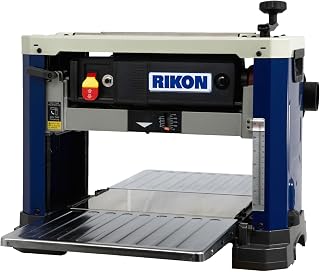
RIKON 25-135H Helical-Style Portable Planer
RIKON has been building benchtop planers for decades, and this model uses 26 two-edge HSS inserts with two feed speeds and four-post head support. The four-post design is critical: it keeps the cutterhead level as you raise or lower it, which is the single most common source of snipe in cheaper machines. At $699 it sits in a sweet spot below the JET and above the WEN. The HSS inserts are less expensive to replace than carbide but do not last quite as long between grinds.
- Pro: Four-post head support delivers the most consistent depth repeatability in its price range.
- Pro: Two feed speeds and a well-known brand with dealer support.
- Con: HSS inserts require more frequent indexing or replacement than carbide, adding long-term maintenance time.
If you want carbide longevity with zero maintenance, pay the premium for a carbide-insert head elsewhere on this list.
JET JPW-15BHH 15-Inch Helical Planer
Step up to 15 inches of width when your projects regularly include panel glue-ups wider than 13 inches. The 3 HP motor and 230V single-phase power give this machine genuine production capacity, and the two-speed feed (16 FPM and 20 FPM) handles both roughing and finishing. It is the heaviest and most expensive machine here at $3,739, and its 4/5 rating tells you that at this price, buyers expect near-perfect execution and find some areas wanting.
- Pro: 15-inch width with helical head eliminates the need to joint wide panels in narrower passes.
- Pro: 3 HP handles full-depth roughing cuts on hard maple without stalling.
- Con: Requires 230V wiring, which is a non-trivial addition to most home shops.
Unless you genuinely need the extra two inches of capacity or produce stock for sale, the price and power requirement make the 13-inch options more practical.
WEN PL1326 13″ Spiral Benchtop Planer
The WEN PL1326 has held a reputation for years as the gateway into spiral-head planing, and at $418 it remains the cheapest option in this group. The 15-amp motor and spiral cutterhead provide a meaningful step up from straight knives, and the 4.7/5 rating from a large volume of buyers confirms it delivers on its promise for the price. The trade-off is expected: lighter mass, simpler feed rollers, and basic depth stops that demand a practiced hand.
- Pro: Lowest price with the highest rating in this roundup, meaning outstanding value per dollar.
- Pro: Proven platform with an active owner community that shares tuning tips and replacement inserts.
- Con: Lighter construction means you will need to support infeed and outfeed stock carefully to avoid snipe.
Skip it if you plane hardwoods daily and want a machine that forgives imperfect stock support; the RIKON or FINDBUYTOOL Pro are better buys for production work.
Buying Guide
Carbide vs. HSS Inserts and Insert Count
Carbide inserts last 8 to 12 times longer than HSS and simply rotate to a fresh edge rather than requiring removal and grinding. However, a well-maintained HSS two-edge insert set costs far less per unit. More inserts around the head (30 to 40) means smaller chip loads at any given RPM, producing a smoother face. If you plane dense hardwoods weekly, carbide pays for itself in reduced downtime.
Feed Speed and Roller Traction
Two-speed feed systems let you slow the rollers to 12 or 16 FPM when finishing figured boards, then speed up for rough dimensioning. Beyond speed selection, roller traction matters: serrated or rubber-coated rollers with high spring pressure prevent board creep under the cutterhead. Poor traction causes chattering that no helical head can fully mask.
Four-Post Head Support and Table Alignment
The depth of your cut is only as consistent as the levelness of the head across the full width of the table. Two-post designs can pivot slightly as the head rises, introducing uneven depth that manifests as snipe or tapered boards. Four-post support with dovetail slides keeps the head parallel to the bed throughout the adjustment range. Look for a micro-adjustable depth stop and a solid outfeed-table lock as practical additions.
Our Verdict
The FINDBUYTOOL 13″ Pro Helical Planer is our top pick for anyone who plans hardwood surfaces more than a few hours per week. Its 40-insert carbide head, two-speed feed, and high user rating represent the most complete package in the benchtop class. For the budget-conscious, the WEN PL1326 delivers a genuine spiral head at $418 with outstanding owner satisfaction. If your primary requirement is snipe-free repeatability out of the box rather than maximum insert count, the RIKON 25-135H wins on its four-post head support alone.
FAQ
Do helical heads actually reduce snipe compared to straight knives?
The cutterhead geometry itself does not cause or prevent snipe; that is a function of table support and head leveling. Helical heads can reduce the visible severity of slight snipe because individual inserts leave shorter, staggered marks rather than one continuous line, but proper four-post head support and outfeed alignment are what truly eliminate it.
How long do carbide inserts last before needing replacement?
Under normal hardwood planing, a single edge on a tungsten carbide insert can last 200 to 400 board feet before showing noticeable dulling. Two-edge inserts give you double that, and indexing to the second edge is a simple rotation with a Torx driver. Most hobbyist shops will go years before needing a full set replacement.
Is 13 inches enough width, or should I buy a 15-inch planer?
Thirteen inches covers the vast majority of boards you will encounter at home centers and small sawmills. If you regularly glue up 16-inch tabletops or plane reclaimed wide planks, the 15-inch models justify their cost and power requirements. For furniture parts and cabinetry, 13 inches is genuinely sufficient.
Can I convert a straight-knife benchtop planer to a helical head?
Some manufacturers sell aftermarket helical conversion kits that replace the existing knife cutterhead with an indexed insert cylinder. Compatibility depends on your machine’s shaft diameter, head width, and table clearance. The cost of a quality conversion kit often approaches 40 to 60 percent of a new dedicated helical planer, so evaluate whether upgrading the whole machine makes more sense for your situation.