Key takeaways
- How to set up planer dust collection in a small shop, from port and hose sizing to CFM targets, filter choice, and the cutting settings that keep the line clear.
What's inside
As an Amazon Associate I earn from qualifying purchases. This post may contain affiliate links at no extra cost to you.
A 13 inch benchtop planer can turn one 8 foot board into a wheelbarrow of shavings in about a minute, so a planer dust collection setup is a chip handling problem before it is an air quality problem. Skip collection entirely and the cutterhead flings shavings across the shop, then drags a few back under the infeed roller where they press dents into the face you just flattened. Undersize the hose and you get the opposite failure: the line packs solid halfway down the board while the motor keeps spinning.
This walkthrough assumes a one person shop, a portable collector or a shop vacuum, flex hose instead of overhead ducting, and one machine running at a time. Work in this order: airflow, hose size, filtration, then cutting technique. That last item surprises people, but depth of cut and feed rate decide how much material you are asking the hose to carry per second.
As an Amazon Associate we earn from qualifying purchases at no extra cost to you. Product prices and availability are accurate as of the date shown and are subject to change.



| Collection Option | Airflow Class | Port or Hose Size | Realistic Use With a Planer |
|---|---|---|---|
| Shop vacuum alone | High suction, low volume | 1-1/4 to 2-1/2 in | Short emergency passes, clogs fast |
| Shop vac plus cyclone separator | High suction, low volume | 2-1/2 in | Benchtop planer, narrow stock, light passes |
| 1 HP portable collector | Moderate volume | 4 in | Benchtop planer with a short hose run |
| 1-1/2 to 2 HP single stage | High volume | 4 in to 5 in | Benchtop and 15 in planers, daily use |
| 2 HP plus cyclone | Highest volume | 6 in main, 5 in drop | Ducted shop, full time planing |
Why suction is the wrong number to shop for
Two very different machines get called dust collection and they are not interchangeable. A shop vacuum makes high static pressure and moves a small volume of air, which suits a sander port or a router base. A dust collector makes low pressure and moves a large volume, which is what a planer needs, because planer waste is bulk chips rather than fine powder. Volume carries chips along; suction alone just compresses them into the first elbow it finds. The working target is roughly 350 to 400 CFM at a benchtop planer port and 600 to 800 CFM at a 15 inch machine. A shop vacuum on 2-1/2 inch hose falls well short of that, which is why it feels fine for two passes and then quits.
Cyclone dust separator for a shop vacuum
If a shop vac is all you have, a separator on a 5 gallon bucket or drum is the upgrade that makes it survivable. It drops most of the shavings before they hit the filter, so airflow stays usable for a full board instead of dying after two feet. It does not add volume, so keep passes light and narrow.
- ✔ Cheap, uses the vac you already own
- ✔ Keeps the vac filter clean, so airflow holds up
- ✔ Rolls anywhere, no ducting needed
- ✘ Still far short of the airflow a wide planer wants
- ✘ Stop and empty the drum often
- ✘ Loud, and the 2-1/2 in line clogs on wet or figured stock
Step by step planer dust collection setup
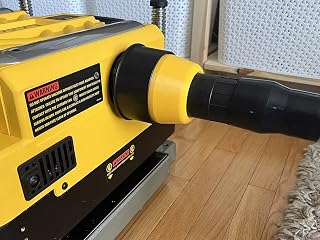
Step 1. Measure the real port diameter. Put a tape across the outside of the chip chute rather than trusting the manual. Benchtop planers usually have a 2-1/2 inch port, often with a 4 inch adapter in the box, and 15 inch machines run 4 inch or 5 inch. Every later decision follows from this number.
Step 2. Match the machine to the port, not to your budget. A 4 inch port means a dust collector. Necking 4 inch down to 2-1/2 inch cuts the opening by about 60 percent, and airflow drops with it.
Step 3. Keep the flex hose short. Aim for 8 to 10 feet or less. Corrugated flex hose has roughly three times the friction loss of smooth wall pipe at the same diameter, and each tight 90 degree bend costs about as much as several feet of straight run. Roll the collector next to the planer instead of stretching a coiled 20 foot hose across the floor.
Step 4. Make the adapter airtight. Hose clamp plus foil HVAC tape, not fabric duct tape, which lets go once chips abrade it. Any leak between the port and the impeller is air the collector pulls instead of chips.
Step 5. Plan for volume before you plane. A 30 gallon drum or a standard lower bag fills faster than beginners expect when you are flattening a stack of 8 foot boards. Empty at about two thirds full, since a packed bag chokes airflow well before it looks full.
Step 6. Test with paper, then with wood. Turn the collector on and run a strip of thin paper around each joint. It should snap flat against a leak. Run a scrap board and watch the hose: chips should keep moving, not pulse.
Step 7. Set the cut to match the airflow. Roughly 1/32 inch per pass in softwood on a benchtop machine, 1/64 inch in wide or figured hardwood, and lighter still on 12 inch panels. Chip load rises with depth times width, so two light passes clear the line when one heavy pass would plug it.
Portable 1-1/2 to 2 HP dust collector with 4 in inlet
This is the class that actually keeps up with a planer. Look for a 4 inch inlet (5 inch if your planer has one), a canister or 1 micron upper filter rather than a 30 micron cloth bag, and casters. Check your circuit first, since a 2 HP collector plus a planer on one 15 amp circuit will trip the breaker.
Sizing hose and duct so chips never settle
Chips stay airborne only above a minimum transport velocity, commonly figured at about 4000 feet per minute in branch lines and 3500 in a main. That is why diameter and airflow have to be considered together. At 4000 FPM, a 4 inch line carries roughly 350 CFM and a 6 inch line roughly 785 CFM. Feed a 6 inch duct with a small collector and velocity falls below the threshold, so shavings drop out and slowly build a plug in the horizontal run.
Two practical rules follow. Keep the largest diameter as close to the collector as you can and reduce only at the machine port, and close every other blast gate before you plane. One open gate on the far side of the shop can pull enough of the total airflow to stall the planer line.
4 inch hose, clamps and blast gate kit
Most disappointing setups are leaks, not weak motors. A kit with the right couplers, clamps and a metal blast gate is cheap insurance, and buying hose in the length you need beats coiling 20 feet behind the machine.
Bags, canisters, and the filter that matters
Chips are the visible problem; the fine fraction is the health problem. A stock 30 micron cloth bag passes a good deal of respirable dust straight back into the room, which is why the upgrade to a 1 micron pleated canister is worth more than extra horsepower for most hobby shops. A canister also holds airflow longer between cleanings because of the added surface area.
Clean or rap the filter when the shavings stop leaving the hose briskly, and wear an N95 while planing dry hardwood no matter what collector you own. Planing releases fine dust from the surface of the board along with the chips, and an ambient air cleaner running for 20 to 30 minutes after you finish handles what settles later.
Common mistakes that ruin a good setup
The frequent ones, roughly in order of how often they show up: leaving the hose at full coiled length instead of trimming it, taping over an obvious gap rather than fitting a proper adapter, running the planer with the collector off for just one pass and then finding roller dents in the stock, forgetting to close other blast gates, and planing green or damp wood, whose heavy chips pack together and clog even a well sized line. One more that is easy to miss: an undersized extension cord starves the collector motor, so plug it into a wall receptacle on its own circuit.
Planer dust collection FAQ
Can I run a planer with only a shop vacuum? On a benchtop machine, with a cyclone separator, light passes and narrow stock, yes. Expect to stop and empty often, and expect clogs at the first elbow if you take a full depth pass in hardwood.
What hose size does my planer need? Use whatever the factory port is, and do not shrink it. That means 4 inch for most 13 inch and larger planers, and 2-1/2 inch only when that is the actual port. Adapting 4 inch down to 2-1/2 inch is the most common cause of a plugged line.
Do I need a cyclone, or is a single stage collector enough? A 1-1/2 to 2 HP single stage with a 1 micron canister handles planer volume well in a hobby shop. A cyclone earns its price when you plane most days, run ducting, or want longer intervals between filter cleanings.
Get the port size, hose length and cut depth right and the rest of this is maintenance. Set the collector beside the machine, seal the joints, empty before the bag looks full, and take two light passes instead of one greedy one.
Check prices on Amazon →