
Key takeaways
- Verify right angles with machinist squares in hardened steel, with beveled edges and sizes for machine setup, layout, and precision woodworking checks.
As an Amazon Associate I earn from qualifying purchases. This post may contain affiliate links at no extra cost to you.
A machinist square is the reference tool a shop trusts when a right angle has to be right, not close. Unlike a carpenter square with a thin rule and a sliding head, a machinist square is a fixed L of ground steel: a blade held at exactly 90 degrees to a heavier stock, with working faces lapped flat so light cannot sneak under the edge. Woodworkers reach for one to set a table saw blade vertical, square a jointer fence, check a miter saw, and test whether a board edge or a freshly assembled box is truly square. Machine setup work that begins with a trustworthy square ends with cuts that meet without gaps.
Disclosure: As an Amazon Associate, I earn from qualifying purchases. Product details were verified at the time of writing.
The five squares below span the useful range for a woodworking and light machining shop: a four-piece set that covers most checks, a small inspection-grade solid square for verifying other tools, a try square with a base that stands on an edge, a compact workshop-grade square for daily setup work, and a wide-seat single square sized for saw and fence checks. Every pick lists its size and its accuracy grade or tolerance figure, because with this tool class the grade is the product.
How to Choose a Machinist Square
Start with the accuracy grade. Two standard systems dominate. DIN 875 grades run 00, 0, 1, and 2, with Grade 0 the tighter inspection grade and Grade 1 the common workshop grade; the figure is a squareness deviation in microns over the blade. BS 939 Grade B is the British workshop grade, typically around 16 microns of squareness. For tuning woodworking machines and checking joinery, DIN 875/1 or BS 939 Grade B is plenty. Reserve DIN 875/0 for verifying other squares and for toolroom-style checks.
Match the size to the work. A 2-inch square fits inside small boxes, checks hand plane soles, and slips into tight machine spaces. A 4-inch square is the everyday size for saw blade and fence checks. A 6-inch square spans wider stock and longer fences. Sets that combine several sizes remove the guesswork, since the right square is the one whose blade covers the surface being tested without hanging off the end.
Choose the form. A solid square is ground from one piece of steel with no joint to shift, which makes it the most stable reference. A try square pairs a thinner blade with a heavier stock or base, so it stands upright on an edge and registers against a face — handy for marking lines across a board edge. A wide-seat design spreads the base for stability on machine tables.
Look at the edges and finish. Beveled or knife edges let you see a hairline of light against the work, which is how tiny errors show up. Ground and lapped working faces matter more than graduations here; most machinist squares carry no scale at all, because they are references, not rulers. Hardened steel holds its geometry through years of shop handling, and a fitted case keeps the edges from getting nicked in a drawer.
The 5 Best Machinist Squares
1. Kinex 4-Piece Solid Machinist Square Set (4026-12-154T) — Best Coverage in One Case

A four-piece set solves the sizing problem in one purchase. This Kinex set covers 2-3/8, 3, 4, and 6 inch blades, so there is a square for small joinery checks, blade setup, and wider stock. Each square is a solid form ground to DIN 875/1 with squareness held within 18 microns, a workshop-grade figure that is honest, published, and tight enough for machine tuning and fine layout. Solid construction means no riveted joint to loosen over time, and the graduated size range makes this the set to buy if you own no machinist square yet.
Specs:
– Sizes: 2-3/8, 3, 4, and 6 in blades (60, 75, 100, and 150 mm)
– Accuracy: DIN 875/1, square within 18 microns (0.0007 in)
– Form: solid one-piece squares, four pieces
– Material: steel, ground working faces
– Best for: a first set that covers layout, setup, and inspection checks
2. Kinex Solid Machinist Square (4026-02-006) — Tightest Tolerance Here
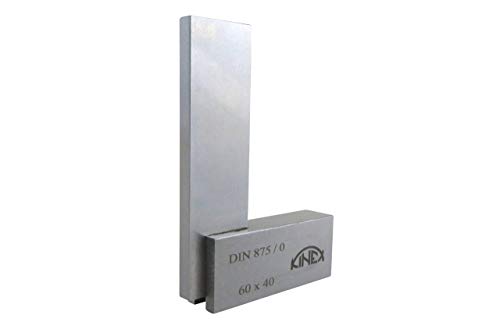
When a square earns its keep by checking other tools, the grade has to step up. This small solid Kinex is built to DIN 875/0 and held within 6 microns of square, the tightest figure in this guide. At 2-3/8 by 1-5/8 inches it is a toolroom-style reference: use it to verify a combination square, confirm a saw blade at 90 degrees, or check the corner of a precision jig. The solid blank has no joint, so the geometry you measure is the geometry the maker ground, and the compact size rides along in an apron pocket or a setup kit.
Specs:
– Size: 2-3/8 x 1-5/8 in (60 x 40 mm)
– Accuracy: DIN 875/0, square within 6 microns (0.0002 in)
– Form: solid one-piece square
– Material: steel, ground and lapped faces
– Best for: verifying other squares and precision setup checks
3. Kinex Try Machinist Square with Base (4034-12-007) — Stands on the Edge

A try square earns its place when the work happens on an edge rather than a flat table. The stock on this Kinex gives the blade a base to stand on, so it registers against the face of a board while the 3-inch blade crosses the edge — the classic posture for marking a line around stock or checking that an edge is square to a face. It is ground to DIN 875/1 and held within 0.0005 inch, squarely in workshop-grade territory, and the base keeps it upright and hands-free during machine fence checks where a flat solid square would tip.
Specs:
– Size: 3 in tall x 2 in wide
– Accuracy: DIN 875/1, square within 0.0005 in
– Form: try square with base stock
– Material: steel, ground working faces
– Best for: edge marking, face-to-edge checks, standing fence checks
4. Groz 01000 2-Inch Precision Steel Square — Compact Workshop Grade

The Groz 01000 is the small square that lives at the machine instead of in a drawer. Its 2-inch blade slips between a saw blade and the table, checks a drill press chuck against the table, and tests small parts and plane irons. Groz builds it with a hardened spring steel blade fixed to the stock, lapped working edges, and a relief groove at the inner corner that clears burrs and dust so the square seats fully. The published figure is 16 microns of squareness to BS 939 Grade B, the long-standing British workshop grade — a documented tolerance rather than a vague promise of precision.
Specs:
– Size: 2 in blade
– Accuracy: BS 939 Grade B, 16 microns squareness (about 0.00063 in)
– Form: blade and stock try form with inner corner relief groove
– Material: hardened spring steel blade, lapped working edges
– Best for: daily machine setup checks in tight spaces
5. PEC Tools Machinist Square, 4 x 3 Inch — Wide Seat for Machine Tables

PEC Tools has made precision layout tools in the USA for decades, and this 4 by 3 inch square follows the wide-seat pattern: a broad base that sits steady on a machine table or a jointer bed while the ground blade rises against a blade, bit, or fence. The blade and seat are ground hardened steel with true 90-degree faces inside and out, so the same tool checks both an outside corner and an inside corner. PEC does not publish a DIN 875 or BS 939 grade for this model, so treat it as a well-made ground shop square rather than a certified reference, and it will serve setup work faithfully.
Specs:
– Size: 4 x 3 in
– Accuracy: precision ground true 90-degree faces, inside and outside; no DIN 875 or BS 939 grade published by the maker
– Form: wide-seat engineer square
– Material: ground hardened steel
– Best for: table saw, jointer, and router table setup checks
Comparison Table
| Product | Size | Accuracy grade / tolerance | Form | Material |
|---|---|---|---|---|
| Kinex 4-Piece Set 4026-12-154T | 2-3/8, 3, 4, 6 in | DIN 875/1, within 18 microns | Solid, 4 pieces | Steel |
| Kinex Solid 4026-02-006 | 2-3/8 x 1-5/8 in | DIN 875/0, within 6 microns | Solid | Steel |
| Kinex Try Square 4034-12-007 | 3 x 2 in | DIN 875/1, within 0.0005 in | Try square with base | Steel |
| Groz 01000 | 2 in | BS 939 Grade B, 16 microns | Blade and stock | Hardened spring steel |
| PEC Tools Wide Seat | 4 x 3 in | Ground true 90 degrees, no grade published | Wide seat | Ground hardened steel |
FAQ
What size machinist square do woodworkers use most?
A 4-inch square handles most saw blade, fence, and joinery checks. A 2-inch square reaches tight spaces, and a 6-inch square spans wider stock, which is why a graduated set is the practical answer for a general shop.
What is the difference between DIN 875/0 and DIN 875/1?
Grade 0 is the tighter inspection grade with a smaller allowed deviation; Grade 1 is the workshop grade. For tuning woodworking machines, Grade 1 is sufficient. Grade 0 suits verifying other squares and reference work.
How do I check whether my square is still square?
Stand it against a straight edge on a flat surface, draw a fine line along the blade, flip the square, and draw a second line from the same point. If the lines stay parallel and together, the square is true. Any split that widens toward the top shows the error doubled.
Can a machinist square replace a combination square?
They do different jobs. A combination square measures, marks depths, and slides along stock. A machinist square is a fixed reference with tighter, published geometry. Most precision-minded shops own both and reach for the machinist square when verifying rather than measuring.
How should I store a machinist square?
Keep it in its case or a padded drawer slot, wipe it clean after use, and avoid tossing it in with edged tools. A nick on a working edge or a drop onto concrete can end its career as a reference, even if it still looks fine.
Verdict
Buy the Kinex four-piece set if you want one purchase that covers nearly every check in a woodworking shop, with a published DIN 875/1 figure behind it. Add the Kinex DIN 875/0 solid square when you need a small reference tight enough to judge other tools. The Kinex try square suits edge work, the Groz 01000 is the compact daily driver for machine setup, and the PEC wide-seat square anchors saw and jointer checks with a steady base. Whichever you choose, the habit matters more than the brand: verify the setup with a real reference before the cut, and the joinery takes care of itself.
Related guides
More from Amazon
Programs that pair well with the guide above. Offers and eligibility are set by Amazon and may change.
A free business account with business pricing and bulk-buying tools for work, shop or home office.
Create a business accountFree shipping on eligible items, Prime Video and more. Eligible new members can start with a free trial.
Start a Prime free trialAudiobooks and podcasts to listen to on the go. Eligible new members can start with a free trial.
Try Audible freeAd-free music streaming. Eligible new subscribers can start with a free trial.
Try Music Unlimited freeAs an Amazon Associate we earn from qualifying purchases.








