
Our Top Picks


As an Amazon Associate I earn from qualifying purchases. This post may contain affiliate links at no extra cost to you.
A palm nailer solves the one problem a hammer and a framing gun both struggle with: driving a nail where there is no room to swing and no space for a full-size tool body. These compact pneumatic drivers sit in the palm of your hand, take loose bulk nails one at a time, and hammer them home with rapid air-powered impacts. They earn their keep on joist hangers, hurricane ties, deck hardware, fence pickets, and the tight stud bays where a framing nailer simply will not fit.
Because the tool is small, the differences between models come down to details: how long a nail it can drive, how the nail is held in the nose, how much the grip isolates your hand from vibration, and how the air fitting behaves when the hose drags across a joist. This guide explains those details, then compares five proven palm nailers for woodworking, framing, and deck work.
Disclosure: As an Amazon Associate, I earn from qualifying purchases. Product details were verified at the time of writing.
How to Choose a Palm Nailer
Nail Range
Most mini palm nailers drive loose bulk nails from about 2 inches up to 3-1/2 inches, which covers common framing nails, joist hanger nails, and the shorter connector nails used in metal hardware. If you regularly set longer spikes or timber nails, check the stated maximum length before buying, because a mini body runs out of driving force sooner than a full-size impact nailer. Match the range to the fasteners you actually use, and remember that hardened connector nails for joist hangers are shorter but thicker, so driving power matters as much as length.
Feed and Magazine Type
Nearly every palm nailer is a single-shot tool: there is no strip magazine, and you drop one loose nail into the nose at a time. A magnetic nose is close to essential, since it holds the nail steady while you position the tool with one hand, which is the whole point when you are wedged between joists. A few larger metal-connector nailers do feed collated strips from a small magazine, but for general framing and deck hardware the single-shot magnetic nose is faster to load, never jams on a broken strip, and accepts any bulk nail that fits the bore.
Size and Weight
These tools weigh roughly one to one and a half pounds and measure only a few inches across. That compact size is what lets them work inside 12-inch joist cavities, between deck boards and beams, and inside cabinet carcasses. Smaller is not automatically better, though: a very light body transmits more of each impact back into your hand. If you plan to drive hundreds of nails in a day, a slightly heavier tool with a fuller grip can be easier to live with.
Grip and Vibration Control
A palm nailer fires dozens of impacts per nail, and all of that energy passes through your palm. Look for an over-molded rubber grip, which insulates against both vibration and the chill of exhaust air. A front exhaust that directs air away from your hand and face also matters during overhead work. Some models add a leather glove or cushioned sleeve in the box, and a 360-degree swivel air fitting keeps the hose from twisting the tool out of position in tight bays.
The 5 Best Palm Nailers
1. Bostitch PN50 Mini Impact Nailer
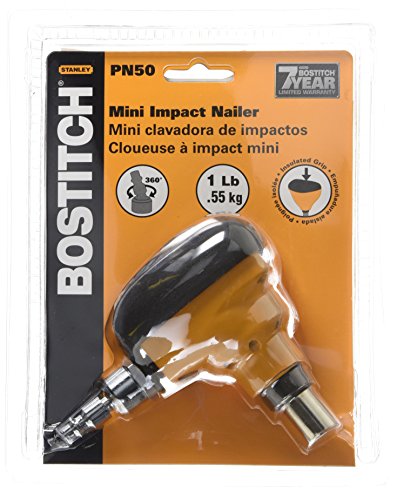
The PN50 is the tool most carpenters picture when they think of a palm nailer. It is a single-shot mini impact nailer with a rubber grip that insulates your hand from vibration and from the cold air the tool exhausts as it works. The 360-degree swivel air fitting is a genuine advantage in joist bays, because the hose can approach from any angle without levering the nose off the nail head. It drives common bulk finish, framing, and timber nails, and its front exhaust keeps dust and air out of your face on overhead work. Bostitch backs it with a long limited warranty, which reflects how simple and durable the mechanism is. It needs a few drops of air tool oil daily, but that is the only real upkeep.
Specs:
- Power source: Pneumatic
- Fastener type: Loose bulk nails, single shot
- Nail length range: Up to 3-1/2 in
- Operating pressure: 80 to 100 PSI
- Air fitting: 360-degree swivel, 1/4 in
- Grip: Rubber insulated
- Exhaust: Front
- Weight: About 1 lb
2. Metabo HPT NH90AB Palm Nailer
The NH90AB is a pro-focused palm nailer built specifically around metal connector work. Its magnetic nose holds each nail securely for precise placement in joist hanger holes, and it is sized for the 2-1/2 inch to 3-1/2 inch bulk fasteners that framing and connector jobs use most. The over-molded rubber grip keeps vibration down, and the 360-degree swivel plug gives the hose freedom to move as you shift between bays. At just over a pound, it is easy to carry on a belt or in a pouch all day. Metabo HPT covers it with a five-year warranty, and the tool accepts most common bulk nails, including finish, framing, and timber nails.
Specs:
- Power source: Pneumatic
- Fastener type: Loose bulk nails, single shot
- Nail length range: 2-1/2 in to 3-1/2 in
- Operating pressure: 80 to 100 PSI
- Air fitting: 360-degree swivel plug, 1/4 in
- Nose: Magnetic
- Grip: Over-molded rubber
- Weight: 1.3 lb
3. Freeman G2MPN 2nd Generation Mini Palm Nailer
The second-generation Freeman G2MPN refines the budget palm nailer formula with a one-piece hardened steel drive blade that stands up better to knots and off-center hits. It drives nails from 6D to 16D, so it covers everything from hanger nails to full 3-1/2 inch framing nails. The magnetic tip holds the nail while you line up the shot, the rubber overmold keeps the grip secure and softens vibration, and the tool ships with the 1/4 inch NPT air connector in the box, so it is ready to hook up. In practice it likes a little more air for framing nails, running best around 95 PSI, while smaller nails drive happily at lower pressure. For deck work and general framing, it is a capable, easy-handling pick.
Specs:
- Power source: Pneumatic
- Fastener type: Loose bulk nails, single shot
- Nail range: 6D to 16D (2 in to 3-1/2 in)
- Operating pressure: 70 to 110 PSI
- Air inlet: 1/4 in NPT, connector included
- Nose: Magnetic tip
- Drive blade: One-piece hardened steel
- Weight: 1.38 lb
4. Grip-Rite GRTMP16 Mini Palm Nailer

Grip-Rite built the GRTMP16 around one job: driving 16D nails up to 3-1/2 inches long in places a framing gun cannot reach. It is about a third of the size and weight of traditional palm nailers, so it disappears into a tool pouch and works comfortably overhead. The magnetic nose holds fasteners in place while you position the tool, and the working pressure range of 70 to 110 PSI means it runs happily off small jobsite compressors. The compact body, roughly 2.8 by 4 by 2.2 inches, slips into narrow joist spaces and between deck framing members where bigger tools bind up. For medium-duty framing, deck hardware, and repair work, it is a tidy, purpose-built option.
Specs:
- Power source: Pneumatic
- Fastener type: Loose bulk nails, single shot
- Nail length range: Up to 3-1/2 in (16D)
- Operating pressure: 70 to 110 PSI
- Nose: Magnetic
- Body: Compact die-cast
- Dimensions: About 2.8 x 4 x 2.2 in
- Weight: About 1.3 lb
5. 3PLUS HMPN50SP Mini Palm Nailer
The HMPN50SP is a straightforward mini palm nailer with a die-cast aluminum body that keeps it light enough for overhead and ladder work. It drives most common bulk nails up to 3-1/2 inches, and a magnetic nail holder keeps each fastener seated while you get the tool into position, which helps when you are working one-handed between joists. The front exhaust directs air away from the work surface and your hand. It covers the everyday list of palm nailer jobs well: joist hangers, decking, fencing, and framing touch-ups where a full-size gun will not fit. Like every tool here it needs an air compressor, but it asks for nothing exotic in return.
Specs:
- Power source: Pneumatic
- Fastener type: Loose bulk nails, single shot
- Nail length range: Up to 3-1/2 in
- Operating pressure: 70 to 100 PSI
- Nose: Magnetic nail holder
- Body: Die-cast aluminum
- Exhaust: Front
- Air inlet: 1/4 in NPT
Comparison Table
| Model | Nail Range | Nose | Operating Pressure | Weight |
|---|---|---|---|---|
| Bostitch PN50 | Up to 3-1/2 in | Standard, swivel fitting | 80-100 PSI | About 1 lb |
| Metabo HPT NH90AB | 2-1/2 to 3-1/2 in | Magnetic | 80-100 PSI | 1.3 lb |
| Freeman G2MPN | 2 to 3-1/2 in (6D-16D) | Magnetic | 70-110 PSI | 1.38 lb |
| Grip-Rite GRTMP16 | Up to 3-1/2 in (16D) | Magnetic | 70-110 PSI | About 1.3 lb |
| 3PLUS HMPN50SP | Up to 3-1/2 in | Magnetic | 70-100 PSI | Compact aluminum body |
FAQ
What size compressor does a palm nailer need?
Not much. Palm nailers sip air compared with framing guns, so a small pancake compressor keeps up easily. What matters more is pressure: most models work between 70 and 110 PSI, and thicker connector nails drive best near the top of that range.
Can a palm nailer drive joist hanger nails?
Yes, that is one of its main jobs. The magnetic nose holds the short, thick connector nail while you aim it into the hanger hole, and the compact body fits between joists where a positive placement nailer or hammer cannot swing.
Do palm nailers use nail strips or coils?
No. With rare exceptions, palm nailers are single-shot tools that take loose bulk nails one at a time. That sounds slow, but loading is instant, there is nothing to jam, and any bulk nail that fits the nose will work.
How do I keep a palm nailer running well?
Add a few drops of pneumatic tool oil each day you use it, drain your compressor tank regularly, and keep the nose magnet clean of metal filings. That is nearly all the maintenance these simple tools ask for.
Verdict
For most woodworkers and framers, the Bostitch PN50 is the safe first choice: it is the lightest tool here, the swivel fitting genuinely helps in tight bays, and the design has been proven over years of jobsite use. If your work centers on joist hangers and metal connectors, the Metabo HPT NH90AB is the specialist pick, with a magnetic nose and a size range matched to connector nails. The Freeman G2MPN and Grip-Rite GRTMP16 both drive full 16D nails while staying compact and easy on the hand, and the 3PLUS HMPN50SP covers the same ground in a light aluminum body. Whichever you choose, pair it with a short, flexible hose and keep the pressure near the top of the range for thick connector nails.
Related guides
More from Amazon
Programs that pair well with the guide above. Offers and eligibility are set by Amazon and may change.
A free business account with business pricing and bulk-buying tools for work, shop or home office.
Create a business accountFree shipping on eligible items, Prime Video and more. Eligible new members can start with a free trial.
Start a Prime free trialAudiobooks and podcasts to listen to on the go. Eligible new members can start with a free trial.
Try Audible freeAd-free music streaming. Eligible new subscribers can start with a free trial.
Try Music Unlimited freeAs an Amazon Associate we earn from qualifying purchases.








