
Key takeaways
- Compare the best wood stabilizer picks with deep vacuum resin, heat-cure formulas, and thin mixes that keep soft turning blanks solid and crack free.
What's inside
- How to Choose the Best Wood Stabilizer
- 1. TurnTex Cactus Juice Stabilizing Resin, 1 Quart
- 2. TurnTex Cactus Juice Stabilizing Resin, 1/2 Gallon
- 3. TurnTex Cactus Juice Stabilizing Resin, 1 Gallon
- 4. Preservation Solutions Pentacryl, 1 Quart
- 5. Preservation Solutions Wood Juice, 1 Quart
- Comparison Table
- FAQ
- Verdict
As an Amazon Associate I earn from qualifying purchases. This post may contain affiliate links at no extra cost to you.
A turning blank fails at one of two moments. Soft, punky, or spalted wood that looked beautiful on the shelf tears out and crumbles the first time a gouge touches it, because the fibers themselves have gone weak. Green wood fails earlier and slower: a fresh-cut bowl blank or cookie dries unevenly, the cells shrink and collapse, and the piece checks, splits, or warps before it ever reaches the lathe. A wood stabilizer answers both failures, but with two different chemistries. Thin heat-cure resins are pulled through dry blanks under vacuum and then hardened with heat, turning soft wood into a solid, turnable block. Soak stabilizers go into wood that is still drying, displacing water and coating the cell walls so the blank dries without cracking. The five picks below cover both families, and each one is labeled by the stage of the blank it is built for.
Disclosure: As an Amazon Associate, I earn from qualifying purchases. Product details were verified at the time of writing.
This guide stays on the stabilizer shelf, and two neighbors deserve a clear boundary. Epoxy resin — the casting and coating family used for river tables and flood coats — is a thick pour product that fills voids on and in a slab; it is not a stabilizer, and none of its picks appear here. A stabilizing resin is water-thin on purpose: it travels through the wood itself, cell by cell, and it will not fill a crack or a hole. Brush-on wood hardeners are the other neighbor — thin consolidants made to firm up rotted repair wood at the surface of a sill or jamb. A stabilizer does a different job: it saturates the whole blank, not just the face you can reach with a brush. Three of the picks are one flagship vacuum resin in three sizes, which is an honest picture of this shelf — the vacuum resin market for home shops runs through a single maker, and the real decision is which size and which activation style fits your bench. The other two picks are soak stabilizers for green and semi-dry wood, the blanks a vacuum resin cannot help yet.
Contents
- How to Choose the Best Wood Stabilizer
- 1. TurnTex Cactus Juice Stabilizing Resin, 1 Quart
- 2. TurnTex Cactus Juice Stabilizing Resin, 1/2 Gallon
- 3. TurnTex Cactus Juice Stabilizing Resin, 1 Gallon
- 4. Preservation Solutions Pentacryl, 1 Quart
- 5. Preservation Solutions Wood Juice, 1 Quart
- Comparison Table
- FAQ
- Verdict
How to Choose the Best Wood Stabilizer
Moisture decides the family before anything else does. Vacuum heat-cure resin only works on dry wood. The maker of the flagship resin in this guide puts the ceiling at 10 percent moisture and prefers blanks dried to zero, because any water left in the cells blocks the resin from taking its place and the cure suffers. Green wood fresh off the saw — above roughly 25 to 30 percent moisture — belongs to the soak family: a green wood stabilizer displaces the water as the blank dries and keeps the cells from collapsing. Semi-dry wood in between, partly air-dried and under about 30 percent, has its own soak formula. Picking the wrong family for your moisture level is the most common way a stabilization run fails, and no technique fixes it afterward.
Dry blanks for vacuum work, and dry them on purpose. Air-dried blanks that feel dry to the hand still hold moisture deep in the blank. The standard preparation is a long bake in the shop oven — around 220 degrees F for at least a full day for air-dried stock — then letting the blanks cool completely before they meet resin. Warm wood in cold resin can start the cure early and ruin the batch. Weigh a blank before and after if you want proof it has stopped losing water. Do not oven-dry green wood this way; fresh-cut wood needs months of air drying first, or the soak treatment below, or it will crack in the heat.
Follow the vacuum chamber directions from the maker, step for step. The working method for heat-cure resin is consistent: blanks go in the chamber weighted down so they cannot float, resin covers them fully, and the pump pulls a deep vacuum — the resin maker calls for a pump able to reach at least 29 inches of mercury — and keeps running until the stream of bubbles from the wood stops, which can take hours. Release the vacuum and let the blanks soak in the resin for at least twice as long as they spent under vacuum, keeping them submerged the whole time so air cannot creep back in. Keep resin out of the pump: work at the pace the chamber maker directs, and never leave a running vacuum setup unwatched.
Cure with heat in a dedicated shop oven — never the kitchen oven. Heat-cure resin sets when the core of the blank reaches its cure temperature and holds it briefly; in a small shop that means a countertop toaster oven kept in the shop for this work alone, holding roughly 190 to 200 degrees F until the resin has solidified, usually an hour to an hour and a half for a small batch of blanks. Say it plainly: the oven that cures resin is not the oven that cooks food, and the two never swap jobs. Wrap blanks in foil or set them on a drip pan, leave space between pieces so they do not cure stuck together, and let them cool to room temperature before unwrapping.
Handle every resin here with gloves, eye protection, and moving air. Wear nitrile or latex gloves and eye protection whenever you pour, mix activator, or pull blanks out of a chamber. Work with ventilation — an open door and a fan moving air out of the shop — and keep uncured resin below the maker’s storage temperature, out of sunlight. Follow the maker’s storage rules for leftovers: the flagship resin maker warns against storing excess resin in glass or PET plastic containers, and activated resin has a shelf life, so date the jug when you mix it.
Size is a shelf-life decision, not just a volume decision. Small sizes of the flagship resin ship already activated, which makes them the easy first purchase and starts a clock of about twelve months once the jug is open and stored cool. The larger sizes ship unactivated, with the activator in a separate bottle: the unactivated shelf life stretches to about three years, and the twelve-month clock starts only when you mix the whole jug — the maker is firm that you activate the entire container, never a portion. Buy the size your real batch pace will finish within that window.
1. TurnTex Cactus Juice Stabilizing Resin, 1 Quart

This is the resin the home stabilizing method was built around, in the size most turners should start with. Cactus Juice is a heat-cured methacrylate resin thin enough to pull through punky, spalted, and soft blanks under vacuum, and it cures to a hard, translucent solid inside the wood rather than a film on top of it. The quart ships already activated, so there is nothing to mix: dry your blanks fully, load the chamber, pull vacuum until the bubbling stops, soak, then cure in the shop oven. It takes dye well — the maker points to Alumilite dyes and its own stabilizing dyes — which makes the quart the natural first jug for pen blanks, bottle stoppers, and small bowl blanks where you want to learn the process and maybe run a colored batch. Keep the jug below 85 degrees F, as an activated resin asks for cool storage. Choose the quart when your batches are small and you want the genuine article without committing to a larger jug on a clock.
Specs
- Type: Heat-cure stabilizing resin for vacuum impregnation
- Composition: Methacrylate ester monomers
- Size: 1 quart (946 mL), pre-activated
- Viscosity: 4–6 cps at 25 degrees C
- Cured hardness: Shore D 80–85 per maker data
- Cure: 190–200 degrees F in a shop oven until solid
- Blank moisture: 10 percent or less, zero preferred
- Storage: Keep below 85 degrees F once activated
2. TurnTex Cactus Juice Stabilizing Resin, 1/2 Gallon
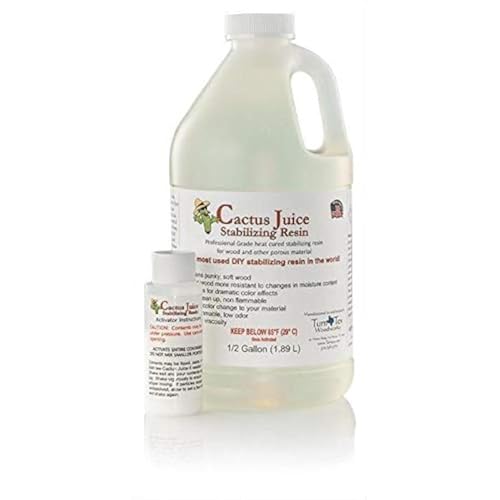
The half gallon is the same resin as the quart pick, sized for turners who stabilize on a regular rhythm — a chamber load of bowl blanks or a run of knife scales most weeks. The meaningful difference is how it ships: this size comes unactivated, with the activator in its own small bottle. That single detail changes the buying math. Unactivated, the jug keeps for about three years on the shelf; once you mix the activator through the whole container, the roughly twelve-month working life begins. So the half gallon suits a shop that will genuinely work through it in a season of steady batches, and it stores patiently until that season starts. The process is identical to the quart — bone-dry blanks, full vacuum until the bubbles quit, a soak at least twice the vacuum time, then the foil-and-toaster-oven cure. Choose this size when the quart started feeling small but a gallon would sit open too long.
Specs
- Type: Heat-cure stabilizing resin for vacuum impregnation
- Composition: Methacrylate ester monomers
- Size: 1/2 gallon (1.89 L), ships unactivated
- Activator: Included in a separate bottle; activate the full jug
- Viscosity: 4–6 cps at 25 degrees C
- Cured hardness: Shore D 80–85 per maker data
- Cure: 190–200 degrees F in a shop oven until solid
- Shelf life: About 3 years unactivated; about 12 months once activated
3. TurnTex Cactus Juice Stabilizing Resin, 1 Gallon
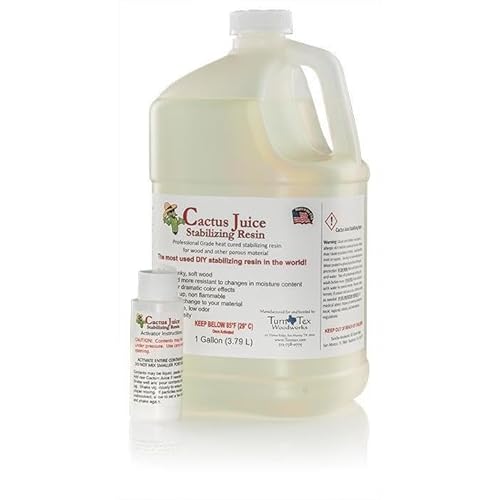
The gallon is the volume buy of the same flagship resin, for shops that stabilize in real quantity — club benches, sellers of stabilized blanks, and turners working through a stack of spalted maple or burl in one campaign. It ships unactivated with the activator included, under the maker’s part number CJ128, so the shelf-life logic of the half gallon applies at double the scale: years of patience unopened, about twelve months of working life once the full jug is activated. A gallon also fills a mid-size chamber properly, which matters more than it sounds — blanks must stay fully submerged from the moment vacuum is released until the soak ends, and running short mid-run means air back in the wood and a failed batch. The resin itself is unchanged: water-thin, dye-friendly, and cured by heat after the vacuum and soak steps. Choose the gallon when your chamber and your blank pile are both big enough that smaller jugs became the bottleneck.
Specs
- Type: Heat-cure stabilizing resin for vacuum impregnation
- Composition: Methacrylate ester monomers
- Size: 1 gallon (128 fl oz), ships unactivated
- Activator: Included; activate the full jug before first use
- Maker part number: CJ128
- Cured hardness: Shore D 80–85 per maker data
- Cure: 190–200 degrees F in a shop oven until solid
- Shelf life: About 3 years unactivated; about 12 months once activated
4. Preservation Solutions Pentacryl, 1 Quart

Pentacryl works the other end of the blank’s life: green wood, treated before drying instead of after. It is a compound of modified polymers formulated for fresh-cut wood above roughly 25 to 30 percent moisture. Soaked or brushed into a green blank, it displaces the water inside the cells and leaves a thin coating on the cell walls, so as the wood dries the cells hold their shape instead of shrinking and collapsing — the collapse is what tears a drying cookie or bowl blank into checks and splits. There is no chamber and no oven cure: soak the piece about 24 hours per inch of thickness, longer for thick turning blanks, or brush repeated coats onto pieces too large to immerse, with extra coats on the end grain where most of the liquid enters. Then dry the wood slowly and evenly, out of direct sun and moving air. The maker is equally clear about the limit: this is not the product for rotted or spalted wood, which drinks it like a sponge and blocks drying. Choose Pentacryl when your blanks start as fresh logs and your enemy is the crack that shows up during seasoning.
Specs
- Type: Green wood stabilizer, soak or brush application
- Composition: Modified polymers; no silicone, wax, or mineral oil
- Size: 1 quart (32 fl oz)
- Moisture target: Green wood above 25–30 percent moisture
- Soak time: About 24 hours per inch of thickness; 36 hours per inch for thick blanks
- Cure: None; the blank air-dries slowly after treatment
- Cleanup: Soap and water
- Note: Not intended for rotted or spalted wood
5. Preservation Solutions Wood Juice, 1 Quart

Wood Juice is Pentacryl’s sibling for the middle of the moisture range — wood that has already air-dried partway and sits below about 30 percent moisture, the semi-dry band where a blank is no longer green but is still moving. The maker’s own rule of thumb draws the line plainly: wetter wood gets the green wood formula, wood under that line gets this one. Like its sibling, it is a modified polymer compound that saturates the wood, displaces the remaining water, and coats the cell walls so the rest of the drying happens without the shrinkage that opens cracks. It goes on by soaking or brushing, undiluted, and it suits the pieces turners actually lose at this stage: thin-wall bowls roughed out and set aside, small blanks, and thin cuts where much of the drying tension is still locked in. Treated wood can be sanded, stained, glued, and finished normally once dry. Choose Wood Juice when your stock is part-seasoned — too dry for the green wood treatment, not yet dry enough for vacuum resin.
Specs
- Type: Semi-dry wood stabilizer, soak or brush application
- Composition: Modified polymers; no silicone, wax, or mineral oil
- Size: 1 quart (32 fl oz)
- Moisture target: Dry to semi-dry wood, under about 30 percent moisture
- Application: Soak or brush on; do not dilute
- Maker model: PSWwjuic32
- Cleanup: Soap and water
- Extras: Contains a UV protectant per maker literature
Comparison Table
| Pick | Family | Blank stage | Method | Best for |
|---|---|---|---|---|
| Cactus Juice, Quart | Heat-cure vacuum resin | Fully dry, 10 percent moisture or less | Vacuum, soak, oven cure | First jug; pen blanks and small batches |
| Cactus Juice, 1/2 Gallon | Heat-cure vacuum resin | Fully dry, 10 percent moisture or less | Vacuum, soak, oven cure | Regular batches on a steady rhythm |
| Cactus Juice, 1 Gallon | Heat-cure vacuum resin | Fully dry, 10 percent moisture or less | Vacuum, soak, oven cure | Volume work and larger chambers |
| Pentacryl, Quart | Soak stabilizer | Green, above 25–30 percent moisture | Soak or brush, then slow air drying | Fresh-cut blanks, cookies, and bowl rounds |
| Wood Juice, Quart | Soak stabilizer | Semi-dry, under about 30 percent moisture | Soak or brush, then slow air drying | Part-seasoned blanks and thin-wall rough turnings |
FAQ
Can I stabilize a green blank with Cactus Juice if I just leave it under vacuum longer?
No. Vacuum resin needs the cells empty, and green wood’s cells are full of water. The resin cannot take the water’s place, uptake stays shallow, and the cure comes out soft or patchy. Green wood is the soak family’s job first: treat it with a green wood stabilizer, let it dry fully, and only then, if the wood is soft or punky, does a vacuum resin run make sense.
Which size of Cactus Juice should a first-time buyer get?
The quart. It ships pre-activated, so the process you learn is the pure process — dry, vacuum, soak, cure — with no mixing step. If stabilizing becomes a habit, move up a size; the larger jugs ship unactivated and keep for years on the shelf, but once activated they carry about a twelve-month working life, so size the jug to the pace you will actually use it.
Can I cure stabilized blanks in my kitchen oven?
No. Cure resin in a dedicated shop oven — an inexpensive countertop toaster oven that lives in the shop and never touches food. The kitchen oven is for cooking, and resin curing does not belong in it. Foil-wrap the blanks or use a drip pan, hold the temperature the maker specifies, and let everything cool before handling.
Will a stabilizing resin fill the crack that is already in my blank?
No, and expecting it to is the most common misunderstanding on this shelf. Stabilizing resin fortifies the wood itself by replacing air inside the cells; it does not bridge gaps, fill voids, or glue a split shut. Filling a crack or a void is a casting epoxy job, a different product family. Stabilize first for strength, then fill separately if the design calls for it.
How long do I soak blanks after the vacuum comes off?
At least twice as long as they spent under vacuum, per the resin maker’s directions, and keep them submerged the whole time. The soak is when the resin actually moves in: with the air gone, the wood draws resin deep as it sits. Topping the level up as it drops is normal — a blank that breaks the surface mid-soak pulls air back in and has to start over.
My spalted blank is soft but fully dry. Which family does it belong to?
The vacuum resin family. Spalted and punky wood that has finished drying is exactly what heat-cure stabilizing resin exists for — the thin resin soaks the weakened fibers and cures hard inside them. Note the boundary on the other side: the green wood soak stabilizer in this guide is explicitly not made for rotted or spalted wood, so keep the two families on their own sides of the moisture line.
Verdict
Match the product to the blank’s stage, and the rest is process. For dry, soft, or spalted wood, the vacuum resin picks do the heavy work of this guide: start with the quart to learn the method, step up to the half gallon when batches become routine, and take the gallon when chamber size and blank volume demand it — the resin is the same, and the choice is really about activation timing and shelf life. For wood that is still drying, skip the chamber entirely: the green wood quart treats fresh-cut blanks before cracks form, and its semi-dry sibling carries part-seasoned stock through the rest of drying. Whichever family you open, the results are decided by discipline — blanks at the right moisture, vacuum held until the bubbles stop, a full soak, heat cure in a shop oven that never cooks food, and gloves and moving air every time resin is poured.
Related guides
More from Amazon
Programs that pair well with the guide above. Offers and eligibility are set by Amazon and may change.
A free business account with business pricing and bulk-buying tools for work, shop or home office.
Create a business accountFree shipping on eligible items, Prime Video and more. Eligible new members can start with a free trial.
Start a Prime free trialAudiobooks and podcasts to listen to on the go. Eligible new members can start with a free trial.
Try Audible freeAd-free music streaming. Eligible new subscribers can start with a free trial.
Try Music Unlimited freeAs an Amazon Associate we earn from qualifying purchases.








