What's inside
As an Amazon Associate I earn from qualifying purchases. This post may contain affiliate links at no extra cost to you.
If you are gluing up 5 to 7 boards for a dining or coffee table top, alignment is the whole battle. A lip of even 1/64″ between boards means a lot of scraping and sanding, and on wide hardwoods that can quickly turn into a wavy top. Both biscuit joiners and doweling jigs promise to keep boards flush during glue-up, but they do it in very different ways and the trade-offs matter more than the marketing suggests.
As an Amazon Associate we earn from qualifying purchases at no extra cost to you.



Contents
What Each Tool Actually Does
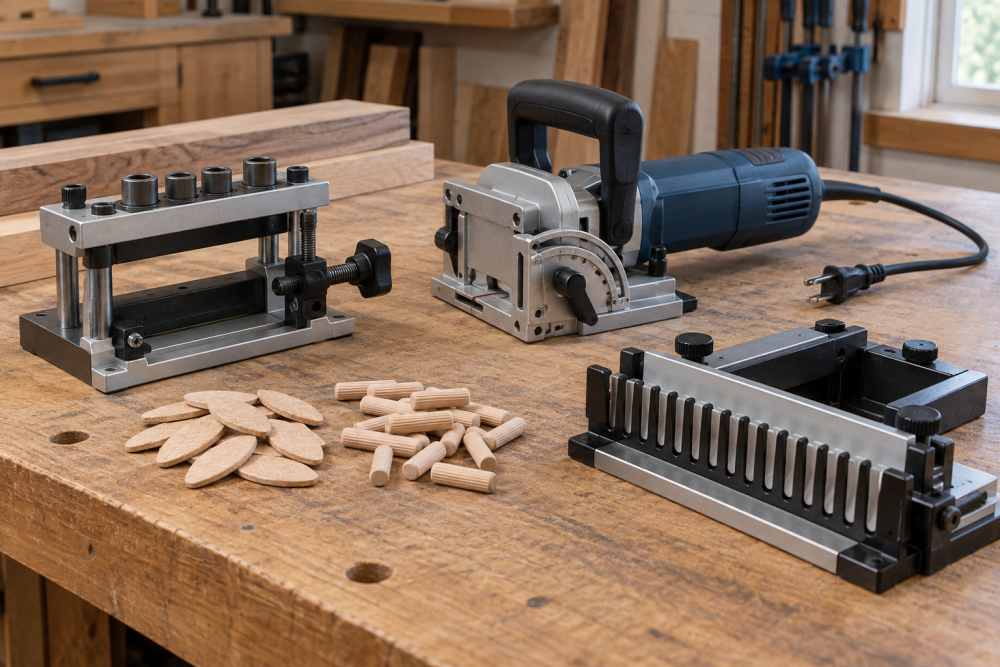
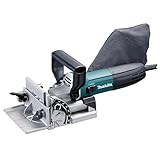
A biscuit joiner cuts a shallow crescent slot in both board edges with a 4-inch carbide blade. You add glue, slip in a compressed beech biscuit (usually a #20, which is about 56 x 23 x 4mm), and clamp. The biscuit swells from the moisture in the glue and locks the joint from shifting up and down while you tighten clamps.
A doweling jig drills precise, matching holes in both edges for wood dowels. Most woodworkers use 6mm, 8mm or 10mm fluted dowels for tabletops. A self-centering doweling jig clamps on the board edge and uses hardened steel bushings to guide a standard drill bit so the holes line up perfectly across the joint. Unlike biscuits, dowels stay tight for the life of the piece and add a bit of mechanical registration along the entire length of the joint.
Neither method is primarily about strength. In a properly glued edge joint with modern PVA or hide glue, the long-grain to long-grain glue bond is stronger than the wood itself. Biscuits and dowels are alignment aids first, reinforcement second.
Alignment Accuracy In The Real World
This is where the tools diverge. A biscuit has deliberate slop. The slot is about 4mm wide and the biscuit is 3.8-4mm thick, with extra room side-to-side so you can nudge boards for flush alignment after clamping. That slop is forgiving but it also means a biscuit will not prevent a board from creeping lengthwise if your clamping pressure is uneven. Expect to hold vertical alignment within about +/- 0.010″ to 0.015″ if your reference faces were flat against the joiner fence.
Dowels have almost no slop when drilled correctly. A tight 8mm dowel in an 8mm hole gives you vertical and lateral registration within +/- 0.005″ or better, which is why cabinetmakers who need panel glue-ups to come out dead flat with minimal sanding often prefer them. The cost of that precision is that there is no fudging. If your jig slips 1/32″ or you drill at a slight angle, the boards will not close or they will pull into a misaligned position and you will have to force them or re-drill.
Failure modes are different too. With biscuits, the most common error is cutting slots with sawdust in the fence or not holding the tool flat, which tilts the slot. The biscuit will still fit but the boards will rock. With dowels, the common failures are drill blowout on the exit side of the hole if you do not back up the cut, and glue starvation or hydraulic lock if you over-glue a tight dowel hole without flutes or a relief groove. Both cause joints that will not close fully.
Strength and Wood Movement: Does It Matter For A Tabletop?
For a 3/4″ to 1″ thick tabletop, neither biscuits nor dowels are needed to prevent the top from breaking along the glue line. Break a test glue-up and the wood will fail before the glue does. Where dowels do help is with thin or short boards and with keeping alignment during seasonal movement. A 40-inch wide solid wood top can move 1/4″ to 3/8″ across the grain seasonally depending on species and humidity. Biscuits swell and then shrink back and over a few years can even telegraph slightly as small ovals on a very flat, finished surface if the slots were cut too close to the face (less than 1/8″ of wood above the slot on 3/4″ stock). Dowels do not swell the same way and do not telegraph.
In practice, if your boards are 4″ to 7″ wide, jointed straight, and you alternate growth rings, a well-clamped glue joint alone will stay flat. Biscuits and dowels just reduce the amount of post-glue-up leveling. If you have a drum sander or wide-belt sander available, that matters less. If you are flattening with a random orbit sander or hand plane, it matters a lot.
Speed, Setup, and Learning Curve
A biscuit joiner is significantly faster on long tabletops. Mark biscuit centers every 6 to 10 inches, set the fence to center on your stock thickness (usually about 3/8″ up from the face on 3/4″ material), and plunge. You can cut 30 slots for a 6-board top in under 10 minutes. Dust collection helps but even without it cleanup is quick. Beginners get usable results on their second or third test joint.
Doweling is slower and more methodical. You need to mark centers precisely, clamp the jig, drill to a consistent depth with a depth stop, and repeat on the mating board. For that same 6-board top with dowels every 8 to 10 inches, expect 45 to 75 minutes of careful layout and drilling, plus time to dry-fit every joint before glue. A doweling jig kit with 6mm, 8mm, and 10mm bushings is cheap, but a good self-centering version that does not slip saves hours of frustration. Using a cordless drill freehand without a jig is not accurate enough for panel alignment.
Both tools need dry-fitting. With biscuits you can dry-fit without glue because the biscuit fits loose until it swells. With dowels you should use dry dowels or undersized test dowels for the dry fit, otherwise you may not get the joint apart again.
Cost, Tool Versatility, and Shop Space
A decent entry biscuit joiner costs $120 to $220 and comes with a dust bag and fence. Biscuits themselves cost pennies each, about $10 to $15 for a jar of 100 #20 biscuits. It does one thing very well and also handles miter alignment for boxes, face frames, and attaching solid wood edging to plywood.
A doweling jig costs $25 to $80 for a self-centering jig with bushings, plus $8 to $12 for a bag of fluted dowels and a set of brad point bits if you do not own them. In other words, you can be fully set up for $50 to $90. Beyond tabletops, the same jig is useful for strong butt joints in carcasses, shelves, and leg-to-apron joints where a biscuit would be too weak. It stores in a drawer, while a biscuit joiner is another bulky tool to keep.
| Feature | Biscuit Joiner | Doweling Jig |
|---|---|---|
| Alignment Precision | Good, ~0.010-0.015″ vertical. Forgiving side-to-side slop. | Excellent, ~0.005″ when jig is clamped tight. No slop. |
| Speed for 6-Board Top | 8-12 minutes to cut all slots | 45-75 minutes to mark and drill |
| Skill Floor | Low. Easy to get flat if fence is clean. | Moderate. Layout and perpendicular drilling must be exact. |
| Joint Telegraphed Over Time | Possible if slot is too shallow | Rare |
| Upfront Cost | $120-$220 for tool | $25-$80 for jig + bits |
| Best For | Large panel glue-ups where speed and forgiveness matter | Maximum flatness, small shops, and joints that also need strength |
Which Should You Buy For Tabletop Glue-Ups?
Buy a biscuit joiner if you build large panels a few times a year and value speed and forgiveness. It is especially useful for 5-foot plus glue-ups where clamping a long top alone makes boards want to slip. Keep the fence and base free of pitch, cut test slots in scrap set to the same thickness, and place biscuits 2 inches from each end and every 6 to 8 inches in between. Do not place a biscuit closer than 3 inches to where you will crosscut or route an edge profile.
Stay with a doweling jig if you are on a budget, have limited shop space, or you want the flattest possible result with the least sanding. It is also the better choice if you already own a good drill and want a tool that does more than just alignment. For 3/4″ tabletop stock, use 8mm x 30mm dowels centered on thickness, spaced 8 to 10 inches apart, and make sure every hole is drilled with a sharp brad point bit and a depth stop set to half the dowel length plus 1/16″ for glue.
If you do a lot of tabletops and can justify both, many woodworkers use biscuits for the long field joints and dowels for the end-to-end joints where boards are not full length. For a one-tool shop building your first tabletop, the doweling jig gets you a flatter top for less money, as long as you are patient with layout. If patience is not your strength and you would rather spend than measure, the biscuit joiner will get you gluing faster with fewer miscues.